Arsenale di Venezia: Inside Venice's Medieval Powerhouse
The Arsenale di Venezia is one of the largest and most significant pre-industrial complexes in European history. Once the engine of Venetian naval supremacy, this 48-hectare compound of shipyards, armories, and rope-making facilities in the Castello district is partially open to visitors year-round, with greatly expanded access during the Venice Biennale.
Quick Facts
- Location
- Campo della Tana 2169/F, Castello, Venice
- Getting There
- "Arsenale" stop (lines 4.1, 4.2, 5.1, 5.2) for the southern entrance; "Bacini – Arsenale nord" (lines 4.1, 4.2, 5.1, 5.2) for the northern side
- Time Needed
- 1–2 hours for exterior and northern area; 3–4 hours during Biennale exhibitions
- Cost
- Northern Arsenale: generally free on weekdays when open. Southern Arsenale (Biennale periods): paid entry; check current La Biennale di Venezia tariffs.
- Best for
- History enthusiasts, architecture lovers, Biennale visitors, and anyone walking the Castello waterfront
- Official website
- www.comune.venezia.it/it/arsenaledivenezia
What the Arsenale Actually Is
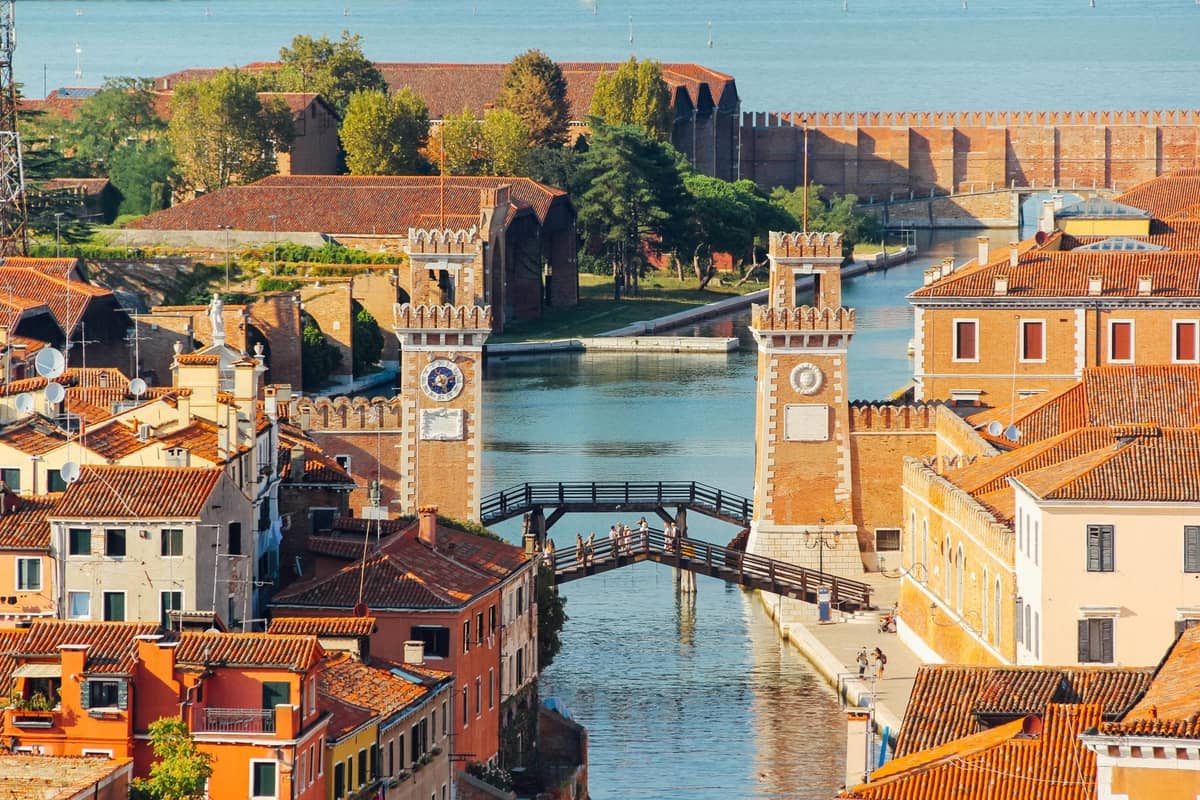
The Arsenale di Venezia is not a single building. It is a walled city within a city: a sprawling complex of dry docks, rope-making workshops, timber stores, and armories covering roughly 32 to 48 hectares at the eastern edge of Venice's Castello sestiere. From the 13th century onward, it was the industrial core of the Venetian Republic's maritime power, the place where galleys were built, outfitted, and launched with a speed and organizational precision that astonished visitors from across Europe.
At its peak, the complex employed several thousand workers, known as Arsenalotti, who were considered an elite labor class with privileges including housing, pensions, and the right to carry the Doge's coffin during state funerals. The operation was so efficient that it reportedly could produce a complete warship in a single day during periods of emergency. Dante Alighieri drew on the Arsenale's ceaseless activity as an image of industry when writing the Inferno.
The Republic fell in 1797 when Napoleon forced Venice's surrender, ending more than five centuries of the Republic's control over shipbuilding at the site. The Italian Navy subsequently occupied the complex for much of the 19th and 20th centuries. Today, management is split between the Comune di Venezia, the Italian Navy, and La Biennale di Venezia, which uses the southern docks and warehouses as one of its two main exhibition venues.
The Entrance and What You See from the Outside
Even if you never pass through the gates, the Arsenale's land entrance on the west side is worth a deliberate stop. The 15th-century portal, known as the Porta Magna, is one of the earliest examples of Renaissance architecture in Venice. Two large stone lions flank the gateway, their origins scattered across the Mediterranean: the most famous pair were taken as war trophies from Piraeus, the port of Athens, by the Venetian admiral Francesco Morosini in 1687. One lion bears runic inscriptions carved by Varangian mercenaries in the 11th century, faint but legible on close inspection.
The exterior wall runs for a considerable stretch along the Fondamenta dell'Arsenale canal. In the early morning, before the day-trip crowds reach this part of Castello, you can walk the full length of the southern wall in relative quiet. The scale of the brick fortifications only becomes clear when you realize there are almost no windows at street level: this was a military-industrial zone designed to keep its operations invisible from the canal.
💡 Local tip
Walk to the Arsenale entrance from Piazza San Marco along the Riva degli Schiavoni waterfront. The route takes around 15 minutes on foot and passes the Bridge of Sighs and the waterfront promenade. It is one of the more pleasant approaches in Venice and avoids narrow interior alleys.
Tickets & tours
Hand-picked options from our booking partner. Prices are indicative; availability and final rates are confirmed when you complete your booking.
Doge's Palace skip-the-line tour
From 67 €Instant confirmationFree cancellationVenice Legends, Anecdotes and Ghost Stories Tour
From 35 €Instant confirmationFree cancellationGhosts and legends tour of Venice
From 29 €Instant confirmationFree cancellationSkip-the-line guided tour of Doge's Palace and Saint Mark's Basilica
From 106 €Instant confirmationFree cancellation
Visiting the Northern Arsenale
The northern section of the complex, managed by the Comune di Venezia, is generally open to the public Monday through Friday from 08:00 to 15:00, and does not charge a separate admission fee for standard access. Hours and days may change during Venice Biennale exhibition months, when additional openings and internal connections are sometimes arranged, so always check current details in advance.
Inside, the atmosphere is unlike anything else in Venice. The corderie, the long rope-making halls, stretch for hundreds of meters in a straight line, their brick vaults creating a corridor that feels almost ecclesiastical in its proportions. In the dry docks, the scale of the original construction program becomes physical: these are not small workshops but industrial infrastructure on a European scale, built centuries before the Industrial Revolution.
Outside Biennale periods, the northern section is genuinely quiet. On weekday mornings you may share the space with local residents crossing to the waterbus stop rather than tourists. The light changes significantly through the day: in the morning the brick takes on a warm amber color, while afternoon visits under overcast skies can feel almost austere. Photography is best in the morning, particularly in the open courtyard areas where reflections off standing water add depth.
ℹ️ Good to know
The Northern Arsenale is accessible from Campo de la Celestia along the north boundary wall, with a pedestrian bridge providing entry. Check the Comune di Venezia website before visiting, as hours can shift around public holidays and institutional events.
The Arsenale During the Venice Biennale
The southern Arsenale is the part most international visitors encounter, because it serves as a primary venue for the Venice Biennale, alternating between the Art Biennale and Architecture Biennale on odd and even years respectively. The Corderie dell'Arsenale and the adjacent Artiglierie and Gaggiandre dry docks are transformed into exhibition spaces that themselves become part of the curatorial experience.
Access to the southern Arsenale during Biennale months requires a paid ticket. Prices follow La Biennale di Venezia's current tariff structure and should be verified directly with the organizer before your visit, as they change between editions. The Biennale runs from roughly May to November, with the vernissage press and preview days in May drawing the largest professional crowds. If you are visiting primarily for the contemporary art or architecture, arriving on a weekday in June or September gives a substantially better experience than weekend visits in high summer.
The Giardini della Biennale, a short walk east along the waterfront, is the Biennale's other major venue and houses the national pavilions. Most visitors split their time between the two sites. For a full account of how the Biennale operates and how to plan around it, the Venice Biennale guide covers practical logistics in detail.
⚠️ What to skip
Outside Biennale editions and specific scheduled events, the southern Arsenale is generally closed to the public. If your visit does not coincide with a Biennale edition or an organized event, you will usually only have access to the northern section on weekdays.
How the Site Fits into the Castello Neighborhood
The Arsenale occupies the eastern third of the Castello sestiere, physically dividing the neighborhood with its high walls. The area immediately west of the Arsenale entrance, around Campo Arsenale and the fondamenta along the canal, functions as a normal Venetian residential zone with bakeries, a fruit seller, and bars that serve working locals rather than tourist traffic. This contrast is one of the more interesting things about the Arsenale visit: you arrive through one of the great monuments of Mediterranean history and step back out onto a street where someone is hanging laundry.
The Riva degli Schiavoni waterfront connects the Arsenale area back toward San Marco and makes for an easy return walk in the evening, when the lagoon light changes to gold and the vaporetti pass in silhouette. East of the Arsenale, toward Sant'Elena, the neighborhood becomes almost entirely residential and is rarely visited by tourists, which makes it worth exploring if you have time.
Practical Details for Your Visit
Getting there by vaporetto is straightforward. For the main entrance on the south side, take lines 4.1, 4.2, 5.1, or 5.2 to the "Arsenale" stop and walk a few minutes north along the fondamenta to the Porta Magna. For the northern entrance, use lines 4.1, 4.2, 5.1, or 5.2 to the "Bacini – Arsenale nord" stop. On foot from Piazza San Marco, the southern entrance is around 15 minutes east along the waterfront.
There is no strict dress code for the Arsenale complex itself, unlike churches. Wear comfortable walking shoes: the internal surfaces include uneven brick paving and areas that can be slippery when wet. During autumn and winter, the fondamenta outside the Arsenale is among the lower-lying areas of Castello and can be affected by acqua alta. Check water levels before planning a visit in the November to January period.
Photography of the exterior, the lions, and the open courtyard areas is unrestricted. Inside during Biennale exhibitions, individual artwork photography policies follow the exhibiting institutions' rules. If you are interested in Venice's wider network of institutional art spaces, the best museums in Venice guide covers additional options across the city.
The Arsenale is a large site and involves considerable walking. For visitors with mobility limitations, the southern Biennale areas are managed by La Biennale di Venezia and accessibility conditions follow their venue standards, which can vary by exhibition setup. Check directly with the Biennale for current step-free access information before visiting.
Who Should Temper Their Expectations
If you are visiting outside a Biennale year and outside an organized event, access is limited to the northern section on weekdays only. The interior in this mode is atmospheric but sparse: you are walking through a largely empty historic complex without interpretive signage or curated exhibits. There is no permanent museum experience here. Visitors expecting a fully explained, interactive history of Venetian shipbuilding will not find it.
Families with young children may find the site less engaging than other Castello attractions unless they coincide with a Biennale. The Museo Storico Navale, located just outside the Arsenale near the Arsenale vaporetto stop, provides a more structured introduction to Venetian naval history and is worth combining with a visit for families or those who want historical context before approaching the complex itself.
Insider Tips
- The stone lions outside the Porta Magna are often photographed from the front, but walk around to the side of the larger Piraeus lion to see the runic inscriptions carved by Varangian mercenaries around 1040 AD. They are faint but visible and represent one of the most unexpected historical details in all of Venice.
- If you are visiting during a Biennale year, the vernissage week in May sees extremely dense professional crowds. Arriving in early June or in late September gives you similar access with a fraction of the congestion and, in September, better light for photography in the open dock areas.
- The Museo Storico Navale sits directly at the Arsenale vaporetto stop and can be combined with any Arsenale visit. It contains historic ship models, navigational instruments, and artifacts from the Republic's naval campaigns, providing the contextual layer the Arsenale complex itself does not supply.
- Outside Biennale periods, the northern Arsenale on a clear weekday morning is one of the quietest large historic spaces in Venice. Arrive shortly after 08:00 and you will likely have the rope-making halls almost entirely to yourself.
- The Biennale ticket also covers entry to the Giardini della Biennale pavilions on the same day, so plan to visit both sites together rather than making separate trips.
Who Is Arsenale di Venezia For?
- Architecture and engineering history enthusiasts who want to understand how Venice built its maritime empire
- Contemporary art and architecture visitors attending the Venice Biennale
- Photographers looking for large-scale brick industrial spaces with strong natural light
- Walkers following the Castello waterfront who want to anchor their route with a significant site
- Visitors who have already covered the main San Marco sights and want to explore a less-visited part of Venice
Nearby Attractions
Other things to see while in Castello:
- Libreria Acqua Alta
Libreria Acqua Alta is a Castello bookshop where thousands of books are stored in a full-sized gondola, antique bathtubs, large waterproof bins, and small boats to protect them from Venice's seasonal floods. Free to enter, open daily, and genuinely unlike any other bookshop in the world.
- Basilica dei Santi Giovanni e Paolo (San Zanipolo)
The Basilica dei Santi Giovanni e Paolo, known locally as San Zanipolo, is the largest church in Venice and one of the most historically significant Gothic buildings in Italy. For nearly six centuries it served as the state funeral church of the Venetian Republic, and its interior holds the tombs of numerous doges (traditionally counted as around 25) alongside masterworks by Bellini, Veronese, and Vivarini.
- Giardini della Biennale
Spread across the eastern tip of the Castello sestiere, the Giardini della Biennale is a park of Napoleonic origin that transforms into the world's most prestigious contemporary art venue every two years. Thirty national pavilions plus the Central Pavilion, mature shade trees, and a waterfront promenade make it worth visiting whether or not the Biennale is running.
- Museo Storico Navale (Maritime Museum)
Housed in a 15th-century granary beside the Arsenale in Castello, the Museo Storico Navale traces Venice's maritime power from the Republic's war galleys to modern Italian Navy vessels. It is one of the most detailed naval collections in Europe, and it rewards visitors who take their time.