Libreria Acqua Alta: Venice's Flood-Proof Bookshop
Libreria Acqua Alta is a Castello bookshop where thousands of books are stored in a full-sized gondola, antique bathtubs, large waterproof bins, and small boats to protect them from Venice's seasonal floods. Free to enter, open daily, and genuinely unlike any other bookshop in the world.
Quick Facts
- Location
- Calle Longa Santa Maria Formosa 5176b, Castello, Venice
- Getting There
- San Zaccaria (line 1; other lines nearby) or Rialto — both around 10 minutes on foot
- Time Needed
- 20–40 minutes; longer if you browse seriously
- Cost
- Free entry; no reservation required
- Best for
- Book lovers, curious wanderers, photographers, first-time Venice visitors
- Official website
- www.libreriacqualta.it/en
What Libreria Acqua Alta Actually Is
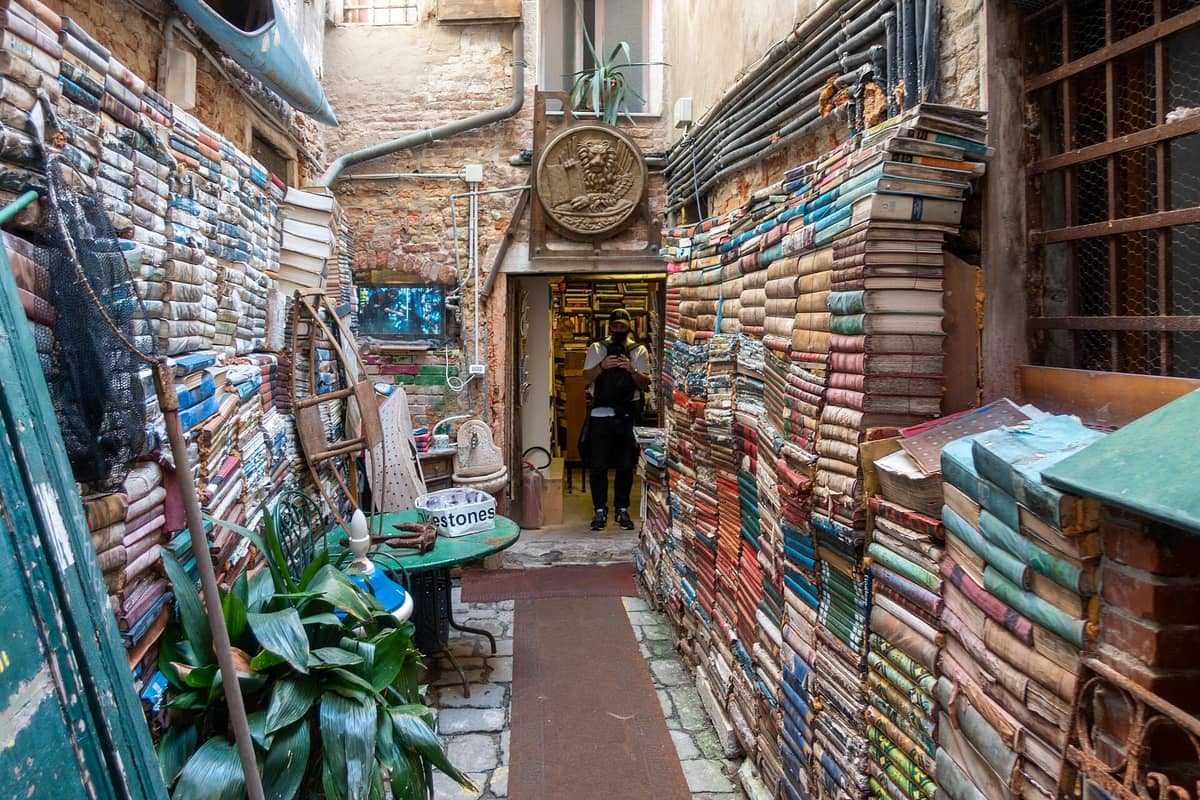
Libreria Acqua Alta — which translates directly as the High Water Bookshop — opened in 2004 in a narrow calle near Campo Santa Maria Formosa, deep in the Castello sestiere. The name is not metaphor. Venice floods. The acqua alta, or high water, rolls in from the Adriatic several times a year, and in low-lying parts of the city, that means water on the floors of ground-level shops. The owner's solution was to store books not on conventional shelves but in vessels: a full-sized gondola, antique bathtubs, large waterproof bins, and wooden barrels. When the water rises, the books rise with it.
This is not a gimmick layered onto an otherwise normal shop. The storage method is genuinely functional. The gondola at the center of the main room holds hundreds of volumes, its hull doing exactly what it was designed to do — keeping contents above water. The result is a space that is part library, part living document of Venetian life, and part controlled chaos. Cats wander freely through the stacks. Corridors narrow to single-file. Postcards, maps, prints, and foreign-language paperbacks are wedged into every available surface.
ℹ️ Good to know
Opening hours: daily (Monday to Sunday), 09:00–19:15. Last entry to the interior at 19:10; last entry to the outdoor book staircase and gondola display at 18:00. Entry is free, no reservation needed.
The Experience: What You'll Actually See Inside
The entrance from the calle is easy to miss — a modest doorway with a cluster of people waiting to pass through, usually the first sign you've found it. Inside, the air has that particular smell of old paper mixed with damp stone: not unpleasant, but distinct. Shelves lean at odd angles. Books are stacked horizontally, vertically, and diagonally. The organization is loose — Italian literature here, travel books there, art monographs somewhere else — but the staff seem to know where things are if you ask.
The gondola at the center is the visual anchor of the space. It sits on the stone floor, filled to its gunwales with books, and feels genuinely old rather than decorative. Around it, the room opens into smaller connecting spaces that seem to multiply as you move deeper into the shop. One section opens onto a small courtyard along a canal, which is where you'll find the bookshelf staircase: a set of steps built from stacked hardcover books, sealed and stabilized, leading up to a view over the adjacent rooftops. This is the most-photographed feature, and for good reason — it's an elegant piece of informal architecture.
The shop also keeps cats, which adds to the unhurried atmosphere. On quieter mornings, a cat may be asleep in the gondola itself. The courtyard offers a direct view of the canal, and on cool days the combination of still water, worn brick, and the smell of the books drifting out from inside gives a clear sense of why this corner of Castello feels different from the areas immediately around Piazza San Marco.
Tickets & tours
Hand-picked options from our booking partner. Prices are indicative; availability and final rates are confirmed when you complete your booking.
Doge's Palace skip-the-line tour
From 67 €Instant confirmationFree cancellationVenice Legends, Anecdotes and Ghost Stories Tour
From 35 €Instant confirmationFree cancellationGhosts and legends tour of Venice
From 29 €Instant confirmationFree cancellationSkip-the-line guided tour of Doge's Palace and Saint Mark's Basilica
From 106 €Instant confirmationFree cancellation
How the Experience Changes by Time of Day
Arrive before 10:00 and the shop is genuinely calm. The light at that hour comes in low and golden through the courtyard opening, hitting the spines of the books in the gondola at a flattering angle. Midday, roughly 11:30 to 14:00, is when visitor density peaks. The narrow corridors make crowding feel more intense here than in an open-air attraction — three or four groups moving in different directions at once can make it difficult to browse properly. If you want to actually read titles and consider purchases, the morning window or the late afternoon (after 16:00) works best.
In the hour before closing, around 18:30 onward, the courtyard becomes off-limits (the last entry for the outdoor area is 18:00), but the interior retains its atmosphere. Autumn afternoons, when the light drops early and the canal outside is dark and still, give the space a more melancholic register that fits the acqua alta theme particularly well. In summer, the midday heat inside can be uncomfortable — there is no air conditioning, and the space is enclosed. Carry water.
💡 Local tip
Arrive at opening (09:00) or after 16:00 on weekdays for the best chance of browsing without crowds. Weekend middays are the most congested.
Acqua Alta: The Flood Context That Makes This Place Make Sense
Venice sits at sea level on 118 islands in the Laguna Veneta, and acqua alta — periodic tidal flooding driven by the Adriatic and amplified by wind and atmospheric pressure — is a structural feature of life in the city. Ground-floor shops, homes, and churches in low-lying areas flood several times a year. The city's MOSE barrier system is activated during sustained high-tide events, but lower-level flooding events still occur regularly, particularly in autumn and early winter.
The Libreria Acqua Alta's storage method is a direct, practical response to this reality. When water comes in under the door, books in bathtubs and gondolas stay dry. What makes the shop interesting beyond its visual quirks is that it embodies something true about how Venice functions: the city adapts around water rather than fighting it. For visitors who want to understand acqua alta beyond its most dramatic images, reading the Venice flood guide before visiting puts the bookshop in fuller context.
Getting There: Navigation Notes
The official address is Calle Longa Santa Maria Formosa 5176b, Castello. The nearest vaporetto stops are San Zaccaria (line 1, with other lines nearby) and Rialto, both around a 10-minute walk through the backstreets of Castello. The route from San Zaccaria passes through Campo Santa Maria Formosa — a wide, relatively uncrowded campo with a good bar and the Church of Santa Maria Formosa — which is worth a few minutes of your time before or after the bookshop visit.
From Piazza San Marco, the walk is under 10 minutes on foot, heading northeast through the Castello lanes. The calle leading directly to the bookshop is narrow and easy to overshoot — look for the cluster of people and the occasional handwritten sign. Google Maps navigates reliably to this address. The shop is also a short detour from the Bridge of Sighs and the Riva degli Schiavoni waterfront, making it sensible to combine on the same half-day loop.
⚠️ What to skip
Accessibility note: The interior is packed, with narrow passages between tall stacks of books and uneven floor surfaces. Wheelchair access is very difficult. The courtyard area involves steps built from books. Those with limited mobility should be aware the space is not designed for ease of movement.
Photography: What Works and What Doesn't
The book staircase in the courtyard is the obvious shot, and it photographs well in soft morning or late-afternoon light. The gondola inside is harder — the interior is dark and the space around it is tight, so a phone camera with a decent night mode or a wide-angle lens performs better than a standard kit lens. The canal-facing courtyard wall has interesting texture and depth if you want to avoid the crowds of the main room.
At peak hours, getting a clean shot of the staircase without other visitors in it requires patience or luck. Early morning is the most reliable window. The cats, if present, make for a much better photograph than most of the posed tourist shots you'll see — they're usually found draped across books near the gondola or sleeping in a corner of the courtyard. Be respectful of other browsers when shooting; the space is small enough that tripods and extended selfie sticks create genuine obstructions.
Worth It?
Libreria Acqua Alta has become one of the most photographed interiors in Venice, and that popularity creates a real tension. On a busy Saturday in summer, the queue to enter can stretch back onto the calle, and inside, moving through the space becomes an exercise in patience. The books themselves are a genuine mix: some sections are well-curated, particularly art, architecture, and Venetian history; other sections are cluttered with tourist-facing ephemera and items that feel more like souvenir shop than bookshop.
That said, the space earns its reputation. The concept is not manufactured whimsy — it reflects how the city actually functions. The visit is free, takes under an hour even with browsing, and places you in a part of Castello that most day-trippers never reach. Combined with a walk around Campo Santa Maria Formosa and a short extension toward the Arsenale, it fits naturally into a broader Venice itinerary without consuming much time or money.
Visitors who expect a quiet, contemplative bookshop with a well-organized collection may come away disappointed. Those who approach it as an architectural curiosity and a living expression of Venetian adaptation to water will find it worth every minute.
Insider Tips
- The courtyard closes to new visitors at 18:00, even though the interior stays open until 19:15. If seeing the book staircase is a priority, do not arrive after 17:45.
- The cats are residents, not props. Don't pick them up or crowd them — they'll approach on their own terms, usually in the quieter morning hours.
- Ask staff about Venetian-specific titles. The selection on local history, lagoon ecology, and Venetian art is stronger than it appears from a casual browse, and staff know where the better material is buried.
- Campo Santa Maria Formosa, two minutes' walk away, has a reliable bar (Bar All'Orologio) for a pre-visit coffee. It's a calmer place to gather yourself before entering the bookshop crowds.
- If acqua alta is occurring during your visit, check the official city alerts before heading out. The calle leading to the shop is low-lying and floods before many other areas of the city.
Who Is Libreria Acqua Alta For?
- Book lovers who want to browse a genuinely unusual collection in an architecturally singular space
- First-time Venice visitors looking to understand the city's relationship with water beyond museum explanations
- Photographers seeking interiors with strong visual character outside the main tourist circuit
- Travelers combining a Castello walk with the Bridge of Sighs, Riva degli Schiavoni, or Campo Santa Maria Formosa
- Anyone looking for a free, low-commitment stop that takes 20–40 minutes and requires no advance planning
Nearby Attractions
Other things to see while in Castello:
- Arsenale di Venezia
The Arsenale di Venezia is one of the largest and most significant pre-industrial complexes in European history. Once the engine of Venetian naval supremacy, this 48-hectare compound of shipyards, armories, and rope-making facilities in the Castello district is partially open to visitors year-round, with greatly expanded access during the Venice Biennale.
- Basilica dei Santi Giovanni e Paolo (San Zanipolo)
The Basilica dei Santi Giovanni e Paolo, known locally as San Zanipolo, is the largest church in Venice and one of the most historically significant Gothic buildings in Italy. For nearly six centuries it served as the state funeral church of the Venetian Republic, and its interior holds the tombs of numerous doges (traditionally counted as around 25) alongside masterworks by Bellini, Veronese, and Vivarini.
- Giardini della Biennale
Spread across the eastern tip of the Castello sestiere, the Giardini della Biennale is a park of Napoleonic origin that transforms into the world's most prestigious contemporary art venue every two years. Thirty national pavilions plus the Central Pavilion, mature shade trees, and a waterfront promenade make it worth visiting whether or not the Biennale is running.
- Museo Storico Navale (Maritime Museum)
Housed in a 15th-century granary beside the Arsenale in Castello, the Museo Storico Navale traces Venice's maritime power from the Republic's war galleys to modern Italian Navy vessels. It is one of the most detailed naval collections in Europe, and it rewards visitors who take their time.