Giardini della Biennale: Venice's Grand Stage for International Art
Spread across the eastern tip of the Castello sestiere, the Giardini della Biennale is a park of Napoleonic origin that transforms into the world's most prestigious contemporary art venue every two years. Thirty national pavilions plus the Central Pavilion, mature shade trees, and a waterfront promenade make it worth visiting whether or not the Biennale is running.
Quick Facts
- Location
- Sestiere Castello, 30122 Venezia, Italy
- Getting There
- Giardini Biennale DX/SX — lines 4.1, 4.2, 5.1, 5.2, 6
- Time Needed
- 1.5–3 hours during exhibitions; 30–45 min outside exhibition periods
- Cost
- Ticket required during Venice Biennale exhibitions; verify current prices at labiennale.org
- Best for
- Contemporary art lovers, architecture enthusiasts, lagoon walkers
- Official website
- www.labiennale.org/it/luoghi/giardini-della-biennale
What the Giardini della Biennale Actually Is
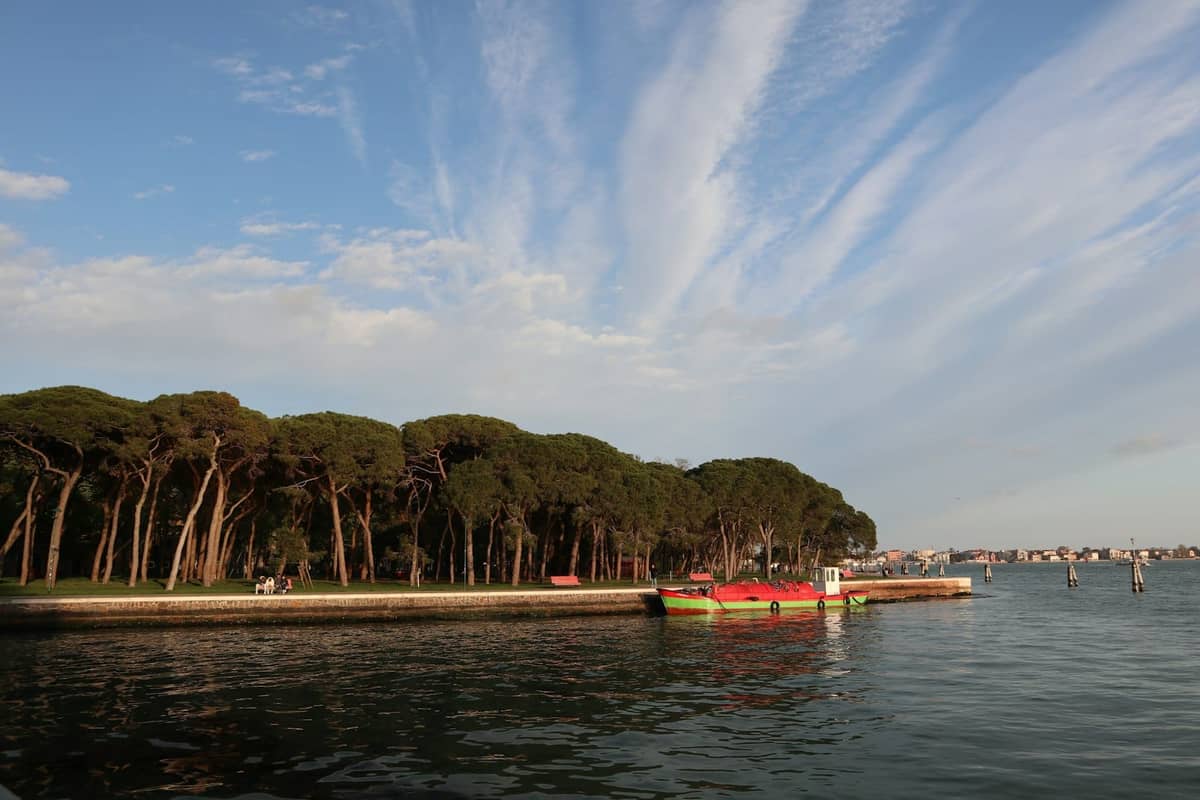
The Giardini della Biennale is not a single museum. It is a public park of roughly seven hectares at the southeastern edge of the Castello sestiere, containing 30 permanent national pavilions plus the Central Pavilion, all owned or leased by their respective countries. Outside the biennial exhibition windows, the park is a quiet green space with towering plane trees, canal views, and almost no tourists. During the Venice Biennale — the international art exhibition held in odd years and the architecture exhibition in even years — the entire site transforms into one of the densest concentrations of commissioned contemporary art and experimental architecture on the planet.
The grounds were originally laid out on the orders of Napoleon Bonaparte in the early nineteenth century, making them one of Venice's few large open green spaces. The city's historic fabric is so compressed that public parks are genuinely rare, which gives the Giardini an additional value beyond its exhibition role. For context on how the Castello neighborhood fits into the broader city, see our guide to the Castello sestiere.
ℹ️ Good to know
The pavilions are open only during official exhibition periods. Outside those windows, the park pathways remain accessible as a public green space, but the buildings are closed. Always check labiennale.org for current exhibition dates before planning your visit.
A Park Born from Napoleonic Urban Planning
When Napoleon's administration reorganized Venice after the fall of the Republic in 1797, one of the few legacies that genuinely improved daily life for ordinary Venetians was the creation of public gardens. The eastern tip of Castello was cleared — including a convent and several smaller buildings — and replanted as a promenade park in the early 1800s. The trees planted in that period, now enormous holm oaks and planes, give the Giardini its distinctive canopy that feels almost incongruous in a city otherwise built wall to wall.
The first Venice Biennale opened in 1895 under the patronage of the city of Venice, making it the oldest recurring international art exhibition in the world. The Giardini was chosen as its permanent home, and national pavilions began appearing from the turn of the twentieth century onward. Belgium (1907), Hungary (1909), and Germany (1909) were among the earliest to establish permanent structures. The pavilion buildings themselves now form an extraordinary outdoor architectural museum, ranging from neoclassical colonnades to Brutalist concrete to postwar Rationalism.
The Finnish Pavilion, designed by Alvar Aalto in 1956, is one of the most studied pieces of Modernist exhibition architecture in Europe. The Venezuelan Pavilion by Carlo Scarpa (1954) is another landmark that architecture students travel specifically to see. If this kind of intersection of art history and architectural history interests you, the Venice Biennale guide covers the full scope of what the event involves across multiple venues.
Tickets & tours
Hand-picked options from our booking partner. Prices are indicative; availability and final rates are confirmed when you complete your booking.
Doge's Palace skip-the-line tour
From 67 €Instant confirmationFree cancellationVenice Legends, Anecdotes and Ghost Stories Tour
From 35 €Instant confirmationFree cancellationGhosts and legends tour of Venice
From 29 €Instant confirmationFree cancellationSkip-the-line guided tour of Doge's Palace and Saint Mark's Basilica
From 106 €Instant confirmationFree cancellation
How the Experience Changes by Time of Day and Season
Arriving at the Giardini on a weekday morning during the Biennale, before 10:00, gives you roughly an hour of relatively uncrowded pavilion access. By mid-morning the central pathways fill with a particular crowd: curators with lanyards, architecture students carrying rolled drawings, and art-world professionals speaking a rotating cast of languages. It is not a family-day-out crowd. By early afternoon, especially on weekends, queues form outside the more talked-about national pavilions and noise levels rise noticeably.
The light in the park changes dramatically through the day. In the morning, the tree canopy filters low eastern sun into warm shafts across the gravel paths. By late afternoon, the waterfront side facing the Bacino di San Marco catches direct sunset light, and the view across the water toward San Giorgio Maggiore island becomes exceptionally clear. If photography matters to you, the hour before closing is often the most rewarding time to be near the lagoon edge.
Outside exhibition seasons, the Giardini is a different place entirely. Venetian families bring children to play on the grass, elderly residents walk dogs along the waterfront, and the pavilion buildings stand locked and slightly ghostly behind their fences. This version of the Giardini feels more authentically Venetian than the art-world circus of Biennale opening week, and it is completely free to enter.
💡 Local tip
Biennale opening week (the first week of the exhibition) draws the densest crowds of the entire run, including international press and invited guests. If you have flexibility, visiting in the second or third week after opening gives you the full program without the crush.
Navigating the Pavilions: What to Expect Inside
A single Biennale ticket covers both the Giardini pavilions and the Arsenale exhibitions, so most visitors split their day between the two venues. The Giardini alone, done properly, takes between ninety minutes and three hours depending on how much time you spend in each pavilion. The Central Pavilion, which houses the international group exhibition curated by the Biennale's artistic director, is typically the largest single space and worth prioritizing.
The national pavilions vary enormously in scale. The United States Pavilion (a neoclassical building from 1930) and the German Pavilion (rebuilt after World War II) are among the largest and most historically charged. Smaller countries sometimes occupy modest single-room structures that force a kind of intimate confrontation with the work that the larger spaces cannot replicate. Part of the Giardini experience is this constant shift in scale and ambience as you move from building to building across a shaded park.
The Biennale also uses the Arsenale as a second major venue, a short walk northeast of the Giardini through the Castello neighborhood. The two together constitute the full exhibition. For a broader look at what else is worth visiting in this part of Venice, the Arsenale di Venezia has its own distinct industrial character and is a compelling space regardless of what is showing.
Getting There and Practical Details
The most direct water bus access is via the Giardini Biennale stops, served by ACTV vaporetto lines 1, 4.1, 4.2, 5.1, and 5.2. From the San Marco area, lines 4.1 and 4.2 are the most straightforward options, running along the southern edge of the island. The journey from the San Zaccaria stop near the Doge's Palace takes roughly 10 minutes. You can also walk from San Marco in around 25 to 30 minutes along the Riva degli Schiavoni waterfront promenade, which is an attractive route in itself.
The walk along the Riva degli Schiavoni is one of Venice's most classically panoramic stretches, with continuous lagoon views and a gradual transition from the tourist core of San Marco into the quieter residential character of Castello. If you are combining the Giardini with a broader exploration of the eastern city, allow a full half-day.
Admission fees apply during active exhibition periods and are set by La Biennale di Venezia. Prices are updated for each edition, so verifying the current rate at labiennale.org before your visit is essential. Concessions typically apply for students, young visitors, and Venetian residents. The park pathways outside exhibition buildings are generally accessible without a ticket.
⚠️ What to skip
Accessibility varies significantly between pavilions. Some older national pavilions have steps, narrow doorways, and uneven terrain that presents challenges for wheelchair users or visitors with mobility limitations. Contact La Biennale directly or check individual pavilion information before visiting if this is a concern.
Weather, Seasons, and What to Bring
Summer visits, which align with the Art Biennale run (usually May through November in odd years, with exact dates varying by edition), mean heat and humidity. The tree canopy provides genuine relief on hot afternoons, but inside the pavilions, air conditioning varies wildly from building to building. Some national pavilions are well-cooled; others are essentially glass-and-concrete boxes that become stifling by midday. Carrying water and visiting the most enclosed pavilions in the morning makes a real practical difference.
The Architecture Biennale runs in even years over a broadly similar May–November period, though exact dates vary by edition, so the Giardini is active in both alternating years. Outside those windows, the park remains open as a free public space but offers nothing in terms of interior exhibitions. If your visit falls outside the Biennale calendar, the Giardini is still worth a short detour for the waterfront views and the architectural exteriors of the pavilions, but it should not be the anchor of your day.
Venice's autumn season brings increased risk of acqua alta (high water flooding). The Giardini's low-lying waterfront areas can flood during significant tidal events, and access paths may be wet or impassable. For a full explanation of how to navigate flooding in Venice, the acqua alta guide covers what to expect and how to prepare.
Who Should Reconsider This Visit
If contemporary and conceptual art leaves you cold, the Giardini during an Art Biennale is likely to frustrate. The work shown is often deliberately challenging, politically engaged, or technically demanding. There is no permanent collection of accessible masterpieces here. Visitors expecting something comparable to a conventional art museum will likely find the experience disorienting rather than rewarding.
Families with very young children may also find the Biennale crowds and the conceptual nature of most work a poor fit for limited attention spans. The park itself is child-friendly, but the pavilion interiors are not designed for that audience. Anyone visiting Venice primarily for its Renaissance art, Byzantine mosaics, or historic palaces should prioritize the Gallerie dell'Accademia, the Doge's Palace, or the Scuola Grande di San Rocco before committing time here.
Insider Tips
- The small cafe inside the Giardini, near the Central Pavilion, is a useful rest stop on hot days and tends to be less crowded than cafes outside the park. Prices are reasonable by Venice standards.
- National pavilions managed by smaller countries often have the most experimental and least-crowded shows. Skip the queue for the high-profile pavilions first thing and start with the less-visited structures while energy is high.
- The waterfront edge of the Giardini, facing the Bacino di San Marco, offers one of the least-photographed views of the San Giorgio Maggiore island silhouette. It is clearest in the late afternoon when the southern light falls directly on the church facade.
- Biennale tickets purchased online in advance are typically cheaper than at the door and also avoid a second queue on busy days. Combination tickets covering both the Giardini and Arsenale venues are always better value than single-venue admission.
- The architectural exteriors of the pavilions can be appreciated without paying admission outside exhibition hours. The Finnish Pavilion by Aalto and the Carlo Scarpa-designed Venezuelan Pavilion are clearly visible and worth examining closely as standalone architectural works.
Who Is Giardini della Biennale For?
- Contemporary art enthusiasts tracking international curatorial trends
- Architecture lovers interested in twentieth-century pavilion design
- Visitors who want to combine a lagoon walk with a cultural destination
- Travelers visiting Venice during the Biennale season who want to engage seriously with the main venue
- Anyone seeking one of Venice's few genuine green spaces away from the tourist core
Nearby Attractions
Other things to see while in Castello:
- Libreria Acqua Alta
Libreria Acqua Alta is a Castello bookshop where thousands of books are stored in a full-sized gondola, antique bathtubs, large waterproof bins, and small boats to protect them from Venice's seasonal floods. Free to enter, open daily, and genuinely unlike any other bookshop in the world.
- Arsenale di Venezia
The Arsenale di Venezia is one of the largest and most significant pre-industrial complexes in European history. Once the engine of Venetian naval supremacy, this 48-hectare compound of shipyards, armories, and rope-making facilities in the Castello district is partially open to visitors year-round, with greatly expanded access during the Venice Biennale.
- Basilica dei Santi Giovanni e Paolo (San Zanipolo)
The Basilica dei Santi Giovanni e Paolo, known locally as San Zanipolo, is the largest church in Venice and one of the most historically significant Gothic buildings in Italy. For nearly six centuries it served as the state funeral church of the Venetian Republic, and its interior holds the tombs of numerous doges (traditionally counted as around 25) alongside masterworks by Bellini, Veronese, and Vivarini.
- Museo Storico Navale (Maritime Museum)
Housed in a 15th-century granary beside the Arsenale in Castello, the Museo Storico Navale traces Venice's maritime power from the Republic's war galleys to modern Italian Navy vessels. It is one of the most detailed naval collections in Europe, and it rewards visitors who take their time.