Basilica dei Santi Giovanni e Paolo (San Zanipolo): Venice's Pantheon of the Doges
The Basilica dei Santi Giovanni e Paolo, known locally as San Zanipolo, is the largest church in Venice and one of the most historically significant Gothic buildings in Italy. For nearly six centuries it served as the state funeral church of the Venetian Republic, and its interior holds the tombs of numerous doges (traditionally counted as around 25) alongside masterworks by Bellini, Veronese, and Vivarini.
Quick Facts
- Location
- Campo SS. Giovanni e Paolo, Castello, Venice
- Getting There
- Vaporetto Ospedale (lines 4.1, 4.2, 5.1, 5.2) or Rialto (line 1), then a short walk
- Time Needed
- 1 to 1.5 hours
- Cost
- Adults €3.50; students (13–25) €1.50; under 13 free
- Best for
- History lovers, art seekers, visitors wanting Gothic architecture away from the San Marco crowds
- Official website
- www.santigiovanniepaolo.it/en
What Is San Zanipolo?
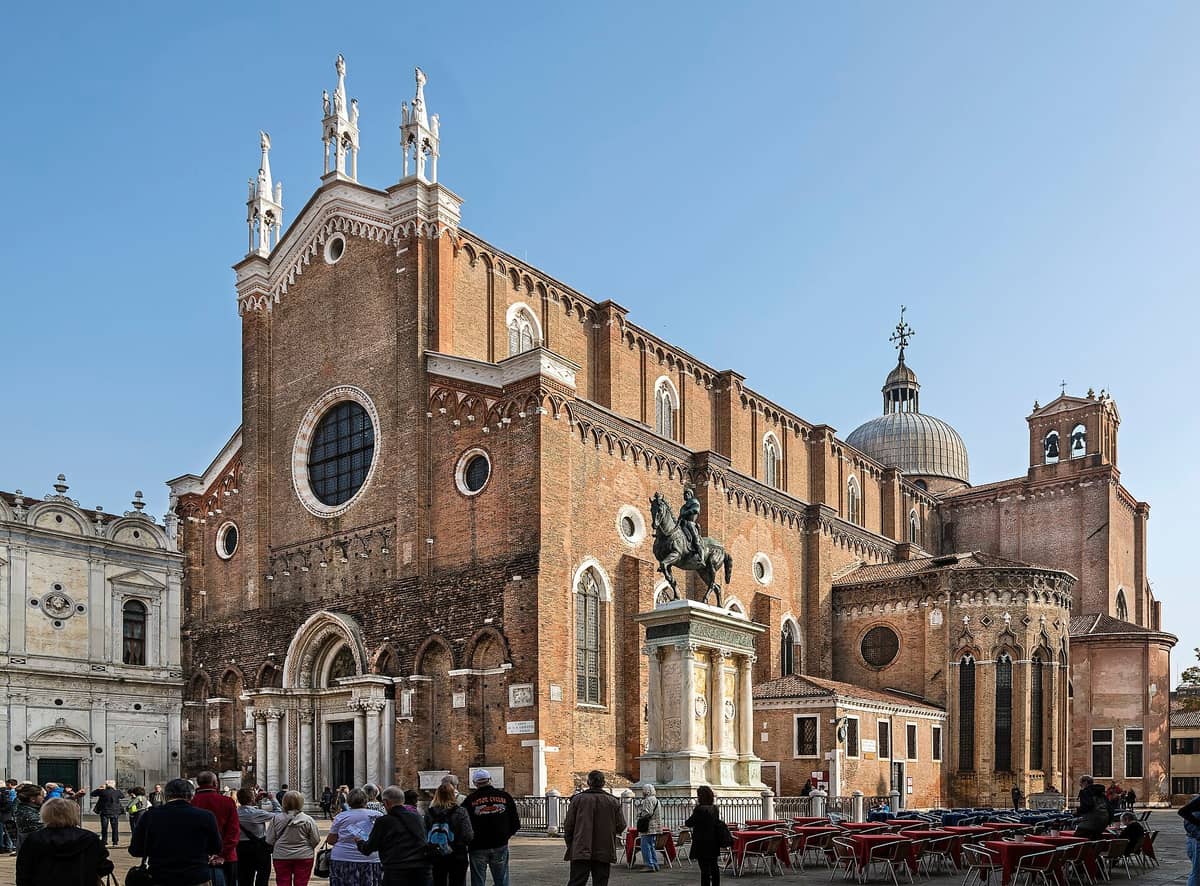
The Basilica dei Santi Giovanni e Paolo, its name compressed in Venetian dialect to San Zanipolo, is one of the largest churches in Venice and one of the finest examples of Italian Gothic architecture anywhere in the country. It stands in the Castello sestiere, set back from the tourist circuits of San Marco, on a wide campo that opens onto a canal. For the Venetian Republic, this was not merely a place of worship: it was the stage on which the Republic buried its leaders. From the 15th to the 18th centuries, doges were given state funerals here, and the weight of that history is still visible in every wall.
Construction began in the late 13th century, commissioned by the Dominican Order, and the church was consecrated on 12 November 1430. The scale is immediately striking: the exterior reads almost like a civic building as much as a religious one, its brick facade broad and relatively plain, in the sober manner of Dominican preaching churches designed for large congregations rather than private devotion. What you carry away from San Zanipolo is a sense of accumulated centuries, the feeling that the Republic itself deposited something of its character here, layer by layer, for five hundred years.
💡 Local tip
Visits are not permitted during religious services. Check the basilica's official calendar before planning an early Sunday visit, as the interior is closed to tourists until 12:00 on Sundays.
Arriving at the Campo: The Approach Matters
The vaporetto stop Ospedale on lines 4.1, 4.2, 5.1, and 5.2 drops you directly on the waterfront closest to the basilica. From there it is a five-minute walk through increasingly quiet calli. Alternatively, the Rialto stop on line 1 allows a slightly longer walk through the market area of Castello, which is worth doing in the morning when local life is still playing out on the bridges and in the small shops.
The campo itself is one of the more generous public spaces in Venice outside of Piazza San Marco. At its center stands Verrocchio's bronze equestrian statue of Bartolomeo Colleoni, cast in the late 15th century and generally considered one of the great equestrian bronzes of the Renaissance. The horse's raised hoof, the condottiere's twisted posture projecting absolute authority: it is worth standing in front of it for five minutes before you enter the church, because it sets the tone for everything inside. To the right, the Renaissance facade of the Scuola Grande di San Marco, now the city hospital, closes the campo with its distinctive trompe-l'oeil marble reliefs.
If this is your first time in the Castello neighborhood, note that the surrounding streets are among the less commercially pressured parts of Venice's historic core. The campo gets morning light from the east, making arrival before 10:00 particularly pleasant. For more on what the neighborhood offers beyond San Zanipolo, see the Castello neighborhood guide.
Tickets & tours
Hand-picked options from our booking partner. Prices are indicative; availability and final rates are confirmed when you complete your booking.
Skip-the-line guided tour of Doge's Palace and Saint Mark's Basilica
From 106 €Instant confirmationFree cancellationExclusive Saint Mark's Basilica After Dark and Doge's Palace Tour
From 149 €Instant confirmationFree cancellationMorning walking tour of Venice with St. Mark's Basilica and gondola ride
From 105 €Instant confirmationFree cancellationVenice small-group walking tour with St. Mark's Basilica and Gondola Ride
From 79 €Instant confirmationFree cancellation
Inside the Basilica: What You Will Actually See
The interior is organized in a classic Dominican triple-nave layout, with the nave soaring to roughly 35 meters and the light arriving through tall Gothic windows. The immediate impression is of controlled grandeur: nothing is flamboyant, but the scale is impossible to ignore. The pale stone of the columns, the terracotta of the brick, and the deep reds of the doge tombs along the walls create a palette that changes noticeably depending on the time of day and weather outside.
The doge monuments are the core of what makes this church extraordinary. They line the walls of the nave and the chapels in a sequence that amounts to a compressed history of Venetian state art from the 14th to the 18th century. The tomb of Doge Pietro Mocenigo, completed around 1481 by Pietro Lombardo and his sons, is one of the finest Renaissance funerary monuments in Italy, its three tiers populated with soldiers and allegorical figures. The tomb of Doge Andrea Vendramin, also by the Lombardo workshop, occupies the opposite wall with comparable ambition. Neither photograph particularly well in the artificial light; see them with your own eyes.
The Cappella del Rosario on the right side of the church contains ceiling paintings by Paolo Veronese, including the Adoration of the Shepherds, the Assumption of the Virgin, and the Adoration of the Magi. The chapel was rebuilt after a fire in 1867 destroyed much of the original content, and the Veronese works here were relocated from elsewhere in the complex. Giovanni Bellini's polyptych of Saint Vincent Ferrer in the right nave remains in its original position and is among the most important pieces in the church: five panels painted around 1465, in excellent condition, with the saint's scene flanked by the Annunciation above.
ℹ️ Good to know
Photography is generally permitted inside the basilica without flash. Natural light is best before noon on clear days, when it enters through the southern windows of the nave.
Time of Day and Crowd Patterns
San Zanipolo is not one of Venice's front-line tourist attractions in the way that the Basilica di San Marco or the Doge's Palace are, which means its crowd patterns are meaningfully different. On weekday mornings between 9:00 and 11:00, the church is genuinely quiet: you will share it with a handful of visitors, some locals stopping in briefly, and the low hum of the building itself. This is the most rewarding time to visit.
By midday the volume increases, and on summer afternoons the nave can become quite congested near the entrance and the Veronese chapel. Even then, the size of the church means that the far chapels and the transepts remain relatively uncrowded. On Sunday afternoons, when the church opens at 12:00, there is often a short rush of visitors arriving together at opening time; waiting until 13:00 gives you a calmer experience.
Winter visits have a particular quality. The campo is cool and often mist-drifts off the nearby canal in the early morning, giving the Colleoni statue and the church facade a tone of quiet severity. Inside, the temperature drops noticeably and the lighting becomes more atmospheric. If you are visiting Venice in the colder months, this is one of the churches that rewards off-season timing most clearly.
For broader guidance on planning around crowds and seasons, the best time to visit Venice guide covers the trade-offs across the calendar year.
Practical Details for Your Visit
Opening hours are Monday to Saturday 9:00 to 17:45 and Sunday 12:00 to 17:45. Admission is €3.50 for adults, €1.50 for students aged 13 to 25, and free for children under 13. These prices are as listed on the basilica's official website, but it is worth confirming before your visit as rates do occasionally change. The address is Campo SS. Giovanni e Paolo, 30122 Venice.
Dress code follows standard Italian church rules: covered shoulders and knees are required. Carry a light scarf or layer if you are visiting in warm weather. The interior is cool even in summer, which makes it a useful stopping point on a hot afternoon walk through Castello. Flat, comfortable shoes are advisable: the campo's stone paving and the church floor are uneven in places.
No detailed official accessibility information was available on the basilica's public pages at the time of writing. Visitors with mobility requirements should contact the basilica directly before their visit. The campo itself is reachable on foot from the Ospedale vaporetto stop along relatively flat calli, though Venice's bridges generally make wheelchair navigation challenging throughout the historic center.
For those building a broader itinerary around Venice's churches, the best churches in Venice guide places San Zanipolo in context alongside other significant religious buildings.
How This Church Fits Into a Day in Castello
San Zanipolo pairs naturally with a walk through the wider Castello sestiere. From the campo, the route east toward the Arsenale passes through some of the most genuinely residential streets in Venice's historic center: small bars, neighborhood shops, and a noticeably lower density of souvenir sellers. The walk from the basilica to the Arsenale gate takes around 15 minutes at a relaxed pace.
The Arsenale di Venezia is just to the southeast, and its fortified brick walls and watergate make a worthwhile short detour even if you are not visiting the naval museum. If you are arriving from the direction of the Rialto, the route through the market and into Castello adds a useful half-day structure to a visit.
Visitors interested in Venetian art who find San Zanipolo engages them might also consider the Gallerie dell'Accademia in Dorsoduro, which holds the deep collection of Venetian painting that contextualizes what you see in the church's chapels.
Who Should Skip San Zanipolo
If your primary interest is Venice's most spectacular interiors and you have very limited time, the Basilica di San Marco and the Scuola Grande di San Rocco will make stronger immediate impressions. San Zanipolo's strength is cumulative: you need to spend time with it, move slowly through the chapels, read the tombs, and let the scale settle. Visitors who prefer a quick tick-and-move approach to churches may find the modest entry price does not justify the time investment. Similarly, if you are mainly drawn to Byzantine architecture or the gold-mosaic tradition of San Marco, the Gothic austerity here is a different aesthetic and may disappoint.
Families with very young children can visit, though there is little specifically aimed at children in the church. The campo outside is large and open, which makes it a practical stopping point regardless.
Insider Tips
- The best light in the nave falls through the southern clerestory windows on clear mornings between 10:00 and 11:30. If you want to study the Bellini polyptych in good light, plan accordingly.
- The tomb of Doge Pietro Mocenigo is on the interior facade wall above the main entrance and is easy to miss if you walk straight into the nave. Turn around immediately after entering and look up.
- The campo bar on the northwest corner of the square is a local institution and a good place to have a coffee before or after your visit without tourist-price markup. Order at the bar, not at a table.
- If you arrive and find a service in progress, the wait is rarely more than 30 minutes. The adjacent campo is worth exploring while you wait: the trompe-l'oeil facade of the Scuola Grande di San Marco rewards close inspection.
- The Cappella del Rosario can be dim: bring a small flashlight or use your phone's torch sparingly to examine the lower sections of the Veronese ceiling panels, which photograph poorly even with good equipment.
Who Is Basilica dei Santi Giovanni e Paolo (San Zanipolo) For?
- History enthusiasts wanting to understand the Venetian Republic beyond Piazza San Marco
- Art lovers tracking the development of Venetian Gothic and Renaissance funerary sculpture
- Travelers visiting Venice in winter or shoulder season who want significant cultural depth without high-season crowds
- Walkers using Castello as a base, combining the church with the Arsenale and neighborhood streets
- Anyone who has already done the main San Marco circuit and wants to go deeper into Venice's less-visited core
Nearby Attractions
Other things to see while in Castello:
- Libreria Acqua Alta
Libreria Acqua Alta is a Castello bookshop where thousands of books are stored in a full-sized gondola, antique bathtubs, large waterproof bins, and small boats to protect them from Venice's seasonal floods. Free to enter, open daily, and genuinely unlike any other bookshop in the world.
- Arsenale di Venezia
The Arsenale di Venezia is one of the largest and most significant pre-industrial complexes in European history. Once the engine of Venetian naval supremacy, this 48-hectare compound of shipyards, armories, and rope-making facilities in the Castello district is partially open to visitors year-round, with greatly expanded access during the Venice Biennale.
- Giardini della Biennale
Spread across the eastern tip of the Castello sestiere, the Giardini della Biennale is a park of Napoleonic origin that transforms into the world's most prestigious contemporary art venue every two years. Thirty national pavilions plus the Central Pavilion, mature shade trees, and a waterfront promenade make it worth visiting whether or not the Biennale is running.
- Museo Storico Navale (Maritime Museum)
Housed in a 15th-century granary beside the Arsenale in Castello, the Museo Storico Navale traces Venice's maritime power from the Republic's war galleys to modern Italian Navy vessels. It is one of the most detailed naval collections in Europe, and it rewards visitors who take their time.