Museo Storico Navale: Venice's Naval History Museum Explained
Housed in a 15th-century granary beside the Arsenale in Castello, the Museo Storico Navale traces Venice's maritime power from the Republic's war galleys to modern Italian Navy vessels. It is one of the most detailed naval collections in Europe, and it rewards visitors who take their time.
Quick Facts
- Location
- Riva S. Biasio, Castello 2148, Venice
- Getting There
- Vaporetto Arsenale (lines 1, 4.1, 4.2); 10-min walk east from Piazza San Marco along Riva degli Schiavoni
- Time Needed
- 1.5 to 2.5 hours for the main building; allow more if the Ships Pavilion reopens
- Cost
- Admission prices vary — verify current full/reduced rates on the official marina militare / MUNAV site (munav.it) before visiting.
- Best for
- History enthusiasts, families with older children, architecture lovers, and anyone curious about how Venice actually worked as a maritime power
- Official website
- www.munav.it/en/home-english
What the Museo Storico Navale Actually Is
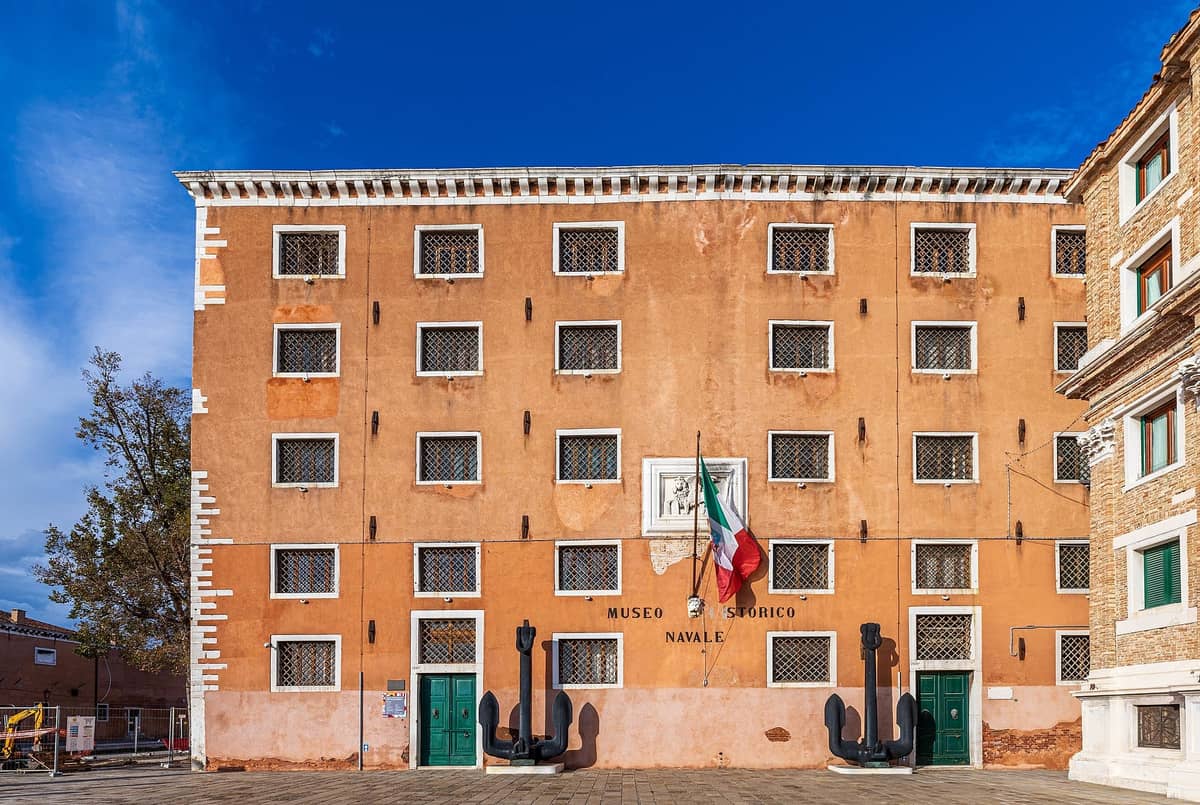
The Museo Storico Navale di Venezia, officially operated by the Italian Navy under the name MUNAV (Museo Navale della Marina Militare), is a five-floor maritime history museum located at Riva San Biagio in the Castello sestiere. The building itself dates to the 15th century and once served as the granary of the Serenissima Republic, the dense, bureaucratic machinery that turned Venice into the dominant sea power of the Mediterranean for centuries. The museum was officially established by Royal Decree in February 1923.
Officially established in 1923 by Royal Decree following initiatives of the Italian Naval General Staff in 1919, the museum holds thousands of objects: detailed scale models of warships and galleys, navigational instruments, figureheads, paintings, cannons, torpedoes, uniforms, and medals. The scope runs from Venetian war galleys of the 14th century through to Italian Navy vessels of the 20th century. It is not a polished, interactive experience in the modern museum sense. It is a dense archive of objects, often with modest labeling, which means it rewards patient visitors and frustrates those expecting multimedia interactives.
ℹ️ Good to know
Opening hours vary by season; recent official MUNAV information indicates daytime opening with Monday closure, but schedules have changed over time. The Ships Pavilion status can also change. Always verify current hours and any closures on munav.it (and related marina militare notices) before your visit.
The Building and Its Setting
The museum sits along the Canale di San Marco at Campo San Biagio, roughly 700 meters east of Piazza San Marco. Walking here from the piazza along the Riva degli Schiavoni takes about ten minutes, and the route itself is worth the journey: you pass the broad stone waterfront, the dome of Santa Maria della Salute across the water, and eventually the long brick wall of the Arsenale coming into view on your left. By the time you arrive at the museum entrance, you have already absorbed a significant amount of Venetian maritime geography.
The proximity to the Arsenale di Venezia is not incidental. The Arsenale was the state shipyard that built and maintained Venice's war fleet, at its peak employing several thousand workers and capable of launching a fully equipped warship in a single day. The museum and the Arsenale are physically and historically inseparable: the museum collection directly documents what was built, fought, and sailed from that compound over five centuries.
The 15th-century granary structure gives the museum its character: thick stone walls, uneven floors in places, low ceilings on upper levels, and a quality of light that changes depending on which floor you are on. It is not climate-controlled in the way that major art museums are, so in summer the upper floors can be warm, and in winter the stone holds a chill. None of this is unbearable, but it affects how long you will want to linger.
Tickets & tours
Hand-picked options from our booking partner. Prices are indicative; availability and final rates are confirmed when you complete your booking.
Doge's Palace skip-the-line tickets and guided tour with museums around St. Mark's Square
From 67 €Instant confirmationFree cancellationCa' Pesaro - International Gallery of Modern Art and Oriental Art Museum entrance ticket
From 8 €Instant confirmationCa' Rezzonico 18th century Venice Museum entrance tickets
From 8 €Instant confirmationCa' Rezzonico 18th century Venice Museum entrance tickets
From 10 €Instant confirmation
What You Will Find Inside: A Floor-by-Floor Overview
The ground floor typically introduces the museum's context and holds some of the larger physical objects. Scale models of Venetian warships are among the most compelling things here: they are detailed enough to show rigging configurations, deck layouts, and the proportional bulk that made these vessels both impressive and dangerous. Alongside these are maps, flags, and material related to the broader history of the Venetian fleet.
Upper floors move through specific themes: naval weapons including swords, boarding axes, and early firearms; navigational instruments such as compasses, astrolabes, and sextants; and a substantial collection of figureheads, the carved wooden prows that identified ships and projected authority in an era before radio. One of the most frequently discussed objects in the museum is a ceremonial barge, the Bucintoro, or more precisely, a scale model and fragments of the final version, the gilded state galley that the Doge of Venice used each year on Ascension Day to conduct the Sposalizio del Mare, the symbolic marriage of Venice to the sea. The original was destroyed by Napoleonic forces in 1798. What remains here is fragmentary but evocative.
Higher floors address the transition from the Republic to Italian unification and then to the modern Italian Navy. Uniforms, medals, photographs, and technical models document two World Wars and the evolving role of naval technology. This section is less theatrical than the early Republic material but historically complete. Visitors with a specific interest in 20th-century military history will find detail here that is absent from most general Venice attractions.
💡 Local tip
If you have limited time, prioritize the ship models and the Bucintoro material on the lower floors. The upper military history floors are thorough but less visually striking for casual visitors.
Time of Day and Crowd Patterns
The museum opens at 11:00, and the first hour tends to be the quietest. Mornings in Castello draw far fewer tourists than the San Marco area, and by the time crowds have moved east along the Riva degli Schiavoni, the museum's first visitors are often already leaving. Arriving at opening means you will have the ship model rooms largely to yourself, which matters in rooms where you want to walk slowly around a large-scale replica without navigating other people.
Midday sees an increase in school groups, particularly in spring. These are typically Italian school parties and are usually orderly, but they do change the acoustic character of the building. If you are visiting with children of your own, this can actually be a pleasant shared experience. If you are there for concentration and detail, slightly earlier or later works better.
The museum closes at 17:00, and the last half-hour tends to be quiet again as earlier visitors have cleared out. Late afternoon light through the upper-floor windows can be good for looking at painted models and wooden figureheads, though photography in lower-lit rooms will require a steady hand.
Practical Walkthrough: Getting There and Getting In
The simplest approach is to take Vaporetto line 1 or lines 4.1/4.2 to the Arsenale stop and walk the short distance to Campo San Biagio. Alternatively, the walk from Piazza San Marco along Riva degli Schiavoni takes about ten minutes and passes several points of interest. This is one of the few instances in Venice where the walk to an attraction is genuinely part of the experience and not just transit.
Admission prices have been reported at different levels in recent years; treat any figure you see online as provisional and verify the current full and reduced tariffs on the official MUNAV / marina militare site before you go. Concessions and free-entry categories also change — check munav.it for the latest details.
Accessibility: the main building has stairs between floors and the general characteristics of a converted historic structure, so full mobility access is limited. The Ships Pavilion annex, when open, has three steps at the entrance and no ramp, though security staff can assist visitors with mobility difficulties. Free entry for visitors with disabilities applies to both the visitor and one companion.
⚠️ What to skip
Closed-day schedules have varied in published sources (some older pages say Tuesday; recent MUNAV information points to Mondays). Arriving on a closed day is a common mistake after the waterfront walk from San Marco. Confirm the current weekly closure on munav.it the day before you plan to visit.
Historical Context: Why This Museum Exists Here
Venice's position as a sea power was not incidental to its prosperity: it was the entire basis of it. From the 9th century onward, the Republic used its fleet to control trade routes between Europe and the East, extracting tolls, protecting merchant convoys, and projecting force across the Adriatic and into the Eastern Mediterranean. The Arsenale next door was the operational center of this system, a state-owned shipbuilding complex that at its height was the largest industrial facility in pre-modern Europe.
When the Republic fell to Napoleon in 1797, that entire structure collapsed. The Arsenale was looted, the Bucintoro was burned for its gold fittings, and the fleet was dismantled or incorporated into French and later Austrian forces. The museum, founded in 1919 after Italian unification and the First World War, was partly an act of historical recovery: an attempt to document and preserve what had survived of that maritime civilization. This origin gives the collection a slightly elegiac quality. Many of the objects here are the only physical evidence that specific ships, specific technologies, and specific practices ever existed.
For travelers who want to understand Venice not just as a city of art and architecture but as a functional political and economic organism, the Museo Storico Navale provides context that you will not find in the Doge's Palace or the Gallerie dell'Accademia. It shows how Venice worked, and what the cost and mechanics of that working actually looked like.
Photography and What to Bring
Photography is generally permitted in the museum for personal, non-commercial use, though flash photography of specific objects may be restricted. The lighting in the main halls is functional rather than dramatic, so a phone camera will struggle in darker corridors and display cases. A camera with reasonable low-light capability, or willingness to slow down and use natural light near windows, will produce better results.
Bring water, particularly in summer. The building gets warm on upper floors and there is no café on site. The walk along the Riva degli Schiavoni has several cafes and water vendors, so stock up before entering. Comfortable shoes matter less here than at outdoor sites, but you will be on stone floors for an extended period. There is a cloakroom for bags.
Insider Tips
- The Bucintoro fragments and scale model are on a lower floor and easy to walk past quickly. Take time with them: this is one of the only physical traces of a ceremony that defined Venetian identity for centuries, and the scale model conveys the theatrical excess of the original better than any photograph.
- If you have an ICOM card (International Council of Museums membership), entry is free. This applies globally, so if you are a museum professional or member anywhere in the world, bring your card.
- The museum's upper floors on 20th-century Italian naval history are almost always empty. If you want a quiet, contemplative half-hour in Venice, the combination of detailed objects and absent crowds is unusual for this city.
- Combine this visit with a walk around the exterior of the Arsenale. You cannot enter most of the compound except during the Venice Biennale, but the gatehouse and canal-side walls are impressive and immediately clarify the scale of what the Republic was operating.
- On rainy days, this museum becomes significantly more appealing relative to outdoor attractions. It is substantial enough to fill two hours and the entrance fee is modest compared to the major civic museums.
Who Is Museo Storico Navale (Maritime Museum) For?
- History and military history enthusiasts who want more than decorative art
- Families with children aged 8 and above, particularly those interested in ships and weapons
- Travelers doing a second or third visit to Venice who have already covered the headline attractions
- Architecture and urban history visitors interested in the Arsenale district and Castello sestiere
- Rainy-day visitors looking for a substantial indoor museum that is not overwhelmed with crowds
Nearby Attractions
Other things to see while in Castello:
- Libreria Acqua Alta
Libreria Acqua Alta is a Castello bookshop where thousands of books are stored in a full-sized gondola, antique bathtubs, large waterproof bins, and small boats to protect them from Venice's seasonal floods. Free to enter, open daily, and genuinely unlike any other bookshop in the world.
- Arsenale di Venezia
The Arsenale di Venezia is one of the largest and most significant pre-industrial complexes in European history. Once the engine of Venetian naval supremacy, this 48-hectare compound of shipyards, armories, and rope-making facilities in the Castello district is partially open to visitors year-round, with greatly expanded access during the Venice Biennale.
- Basilica dei Santi Giovanni e Paolo (San Zanipolo)
The Basilica dei Santi Giovanni e Paolo, known locally as San Zanipolo, is the largest church in Venice and one of the most historically significant Gothic buildings in Italy. For nearly six centuries it served as the state funeral church of the Venetian Republic, and its interior holds the tombs of numerous doges (traditionally counted as around 25) alongside masterworks by Bellini, Veronese, and Vivarini.
- Giardini della Biennale
Spread across the eastern tip of the Castello sestiere, the Giardini della Biennale is a park of Napoleonic origin that transforms into the world's most prestigious contemporary art venue every two years. Thirty national pavilions plus the Central Pavilion, mature shade trees, and a waterfront promenade make it worth visiting whether or not the Biennale is running.