Scuola Dalmata dei Santi Giorgio e Trifone: Carpaccio's Masterpiece in Castello
Founded in 1451 by Venice's Dalmatian community, the Scuola Dalmata dei Santi Giorgio e Trifone holds one of the most intimate and complete Renaissance painting cycles in existence. Vittore Carpaccio's nine canvases, painted between roughly 1502 and 1510, line the ground-floor hall almost exactly as they were intended to be seen. The crowds that swamp the Accademia rarely make it here.
Quick Facts
- Location
- Calle dei Furlani 3259/a, Castello, Venice
- Getting There
- San Zaccaria (lines 1, 2, 4.1, 4.2, 5.1, 5.2) — approx. 10-min walk through Castello
- Time Needed
- 45–90 minutes
- Cost
- Approx. €5 per person (standard adult admission; verify locally before visiting)
- Best for
- Renaissance art lovers, history seekers, travellers escaping major tourist crowds
- Official website
- http://www.scuoladalmatavenezia.com
What Is the Scuola Dalmata dei Santi Giorgio e Trifone?
The Scuola Dalmata dei Santi Giorgio e Trifone — also widely known as the Scuola di San Giorgio degli Schiavoni — is a Renaissance confraternity building in Venice's eastern sestiere of Castello. It is not a church, not a museum in the modern sense, and not a palace. It is a scuola: a lay confraternity house, the kind of civic-religious institution that shaped Venetian social life for centuries. This one was founded on 24 March 1451 by decree of the Council of Ten, established specifically to serve Venice's Dalmatian community, the 'Schiavoni' as they were commonly called. Dalmatia, the coastal region of the eastern Adriatic, was then under Venetian rule, and its merchants, sailors, and tradespeople formed a significant and organized community within the city.
The building you enter today has its origins in that 15th-century foundation but was substantially renovated in 1551. That renovation gave the facade its current appearance: clean white Istrian stone, a carved relief of Saint George above the portal, and an understated dignity that blends easily into the surrounding Castello streetscape. You could walk past it without registering its significance. Many visitors do exactly that.
The Carpaccio Cycle: Why This Room Matters
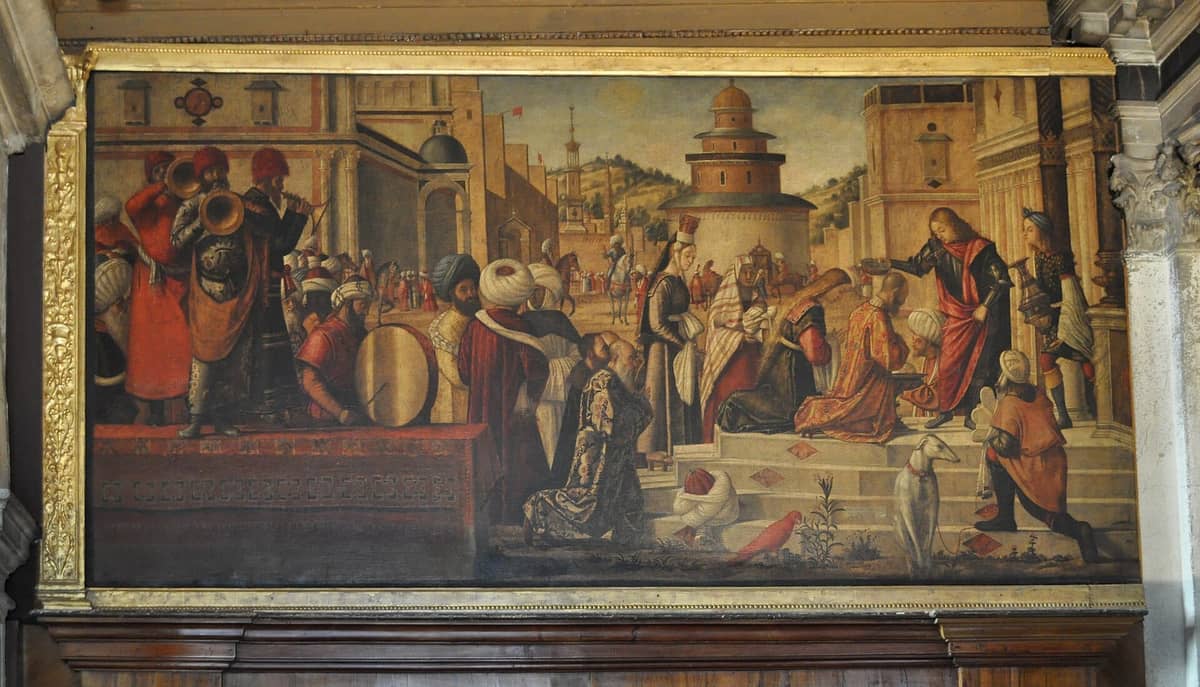
The reason to seek out the Scuola Dalmata is a single room on the ground floor, and what hangs inside it. Between approximately 1502 and 1510, the Venetian painter Vittore Carpaccio executed a cycle of nine large canvases depicting the lives of Saints George, Tryphon, and Jerome — the patron saints of the Dalmatian confraternity. These works were made for this space. They were not moved here from a church, not rescued from a dissolved institution, not acquired at auction. They were commissioned for these walls and they remain on these walls. That continuity of context is rare in Italian Renaissance art, and it changes how you experience them.
The most immediately striking canvas is the Saint George and the Dragon, in which a mounted George drives his lance into a dragon amid a litter of half-devoured human remains. Carpaccio renders the carnage with an almost clinical calm — peacock feathers, elegant slippers, a young woman watching from the distance — all set against a pale estuary landscape. The composition rewards slow looking. The longer you stand with it, the more detail surfaces.
The cycle continues through the Triumph of Saint George, the Baptism of the Selenites, scenes from the life of Saint Tryphon, and a sequence devoted to Saint Jerome including the famous Saint Augustine in His Study, where the scholar sits at his desk at the moment he heard of Jerome's death. Light falls through a window at a precise angle; small objects — a bronze statuette, an open book, a small dog — populate the room with accumulated meaning. Carpaccio's ability to make interior space feel luminous and inhabited is on full display.
💡 Local tip
Bring a small torch or use your phone's flashlight. The room lighting, though improved in recent years, can leave the lower sections of the canvases in shadow. Moving slowly along the walls and looking at details at close range is the way to see Carpaccio properly.
Tickets & tours
Hand-picked options from our booking partner. Prices are indicative; availability and final rates are confirmed when you complete your booking.
Giorgio Cini, Borges Labyrinth and Vatican chapels tour with audio guide
From 28 €Instant confirmationFree cancellationWood of the Foundation and the Vatican chapels tour with audio guide
From 15 €Instant confirmationFree cancellationGiorgio Cini Foundation and Wood with the Vatican chapels tour with audio guide
From 22 €Instant confirmationFree cancellationBorges Labyrinth tour with audio guide
From 15 €Instant confirmation
The Experience: What It Feels Like to Visit
The Scuola sits on Calle dei Furlani, a narrow street that runs a short distance inland from the Riva degli Schiavoni. The walk from the San Zaccaria vaporetto stop takes about ten minutes through increasingly quiet Castello streets. The noise of the waterfront drops away quickly. By the time you reach the building, you are in the kind of Venice that does not appear on most itineraries: residential, unhurried, with laundry strung above the calli and the sound of water from a nearby rio.
The entrance fee is modest — approximately €5 at the time of writing, though you should verify this locally before your visit. There is no ticket machine, no audio guide kiosk, no gift shop taking up half the ground floor. You pay, you enter, you look at one of the great small painting collections in Europe. The room itself is compact enough that you are always within a few meters of the canvases. The scale is human.
Morning visits, particularly on weekdays, tend to be quietest. The building receives nowhere near the volume of the Gallerie dell'Accademia or the Frari, and it is entirely possible to have the ground-floor hall largely to yourself for stretches of ten or fifteen minutes, which is the correct way to see this work. Midday on weekends brings slightly more traffic, but the space rarely feels crowded. Late afternoon light in autumn can be particularly atmospheric if the front shutters are partially open.
⚠️ What to skip
Opening hours vary seasonally and the scuola occasionally closes for confraternity events or private functions. Always verify hours before visiting — call ahead or check the official website. The building is closed on Tuesdays in most current schedules.
The Confraternity Upstairs: A Living Institution
Unlike many Venetian scuole that have become purely museum spaces, the Scuola Dalmata dei Santi Giorgio e Trifone remains an active confraternity. The upper floor — the sala dell'albergo — contains the confraternity's meeting room, decorated with later paintings and wooden furnishings, and continues to be used for official functions. This living institutional character gives the place an atmosphere that pure museum spaces lack. You are visiting a building that is still doing something.
The confraternity was established under a mariegola, a statutes document that governed its members' obligations to one another: mutual aid during illness, financial support for funerals, devotional practice, and the collective maintenance of the building and its artworks. The Dalmatian community in Venice was maritime in character — these were people whose livelihoods depended on the Adriatic sea routes that Venice controlled — and the choice of patron saints reflects that identity. Saint George was venerated widely across the eastern Mediterranean; Saint Tryphon was the patron of Kotor, one of the major Dalmatian ports.
Practical Details: Getting There and Getting In
The nearest vaporetto stop is San Zaccaria, served by ACTV lines 1, 2, 4.1, and 4.2 along the Riva degli Schiavoni. From San Zaccaria, walk east along the waterfront and then turn inland toward Castello following signs. The walk is flat — no bridges of any significance — and straightforward with a map. The address is Calle dei Furlani 3259/a; the street name helps but the surrounding calli are narrow and not all are signposted clearly. Allow a few extra minutes if it is your first time navigating this part of Castello.
The building has a modest facade with no large tourist signage. Look for the Istrian stone relief of Saint George above the doorway — that is your landmark. As of current information, opening hours are every day except Tuesday, 10:00–17:30 (last entry 17:00); these are subject to change, so consult the official website at scuoladalmatavenezia.com for up-to-date details.
Accessibility for visitors with mobility limitations is not well documented for this site. The building is a preserved Renaissance structure in a narrow Castello street, and the internal layout may include steps and uneven surfaces. Visitors with specific accessibility requirements should contact the scuola directly before planning a visit.
ℹ️ Good to know
Photography is generally permitted for personal use in the ground-floor hall, though flash photography should be avoided near the canvases. The low and angled lighting means a steady hand or a phone with good low-light performance will produce the best results.
Context: Placing This Site in Venetian Art History
Vittore Carpaccio (c. 1460–1525/26) was one of the most distinctive painters working in Venice during the late 15th and early 16th centuries. He is perhaps best known for his large narrative cycles, of which the Scuola Dalmata cycle is the most completely preserved in situ. The other major Carpaccio cycle, depicting the Legend of Saint Ursula, was removed from its original location and is now in the Gallerie dell'Accademia. Seeing both cycles in Venice — one in its original setting, one in a museum context — gives you a genuine comparative understanding of how such painting programs functioned.
Carpaccio's style sits between the ceremonial grandeur of Gentile Bellini and the more psychological depth later associated with Titian. His particular contribution was narrative clarity combined with extraordinary attention to material culture: fabrics, vessels, animals, architectural detail. The Scuola Dalmata cycle is full of this quality. Visitors who come from seeing the Tintoretto canvases at the Scuola Grande di San Rocco will find Carpaccio offers something quite different: quieter, more precise, more concerned with the texture of ordinary life alongside the miraculous.
For broader context on Venice's Renaissance art landscape, the best museums in Venice guide covers the major institutions worth pairing with a visit here.
Who Should Think Twice
This is not an attraction for visitors in a hurry. If you have half a day in Venice and want to check major landmarks off a list, the Scuola Dalmata is probably not where you should prioritize. The site rewards close looking and some prior knowledge of the subject matter; visitors who arrive with no interest in Renaissance painting and no context for what they are seeing may find the experience underwhelming. There are no interactive displays, no reconstructed period rooms, no dramatic curatorial interventions. There are canvases on walls, a painted ceiling, and a very quiet room. That is the whole offer.
The space is also small. Visitors hoping for the experience of a grand Venetian palazzo or a sweeping museum survey will be surprised by the intimacy and modesty of the scale. This is not a criticism — the scale is part of what makes the experience distinctive — but it is worth knowing before you go.
Insider Tips
- The Sunday morning slot (9:30–12:30 in summer) is often the quietest of the week, counterintuitively — most visitors are either at the Basilica or sleeping. Weekday mornings just after opening are similarly uncrowded.
- Pair this visit with the nearby church of San Giovanni in Bragora (a short walk north), where Carpaccio's Baptism of Christ hangs in situ. Two Carpaccio works in original settings in one morning is a rare Venice experience.
- The Istrian stone facade and portal relief are worth examining before you go inside. The 1551 renovation that produced them represents a deliberate architectural statement of community identity by the Dalmatian confraternity at a time when Venetian-Dalmatian political relations were increasingly complex.
- If you want to understand the wider context of Venice's scuole system — and why these confraternity art programs existed — visit the Scuola Grande di San Rocco either before or after. The scale contrast between the two sites is instructive: San Rocco is overwhelming, Carpaccio is intimate.
- The area around Calle dei Furlani is one of the less-walked parts of central Castello. Give yourself an extra twenty minutes to explore the surrounding calli and campielli before or after your visit — the residential character of this neighborhood reads very differently from the tourist-dense zones near San Marco.
Who Is Scuola Dalmata dei Santi Giorgio e Trifone For?
- Renaissance art enthusiasts who want to see Carpaccio's work in its original architectural context
- Repeat visitors to Venice looking beyond the major institutions
- Travellers interested in the history of Venice's minority communities and diaspora institutions
- Anyone wanting a genuine off-peak cultural experience with a very low entry cost
- Photographers seeking extraordinary low-light subjects away from heavily visited sites
Nearby Attractions
Other things to see while in Castello:
- Libreria Acqua Alta
Libreria Acqua Alta is a Castello bookshop where thousands of books are stored in a full-sized gondola, antique bathtubs, large waterproof bins, and small boats to protect them from Venice's seasonal floods. Free to enter, open daily, and genuinely unlike any other bookshop in the world.
- Arsenale di Venezia
The Arsenale di Venezia is one of the largest and most significant pre-industrial complexes in European history. Once the engine of Venetian naval supremacy, this 48-hectare compound of shipyards, armories, and rope-making facilities in the Castello district is partially open to visitors year-round, with greatly expanded access during the Venice Biennale.
- Basilica dei Santi Giovanni e Paolo (San Zanipolo)
The Basilica dei Santi Giovanni e Paolo, known locally as San Zanipolo, is the largest church in Venice and one of the most historically significant Gothic buildings in Italy. For nearly six centuries it served as the state funeral church of the Venetian Republic, and its interior holds the tombs of numerous doges (traditionally counted as around 25) alongside masterworks by Bellini, Veronese, and Vivarini.
- Giardini della Biennale
Spread across the eastern tip of the Castello sestiere, the Giardini della Biennale is a park of Napoleonic origin that transforms into the world's most prestigious contemporary art venue every two years. Thirty national pavilions plus the Central Pavilion, mature shade trees, and a waterfront promenade make it worth visiting whether or not the Biennale is running.