St. Mark's Basilica: Venice's Golden Cathedral Explained
St. Mark's Basilica is Venice's most recognizable monument and one of the finest examples of Byzantine architecture in the Western world. With 8,000 square metres of gold mosaics lining its ceilings, the basilica rewards those who know what to look for. This guide tells you exactly how to visit, when to go, and what to expect.
Quick Facts
- Location
- Piazza San Marco, 328, San Marco district, Venice
- Getting There
- Vaporetto Line 1 to San Marco Vallaresso, or Lines 1 and 2 to San Zaccaria; short walk to the square
- Time Needed
- 1.5 to 3 hours, depending on which paid sections you visit
- Cost
- Timed admission required and paid (about €10 for standard online tickets; check basilicasanmarco.it). Museum, Pala d'Oro, and Treasury are extras.
- Best for
- History lovers, art and architecture enthusiasts, first-time visitors to Venice
- Official website
- www.basilicasanmarco.it
What Is St. Mark's Basilica?
The Basilica Cattedrale Patriarcale di San Marco, known in English as St. Mark's Basilica, stands at the eastern end of Piazza San Marco and has anchored the spiritual and political life of Venice for nearly a thousand years. Construction of the current structure was completed in 1094, though the original basilica dates to 829, built to house relics of the Evangelist Saint Mark brought from Alexandria. After a fire destroyed the first building in 976, it was rebuilt, and the structure seen today reflects centuries of layered additions, each one reflecting the wealth and ambition of the Venetian Republic.
The basilica served as the private chapel of the Doge of Venice before becoming the city's cathedral in 1807, when the seat of the Patriarch of Venice was moved here from San Pietro di Castello. That distinction matters: for most of its history, this was not the main parish church of Venice but the chapel of state power, filled with art and treasures looted or traded from across the Byzantine world. That context shapes everything inside it.
💡 Local tip
Timed admission to the main basilica is required and paid (about €10 for standard online tickets; check basilicasanmarco.it). Tickets for the Museo di San Marco and the Pala d'Oro are extras on top of general admission. Booking a timed slot in advance helps you avoid long waits, especially in summer.
The Architecture: Five Domes and a Thousand Years of Decisions
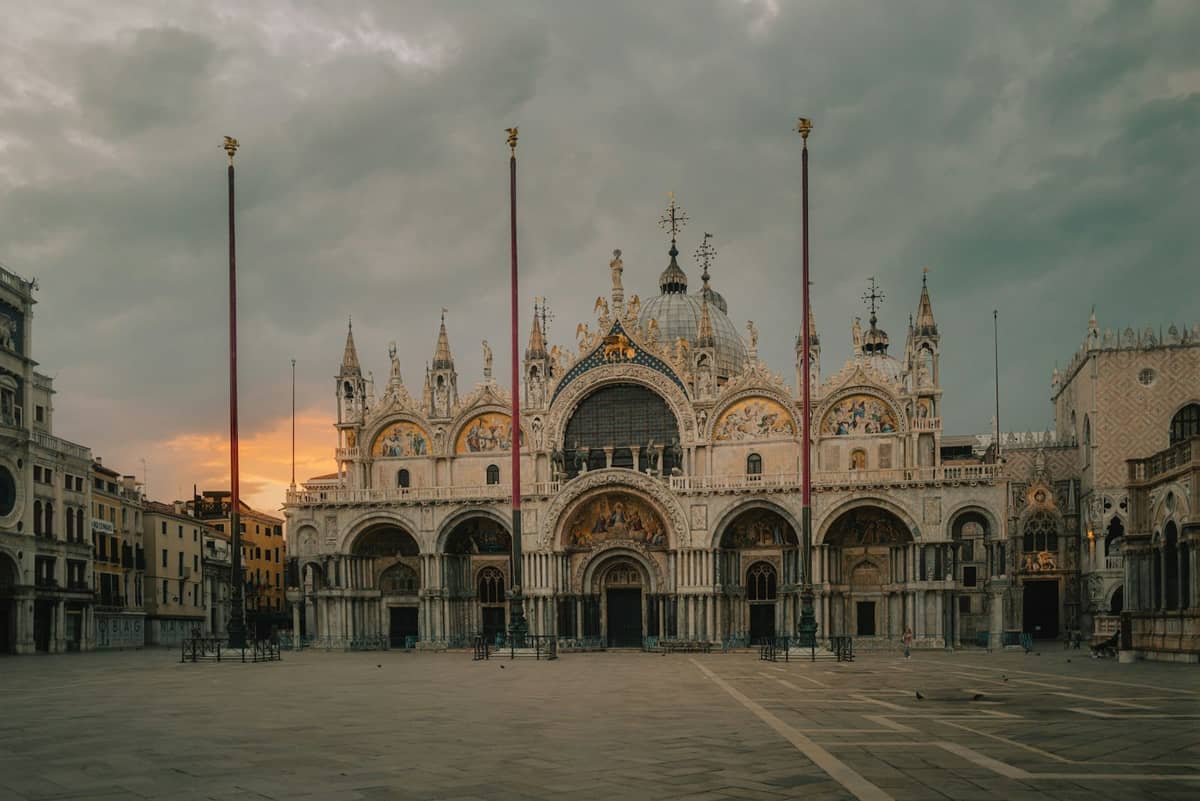
From the outside, the basilica presents a facade that defies clean architectural categorisation. The five arched portals are framed with columns stripped from earlier Roman and Byzantine buildings, a deliberate act of appropriation that communicated Venice's dominance over the ancient world. The four bronze horses above the central doorway are reproductions; the originals, dating to antiquity and brought from Constantinople in 1204, are housed inside the Museo di San Marco to protect them from pollution.
The floor plan follows a Greek cross with five domes, drawing directly on Byzantine models, particularly the Church of the Holy Apostles in Constantinople. But the builders kept layering on Gothic pinnacles, Renaissance reliefs, and Romanesque arches over successive centuries, which is why the facade reads as richly composite rather than stylistically unified. Stand back far enough in the piazza and the whole thing shimmers slightly in sunlight, the gold of the mosaic lunettes catching the angle of the afternoon sun.
Inside, the floor is a different matter entirely. Laid in marble and coloured stone in complex geometric patterns, it undulates visibly across the nave, the result of centuries of subsidence in the underlying lagoon sediment. Walking across it feels slightly disorienting, as if the ground itself is breathing. Some visitors find this charming; others find it uncomfortable if they have mobility concerns, something worth knowing before you visit.
Tickets & tours
Hand-picked options from our booking partner. Prices are indicative; availability and final rates are confirmed when you complete your booking.
Skip-the-line guided tour of Doge's Palace and Saint Mark's Basilica
From 106 €Instant confirmationFree cancellationExclusive Saint Mark's Basilica After Dark and Doge's Palace Tour
From 149 €Instant confirmationFree cancellationMorning walking tour of Venice with St. Mark's Basilica and gondola ride
From 105 €Instant confirmationFree cancellationVenice small-group walking tour with St. Mark's Basilica and Gondola Ride
From 79 €Instant confirmationFree cancellation
The Mosaics: 8,000 Square Metres of Gold
The interior of St. Mark's Basilica is covered in approximately 8,000 square metres of gold mosaic, spread across the ceilings, domes, arches, and upper walls. These are not paintings; they are composed of tiny glass tesserae, many of them backed with gold leaf, pressed into a dark setting compound. The effect in dim light is less the blaze of a decorated church and more a deep, warm luminescence, as if the walls are lit from within.
The oldest mosaics date to the 11th and 12th centuries. The subjects are drawn from both the Old and New Testaments, with particular emphasis on the life of Saint Mark. Look up into the central dome and you will find the Ascension of Christ surrounded by the Virgin, the Apostles, and allegorical figures of the Virtues. The dome above the altar depicts the Pentecost. Reading the iconographic programme across the five domes tells a coherent theological narrative, though most visitors don't realise it because guidebooks rarely frame it that way.
Visit on an overcast morning, when the diffuse grey light filters through the small windows and catches the gold at low angles. At this hour, the tesserae seem to shift and pulse as you move. On bright midday visits, when the piazza fills with tour groups and the basilica hits its crowds, it becomes harder to simply stand still and look upward. If the mosaics are your primary reason for coming, arrive as early as admission permits.
What to See Beyond the Main Nave
General admission covers the main body of the basilica and requires a timed, paid ticket (about €10 for standard online tickets; check basilicasanmarco.it). Several specific areas are extras and are worth understanding before you decide.
The Pala d'Oro is a gold and enamel altarpiece positioned behind the high altar. Created in Constantinople and progressively enlarged between the 10th and 14th centuries, it contains over 250 enamel panels set in a gold framework encrusted with gems. It is dense, intricate, and requires time to read properly. The lighting in the sanctuary can be uneven depending on the time of day, so bring patience.
The Treasury holds an extraordinary collection of Byzantine liturgical objects, many of them acquired during the sack of Constantinople in 1204. The objects are small in scale but exceptional in craftsmanship: chalices in onyx and crystal, reliquaries, icons. The room itself is quiet and rarely as crowded as the nave. The Museo di San Marco, reached by a staircase from the narthex, contains the original bronze horses and offers a loggia with a close-up view of the facade mosaics and a direct sightline across the piazza. This terrace view is one of the most useful perspectives in Venice for understanding the scale and composition of the square.
ℹ️ Good to know
Timed admission is required and paid for the main basilica (about €10 for standard online tickets; check basilicasanmarco.it). Bags and large backpacks are not permitted inside. A free luggage deposit is available nearby. Visitors wearing clothing that exposes shoulders or knees may be asked to cover up before entering, as is standard for Italian religious sites.
When to Visit and How Crowds Behave
St. Mark's Basilica is Venice's single most visited attraction, and that fact shapes every aspect of the experience. In peak season (June through August and around Easter), the queue for entry can stretch across the piazza and wait times of 45 to 90 minutes are common by mid-morning. The basilica also attracts a significant percentage of Venice's day-trippers, and crowd levels tend to increase markedly as cruise ship passengers and organized tours arrive from mid-morning onward.
The most consistent advice from frequent visitors is to arrive at or very slightly before opening (9:30 on weekdays and Saturday). In the first thirty to forty minutes, the nave is navigable, the light is at a workable angle, and the atmosphere inside has a different quality than it will have two hours later. If you visit on a Sunday or public holiday, entry for tourists is restricted to afternoon hours (from 14:00), as morning services take priority.
Autumn and winter visits offer noticeably thinner crowds, though the piazza is subject to acqua alta flooding in these months. If the square is flooded, temporary walkways (passerelle) are installed, which you can walk across to reach the basilica entrance. For a detailed breakdown of flooding conditions and what to expect at different times of year, the acqua alta visitor guide covers the practicalities thoroughly.
⚠️ What to skip
Photography without flash is permitted in the main basilica. Tripods and selfie sticks are not allowed inside. During religious services, tourist access to certain areas may be suspended without prior notice.
Getting There and Getting In
The basilica is located at the far eastern end of Piazza San Marco. From the vaporetto stops, it is a short and direct walk. Line 1 stops at San Marco Vallaresso, at the western edge of the piazza. Lines 1 and 2 stop at nearby San Zaccaria, slightly closer to the Doge's Palace end. From either stop, you will be in the piazza within five minutes. There is no vehicle access within the historic centre, so water transport and walking are the only options.
If you are staying in a different sestiere, the guide to getting around Venice explains how to combine vaporetto lines with walking routes to reach San Marco without unnecessarily backtracking through the narrow calli.
Opening hours (current as of writing): Monday to Saturday 9:30 to 17:15; Sunday and public holidays 14:00 to 17:15. Hours can change for religious events or special services. Always confirm the current schedule on the official website at basilicasanmarco.it before visiting, as these hours have shifted seasonally in the past.
Who Should Think Twice
If your primary interest is Italian Renaissance or Baroque painting, this is not the right church for you. The visual language here is entirely Byzantine and medieval: gold ground, flat figures, stylised gesture. There are no large-scale oil paintings or frescoes in the manner of, say, the Frari or Santi Giovanni e Paolo.
Visitors with mobility difficulties should note that the interior floor is uneven due to centuries of settlement, and there are steps to navigate within several sections. The piazza itself is flat and wheelchair-accessible under normal conditions, but flooding events can complicate this. The Doge's Palace immediately adjacent involves significantly more stair climbing across multiple floors, so plan accordingly if visiting both on the same day.
Visitors expecting a calm, reflective religious experience during peak hours will likely be disappointed. The basilica operates simultaneously as a living cathedral and one of the most-visited tourist sites in Europe, and the tension between those two functions is audible on busy days. If a quieter experience matters to you, the early morning slot in shoulder season is the realistic option.
Insider Tips
- The loggia of the Museo di San Marco (accessed via the interior staircase) gives you the closest possible look at the facade mosaics and a panoramic view over the piazza. Most visitors skip this section because of the ticket cost, which means the terrace itself is often uncrowded even when the nave below is packed.
- The narthex (the covered outer vestibule before the main nave) contains some of the oldest mosaics in the basilica, including 13th-century scenes from Genesis with a distinctive, archaic style quite different from the interior. Many visitors walk straight through it. Pause and look at the ceiling before you enter.
- If you want to photograph the exterior facade at its most photogenic, late afternoon light from the west catches the gold lunette mosaics directly. Early morning gives you the piazza with far fewer people in the frame.
- The basilica's official website allows you to pre-book timed entry to the Pala d'Oro and the Museo di San Marco. Booking even one day in advance can save you a long wait during busy periods, and the process is straightforward.
- Dress code is enforced at the entrance. Disposable paper ponchos are sometimes available nearby for purchase if you arrive underprepared, but bringing a scarf or light layer to cover shoulders costs nothing and saves the negotiation at the door.
Who Is St. Mark's Basilica (Basilica di San Marco) For?
- First-time visitors to Venice who want to understand the city's medieval and Byzantine heritage
- Architecture and art history enthusiasts interested in the interplay between Western and Eastern Christian traditions
- Travellers visiting in autumn or winter who want a major monument with thinner crowds
- Anyone curious about Venice's relationship with Constantinople and the spoils of the Fourth Crusade
- Photographers interested in Byzantine mosaic art and one of the most complex architectural facades in Europe
Nearby Attractions
Other things to see while in San Marco:
- Bridge of Sighs (Ponte dei Sospiri)
The Ponte dei Sospiri is one of Venice's most photographed structures, an enclosed white limestone bridge linking the Doge's Palace to the New Prisons over the narrow Rio di Palazzo canal. You can see it for free from the Ponte della Paglia, or cross it from the inside as part of a Doge's Palace ticket. Here is everything you need to visit it well.
- Doge's Palace (Palazzo Ducale)
Doge's Palace is the Gothic heart of Venice's political history, rising at the edge of Piazza San Marco with a facade unlike anything else in Italy. This guide covers what you'll actually experience inside, when to visit for smaller crowds, and how to make the most of one of Europe's most significant civic buildings.
- Grand Canal (Canal Grande)
The Canal Grande is the main artery of Venice, a reverse-S shaped waterway stretching 3.8 km through the heart of the city and lined with more than 170 palaces spanning six centuries of Venetian architecture. Free to view at any hour, it rewards visitors who know when and how to travel it.
- Museo Correr
Occupying the grand Napoleonic Wing and part of the Procuratie Nuove above Piazza San Marco, the Museo Correr holds centuries of Venetian civic history, Renaissance painting, and lavishly decorated royal apartments. It rewards visitors who take their time, and it's consistently overlooked by crowds fixated on the Doge's Palace next door.