St. Mark's Campanile: Venice from 98 Metres Up
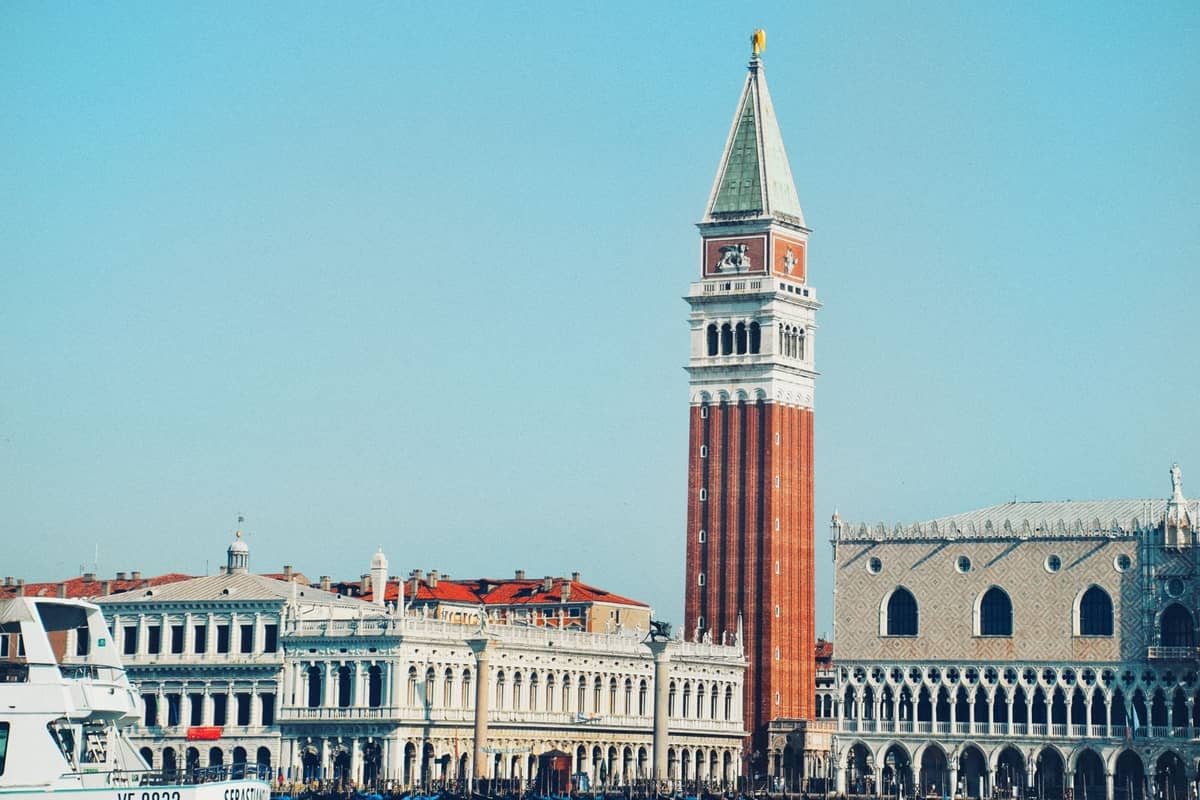
Standing about 99 metres above Piazza San Marco, the Campanile di San Marco is the tallest structure in Venice and its most recognisable silhouette. A modern lift carries visitors to the top in seconds, where the lagoon city and its surrounding islands unfold in every direction. The current tower is a faithful reconstruction completed in 1912 of the original, which dramatically collapsed in 1902 without casualties.
Quick Facts
- Location
- Piazza San Marco, San Marco, Venice — freestanding bell tower beside St Mark's Basilica
- Getting There
- Vaporetto stops San Marco or San Zaccaria
- Time Needed
- 30–60 minutes including queue; allow extra time for busy periods
- Cost
- Approx. €15 adults; reductions and free entry for young children. Verify current prices at the official site.
- Best for
- Panoramic views of Venice, the lagoon, and the Alps; photography; architectural history
- Official website
- stmarksbasilica.venezia.it/en/campanile.html
What the Campanile Actually Is
The Campanile di San Marco is Venice's defining vertical landmark: a freestanding brick bell tower rising about 99 metres above Piazza San Marco, capped by a pyramidal spire and a gilded angel that rotates with the wind. For centuries it served as a lighthouse, watchtower, and civic timekeeper. Today it functions primarily as the city's highest public viewpoint, accessible by lift.
The tower occupies Piazza San Marco, positioned beside St Mark's Basilica and the Libreria Marciana. From the ground, it looks immovable and ancient. The reality is more dramatic: the entire structure you see is less than 115 years old.
A Tower That Fell and Rose Again
The original bell tower on this site dates to the 9th century, though it was rebuilt and modified numerous times over the following centuries, reaching its pre-1900 form largely in 1515. On the morning of 14 July 1902, after weeks of visible cracking and structural warnings, the tower collapsed into a heap of rubble in under a minute. The Loggetta at the base, a Renaissance structure by Jacopo Sansovino, was destroyed in the collapse; St Mark's Basilica and the Doge's Palace were spared.
Venice voted almost immediately to rebuild it exactly as it was, using the same design and materials. The phrase coined at the time, "com'era, dov'era" (as it was, where it was), became the guiding principle. The reconstruction was completed and inaugurated on 25 April 1912. The precision of the replica is such that casual visitors rarely realise they are looking at an Edwardian-era structure.
ℹ️ Good to know
The Campanile can close without notice due to strong winds, dense fog, or liturgical events. Check conditions before joining the queue, particularly in winter or during acqua alta weather patterns.
Tickets & tours
Hand-picked options from our booking partner. Prices are indicative; availability and final rates are confirmed when you complete your booking.
Skip-the-line guided tour of Doge's Palace and Saint Mark's Basilica
From 106 €Instant confirmationFree cancellationExclusive Saint Mark's Basilica After Dark and Doge's Palace Tour
From 149 €Instant confirmationFree cancellationSt. Mark's Bell Tower and History Gallery Skip-the-Line Tickets
From 26 €Instant confirmationMorning walking tour of Venice with St. Mark's Basilica and gondola ride
From 105 €Instant confirmationFree cancellation
The View: What You Actually See
The lift opens onto the belfry chamber where five bells hang, each with a distinct historical function. The largest, the Marangona, rang to mark the beginning and end of the working day for Venetian craftsmen for centuries. Above this chamber, the open loggia wraps around all four sides and delivers the view Venice is famous for promising but rarely fully delivers at ground level.
Looking north, the rooftops of the city stretch toward the railway station and Cannaregio, the skylines punctuated by the domes of other churches. To the west, the Grand Canal curves away toward the Rialto. South and east, the open lagoon spreads across your field of vision, with the Lido and the Adriatic beyond. On the clearest winter mornings, the snow-covered peaks of the Dolomites appear on the northern horizon, a view that genuinely stops most people mid-sentence.
What the view makes clear immediately is how densely packed and canal-threaded Venice actually is. From the Rialto Bridge or the waterfront, you see fragments. From up here, you see the whole organism: the six sestieri laid out like a fish skeleton, surrounded by grey-green water, with the lagoon islands scattered around it. San Giorgio Maggiore looks close enough to shout across to.
How the Experience Changes by Time of Day
Morning visits (opening time, around 09:30) offer the shortest queues and the softest light on the rooftops, though summer mornings can already feel warm by 10:00. The piazza below is quieter, the cafes just setting out their chairs, and the morning light catches the gold mosaics of St Mark's Basilica façade.
Late afternoon, particularly in spring and autumn, produces the most photogenic conditions. The low western sun turns the brick facades amber and casts long shadows down the calli. The piazza below fills with the day's densest crowds, which is useful from above: looking straight down at Piazza San Marco is one of the more surreal urban spectacles in Europe.
Summer evening visits, available into the evening between April and September, offer something different again. The heat drops, the cruise ships in the distance are lit up, and the lagoon shifts from silver to indigo. Queues at this hour are typically shorter than the mid-afternoon peak. In winter, hours shorten significantly, and the light is low from early afternoon.
💡 Local tip
For the Dolomites view, aim for a clear weekday morning in late autumn or winter. The mountains are invisible in summer haze and most overcast conditions. Check weather forecasts the day before.
Getting There and Getting Up
The Campanile stands directly in Piazza San Marco, the most visited square in Venice. Access from the vaporetto is straightforward: alight at either San Marco (Vallaresso) or San Zaccaria, both served by multiple lines including the key Line 1 and Line 2 routes along the Grand Canal. From either stop, the tower is a 3–5 minute walk through the piazza.
The entrance is at the base of the tower, facing toward the Doge's Palace and the waterfront. Tickets are purchased at the base. There are no public stairs to the top: access is by lift only, which makes it one of the more accessible viewpoints in Venice for visitors with mobility limitations. The lift is not large, so groups move in small batches, and queues can develop quickly during peak hours.
Arriving via the San Marco waterfront also gives you the option of combining the visit with the Doge's Palace or stepping into St Mark's Basilica before or after, all of which occupy the same piazza.
Photography and Practical Notes
The viewing platform is enclosed by metal grilles, which present an obstacle for photography. The grille openings are wide enough to shoot through with a standard phone or compact camera, but telephoto lenses can be awkward. A wide-angle lens or phone camera performs best here. Video through the grille generally looks cleaner than still photography because the eye adjusts for the bars in motion.
Vertically downward shots of the piazza are easier on the south and west sides where the grille angles slightly outward. The north face gives the clearest rooftop view of the city. The east face frames San Giorgio Maggiore and the lagoon entrance. Arrive with a charged phone or camera: the light at the top can be harsh and fast-changing.
If you are particularly interested in panoramic views of Venice, the Campanile is the definitive option, but it is not the only one. The upper terrace of San Giorgio Maggiore offers an almost identical height view from the opposite direction, often with shorter queues. Both are worth comparing for photographers on a second or third visit.
Who This Suits and Who Should Reconsider
The Campanile is genuinely one of the most rewarding single paid experiences in Venice. The clarity and completeness of the panorama is hard to replicate, and the historical story of the collapse and reconstruction adds genuine depth to what could otherwise be a simple lift-to-the-top experience.
That said, visitors with significant fear of heights may find the open loggia uncomfortable, even though the grilles are solid. Those visiting only for the view should know that the platform is small and shared: in peak summer hours it can feel crowded, with little space to stand still for more than a few minutes. If you are primarily interested in Byzantine art or medieval civic history, the time and money may be better spent inside the Basilica or the Doge's Palace instead.
Visitors on a tight budget can also read our guide to free things to do in Venice for no-cost viewpoints and city experiences.
Insider Tips
- Book tickets online through the official Procuratoria di San Marco site before you arrive. Walk-up queues in July and August can be long during the 11:00–16:00 window. Online booking typically lets you select a timed entry slot.
- The lift fits only a small group at a time. If you arrive with a timed ticket and find a short spontaneous queue at the door, join it: the rhythm of people coming down creates natural gaps every few minutes.
- For the clearest Dolomites sighting, visit on a day following a strong northerly wind (tramontana) in autumn or winter. These winds sweep the lagoon haze away and produce the sharpest mountain views.
- Look directly down from the south face to see the paving pattern of Piazza San Marco without people obscuring it. Early morning is the best time in summer when the piazza floor is visible from above.
- The Marangona bell, the largest of the five bells, still rings. If your visit coincides with a bell-ringing moment, the sound inside the belfry chamber is extraordinary and extremely loud. It is not a subtle experience.
Who Is St. Mark's Campanile For?
- First-time visitors to Venice who want a single orientation experience before exploring the city on foot
- Photographers seeking a wide-angle overview of the entire lagoon city and its island geography
- Travellers visiting in clear late-autumn or winter conditions who want a chance at the Dolomites horizon view
- Visitors with mobility limitations, since the lift-only access makes this one of Venice's most accessible elevated viewpoints
- History enthusiasts interested in 20th-century reconstruction and the 1902 collapse story
Nearby Attractions
Other things to see while in San Marco:
- Bridge of Sighs (Ponte dei Sospiri)
The Ponte dei Sospiri is one of Venice's most photographed structures, an enclosed white limestone bridge linking the Doge's Palace to the New Prisons over the narrow Rio di Palazzo canal. You can see it for free from the Ponte della Paglia, or cross it from the inside as part of a Doge's Palace ticket. Here is everything you need to visit it well.
- Doge's Palace (Palazzo Ducale)
Doge's Palace is the Gothic heart of Venice's political history, rising at the edge of Piazza San Marco with a facade unlike anything else in Italy. This guide covers what you'll actually experience inside, when to visit for smaller crowds, and how to make the most of one of Europe's most significant civic buildings.
- Grand Canal (Canal Grande)
The Canal Grande is the main artery of Venice, a reverse-S shaped waterway stretching 3.8 km through the heart of the city and lined with more than 170 palaces spanning six centuries of Venetian architecture. Free to view at any hour, it rewards visitors who know when and how to travel it.
- Museo Correr
Occupying the grand Napoleonic Wing and part of the Procuratie Nuove above Piazza San Marco, the Museo Correr holds centuries of Venetian civic history, Renaissance painting, and lavishly decorated royal apartments. It rewards visitors who take their time, and it's consistently overlooked by crowds fixated on the Doge's Palace next door.