Old Dispensary (Ithnashiri Dispensary): Stone Town's Most Elaborate Facade
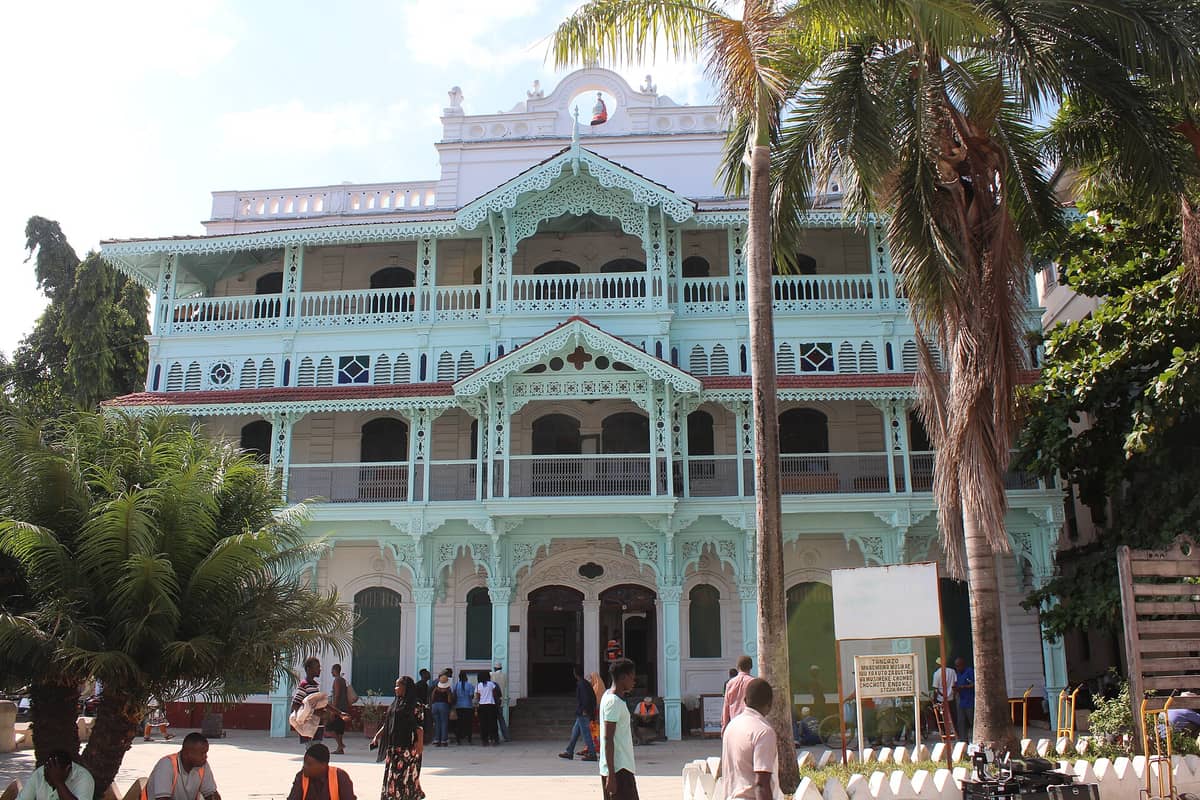
Standing on Mizingani Road opposite the port, the Old Dispensary is the finest example of Indo-Arab colonial architecture in Stone Town. Its tiered wooden balconies and carved stonework make it one of the most photographed facades in Zanzibar, and it costs nothing to admire from the street.
Quick Facts
- Location
- Mizingani Road, Stone Town, Zanzibar — opposite the Zanzibar Ports Authority
- Getting There
- 10-minute walk from the Zanzibar ferry terminal; walkable from anywhere in Stone Town's core
- Time Needed
- 20–40 minutes for exterior and ground floor; longer if the interior is accessible
- Cost
- Free to view from outside; interior access has been reported as free, though hours are unconfirmed — verify on arrival
- Best for
- Architecture enthusiasts, photographers, history-minded travelers, and anyone arriving or departing by ferry
What the Old Dispensary Actually Is
The Old Dispensary, formally known as the Ithnashiri Dispensary, is a four-story ornamental building on Mizingani Road, Stone Town's waterfront street. Construction began in 1887 and was completed in 1894, making it a product of Zanzibar's late sultanate period, when the island was one of the wealthiest trading entrepots in the western Indian Ocean. The building was originally endowed by a wealthy Indian merchant and served as a charitable medical dispensary for the city's poor. It was restored between 1994 and 1997, bringing its carved wooden balconies and decorative stonework back from serious disrepair.
What makes it architecturally remarkable is the layering of traditions on a single facade. The structural bones are Swahili coastal, but the decorative vocabulary is overwhelmingly Gujarati Indian: four tiers of intricately carved wooden balconies project over the street, each level slightly different in its detailing. The ground floor opens onto a colonnaded arcade. Stone relief work frames the windows. The whole composition is closer to a merchant's haveli in Surat or Bhuj than to anything you'd find in mainland East Africa, and that cultural hybridity is precisely the point — Stone Town's architecture is a physical record of its cosmopolitan trading history.
ℹ️ Good to know
The Old Dispensary sits directly on Mizingani Road, less than 200 metres from the main ferry terminal. If you're arriving in Stone Town by ferry from Dar es Salaam, it's the first significant building you'll pass on your walk into the old city.
The Facade: What to Look For
Most visitors spend the majority of their time on the street side, which is where the building earns its reputation. Stand back far enough to take in all four floors at once. The carved wooden balustrades change pattern level by level — floral and geometric motifs alternate, and the density of carving increases toward the upper floors, where the craftsmen clearly had more creative latitude. The wood has been treated and restored, but you can still see the grain of the original joinery up close if you approach the ground-floor arcade.
The stonework around the ground-floor arches deserves attention too. It uses the same coral rag stone found throughout Stone Town, carved into decorative brackets and friezes that echo the woodwork above. This combination of coral stone below and carved timber above is the signature material language of 19th-century Stone Town construction. If you've spent time looking at the famous carved doors of the medina, you'll recognize the same woodworking tradition at a much larger scale here.
For a deeper look at how the Old Dispensary fits into Stone Town's broader architectural landscape, the Zanzibar Stone Town architecture guide provides useful context on the buildings that shaped this UNESCO-listed historic district.
Tickets & tours
Live prices and dates from our booking partner. If you book, we may earn a commission at no extra cost to you.
Zanzibar catamaran and snorkelling tour to Mnemba Marine Park
From 114 €Instant confirmationFree cancellationNyerere National Park two-day safari with two game drives
From 866 €Instant confirmationFree cancellationSerengeti National Park private three-day safari from Zanzibar
From 2.144 €Instant confirmationFree cancellationZanzibar north coast sunset dhow cruise
From 42 €Instant confirmationFree cancellation
Time of Day: How the Experience Changes
The building faces roughly west toward the harbor, which means morning light hits the facade cleanly and reveals the texture of the carved wood and stone in sharp relief. This is the best time for photography: the shadows from the balcony projections create depth, and the street below is quieter, with fewer vendors and less foot traffic from the port. By mid-morning, when ferry arrivals pick up, Mizingani Road becomes considerably more active.
By late afternoon the light shifts behind the building, putting the facade in partial shade. The street itself becomes livelier — daladala vehicles, motorcycle taxis, and pedestrians moving between the port and the market quarter create a constant low-level noise that is part of any honest description of this location. The Old Dispensary is not a tranquil courtyard; it's on one of Stone Town's main arteries. If you find that kind of street energy distracting rather than atmospheric, come early.
After dark, the building is illuminated to varying degrees depending on the time of year and what's operational, but the illumination is unreliable and the street becomes much less active. The waterfront promenade nearby is more rewarding in the evening.
💡 Local tip
For the cleanest facade photographs, arrive before 9 a.m. The combination of low-angle morning light and minimal foot traffic gives you a clear sightline across Mizingani Road.
Historical Context: Why This Building Exists
The Old Dispensary was completed at a historically loaded moment. By 1894, the Sultanate of Zanzibar was operating under British protection, the slave trade had officially been abolished (though enforcement was imperfect), and Zanzibar's clove and ivory economy was shifting under new imperial pressures. The building's endowment by an Indian merchant philanthropist reflects the enormous economic power that the Indian trading diaspora had accumulated in Zanzibar over the previous century. Indian merchants had financed much of the sultanate's commercial activity, and their cultural imprint on Stone Town's built environment was profound.
The dispensary function, established on the ground floor in 1900, was significant: providing medical care to the urban poor in a city that had no public health infrastructure was a serious act of philanthropy, and the scale and ornamentation of the building communicated the donor's status as much as it served a practical purpose. This dual function, charitable institution wrapped in architectural display, was common to the period across British India and its trading peripheries.
Understanding Stone Town's layered history, including the slave trade economy that preceded and overlapped this building's construction, adds weight to any visit. The Slave Trade Museum and the Zanzibar slave history guide provide the context that the building itself doesn't communicate directly.
Practical Walkthrough: What to Actually Do Here
The exterior can be absorbed in 15 minutes if you're moving through Stone Town on a walking circuit. The ground-floor arcade may not be open to visitors, as the building has been transformed into a health clinic. Published sources have reported free entry, though opening hours are inconsistently listed across third-party sites — some show 24-hour access, others indicate a morning-to-midnight schedule. Confirm on arrival rather than planning around a fixed schedule.
There is no official guided tour of the building itself. If you're hiring a local guide for the day, ask whether it can be included as a stop rather than treating it as a standalone destination.
The building is logically combined with several other Mizingani Road and waterfront landmarks in a single morning. The Zanzibar waterfront and Forodhani Gardens are both within comfortable walking distance, as is the House of Wonders to the south. A Stone Town walking itinerary that strings these stops together makes more sense than visiting any one of them in isolation.
Who This Is and Isn't For
The Old Dispensary rewards travelers who slow down in front of buildings and actually look at them. If you have any interest in colonial-era architecture, Indo-Arab design traditions, or the material culture of the Indian Ocean trade world, this is a genuinely interesting structure. Architecture students and photographers with an eye for decorative detail consistently rank it among Stone Town's most rewarding facades.
If you're visiting Stone Town primarily for the beach transfer or a quick market stop before heading north, the Old Dispensary is easy to walk past on Mizingani Road without it meaning much. It's not a museum with interpretation panels that explains its own significance, so visitors who need context provided rather than sought will get little from a quick glance at the exterior. Similarly, travelers with mobility limitations should know that Mizingani Road has uneven paving, and the building's upper floors are not generally visitor-accessible.
⚠️ What to skip
Opening hours and interior access are inconsistently reported across listing sites. Do not book a tight itinerary around interior visits. The exterior is always viewable from the street.
Insider Tips
- Cross Mizingani Road and stand near the port fence to photograph the full four-story facade. From the opposite pavement you're too close to capture all four balcony tiers in a single frame without a wide-angle lens.
- The carved wooden balconies are most detailed on the upper two floors. From the street, look closely at the joinery and decorative details; interior access is not assured.
- Mizingani Road attracts persistent offers from souvenir vendors and informal guides, particularly around the ferry terminal end. A polite but firm response and purposeful walking reduces the interruptions; stopping to photograph the building can invite approaches.
- The Old Dispensary is one of the few Stone Town buildings whose restoration work is relatively well-documented. If you're researching historic preservation in East Africa, it's a useful case study alongside the House of Wonders restorations.
- Combine your visit with an early look at Forodhani Gardens before the food stalls set up. The waterfront in the morning, before the tourist economy fully activates, has a different quality entirely.
Who Is Old Dispensary For?
- Architecture and design enthusiasts interested in Indo-Arab and Gujarati building traditions
- Photographers looking for ornate colonial facades with good morning light
- Travelers doing a self-guided Stone Town walking circuit who want depth over distance
- History-minded visitors interested in the Indian Ocean trade world and Zanzibar's cosmopolitan past
- Anyone arriving by ferry who wants a meaningful first impression of Stone Town beyond the port gates
Nearby Attractions
Other things to see while in Stone Town:
- Darajani Market
Darajani Market, also known as Marikiti Kuu or the Great Market, is a principal market in Stone Town. Dating to 1904, it draws fishermen, spice traders, and local shoppers every morning in a scene that has changed little in over a century. Entry is free, and an hour here tells you more about Zanzibari daily life than any museum.
- Forodhani Gardens
Forodhani Gardens is a seafront park in the heart of Stone Town that doubles as Zanzibar's most celebrated street food market after dark. By day it's a quiet refuge of sea breezes and colonial-era architecture; by evening, dozens of grills and lantern-lit stalls transform it into the social and culinary center of the old city.
- Freddie Mercury Museum
Opened in 2019 on Kenyatta Road in Stone Town's Shangani quarter, the Freddie Mercury Museum occupies the building associated with his childhood. It is a small but carefully assembled tribute to his life, his music, and his largely overlooked Zanzibari origins — making it one of the most personally resonant stops in all of Stone Town.
- Hamamni Persian Baths
Built for Sultan Barghash between 1870 and 1888, the Hamamni Persian Baths were once the grandest public bathhouse in Zanzibar. Today the ruins stand as one of Stone Town's most atmospheric historic sites, offering a quiet counterpoint to the neighborhood's busier attractions.
Planning a trip? Discover personalized activities with the Nomado app.