House of Wonders (Beit al-Ajaib): Stone Town's Fallen Giant
The House of Wonders, known in Arabic as Beit al-Ajaib, is the most architecturally ambitious building on Zanzibar's waterfront. Partially collapsed in 2020, it remains one of the most photographed facades in Stone Town and a landmark that every visitor to the area will pass.
Quick Facts
- Location
- Mizingani Road, Stone Town, facing Forodhani Gardens
- Getting There
- About 10 minutes on foot from Darajani Market; roughly 20 minutes by taxi from the airport
- Time Needed
- 15–30 minutes for exterior viewing; combine with the surrounding waterfront
- Cost
- Free to view from outside; check current access arrangements before visiting
- Best for
- History lovers, architecture enthusiasts, photographers, and anyone doing a Stone Town walking tour
What Is the House of Wonders?
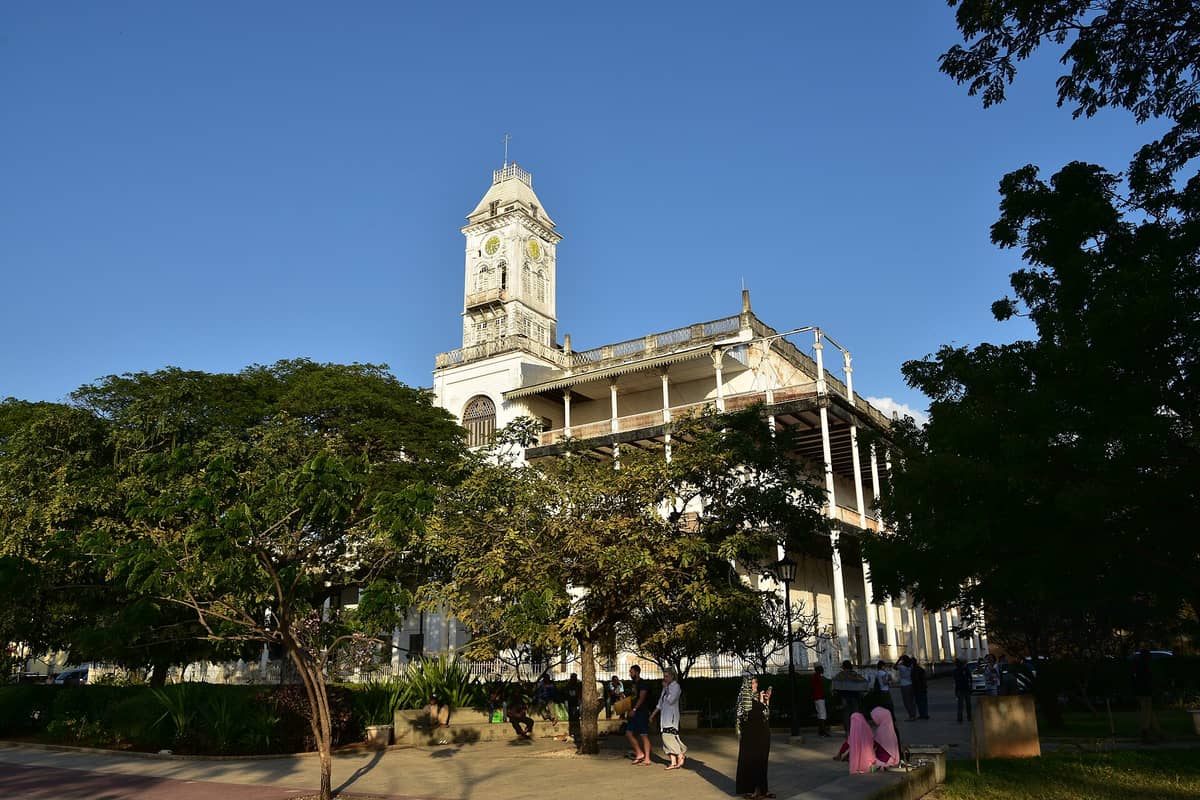
Beit al-Ajaib, or the House of Wonders, stands on Mizingani Road at the heart of Stone Town's seafront, between the Old Fort and the Palace Museum. It is a prominent, ornate structure in Stone Town, a multi-story palace wrapped in tiers of cast-iron balconies and topped by a prominent clock tower. Even in its current damaged state, it dominates the waterfront skyline in a way nothing else does.
The building was built as a large ceremonial palace by Sultan Barghash bin Said of Zanzibar. It became a landmark of Stone Town and later housed the Museum of History and Culture of Zanzibar and the Swahili Coast.
⚠️ What to skip
Important: Check current visitor access before going inside. Part of the building collapsed on 25 December 2020. UNESCO reported emergency rescue and assessment efforts after the collapse; current access arrangements should be confirmed locally. You can view the exterior from the pavement and Forodhani Gardens.
The Collapse and Reconstruction
On Christmas Day 2020, a section of the House of Wonders collapsed, drawing international attention to the building. The section that collapsed was undergoing renovations, according to UNESCO.
After the collapse, UNESCO organized a mission in which the World Monuments Fund sent structural engineers and architects to advise the Zanzibar government on emergency stabilization. Zanzibar's historical ties to Oman are part of the region's past, and reconstruction timelines in complex heritage projects are difficult to predict. Before visiting, check recent local news or ask your accommodation for the latest status.
The collapse adds a layer of melancholy to viewing the building today. Standing in Forodhani Gardens opposite, you can clearly see the scaffolding and fencing, a reminder that what you are looking at is a work in progress. But even partially obscured, the sheer scale of the structure and the delicacy of its ironwork balconies make it worth stopping at.
Tickets & tours
Live prices and dates from our booking partner. If you book, we may earn a commission at no extra cost to you.
Zanzibar catamaran and snorkelling tour to Mnemba Marine Park
From 114 €Instant confirmationFree cancellationNyerere National Park two-day safari with two game drives
From 866 €Instant confirmationFree cancellationSerengeti National Park private three-day safari from Zanzibar
From 2.144 €Instant confirmationFree cancellationZanzibar north coast sunset dhow cruise
From 42 €Instant confirmationFree cancellation
Architectural Significance
The House of Wonders is not Swahili architecture in the traditional sense. It is an eclectic fusion: Omani Arab spatial planning, Indian craftsman detailing, and European colonial engineering all overlapping in a single building. The tiered cast-iron verandas running around each floor are a particularly striking feature, unusual for the region and likely influenced by colonial architecture in India, where similar ironwork was produced during the same period.
The building's position on the seafront was deliberate. Sultans used it as a ceremonial palace for state occasions, and its visibility from arriving ships sent a clear message about Zanzibar's wealth and sophistication at a time when the city was one of the most important trading hubs in the Indian Ocean world. To understand that context more fully, the Stone Town architecture guide covers the broader patterns of how the city was built and why it looks the way it does.
What the Experience Is Actually Like Right Now
The House of Wonders faces Forodhani Gardens, offering a view of its waterfront facade. Conditions at the site and the best vantage point can vary, so check locally before visiting. The morning light from the east catches the pale coral-stone walls and the ironwork at an angle that afternoon sun from the water washes out.
By late afternoon, the waterfront fills with people: local vendors, children playing, tourists walking the seafront, and the constant movement of motorcycle taxis and minibuses on Mizingani Road. The energy is lively but the noise makes any reflective engagement with the building difficult. If you want to take photographs without scaffolding workers or crowds in the foreground, arrive before 9 a.m.
At night, the gardens across the road transform into the open-air Forodhani food market, and the building is lit from below in a way that makes the ironwork balconies look almost theatrical. It is a different kind of beauty from the daylight view, softer and less precise, but worth seeing if you are in the area for dinner.
💡 Local tip
Photography tip: For the cleanest shot of the full building, stand on the seafront walkway in Forodhani Gardens in the morning. Use the gardens' low stone wall as a foreground anchor. The clock tower frames well from the southern end of the gardens.
Placing the House of Wonders in a Stone Town Walk
The House of Wonders is not a destination you visit independently. It sits at the epicentre of the most walkable stretch of Stone Town's seafront, and most visitors pass it at least twice while exploring the waterfront and the old market district. A logical route links it with the Old Fort immediately to the south, Darajani Market about ten minutes inland, the Slave Trade Museum a short walk further, and the Old Dispensary to the north on the waterfront road.
For a structured approach to covering all of this, the Stone Town walking guide maps a half-day route that takes in the major architectural and historical sites without backtracking. The House of Wonders fits naturally into the waterfront section.
Who Should Skip It (Or Temper Expectations)
Travelers who came specifically to see the museum collection housed inside the House of Wonders may be disappointed if access is unavailable. Check current access arrangements for the House of Wonders and the nearby Palace Museum before planning a visit.
Those with limited time in Stone Town and little interest in architectural history may find a brief look from the gardens sufficient. There is nothing to do here beyond looking and photographing. It is not a place to sit, explore, or interact with for more than twenty or thirty minutes. But for anyone with even a passing interest in how empires leave their marks in stone, the building repays attention even in its current state.
Getting There and Practical Notes
The House of Wonders is on Mizingani Road, the main seafront road running through Stone Town. It is within easy walking distance of most Stone Town accommodation. From Darajani Market, the main transit hub for dala-dala minibuses, the walk takes roughly ten minutes along Creek Road and into the old town. There is no dedicated parking area nearby, and Mizingani Road is often congested with motorcycle taxis and pedestrians, so arriving on foot or by taxi and walking the last stretch is the most practical approach.
Check current site access and accessibility arrangements before visiting, as conditions may change during conservation work.
ℹ️ Good to know
The House of Wonders is located directly on Stone Town's seafront, between the Old Fort to the south and the Old Dispensary to the north. Forodhani Gardens, directly opposite, provide the best viewing angle and a shaded area to rest.
Insider Tips
- The building looks best on an overcast morning when the light is diffuse and the pale coral-stone walls are not bleached out by direct sun. Overcast skies are common during the long rains (March to May) and short rains (November), so those periods actually produce good photography conditions despite being off-peak for tourism.
- The evening food market in Forodhani Gardens sets up on the same side of the road as the best viewing angle. Arriving before stalls are assembled (before around 5:30 p.m.) gives you unobstructed sight lines and quieter surroundings.
- The Palace Museum (Beit al-Sahel) is nearby and covers Sultanate-period history; check its current visitor access before planning a visit.
- Do not rely on information from tour operators or taxi drivers about reopening dates. Updates will come from official Zanzibar government or Oman-funded restoration announcements. Check recent news before your visit if seeing the interior is your goal.
- The clock tower is visible from well north and south along the waterfront road. If you are doing the seafront walk toward the Old Dispensary or back toward the dhow harbor, the tower serves as a useful orientation point across the whole Stone Town waterfront.
Who Is House of Wonders (Beit al-Ajaib) For?
- Architecture and history enthusiasts who want to understand Stone Town's Sultanate-era past
- Photographers working on a Stone Town documentary or travel portfolio
- Travelers doing a full Stone Town walking route who want context for the waterfront streetscape
- Anyone interested in Omani Arab influence on East African heritage and urban form
- Visitors combining a waterfront stroll with an evening at the Forodhani Gardens food market
Nearby Attractions
Other things to see while in Stone Town:
- Darajani Market
Darajani Market, also known as Marikiti Kuu or the Great Market, is a principal market in Stone Town. Dating to 1904, it draws fishermen, spice traders, and local shoppers every morning in a scene that has changed little in over a century. Entry is free, and an hour here tells you more about Zanzibari daily life than any museum.
- Forodhani Gardens
Forodhani Gardens is a seafront park in the heart of Stone Town that doubles as Zanzibar's most celebrated street food market after dark. By day it's a quiet refuge of sea breezes and colonial-era architecture; by evening, dozens of grills and lantern-lit stalls transform it into the social and culinary center of the old city.
- Freddie Mercury Museum
Opened in 2019 on Kenyatta Road in Stone Town's Shangani quarter, the Freddie Mercury Museum occupies the building associated with his childhood. It is a small but carefully assembled tribute to his life, his music, and his largely overlooked Zanzibari origins — making it one of the most personally resonant stops in all of Stone Town.
- Hamamni Persian Baths
Built for Sultan Barghash between 1870 and 1888, the Hamamni Persian Baths were once the grandest public bathhouse in Zanzibar. Today the ruins stand as one of Stone Town's most atmospheric historic sites, offering a quiet counterpoint to the neighborhood's busier attractions.
Planning a trip? Discover personalized activities with the Nomado app.