Forodhani Gardens: Stone Town's Waterfront Park and Night Food Market
Forodhani Gardens is a seafront park in the heart of Stone Town that doubles as Zanzibar's most celebrated street food market after dark. By day it's a quiet refuge of sea breezes and colonial-era architecture; by evening, dozens of grills and lantern-lit stalls transform it into the social and culinary center of the old city.
Quick Facts
- Location
- Stone Town waterfront, near Forodhani Street, opposite the Old Fort, Zanzibar City
- Getting There
- Walk from anywhere in central Stone Town; on the seafront promenade, a 5-10 min walk from most guesthouses
- Time Needed
- 30 min (daytime stroll) to 2 hours (evening market visit)
- Cost
- Free park entry; food stalls priced individually; public restrooms reported at 500 TZS
- Best for
- Street food lovers, sunset watching, first evenings in Stone Town
What Forodhani Gardens Actually Is
Forodhani Gardens is a long, open seafront park that runs along the western edge of Stone Town, facing the Indian Ocean. The park was originally laid out in 1936 to mark Sultan Khalifa's Silver Jubilee, which is why it also goes by the name Jubilee Gardens, and was significantly restored in 2009. Today it functions as two completely different places depending on the hour.
During the day, it's one of the calmer corners of Stone Town: a place where old men sit on low walls watching the ocean, children kick footballs on the flagstones, and the smell of the sea cuts through the heat. The gardens face the Old Fort and sit adjacent to the House of Wonders, so the architectural backdrop even in daylight hours is considerable.
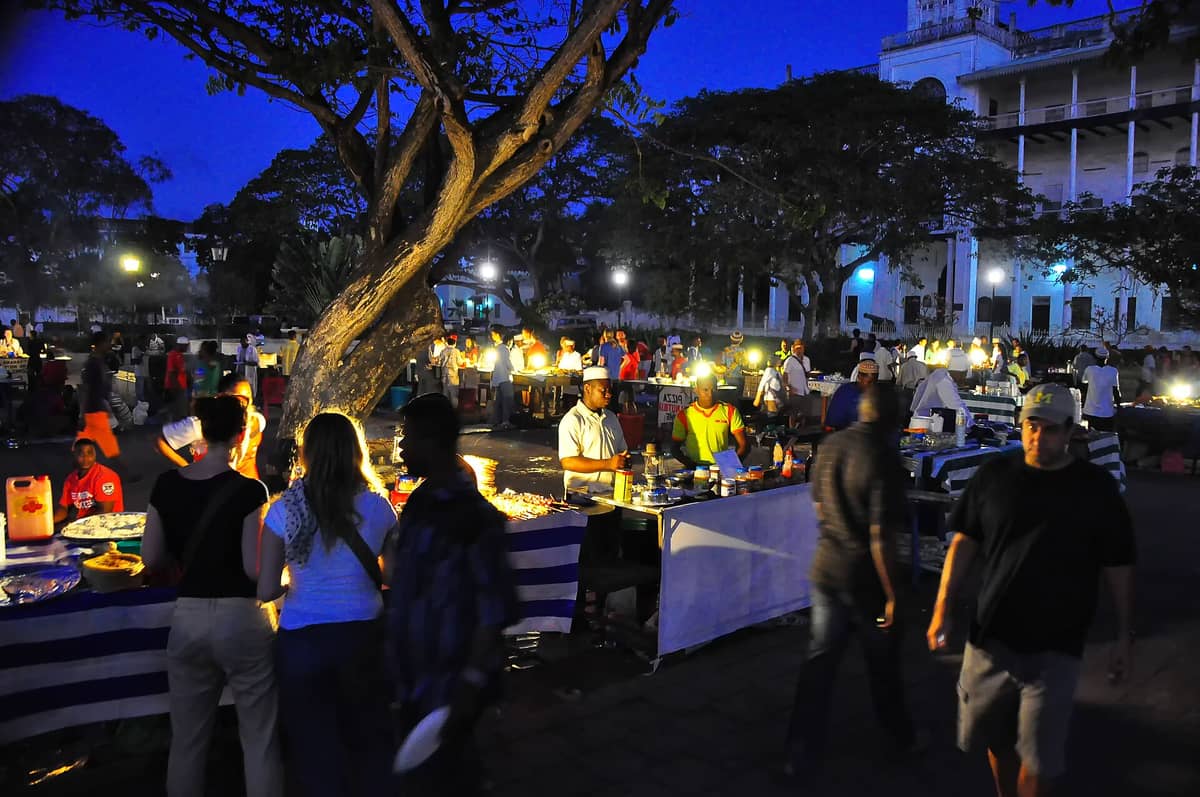
From around sunset onward, vendors arrive and begin assembling rows of grill stations and display tables. By the time the sky turns orange over the water, Forodhani has become a full outdoor market, filling with local families, travelers, and the thick smoke of grilled seafood. It is the most concentrated expression of Stone Town's street food culture and one of the primary reasons visitors plan their first evening here. For broader context on Stone Town's layout and what surrounds the gardens, the Stone Town walking guide covers the area in detail.
The Daytime Experience: Colonial Architecture and Ocean Light
Arriving during the day offers something the evening crowds obscure: a clear view of the spatial relationship between the gardens and the surrounding architecture. The park sits directly opposite Ngome Kongwe, the Old Fort, whose coral-stone walls date to the late seventeenth century. To the right, the damaged House of Wonders is under restoration. The seafront promenade itself has a faded colonial formality about it that the evening's chaos completely erases.
The light here in the hours before noon is sharp and photogenic; the pale walls of the fort and the bougainvillea along the garden railings photograph well with the ocean as a background. By midday, the sun is severe and the flagstones radiate heat, so this is not a place to linger without shade. The gardens do have some tree cover, but it is not extensive.
💡 Local tip
If you want the park to yourself and the architecture cleanly lit, arrive before 9 AM. The walk along the promenade north toward the dhow harbor is particularly good in the early morning, when fishing boats return and the market at Darajani is already running.
Tickets & tours
Live prices and dates from our booking partner. If you book, we may earn a commission at no extra cost to you.
Zanzibar catamaran and snorkelling tour to Mnemba Marine Park
From 114 €Instant confirmationFree cancellationNyerere National Park two-day safari with two game drives
From 866 €Instant confirmationFree cancellationSerengeti National Park private three-day safari from Zanzibar
From 2.144 €Instant confirmationFree cancellationZanzibar north coast sunset dhow cruise
From 42 €Instant confirmationFree cancellation
The Evening Market: What You'll Find on the Grill
The food market at Forodhani Gardens begins setting up around sunset and is generally running until around 23:00, though setup and wind-down times vary. There is no single operator, it is a collection of individual vendors who each hold a spot. This means quality and pricing are not uniform, and the experience rewards some comparison before you commit.
The dominant items are grilled seafood: whole lobster, calamari, king prawns, octopus, and fish fillets, all sold by weight or by piece and cooked to order over charcoal. Alongside the seafood stalls you'll find Zanzibar pizza, which is a local specialty with nothing in common with Italian pizza, essentially a thin dough pocket filled with egg, vegetables, minced meat, or cheese and then folded and fried on a flat iron. It is one of the more interesting things to eat in Stone Town and costs very little.
Sugar cane juice is pressed fresh at several stalls, the machine grinding loudly into the general noise of the market. Urojo, a tart and spiced Zanzibar mix soup with chickpea fritters and potato, is available from some vendors and is worth trying if you can find it. The market also sells coconut bread, samosas, and various grilled skewers of meat.
⚠️ What to skip
Pricing at the seafood stalls is not always posted. Whole lobster in particular can be quoted at very different prices by different vendors, and costs can add up quickly once items are on the grill. Agree on the price before grilling begins, not after. Prices are generally higher here than at restaurants away from the waterfront, which is the trade-off for the setting.
The atmosphere is genuinely sociable rather than purely transactional. Locals and visitors eat at the same plastic tables, vendors shout across the smoke, and children weave between the stalls. If you want to explore Stone Town's food culture beyond this market, the Zanzibar food guide covers restaurants, street food, and Swahili cuisine across the island.
How the Atmosphere Changes Through the Night
The first hour after sunset is the most photographed and also the most crowded. Tour groups arrive, often guided, and the market is at peak noise. If you are sensitive to crowds, this window between roughly 6:30 and 8:00 PM can feel overwhelming. The smoke from the charcoal grills is dense and low, coating everything in a woody smell that will stay on your clothes.
After 9 PM, the dynamic shifts. Groups have largely left, the vendor calls are less aggressive, and the ocean breeze off the channel tends to pick up, clearing some of the smoke. This is when the market feels more like somewhere locals actually choose to be rather than somewhere tourists are herded through. The light from the lanterns and the glow of the charcoal has a specific quality at this hour that is difficult to photograph well but easy to remember.
The gardens themselves remain lit and reasonably safe into the late evening by Stone Town standards, though common sense applies regarding your belongings in a crowded nighttime market. Keep bags closed and in front of you.
Historical and Architectural Context
The 1936 origins of the gardens tie Forodhani to the late-British-protectorate period of Zanzibari history, when the seafront was being formalized as a civic space. The name Forodhani refers to a landing point or customs area, reflecting the waterfront's historic function as a point of arrival and departure in a city that was, for centuries, one of the most important ports in the western Indian Ocean.
The 2009 restoration gave the gardens their current form: improved paving, repaired seating walls, and a reorganized space for the market. This restoration was part of a broader effort to rehabilitate Stone Town's public spaces, which is a UNESCO World Heritage Site. The architectural density around the gardens makes this one of the best single spots in Zanzibar City to understand the layered history of the place. The Stone Town architecture guide explains the Persian, Arab, Indian, and British influences that define the surrounding buildings.
Directly adjacent to the gardens sits the House of Wonders, which was among the first buildings in East Africa to have electricity and the first in the region with an elevator when it was completed in 1883. The Old Fort opposite dates to the late seventeenth century and was built by Omani Arabs. For a deeper understanding of how this coastline was shaped by the slave trade and Indian Ocean commerce, the Zanzibar slave history guide provides essential context.
Practical Details for Visitors
The gardens are free to enter at all hours. The park is described by travel sources as open around the clock. Public restrooms are available nearby and were reported to cost 500 TZS as of research date, though small fees like this can change. The gardens are on flat ground, which makes daytime access relatively straightforward, but the density of stalls and crowd during the evening market can make movement through the space difficult for anyone with mobility limitations.
Getting here is simple: Forodhani Gardens are on the Stone Town seafront, a short walk from virtually every guesthouse in the historic center. There are no taxis or dala-dalas needed for anyone already staying in Stone Town. If arriving from outside the city, taxis drop off along the waterfront road.
Photography at night requires managing the contrast between the very bright grill fires and the dark surroundings. Phones without a decent night mode tend to struggle. The most interesting shots are usually of the food preparation itself rather than wide views of the market, which photographs better in person than on a screen.
ℹ️ Good to know
Forodhani Gardens is not the place to come if you want a quiet, uncrowded introduction to Zanzibari food. Visitors who prefer that experience might do better at one of the smaller local restaurants in the Stone Town lanes, which serve similar dishes at lower prices. The market's value is in the setting and the energy, not in finding the cheapest or most refined meal on the island.
Is It Worth Your Evening?
For a first night in Stone Town, yes, almost certainly. The combination of location, architecture, the smell of charcoal and the ocean, and the chance to eat something genuinely local in an outdoor space with other people makes it a useful orientation to the city. It is particularly well-suited to travelers who have just arrived and want to understand Stone Town before exploring deeper into the lanes.
For repeat visitors or travelers with more than two or three days in Stone Town, the market is enjoyable but not essential on every evening. The novelty of the setting wears off after a visit or two, and the consistent pricing advantage sits with the smaller restaurants in the back streets.
If you are planning a full itinerary around Stone Town, combining a Forodhani evening with a daytime visit to the slave trade museum and a walk through the Darajani market gives a more complete picture of the city. The three-day Zanzibar itinerary includes suggested sequencing for these sites.
Insider Tips
- Walk the length of all the stalls before buying anything. Prices and quality vary from one end of the market to the other, and a 60-second survey will help you choose better.
- Zanzibar pizza is one of the most underrated things to eat in Stone Town. It looks unassuming but the filled-and-fried preparation is genuinely local and costs far less than the seafood. Try it from a stall with a queue of local customers.
- If you arrive between 8:30 and 9:00 PM, most tour groups have left and vendors are often more willing to negotiate on price. The atmosphere is also calmer, which some travelers prefer.
- Bring small-denomination bills. Many stalls struggle to make change for large notes, and this becomes more common as the night goes on and vendors run low on cash.
- The seating walls along the ocean side of the gardens are the best spot to eat. You get the sea breeze, some separation from the smoke, and a view of the lit waterfront and dhows in the channel.
Who Is Forodhani Gardens For?
- First-time visitors to Stone Town wanting an immediate introduction to Swahili street food culture
- Travelers who enjoy open-air markets with a strong local presence and evening atmosphere
- Couples looking for a casual sunset and dinner combination on the waterfront
- Food-focused travelers curious about Zanzibar pizza, urojo soup, and grilled Indian Ocean seafood
- Anyone who wants an architectural backdrop for an evening walk without paying museum fees
Nearby Attractions
Other things to see while in Stone Town:
- Darajani Market
Darajani Market, also known as Marikiti Kuu or the Great Market, is a principal market in Stone Town. Dating to 1904, it draws fishermen, spice traders, and local shoppers every morning in a scene that has changed little in over a century. Entry is free, and an hour here tells you more about Zanzibari daily life than any museum.
- Freddie Mercury Museum
Opened in 2019 on Kenyatta Road in Stone Town's Shangani quarter, the Freddie Mercury Museum occupies the building associated with his childhood. It is a small but carefully assembled tribute to his life, his music, and his largely overlooked Zanzibari origins — making it one of the most personally resonant stops in all of Stone Town.
- Hamamni Persian Baths
Built for Sultan Barghash between 1870 and 1888, the Hamamni Persian Baths were once the grandest public bathhouse in Zanzibar. Today the ruins stand as one of Stone Town's most atmospheric historic sites, offering a quiet counterpoint to the neighborhood's busier attractions.
- House of Wonders (Beit al-Ajaib)
The House of Wonders, known in Arabic as Beit al-Ajaib, is the most architecturally ambitious building on Zanzibar's waterfront. Partially collapsed in 2020, it remains one of the most photographed facades in Stone Town and a landmark that every visitor to the area will pass.
Planning a trip? Discover personalized activities with the Nomado app.