Freddie Mercury Museum: Stone Town's Tribute to a Rock Legend
Opened in 2019 on Kenyatta Road in Stone Town's Shangani quarter, the Freddie Mercury Museum occupies the building associated with his childhood. It is a small but carefully assembled tribute to his life, his music, and his largely overlooked Zanzibari origins — making it one of the most personally resonant stops in all of Stone Town.
Quick Facts
- Location
- 57 Kenyatta Road, Shangani, Stone Town, Zanzibar
- Getting There
- Central Stone Town — walkable from most hotels; taxis available on Kenyatta Road
- Time Needed
- 45 minutes to 1.5 hours
- Cost
- Official site lists US$8 adults / US$6 children — verify current prices before visiting
- Best for
- Music fans, cultural travellers, history enthusiasts
- Official website
- freddiemercurymuseum.com
What Is the Freddie Mercury Museum?
The Freddie Mercury Museum opened on 24 November 2019 — the 28th anniversary of Mercury's death — in the Shangani district of Stone Town, Zanzibar. The building at 57 Kenyatta Road is widely identified as a place where the singer lived during his childhood, not his birthplace; Farrokh Bulsara was born in Zanzibar in 1946 before his family relocated to India and, eventually, to England. It is the only museum in the world dedicated exclusively to Mercury's life, and it grounds his story in a place most of his global fanbase had never associated with him.
The museum is modest in scale. This is not the Victoria and Albert or the Rock and Roll Hall of Fame. What it offers instead is intimacy: a focused collection of photographs, personal memorabilia, replica stage costumes, album artwork, and contextual panels that trace Mercury's journey from a colonial-era Zanzibar childhood through his years at boarding school in India to his ascent as one of rock's defining performers. For fans who already know the music well, the Zanzibari chapter of his biography is the least documented, and this museum fills that gap more substantively than anything else currently available.
💡 Local tip
Check opening hours directly at freddiemercurymuseum.com before visiting. The official site lists 9:00–20:00 daily.
The Building and Its Setting
Kenyatta Road runs along the western edge of Stone Town, close to the seafront, and the Shangani area around it is one of the older and more architecturally coherent parts of the city. The street is lined with coral-stone buildings showing the layered influences of Arab, South Asian, and British colonial design that define Stone Town's character. The museum building itself is a handsome example of Zanzibari townhouse architecture: thick walls, carved timber detailing, and the kind of narrow proportions typical of plots in this part of the old city.
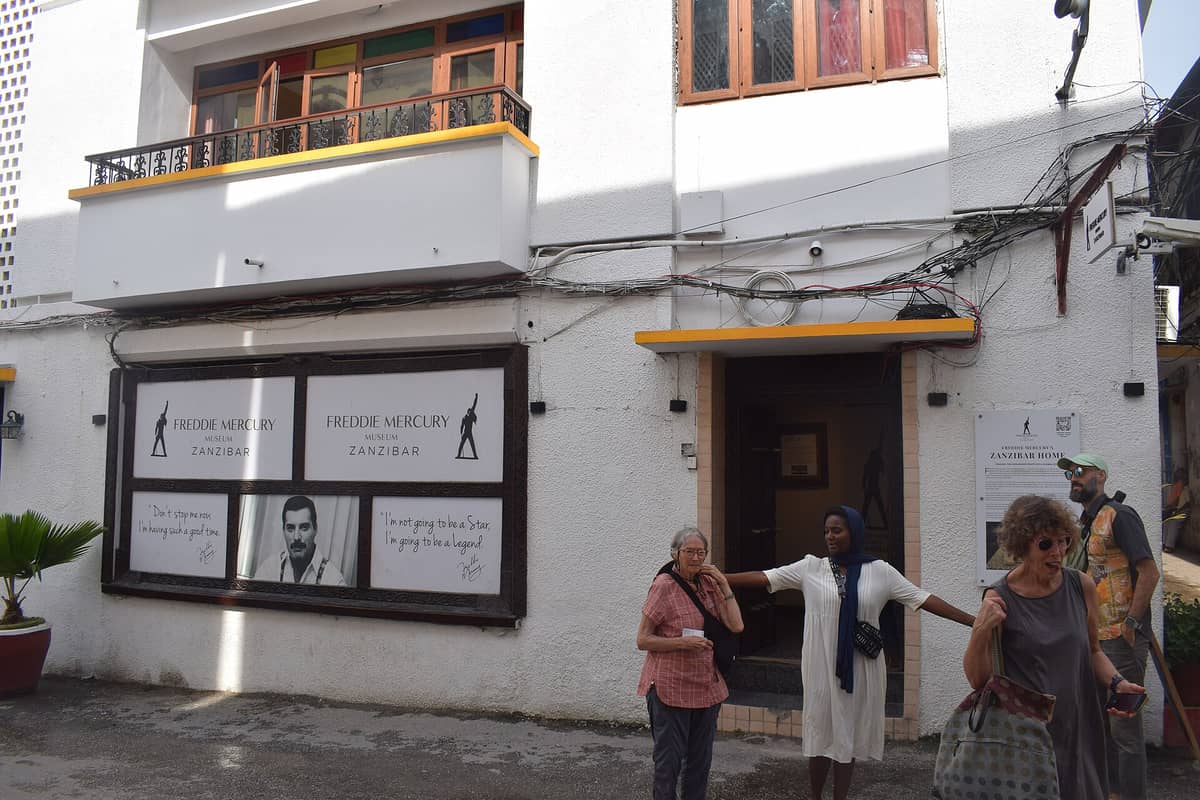
From outside, the museum is immediately identifiable. A large photographic mural of Mercury is displayed on the facade, and a bronze or resin statue of the singer stands near the entrance in a characteristic pose. The statue draws a steady stream of people posing for photographs at most hours of the day, which gives the front of the building a lively, informal atmosphere. Whether or not you go inside, the exterior is worth a few minutes — and it makes orientation in this part of Stone Town straightforward.
The surrounding Shangani area is worth exploring on foot before or after your visit. Kenyatta Road leads toward the Zanzibar waterfront within a short walk, and the neighbourhood contains several of Stone Town's most significant historic buildings. If you want a fuller understanding of the architectural landscape Mercury grew up in, the Stone Town architecture guide covers the broader context in detail.
Tickets & tours
Live prices and dates from our booking partner. If you book, we may earn a commission at no extra cost to you.
Zanzibar catamaran and snorkelling tour to Mnemba Marine Park
From 114 €Instant confirmationFree cancellationNyerere National Park two-day safari with two game drives
From 866 €Instant confirmationFree cancellationSerengeti National Park private three-day safari from Zanzibar
From 2.144 €Instant confirmationFree cancellationZanzibar north coast sunset dhow cruise
From 42 €Instant confirmationFree cancellation
Inside the Museum: What You Actually See
The interior is arranged across a compact series of rooms. Display cases hold personal items and replica stage props, while framed photographs trace Mercury's life chronologically. The early panels focus specifically on his Zanzibari childhood: images of the island in the 1940s and 1950s, documentation of his family's Parsi community connections, and photographs that would be unfamiliar even to dedicated fans. This section, brief as it is, is the museum's most distinctive contribution — the rest of the story is better told in larger institutions elsewhere.
Moving through the rooms, the displays shift to his years at St. Peter's School in Panchgani, India, his arrival in England, the formation of Queen, and the band's career arc through the 1970s and 1980s. Concert posters, album covers, and replica outfits from famous performances fill the later sections. The presentation is not elaborate by international museum standards. Labels are informative but not exhaustive, and the overall production quality reflects the museum's relatively recent founding and its location in a city where resource constraints are real. That said, the curation is clearly done with affection and genuine knowledge of the subject.
Audio and video content, including performance footage, is incorporated into the experience, which adds considerably to the atmosphere inside. Hearing Mercury's voice in the building associated with his childhood has an effect that no amount of printed text can replicate. Visitors who arrive at quieter times, typically mid-morning on weekdays, tend to linger longer in these sections.
How the Experience Changes by Time of Day
The museum draws a fairly consistent flow of visitors throughout the day, with the statue out front attracting passers-by even at times when foot traffic inside is light. Mid-morning tends to be the quieter window: tours arriving from beach resorts generally reach Stone Town by late morning or early afternoon, and the museum becomes noticeably busier from around 11:30 onward. If you prefer to move through the rooms at your own pace without other groups in the same space, aim for opening time.
The interior lighting is artificial, so time of day does not dramatically alter the quality of what you see inside. Outside, the best light for photographs of the facade and statue is in the morning, when the sun hits the front of the building directly. By mid-afternoon, the Shangani streets become warm and crowded, and the area in front of the museum can get congested with tour groups. The good news is that the museum itself is air-conditioned, making it a genuinely pleasant stop during the heat of the day.
Freddie Mercury, Zanzibar, and Why This Story Matters
Farrokh Bulsara was born in Zanzibar on 5 September 1946, to Bomi and Jer Bulsara, Parsi Zoroastrians who had come to Zanzibar from India as part of the British colonial civil service. His father worked as a cashier for the British colonial government. The family lived in Zanzibar during Farrokh's earliest years, and while he left the island at age eight to attend boarding school in India, the city's cosmopolitan and cross-cultural character, where Arab, African, South Asian, and European influences converged on a small island, arguably shaped the expansive, boundary-crossing sensibility that later defined his art.
Mercury was, by his own choice, private about his origins. He rarely discussed Zanzibar in interviews, and for decades his birthplace remained a minor footnote in rock biographies. The museum's founding represents a deliberate reclamation of that part of his identity, both by Zanzibar itself and by those who argue that his story is incomplete without it. Whether you find this framing compelling or overstated, the historical connection is real and documented.
Understanding Mercury's birthplace is also a gateway into understanding Stone Town's broader history as one of the Indian Ocean world's great crossroads. The Swahili culture guide offers useful background on the cultural layers that shaped life in colonial-era Zanzibar, and a Stone Town walking guide can help you connect the museum visit to the wider neighbourhood.
Practical Information and Getting There
The museum is located in Shangani, the western tip of Stone Town's peninsula, which is one of the most walkable parts of the city. From most Stone Town hotels, the walk to 57 Kenyatta Road is under fifteen minutes. The street is accessible by taxi from anywhere in Zanzibar City, and drivers in Stone Town will know the location. There is no dedicated parking area, but taxis can drop off and collect directly on Kenyatta Road.
Admission is listed on the official site as US$8 for adults and US$6 for children; verify current prices at freddiemercurymuseum.com or on arrival. US dollars are widely accepted in Zanzibar alongside Tanzanian shillings. The museum’s official website lists opening hours as 9:00–20:00 daily, though hours should be confirmed before visiting, particularly around public holidays or festival periods.
ℹ️ Good to know
No verified accessibility information is currently available for this museum. The building's historic coral-stone construction may present challenges for visitors with mobility requirements. Contact the museum directly before visiting if this is a consideration.
Photography is generally permitted inside the museum, though it is courteous to confirm with staff on arrival. The small gift shop near the exit sells Queen and Freddie Mercury merchandise, including items specific to the Zanzibar connection, which are not easily found elsewhere.
Honest Assessment: Is It Worth Your Time?
The Freddie Mercury Museum is a sincere, well-intentioned tribute operating within real constraints. Visitors expecting a large-scale, comprehensively resourced rock museum will find the scale modest. The collection is not enormous, and the production values reflect a regional institution rather than a flagship cultural venue. That is worth knowing in advance so you arrive with calibrated expectations.
For fans of Mercury or Queen, the visit is genuinely moving in a way that is difficult to replicate elsewhere: the physical connection to his birthplace gives the experience a weight that posters and album covers alone cannot provide. For general travellers with a broad interest in cultural history and the surprisingly layered story of how a Zanzibar-born Parsi boy became one of the twentieth century's most celebrated performers, it offers about an hour of substantive engagement. Travellers with no particular interest in Mercury or rock music, or those on a very tight Stone Town itinerary, may find other sites a better use of limited time.
If you are planning a full day in Stone Town, the museum pairs naturally with the Forodhani Gardens along the waterfront and the House of Wonders nearby. Together, these three stops give a reasonably complete picture of Stone Town's historic core and its cross-cultural inheritance.
Insider Tips
- Arrive at or shortly after opening time on a weekday for the quietest experience. Group tours from the beach resorts tend to arrive from around 11:30 onward, and the rooms feel significantly more crowded once they do.
- The gift shop stocks merchandise specific to the Zanzibar connection, including items not available through standard Queen or Mercury merchandise channels. If you are a fan, browse before leaving.
- The statue out front is the main photography spot for passing tourists, but it is often crowded. The best unobstructed shot of the facade is from slightly across the street in the early morning, when the light falls directly on the building and foot traffic is light.
- Combine the visit with a walk along the Shangani waterfront area. Kenyatta Road connects quickly to the seafront, where the atmosphere changes completely from the stone-lane interior of Stone Town.
- Verify hours and prices directly at freddiemercurymuseum.com before planning your day around this stop. Hours listed on third-party travel sites are not always current.
Who Is Freddie Mercury Museum For?
- Queen and Freddie Mercury fans looking to connect the music to its geographic origins
- Travellers with an interest in colonial-era Zanzibar history and the island's multicultural past
- Culture-focused visitors who want more than beaches on a Stone Town day
- Families with older children interested in music history
- Anyone building a self-guided Stone Town walking itinerary through the Shangani district
Nearby Attractions
Other things to see while in Stone Town:
- Darajani Market
Darajani Market, also known as Marikiti Kuu or the Great Market, is a principal market in Stone Town. Dating to 1904, it draws fishermen, spice traders, and local shoppers every morning in a scene that has changed little in over a century. Entry is free, and an hour here tells you more about Zanzibari daily life than any museum.
- Forodhani Gardens
Forodhani Gardens is a seafront park in the heart of Stone Town that doubles as Zanzibar's most celebrated street food market after dark. By day it's a quiet refuge of sea breezes and colonial-era architecture; by evening, dozens of grills and lantern-lit stalls transform it into the social and culinary center of the old city.
- Hamamni Persian Baths
Built for Sultan Barghash between 1870 and 1888, the Hamamni Persian Baths were once the grandest public bathhouse in Zanzibar. Today the ruins stand as one of Stone Town's most atmospheric historic sites, offering a quiet counterpoint to the neighborhood's busier attractions.
- House of Wonders (Beit al-Ajaib)
The House of Wonders, known in Arabic as Beit al-Ajaib, is the most architecturally ambitious building on Zanzibar's waterfront. Partially collapsed in 2020, it remains one of the most photographed facades in Stone Town and a landmark that every visitor to the area will pass.
Planning a trip? Discover personalized activities with the Nomado app.