Zanzibar Waterfront & Mizingani Road: Stone Town's Living Edge
Mizingani Road traces the seaward edge of Stone Town, where the Indian Ocean meets centuries of Swahili, Arab, and colonial history. Free to walk at any hour, it offers a front-row view of working dhows, ferry traffic, and the slow rhythms of a city that has faced the sea for generations.
Quick Facts
- Location
- Mizingani Road, Stone Town, Zanzibar, Tanzania
- Getting There
- A short walk from the Stone Town ferry terminal; dala-dala shared minibuses serve the town centre
- Time Needed
- 30 minutes to 1.5 hours depending on pace; works well as part of a broader Stone Town walk
- Cost
- Free — Mizingani Road is a public street; nearby attractions charge separately
- Best for
- Sunset views, photography, first-day orientation, slow walkers who want context before diving into the old town
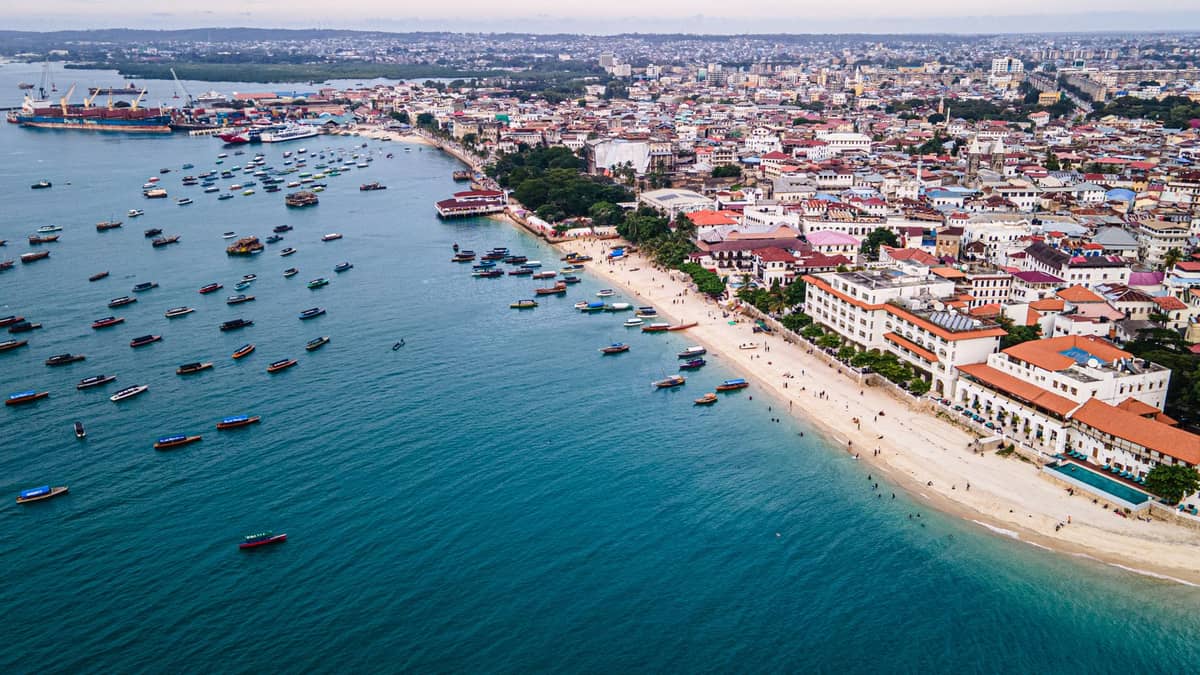
What Is the Zanzibar Waterfront?
Mizingani Road is Stone Town's main seafront street, running along the western edge of the old city where the historic harbour meets land. It is not a groomed promenade designed for tourists. It is a working urban edge: ferries from Dar es Salaam dock nearby, freight is loaded onto wooden dhows, and the city's daily traffic presses close to the seawall. That rawness is precisely what makes it worth your time.
The road takes its name from the Swahili word for 'waterfront' or 'seafront', and it has served as Stone Town's public face to the Indian Ocean for centuries. A World Bank infrastructure document references a stretch of approximately 315 metres of seawall along the Mizingani seafront, giving some sense of the road's compact scale. In practical terms, you can walk the core waterfront section in under twenty minutes, though most visitors linger far longer.
ℹ️ Good to know
Mizingani Road and the Stone Town waterfront are public spaces with no entrance fee and no set opening hours. The street is accessible at all hours, though the area is quietest after dark and most active from mid-morning through sunset.
How the Waterfront Changes Through the Day
The character of Mizingani Road shifts dramatically depending on when you arrive. Early morning, before 8am, the air carries salt and the faint smell of fish from nearby landing areas. Fishermen and ferry workers move with purpose. The light is soft and flat, good for photography without harsh shadows, and the crowds that arrive later have not yet materialised.
By mid-morning the pace intensifies. Tuk-tuks and pikipiki motorcycle taxis weave between pedestrians. Vendors set up near the ferry terminal. The sound of Swahili conversation, occasional Arabic, and the low engine noise of harbour boats creates a layered backdrop that no amount of description fully captures until you are standing in it.
Sunset is the waterfront's signature hour. The western exposure means the sky over the ocean turns shades of deep orange and rose, with dhow silhouettes cutting across the colour. Locals gather in numbers, families sit along the seawall, and the Forodhani Gardens just north of the main road begin filling with food stalls whose charcoal smoke drifts toward the water. If you visit at only one time of day, make it the hour before sunset.
💡 Local tip
For the cleanest sunset photographs along Mizingani Road, position yourself with the ocean directly to your west and the dhows in the foreground. Arrive 30 to 40 minutes before sunset to claim a clear spot on the seawall.
Tickets & tours
Live prices and dates from our booking partner. If you book, we may earn a commission at no extra cost to you.
Zanzibar catamaran and snorkelling tour to Mnemba Marine Park
From 114 €Instant confirmationFree cancellationSerengeti National Park private three-day safari from Zanzibar
From 2.144 €Instant confirmationFree cancellationZanzibar north coast sunset dhow cruise
From 42 €Instant confirmationFree cancellationZanzibar Prison Island private tour
From 224 €Instant confirmationFree cancellation
Historical and Cultural Context
Stone Town's waterfront was the commercial and political heart of one of the Indian Ocean's most consequential trading ports. From the 18th century onward, the Sultanate of Oman shifted its capital to Zanzibar City, and the harbour became a hub for the ivory, clove, and tragically the slave trade that shaped the entire East African coast. The buildings that line Mizingani Road and the streets immediately behind it are physical records of that layered history: Arab merchant houses with intricately carved wooden doors, former British administrative buildings with colonnaded facades, and older Swahili structures whose coral-stone walls have survived more than two centuries of tropical humidity.
Understanding this history adds weight to a walk that might otherwise read as pleasant but shallow. For anyone wanting to go deeper, the Slave Trade Museum is a short walk inland and provides some of the most sobering context available in Stone Town. The Zanzibar slave history guide covers this chapter in detail.
The architecture visible from the waterfront is itself a subject worth studying. The Old Dispensary, a few minutes' walk along the road, is one of the most ornate colonial-era buildings remaining in East Africa, with tiered verandas and decorative ironwork that speaks to the wealth concentrated in this small port city. The House of Wonders, facing the waterfront on the seafront plaza, was built in 1883 as the palace of Sultan Barghash and was the first building in East Africa to have an electric lift; it is currently under restoration.
The House of Wonders and the Old Dispensary are both visible from Mizingani Road and provide strong architectural anchors for orienting yourself in the streetscape. The Stone Town architecture guide breaks down the key building styles and periods in depth.
The Practical Walkthrough
Most visitors arrive at the waterfront either from the Stone Town ferry terminal after crossing from Dar es Salaam, or by walking west from the old town's interior lanes. The ferry terminal sits at the southern end of the waterfront strip, making Mizingani Road a natural first impression of Stone Town for arrivals by sea.
Walking north from the terminal, you pass the broad seafront plaza where the House of Wonders and the Old Fort face the ocean. The plaza is open and often used as a gathering point. Forodhani Gardens occupies a stretch of this plaza and comes alive in the evenings with grilled seafood, sugarcane juice, and Zanzibar pizza cooked on flat griddles. The combination of salt air, charcoal smoke, and frying garlic is one of the more distinctive sensory experiences Stone Town offers.
The Forodhani Gardens night market is worth planning around if you are visiting at dinner time. Prices are very low by any international standard, but agree on cost before ordering and carry small denomination Tanzanian shillings or US dollar bills.
Continuing north along Mizingani Road, the architectural density increases and the working harbour comes into clearer view. Wooden dhows in various states of construction or repair are visible along the shoreline. Some are traditional fishing vessels; others are tourist dhow cruises preparing for sunset trips. The dhow-building tradition in Zanzibar is centuries old and the craft remains largely unchanged in its methods.
⚠️ What to skip
Pavement conditions along Mizingani Road and the adjacent lanes of Stone Town are uneven. Loose stones, raised curbs, and broken sections of road surface are common. Wear shoes with solid grip. This is also relevant for anyone with mobility challenges: wheelchair and pushchair access is difficult through much of Stone Town, and the waterfront itself has no verified step-free route information available.
Photography, Light, and What to Bring
The waterfront rewards photographers who think carefully about timing. The blue hour after sunset produces a steel-grey ocean against the warm glow of street lighting and lit building facades. Midday should be avoided for portraits or architectural shots; the equatorial sun creates flat light and heavy shadows that flatten Stone Town's textured stonework.
A wide-angle lens or a phone camera handles the broad harbour views well. For detail shots of the carved doors, coral-stone walls, and decorative architectural elements visible just steps from Mizingani Road, a short telephoto or standard lens gives more control. Always ask permission before photographing individuals, particularly in residential areas off the main road.
Bring water. The waterfront and old town have limited reliable places to buy drinks away from the main plaza, and the humidity can be draining even in cooler months. Modest dress is appropriate throughout Stone Town, which is a predominantly Muslim community. Shoulders and knees covered will avoid attention and is a straightforward sign of respect.
Is It Worth Your Time, or Is It Overhyped?
Honest answer: the waterfront itself is not spectacular in isolation. If you arrive expecting a manicured esplanade with clear water and organised attractions, you will find something messier and more complicated. The harbour is working and functional, not scenic in the resort sense. The seawall needs maintenance in places. Traffic on Mizingani Road can be loud.
What it does offer is something rarer: an authentic edge between a historic city and the ocean that shaped it. It works best as a corridor between things rather than a destination in itself. Use it to move between Forodhani Gardens, the House of Wonders, the ferry terminal, and the old town interior. Treat it as context, not centrepiece, and it earns its place in any Stone Town itinerary.
Visitors who want a more structured exploration of Stone Town as a whole should consider using the Stone Town walking guide, which maps a logical route through the key sites and provides historical background for each stop.
Travelers who need beaches, clear water, and resort amenities should note that Mizingani Road offers none of these. The waterfront is urban, historical, and textured. If that is not what you are after on a given day, take a dala-dala north and spend the afternoon at Nungwi or Kendwa instead.
Insider Tips
- The best dhow views are actually from the small stretch of seawall north of the main plaza, past the cluster of tourist craft stalls. Most visitors stop at Forodhani and never walk the quieter northern section, where you can watch working boats up close without the foot traffic.
- If you are arriving by ferry from Dar es Salaam, resist the pressure from touts immediately outside the terminal. Walk 100 metres north along Mizingani Road first, get your bearings, and then arrange onward transport from a calmer position with a clearer head.
- The area around Jaws Corner, a few minutes' walk inland, is where local men gather for strong coffee and conversation in the mornings. It requires no tourist infrastructure and costs almost nothing. It is the kind of street corner that reveals more about daily Stone Town life than any organised tour.
- Forodhani Gardens is far more crowded on weekends and during high season (June to October and December to January). If you want to eat there without queuing, arrive right at the opening time in the early evening rather than at peak hour after 7pm.
- The carved wooden doors that line the streets just behind Mizingani Road are among Stone Town's most photographed features. The best concentration is on Gizenga Street and the lanes around it, less than five minutes' walk from the waterfront. Early morning gives the cleanest light and the fewest people.
Who Is Zanzibar Waterfront & Mizingani Road For?
- First-time visitors to Stone Town who want a quick geographic orientation before exploring the interior lanes
- Photographers working at golden hour or blue hour looking for harbour and dhow compositions
- History-focused travelers using the waterfront as a starting point for deeper dives into Swahili and sultanate-era architecture
- Travelers arriving by ferry from Dar es Salaam who want to absorb Stone Town gradually rather than plunge immediately into the old town's maze
- Budget travelers: the waterfront, the views, and the evening food scene at Forodhani are all either free or very cheap
Nearby Attractions
Other things to see while in Stone Town:
- Darajani Market
Darajani Market, also known as Marikiti Kuu or the Great Market, is a principal market in Stone Town. Dating to 1904, it draws fishermen, spice traders, and local shoppers every morning in a scene that has changed little in over a century. Entry is free, and an hour here tells you more about Zanzibari daily life than any museum.
- Forodhani Gardens
Forodhani Gardens is a seafront park in the heart of Stone Town that doubles as Zanzibar's most celebrated street food market after dark. By day it's a quiet refuge of sea breezes and colonial-era architecture; by evening, dozens of grills and lantern-lit stalls transform it into the social and culinary center of the old city.
- Freddie Mercury Museum
Opened in 2019 on Kenyatta Road in Stone Town's Shangani quarter, the Freddie Mercury Museum occupies the building associated with his childhood. It is a small but carefully assembled tribute to his life, his music, and his largely overlooked Zanzibari origins — making it one of the most personally resonant stops in all of Stone Town.
- Hamamni Persian Baths
Built for Sultan Barghash between 1870 and 1888, the Hamamni Persian Baths were once the grandest public bathhouse in Zanzibar. Today the ruins stand as one of Stone Town's most atmospheric historic sites, offering a quiet counterpoint to the neighborhood's busier attractions.
Planning a trip? Discover personalized activities with the Nomado app.