New York Café Budapest: Inside the World's Most Beautiful Café
Opened in 1894 inside a Neo-Baroque palace on the Grand Boulevard, New York Café is one of Budapest's most visually arresting interiors. Gold-leaf ceilings, marble columns, painted frescoes, and a literary past that stretches back to the Austro-Hungarian era make it genuinely unlike any other café in Central Europe. The experience comes with caveats, but for the right traveler, it is worth every forint.
Quick Facts
- Location
- Erzsébet körút 9–11, District VII, inside Anantara New York Palace Budapest Hotel
- Getting There
- Blaha Lujza tér (Metro M2, Trams 4 & 6) — about a 3-minute walk
- Time Needed
- 45 minutes to 2 hours depending on whether you eat or just have coffee
- Cost
- No admission fee; coffee from ~2,000 HUF, full breakfast/lunch menus significantly higher — verify current prices on-site
- Best for
- Architecture lovers, history enthusiasts, special occasion meals, photography
- Official website
- newyorkcafe.hu/en
What New York Café Actually Is
New York Café (New York kávéház) occupies the ground and basement floors of the New York Palace on Erzsébet körút, Budapest's grand inner ring road. The building was constructed in the early 1890s for the New York Life Insurance Company, and the café opened in 1894. Today the palace operates as the Anantara New York Palace Budapest Hotel, and the café functions as its showpiece restaurant and coffee house.
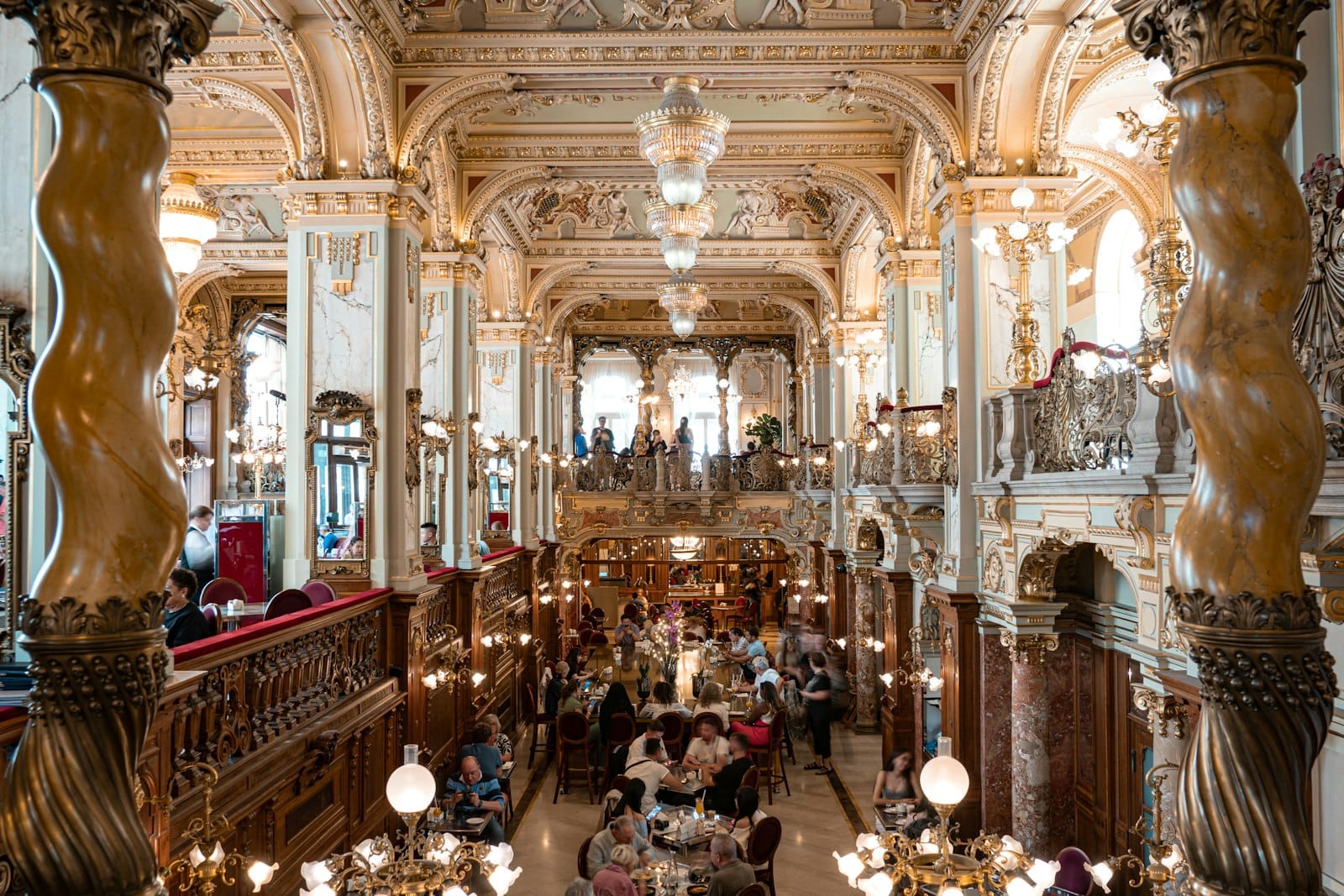
What you are walking into is a three-floor gilded hall of frescoed ceilings, red marble columns, wrought-iron balconies, and chandeliers scaled to a place that was built to impress. The architectural style is Neo-Baroque with heavy Eclectic influences, and the 2006 restoration that brought the café back after decades of post-war neglect did not soften any of that original ambition. This is an interior designed to make you stop at the entrance and look up.
ℹ️ Good to know
New York Café is open Monday to Wednesday 07:00–24:00 and Thursday to Sunday 07:00–01:00. No ticket or entry fee is required — you simply sit down and order. Reservations are strongly recommended, especially on weekends and during peak tourist season.
The History Behind the Grandeur
The café's reputation was made in the late nineteenth and early twentieth centuries, when it became the regular meeting place for Budapest's literary and artistic community. Journalists, novelists, and poets gathered here — some reportedly spending entire working days at its tables. The story goes that at the café's 1894 opening, a group of writers threw the front door key into the Danube so the place could never close. Whether true or not, the café did operate continuously through the Austro-Hungarian era, right up until the disruptions of the Second World War.
The building was damaged and the café fell into disuse during the decades of socialist rule that followed. By the late twentieth century it had been used, at various points, as a warehouse and a sports goods shop. The restoration that returned it to something close to its original appearance was completed in 2006, funded by the Boscolo hotel group (the property later passed to Anantara). The scale of that restoration project is visible in every detail: the gilding on the upper balconies, the ceiling paintings, the custom furniture.
For more on how this era of architecture shaped the city, the Budapest Art Nouveau guide places New York Café in the context of the broader building boom that transformed Pest in the 1890s.
Tickets & tours
Hand-picked options from our booking partner. Prices are indicative; availability and final rates are confirmed when you complete your booking.
Cafe Wandering tour: An Excursion through Budapest's Belle Epoque
From 77 €Instant confirmationFree cancellationBudapest Guided E-Scooter Tour by Night
From 60 €Instant confirmationFree cancellationHalf-day tour to Princess Sissi's Godollő royal palace from Budapest
From 41 €Instant confirmationFree cancellationHalf-Day Countryside Wine Tour from Budapest
From 95 €Instant confirmationFree cancellation
How the Experience Changes by Time of Day
Mornings from opening until around 09:30 are the quietest window. The light through the tall arched windows is warm and direct, and the frescoed ceiling catches it differently than at any other hour. At this time you can actually sit at a table without a wait, hear the room rather than a wall of ambient noise, and appreciate the proportions of the space. The breakfast menu is active, staff are attentive, and the café feels closest to what it might have been for its original patrons.
By mid-morning, tour groups begin arriving. From roughly 10:00 onward, and particularly between 11:00 and 15:00, the room fills quickly. The noise level rises considerably, the wait for a table without a reservation becomes real, and photography of the interior without strangers in frame becomes difficult. This is not a reason to avoid the café, but it is a reason to time your visit carefully.
Evening visits, particularly on weekdays after 20:00, offer a third character entirely. The lighting shifts to warm artificial gold, the tour groups have cleared out, and the café operates more as a dinner venue. The atmosphere is more intimate and the sound levels drop to something manageable. Thursday through Sunday evenings can pick up again after 21:00, especially in summer.
💡 Local tip
The best single window for visiting is a weekday morning before 09:30. You get the natural light, the quietest room, and the full visual impact of the interior without fighting for it.
Navigating the Space: What to Expect on Arrival
The entrance is directly from Erzsébet körút, set within the hotel's main facade. You do not need to pass through the hotel lobby to reach the café — there is a dedicated entrance. Inside, the room opens immediately: the scale of the main hall is apparent from the threshold. A host station is positioned near the door, and you will be directed to a table rather than choosing your own seat, which is standard practice for a venue operating at this level.
The main floor and the upper balcony level both offer seating. The balcony tables provide a better vantage point for seeing the full height of the ceiling and the architectural detail of the upper walls. If you are visiting primarily to experience the architecture, ask specifically for a balcony seat when booking. The basement level also has seating and is used for overflow during busy periods; it is architecturally interesting in its own right but does not have the ceiling height of the main floor.
Service operates on a full café-restaurant model. Coffee, pastries, and cakes are available alongside a full breakfast, lunch, and dinner menu. Prices are significantly above Budapest café averages and broadly in line with upscale hotel dining. A coffee and a slice of cake for two will represent a noticeable spend; a full meal considerably more. This is not the right place to fuel up cheaply before a day of sightseeing — it is the right place when the experience itself is the point.
Photography: What Works and What Doesn't
The interior is visually rich enough that even a smartphone will produce strong images if the light is cooperating. The morning window before 09:30 produces the most photogenic conditions, with natural light reaching the frescoed ceiling from the street-side windows. A wide-angle lens or the ultrawide setting on a modern phone is useful for capturing the full height of the main hall from a standing position near the entrance.
During busy periods, framing a shot without other guests in it requires patience. The balcony level, shooting downward into the main hall, produces the most architectural compositions. Flash photography is discouraged and generally unnecessary given the brightness of the interior. Tripods are not permitted. The café does not explicitly prohibit photography for personal use, but behave with discretion — this is an operating restaurant, not a museum.
⚠️ What to skip
Between roughly 10:30 and 15:00 on weekends, the main hall is often at full capacity and photography of the full interior without diners in frame is essentially impossible. If images of the space matter to you, visit early on a weekday.
Getting There and Practical Logistics
The café is on Erzsébet körút in District VII, a short walk from Blaha Lujza tér. Metro line M2 (the red line) stops directly at Blaha Lujza tér, and trams 4 and 6, which run the full length of the Grand Boulevard, stop there as well. From the tram stop, the New York Palace facade is visible along the boulevard. The walk is around three minutes.
The surrounding area is part of Budapest's Jewish Quarter, one of the most architecturally layered parts of the city. Combining a morning visit to New York Café with a walk through the nearby streets — including the Great Synagogue on Dohány utca — makes for a coherent half-day in this part of Pest.
Reservations can be made directly through the official website, but currently are only accepted for dinner visits after 18:00; daytime seating (07:00–18:00) is on a first-come, first-served basis. Walk-ins are accepted subject to availability, but the wait during busy periods can be substantial.
Accessibility information for visitors with mobility requirements is not comprehensively published on the café's website. The entrance is at street level and the building operates as a functioning luxury hotel, but specific details about step-free access to all seating levels and accessible facilities should be confirmed directly with the venue before visiting.
An Honest Assessment: Who This Is For
New York Café gets accused of being overhyped, and the accusation is not entirely wrong. The prices are high by Budapest standards, the crowds during peak hours are real, and the tourist density can undercut any sense of stepping into a living piece of literary history. If you are looking for a quiet place to drink good coffee and work, this is not it.
But as an architectural interior, it is genuinely remarkable. Budapest has a concentration of late nineteenth-century grandeur that few European capitals can match, and New York Café sits at the top of that list alongside the Hungarian State Opera House and the Parliament building. If you care about how rooms were built and what they were meant to communicate about ambition and prosperity, this is one of the most complete examples in Central Europe.
Travelers visiting on a three-day Budapest itinerary should factor it in as a morning coffee stop rather than a full meal unless special occasions or architecture are the point. For a broader sense of what makes the city worth visiting, the Budapest attractions guide covers the full range of options across both sides of the river.
Insider Tips
- Book a balcony table when reserving — it gives you a proper aerial view of the main hall ceiling and the full architectural sweep of the room, which is not visible from ground-floor seating.
- Weekday mornings before 09:30 are the one time the café functions at something close to its original purpose: a quiet room where you can sit with a coffee and actually think. The difference from a midday Saturday visit is significant.
- If you want the café experience without the full meal bill, ordering coffee and one of the house cakes is a legitimate option. Staff will not rush you out. Budget accordingly — even a simple order here costs more than most Budapest cafés.
- The facade of the New York Palace on Erzsébet körút is worth photographing from the opposite pavement before you enter — the full width of the building, with its corner tower and ornate stonework, does not photograph well from the entrance steps.
- Erzsébet körút sees heavy tram traffic. When leaving, trams 4 and 6 toward the city center run frequently and get you to Pest's main thoroughfares quickly without needing the metro.
Who Is New York Café For?
- Architecture and interior design enthusiasts who want to see Budapest's Belle Époque ambition at its most complete
- Couples looking for a special occasion breakfast or a visually memorable coffee stop
- Travelers with an interest in Central European literary and cultural history
- Photographers focused on architectural interiors, particularly when visiting early morning
- First-time Budapest visitors who want to understand the scale and confidence of the city's late nineteenth-century building culture
Nearby Attractions
Other things to see while in Pest City Center (V. District):
- Central Market Hall (Nagy Vásárcsarnok)
The Central Market Hall, known locally as Nagy Vásárcsarnok, is Budapest's largest historic covered market hall. Built in 1897 to a design by architect Samu Petz, it fills three floors with fresh produce, Hungarian specialties, folk crafts, and street food. Entry is free, and it sits steps from the Liberty Bridge in the heart of Pest.
- Chain Bridge (Széchenyi Lánchíd)
The Széchenyi Chain Bridge (Széchenyi lánchíd) is one of the oldest and most recognizable bridges in Budapest, linking the historic Pest riverfront with the foot of Castle Hill. Free to cross at any hour, it rewards visitors with sweeping Danube views and a walk through 175 years of Hungarian history.
- Hungarian National Museum
The Hungarian National Museum is the oldest national history museum in Hungary, tracing the country's story from prehistoric times through the 20th century. Housed in a commanding neoclassical building from 1847, it anchors Budapest's Pest district and offers one of the most complete windows into Hungarian identity available to visitors.
- Hungarian Parliament Building
Rising from the Pest bank of the Danube in a symphony of Gothic spires and terracotta stone, the Hungarian Parliament Building is the defining landmark of Budapest. Built between 1885 and 1904, it houses the Holy Crown of Hungary and opens its gilded interior to guided tours on most days. This guide covers everything you need to visit well.