Jane's Carousel: The Antique Ride with the Best Skyline View in Brooklyn
Jane's Carousel is a fully restored 1922 merry-go-round housed in a striking glass pavilion designed by architect Jean Nouvel, set directly on the East River between the Brooklyn and Manhattan Bridges. At $4 a ride, it offers one of the most atmospheric and affordable experiences in Brooklyn Bridge Park, combining genuine historic craftsmanship with an almost unreasonably good view of the Manhattan skyline.
Quick Facts
- Location
- Empire Fulton Ferry section, Brooklyn Bridge Park, DUMBO, Brooklyn, NY 11201
- Getting There
- A/C to High St, or F to York St. Walk approx. 10 min to the waterfront.
- Time Needed
- 30–60 minutes, including a walk along the waterfront
- Cost
- Approx. $4 per ride (verify at janescarousel.com)
- Best for
- Families, architecture enthusiasts, photographers, couples
- Official website
- janescarousel.com
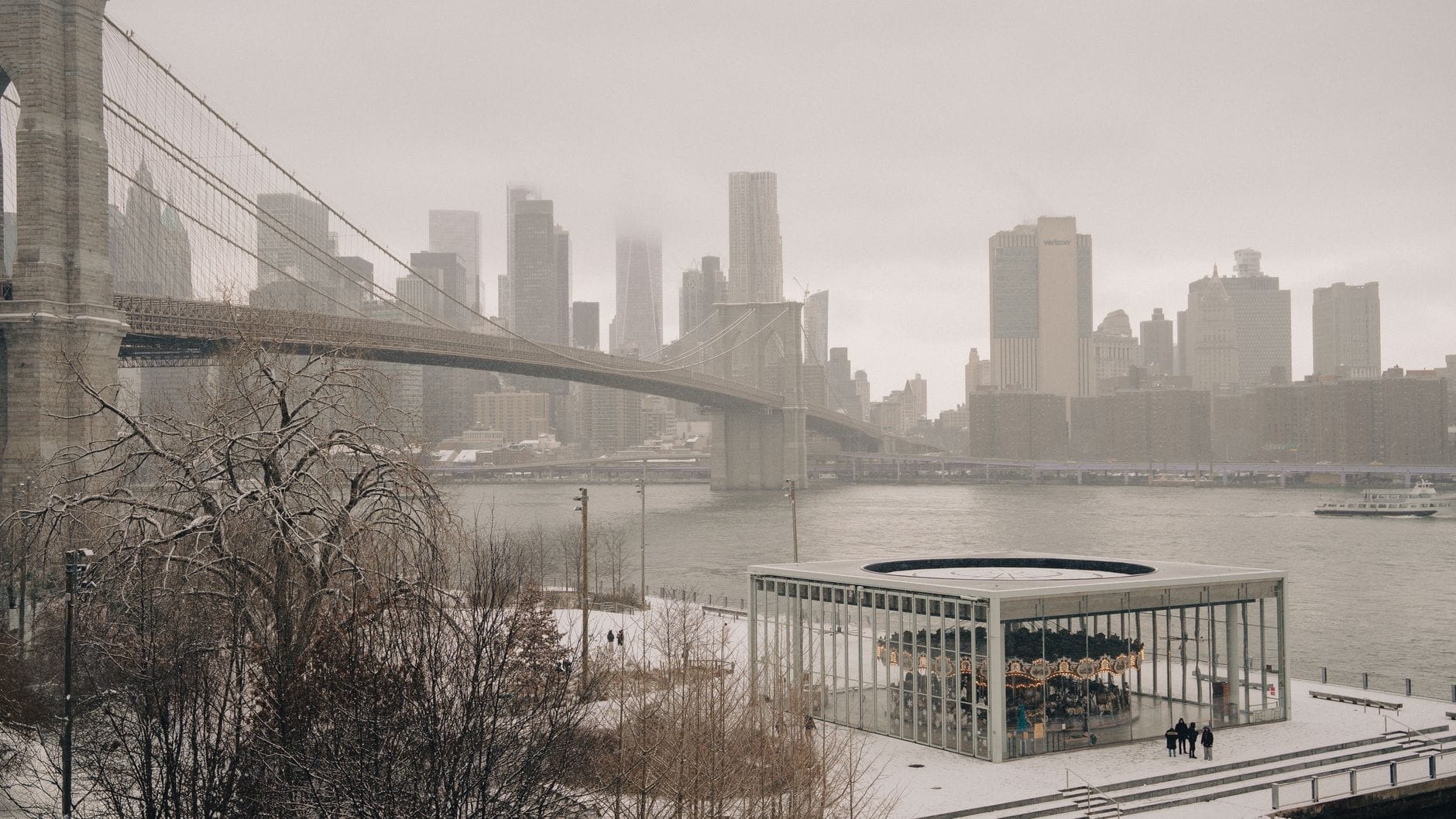
What Jane's Carousel Actually Is
Jane's Carousel is a hand-carved wooden carousel built in 1922 by the Philadelphia Toboggan Company, originally installed at Idora Park in Youngstown, Ohio. It features 48 carved wooden horses and two chariots, each painted and decorated in a style typical of early 20th-century American fairground craftsmanship. After Idora Park closed, the carousel was purchased at auction in 1984 by Jane and David Walentas, developers who had also invested heavily in the then-industrial DUMBO neighborhood. Jane Walentas spent decades overseeing a meticulous restoration of every horse and mechanical component before the carousel finally opened to the public on September 16, 2011.
The pavilion housing it was designed by French architect Jean Nouvel and measures approximately 72 by 72 feet. It is clad in large panels of glass that are retractable in warmer months, opening the structure to the river breeze, and sealed shut in winter so the carousel can operate year-round. The result is something genuinely unusual: a century-old fairground ride sitting inside a piece of contemporary architecture, framed by two of New York's most recognizable bridges.
💡 Local tip
Hours are listed as approximately 10:00 AM to 6:50 PM, but the schedule can vary by day and season. Check the official site at janescarousel.com before making it the centerpiece of your visit.
The Experience at Different Times of Day
Morning visits, roughly between 10 AM and noon on weekdays, are the quietest. The park has a calm quality at that hour: the cobblestones on Water Street are still damp from overnight dew, and the light off the East River hits the pavilion's glass panels at a low angle that makes the whole structure glow. You will likely share the carousel with a handful of parents and young children rather than a crowd.
By early afternoon on weekends, the dynamic shifts considerably. Families arrive in number, and the line to ride can stretch outside the pavilion. The carousel itself is not large, so wait times of 15 to 20 minutes are possible on busy Saturday afternoons in spring and fall. The ambient noise inside the pavilion rises significantly when it fills up: the carousel's original band organ music competes with children's voices bouncing off the glass walls. It is lively rather than unpleasant, but it is a fundamentally different atmosphere from a quiet weekday morning.
The most photogenic window is the hour before sunset, when the Manhattan skyline visible through the southern glass panels catches warm light and the bridges frame the view on either side. At that hour the carousel lights and the exterior illumination begin to compete with the fading sky in a way that is difficult to replicate at any other time. If photography is your primary goal, plan around late afternoon rather than midday, when the light is flat and the glass reflects glare directly into your lens.
Tickets & tours
Hand-picked options from our booking partner. Prices are indicative; availability and final rates are confirmed when you complete your booking.
Statue of Liberty, Ellis Island, and Brooklyn Bridge Happy Hour Cruise
From 49 €Instant confirmationFree cancellationSpirit of New York Dinner Cruise
From 161 €Instant confirmationFree cancellationNew York City Highlights bike tour
From 70 €Instant confirmationFree cancellationNew York Statue of Liberty and Ellis Island tour by ferry
From 55 €Instant confirmation
The Architecture and the Setting
Jean Nouvel's pavilion is worth examining on its own terms, separate from the carousel inside it. The structure sits at the edge of the park's Empire Fulton Ferry section, right on the water. Its glass panels can be fully retracted in summer, which dissolves the boundary between the interior and the waterfront promenade outside. When fully open, the smell of the East River comes through clearly, along with the ambient sounds of the bridges overhead, including the low rumble of traffic on the Brooklyn Bridge and the occasional horn from a passing ferry.
The pavilion's position between the Brooklyn Bridge and the Manhattan Bridge is not incidental. Both structures loom immediately above and beside it, creating a layered composition of 19th-century stone, early 20th-century steel, and 21st-century glass that is specific to this small section of the waterfront. It connects naturally to the broader Brooklyn Bridge Park experience, which extends along the waterfront in both directions and offers some of the most compelling views of the Manhattan skyline available from Brooklyn.
The cobblestone streets of DUMBO immediately behind the carousel add further texture. This neighborhood, whose name is an acronym for Down Under the Manhattan Bridge Overpass, retains its 19th-century warehouse architecture in many blocks, and the combination of cast-iron building facades, granite cobblestones, and the steel bridge frame above creates a backdrop that no purpose-built tourist district can replicate.
History and Restoration
The Philadelphia Toboggan Company, which built this carousel in 1922, was one of the most respected manufacturers of carousels and roller coasters in the United States during the early 20th century. Their carved horses are known for the quality of their articulation and the expressiveness of their design, traits that distinguish them from mass-produced fairground equipment of the same era. Idora Park, where this carousel originally operated, was a regional amusement park that ran from 1899 until 1984, when a fire severely damaged the park and it was closed. The carousel survived.
Jane Walentas's restoration project, which ran across roughly two decades after the 1984 purchase, involved stripping each horse back to bare wood, repairing structural damage, and repainting every figure using photographic records and period techniques. The mechanical components of the carousel, including the original drive system and band organ, were also rebuilt. The result is a functional carousel that operates today as it would have in the 1920s, which makes it a genuinely rare piece of American folk art and industrial history, not a replica or a pastiche.
Getting There and Navigating the Area
The most straightforward subway approach from Manhattan is the A or C train to High Street station, which puts you on the Brooklyn side at a point roughly a 10-minute walk from the carousel. Follow the signs toward the waterfront and enter the park from the Main Street or Dock Street entrances. The F train to York Street is another option, with a similar walking distance. If you are arriving from Brooklyn Bridge on foot, the bridge pedestrian path deposits you at Tillary Street in Brooklyn; the walk down to the carousel from there takes about 15 minutes and passes through the heart of DUMBO.
Cycling is an efficient option. The waterfront bike path through Brooklyn Bridge Park is well-maintained and connects the carousel to Pier 1 and Pier 6 to the south, and to the Manhattan Bridge underpass path to the north. Bike parking is available near the pavilion entrance.
ℹ️ Good to know
The carousel pavilion is wheelchair accessible. Jean Nouvel's design incorporates level entry and wide retractable doors, with no steps between the exterior promenade and the carousel platform.
What to Combine It With
The carousel sits within a cluster of genuinely worthwhile stops that can fill a half-day without feeling rushed. The Brooklyn Heights Promenade is a 20-minute walk south through the park, offering an elevated walkway with sustained Manhattan skyline views. In the other direction, DUMBO's streets hold several galleries, independent coffee shops, and the original outpost of the Brooklyn Flea market on weekends. The DUMBO neighborhood repays unhurried exploration on its own terms.
On weekends between April and October, Smorgasburg operates at Pier 5 in Brooklyn Bridge Park, roughly a 15-minute walk south from the carousel. The combination of the carousel, a waterfront walk, and the food market makes for a logical and crowd-pleasing Saturday itinerary, particularly for families.
If your interest leans toward DUMBO's history and how this neighborhood transformed from a working industrial district, the context is worth reading before you arrive. The Walentas family's role in developing DUMBO, which also explains how the carousel ended up here, is part of a larger New York City story about neighborhood change and real estate that you can explore further in a Brooklyn neighborhood guide.
Who Should Manage Their Expectations
The carousel ride itself lasts only a few minutes. If you are traveling without children or a specific interest in historic fairground equipment and architecture, the ride alone may not justify a dedicated trip across the bridge. The real draw is the combination of the setting, the pavilion architecture, and the waterfront location, all of which are freely accessible without paying to ride. Adults who visit for the atmosphere and the views will likely feel the $4 ticket is fair; adults visiting with the expectation of a major standalone attraction may find it brief.
In summer, midday heat inside the glass pavilion can be significant even with panels open. Visitors with young children who overheat easily should plan for a morning or late afternoon visit rather than arriving at noon in July. Weather also affects the surrounding park experience: the waterfront is exposed and uncomfortable in heavy rain or high wind, and the views that make this location special are diminished on overcast days.
Insider Tips
- The best photograph from the DUMBO neighborhood is the view down Washington Street through the arch of the Manhattan Bridge, with the carousel pavilion visible in the background near the water. Position yourself at the intersection of Washington and Front Streets.
- Weekday mornings before noon are reliably quieter than weekends, and the light from the east hits the glass pavilion most favorably in the first two hours after opening.
- If the line for the carousel is long, the park benches directly in front of the pavilion facing the water are an excellent spot to sit and watch the bridges and the skyline at no cost. The view from ground level here is as good as from anywhere in the park.
- The carousel's band organ plays original mechanical music during rides. It is loud inside the enclosed pavilion in winter when the glass panels are sealed. If you or a traveling companion are sensitive to high noise levels, summer visits with the panels retracted are considerably more comfortable.
- Brooklyn Bridge Park has no dedicated large parking facility nearby. If driving, street parking in DUMBO is extremely limited, particularly on weekends. Public transit or cycling is strongly preferred.
Who Is Jane's Carousel For?
- Families with young children looking for a memorable, affordable, and quick activity in Brooklyn
- Architecture enthusiasts interested in the contrast between Jean Nouvel's pavilion and its 1922 contents
- Photographers pursuing skyline and bridge compositions from the Brooklyn waterfront
- Couples combining a waterfront walk with a low-key, nostalgic experience
- First-time visitors to Brooklyn who want a compact introduction to DUMBO and Brooklyn Bridge Park
Nearby Attractions
Other things to see while in DUMBO & Brooklyn Heights:
- Brooklyn Bridge
The Brooklyn Bridge spans the East River between Lower Manhattan and Brooklyn Heights, and crossing it on foot is one of the most rewarding walks in New York City. Open at all hours to pedestrians, completely free, and loaded with 140 years of engineering history, it rewards visitors who time their visit well and know where to stand.
- Brooklyn Bridge Park
Stretching 1.3 miles along Brooklyn's East River shoreline, Brooklyn Bridge Park is an 85-acre public waterfront space that trades industrial piers for lawns, kayaking, playgrounds, and some of the most direct views of the Manhattan skyline and Brooklyn Bridge anywhere in the city. Entry is free, and the park runs from Washington Street all the way to Atlantic Avenue.
- Brooklyn Flea
Brooklyn Flea is New York City's most well-known weekend flea market, operating every Saturday and Sunday under the DUMBO Archway at 80 Pearl Street. Free to enter and operating seasonally from April through December, it draws a mix of serious vintage hunters, casual browsers, and food lovers into one of Brooklyn's most photogenic neighborhoods.
- Brooklyn Heights Promenade
The Brooklyn Heights Promenade is a free, third-of-a-mile walkway perched above the Brooklyn-Queens Expressway, offering one of the most photographed views of the Manhattan skyline, Brooklyn Bridge, and New York Harbor. Open daily at no cost, it suits everyone from early-morning joggers to sunset photographers.