Hippodrome of Constantinople: Istanbul's Ancient Chariot Racing Ground
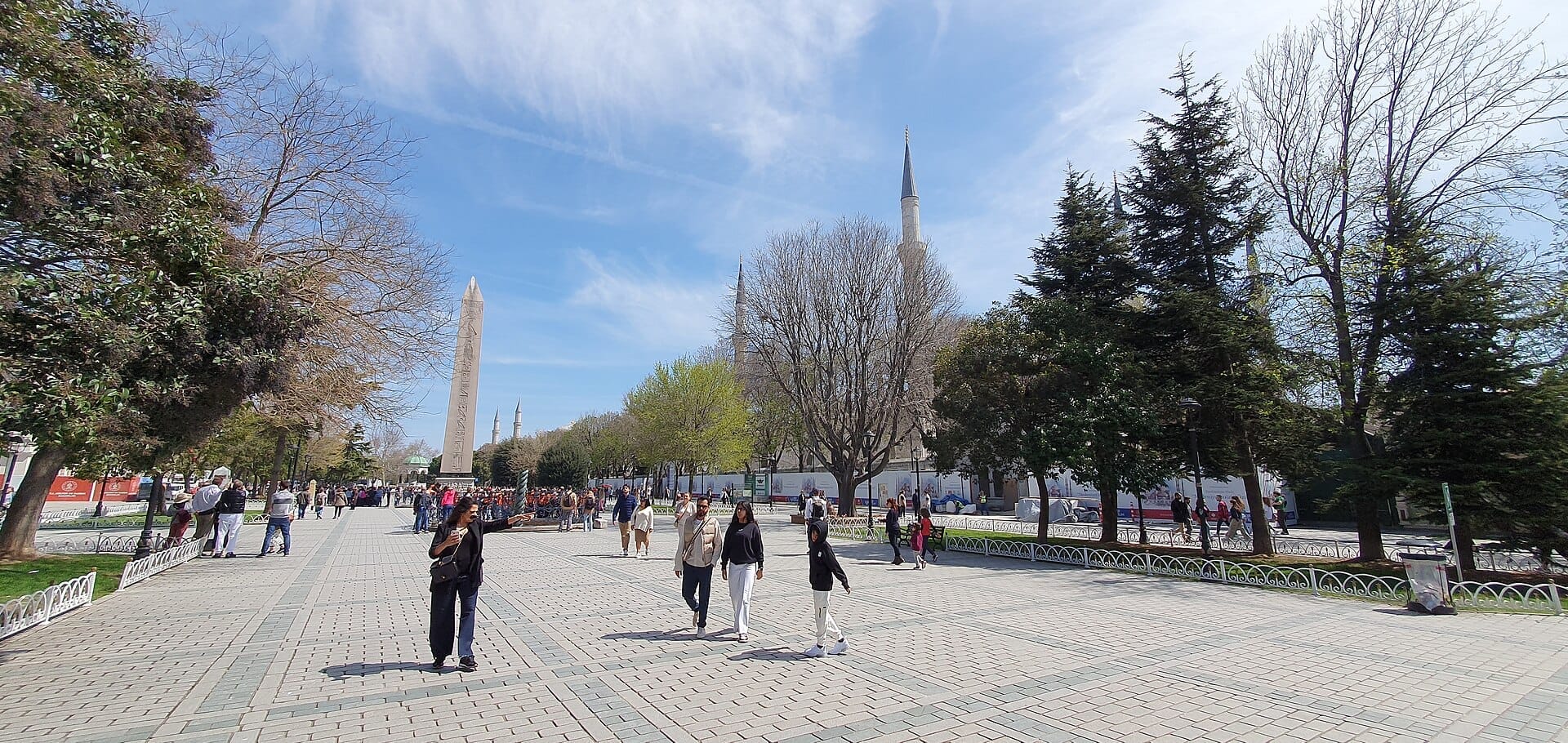
Once the thundering heart of Byzantine civic life, the Hippodrome of Constantinople is now Sultanahmet Square, an open public space framed by three extraordinary ancient monuments. Entry is free, the site never closes, and the ground beneath your feet sits more than two metres above the original Roman track.
Quick Facts
- Location
- Sultanahmet Square (At Meydanı), Fatih district, Istanbul
- Getting There
- T1 tram – Sultanahmet stop (2-minute walk)
- Time Needed
- 30–60 minutes for the square; combine with nearby sites for a half-day
- Cost
- Free – open public square, no ticket required
- Best for
- History lovers, architecture, photography, first-time visitors to Istanbul
What Is the Hippodrome of Constantinople?
The Hippodrome of Constantinople is among the oldest surviving large public spaces in the city still in daily use. It was begun under Roman Emperor Septimius Severus in the early 3rd century AD and dramatically expanded by Emperor Constantine the Great around 324 AD when he established Constantinople as the capital of the Roman Empire, and it served for over a millennium as the political, sporting, and ceremonial center of one of history's most powerful cities.
Today the site is known officially in Turkish as Sultanahmet Meydanı or At Meydanı (Horse Square). The rectangular footprint of Sultanahmet Square directly follows the ground plan of the ancient track. The original racing surface lies more than two metres below the current pavement, but the elongated shape of the square makes the Hippodrome's scale legible to anyone who knows what to look for.
The site forms the open-air core of Istanbul's historic peninsula. Walk two minutes in any direction and you are standing at either the Blue Mosque or Hagia Sophia. Few city squares in the world are bracketed by two monuments of that magnitude, which is part of why the Hippodrome rewards time that most visitors do not give it.
💡 Local tip
The Hippodrome is free and open 24 hours. Most visitors rush through in fifteen minutes. Arrive at 7–8 AM when the square is nearly empty, light is warm and low, and the obelisks cast long shadows across the paving stones. This is when the scale and silence of the place actually register.
The Monuments Still Standing on the Spina
In a working hippodrome, the spina was the long central barrier running down the middle of the track around which chariots raced. Three ancient structures that once decorated this spine survive in place, and understanding each one transforms the square from a pleasant piazza into something genuinely extraordinary.
The Obelisk of Theodosius
The most striking object in the square is a pink granite obelisk originally quarried and carved in ancient Egypt around 1450 BC, during the reign of Pharaoh Thutmose III. It was shipped from Egypt to Constantinople in the 4th century and erected by Emperor Theodosius I in 390 AD. The hieroglyphic inscriptions on its four faces celebrate Thutmose III's military victories at Karnak. The obelisk stands on a carved marble base decorated with relief sculptures showing Theodosius watching chariot races from the imperial box, receiving tribute, and presiding over ceremonies. Those relief carvings are among the finest surviving examples of late Roman imperial art, and they are right there at eye level, unprotected, completely free to examine at close range.
The stone is around 3,500 years old. Pause on that. The pharaoh who commissioned it lived roughly 900 years before Rome was founded.
The Serpent Column
A few metres to the south stands a bronze column formed by three intertwined serpents. This is the Serpent Column, cast in 479 BC to commemorate the Greek city-states' victory over the Persian Empire at the Battle of Plataea. It originally stood at the Oracle of Delphi before being transported to Constantinople by Constantine. The serpent heads are mostly gone (one is displayed in the Istanbul Archaeology Museums), but the twisted bronze shaft retains a coiled energy that photographs cannot quite convey. Running your eye from the base upward, the intertwining is surprisingly precise for bronze work that is 2,500 years old.
The Walled Obelisk
At the southern end of the square, the Walled Obelisk (also called the Constantine Obelisk) is a rougher, bulkier structure built from stone blocks. Originally sheathed in gilded bronze plaques, it was stripped during the Fourth Crusade in 1204 when Crusader forces sacked Constantinople and looted its treasures. What remains is the masonry core, still around 30 metres tall, and still recognizable as a monument that once gleamed. Its worn surface tells a different kind of story than the precision-carved Egyptian granite beside it.
The German Fountain
At the northern end of the square, the German Fountain is an octagonal neo-Byzantine canopied structure gifted by Kaiser Wilhelm II to Sultan Abdülhamid II in 1901, marking the German emperor's state visit to Istanbul in 1898. The interior dome is covered in golden mosaics. It functions as a visual full stop to the square's northern entrance and is worth a look inside the canopy, particularly on bright days when the mosaic tiles catch the light.
Tickets & tours
Hand-picked options from our booking partner. Prices are indicative; availability and final rates are confirmed when you complete your booking.
Bosphorus sunset cruise on luxury yacht with guide
From 55 €Free cancellationIstanbul and Bosphorus cruise on private boat - half day afternoon tour
From 40 €Instant confirmationFree cancellationWhirling Dervishes live show and exhibition
From 29 €Instant confirmationBasilica Cistern fast-track entry ticket and optional audio guide
From 34 €Instant confirmation
How the Square Changes Through the Day
Early morning, roughly 7 to 9 AM, the Hippodrome belongs to a handful of locals walking dogs, municipal workers, and the occasional early-rising traveler. The stone paving is often damp with dew in cooler months. The Blue Mosque's first call to prayer happens before dawn, and by early morning the neighborhood still carries a kind of quiet that disappears completely by 10 AM.
From mid-morning onward, tour groups arrive in waves. By 11 AM the square fills quickly, with guided groups clustering around the obelisks. The crowd is densest in the hours directly before and after the midday prayer at the Blue Mosque. If you are trying to photograph the Obelisk of Theodosius base reliefs without thirty people in frame, this is the wrong window.
Late afternoon, around 4 to 6 PM, the crowds thin again and the quality of light improves considerably. The Egyptian obelisk faces east-west in a way that catches warm late sun. Evening brings tea vendors, families from nearby neighborhoods, and a noticeably more local atmosphere as the tour coaches depart. The square is lit at night, and the obelisks take on a different character under artificial light, though the fine detail of the Theodosius base is harder to read.
ℹ️ Good to know
Photography: The Obelisk of Theodosius base reliefs face all four directions. The western face, showing the emperor in the imperial box, is the most detailed. For a clean shot, come before 9 AM or after 5 PM. A wide-angle lens helps with the Walled Obelisk, which is taller than it appears from photographs.
The History You Are Standing On
For over a thousand years, this was where the fate of empires was decided. The Hippodrome was not merely a sports venue. It was the primary gathering place of Constantinople, where the emperor appeared before his people, political rivals were paraded in defeat, and popular discontent could boil over into rebellion. The Nika Revolt of 532 AD, one of the deadliest urban uprisings in history, culminated here when Emperor Justinian's forces massacred tens of thousands of rioters inside the Hippodrome. Some historical estimates suggest 30,000 people died in the square over the course of that single event. The site's capacity is estimated between 40,000 and 100,000 spectators, though sources vary on the precise figure. For more on Istanbul's Byzantine layer, the Istanbul Byzantine history guide provides useful context.
After the Ottoman conquest of Constantinople in 1453, the Hippodrome continued to function as a public space. The Ottomans called it At Meydanı, Horse Square, and used it for festivals, processions, and public events. The great monuments on the spina were preserved, which is why they survive today while comparable structures in Rome and elsewhere were dismantled for building material.
The Fourth Crusade's sack of 1204 caused catastrophic losses to the Hippodrome's decoration, including the famous bronze Horses of Saint Mark, which were taken to Venice and can still be seen today above the entrance to St. Mark's Basilica. The stripping of the Walled Obelisk's bronze cladding dates from the same period. The historic peninsula guide traces how these layers of empire stack up across the surrounding neighborhood.
Practical Walkthrough: What to Do and In What Order
Arrive at the northern end of the square near the German Fountain and walk south. This is the natural direction of movement, and it follows the approximate orientation of the ancient spina. The Obelisk of Theodosius comes first and deserves the most time. Walk completely around the base and read the relief carvings on each side. The imperial box scene on the west face is the clearest. The Greek inscription records that the obelisk was erected in 32 days, which engineers today consider remarkable given the obelisk's weight of roughly 200–260 tonnes.
The Serpent Column is directly behind the obelisk heading south. It sits lower than ground level, in a small pit that reflects the height difference between the ancient track surface and the current square. Walk around it and note the join points between the three serpent bodies.
The Walled Obelisk at the far southern end requires a short walk. It is less photographed than the Egyptian obelisk but gives the clearest sense of the Hippodrome's original length. Standing between the two obelisks, you are standing in roughly the center of what was once an approximately 450-metre-long racetrack.
💡 Local tip
The Ibrahim Pasha Palace on the western side of the square houses the Museum of Turkish and Islamic Arts, one of Istanbul's most undervisited collections. It looks directly onto the Hippodrome and is worth combining into the same visit.
If you have time after the square, the Basilica Cistern is a five-minute walk northeast and represents a completely different register of Byzantine engineering. The Istanbul Archaeology Museums are ten minutes northeast and hold the missing serpent head from the Serpent Column, among thousands of other objects.
Who It's For (and Who It Isn't)
The Hippodrome of Constantinople is not a spectacular sight in the conventional sense. There is no entry gate, no audio guide, no museum infrastructure. The square is a public piazza with three ancient objects in it, surrounded by pigeons, vendors selling corn, and a constant flow of visitors walking between the Blue Mosque and Hagia Sophia. Visitors expecting a reconstructed Roman experience, or even clearly marked interpretive signage, will find the site underwhelming.
What the Hippodrome offers is density of historical significance in a form that rewards prior knowledge. If you arrive knowing that the obelisk in front of you is older than the Roman Empire by nearly a thousand years, and that the bronze column next to it stood at Delphi when Socrates was alive, the square becomes one of the most remarkable places in the world. If you arrive with no context, it reads as a pleasant park between two famous mosques.
Children can enjoy the open space and the scale of the monuments, but the experience is primarily intellectual rather than sensory. Travelers with limited mobility will find the square entirely flat and easy to navigate, as it is an open paved area with no steps. The site is fully accessible.
⚠️ What to skip
Petty theft and aggressive vendor approaches are occasionally reported in Sultanahmet Square. Keep bags secure, decline overly insistent offers to show you around, and be cautious of anyone who initiates unsolicited conversation with restaurant or shop recommendations.
Insider Tips
- Walk to the far southern end of the square and look back north toward the Blue Mosque. This reverse view, with all three monuments in line, gives the clearest sense of the Hippodrome's original length and axial geometry. Most visitors never make this short walk.
- The marble base of the Obelisk of Theodosius has four distinct relief panels, each facing a compass direction. The north face, often in shade, shows chariot race scenes in the finest surviving detail. It gets less attention than the west face but is worth circling around to find.
- The Museum of Turkish and Islamic Arts in the Ibrahim Pasha Palace on the square's west side is included in the Istanbul Museum Pass and offers one of the few elevated views down onto the Hippodrome from its upper windows.
- If you are visiting in April, the Sultanahmet area hosts the Istanbul Tulip Festival with plantings throughout the square and surrounding parks. The obelisks framed by tulip beds make for striking photographs without requiring any special access.
- For a deeper read of the site before visiting, the Istanbul Archaeology Museums hold the surviving bronze serpent head from the Serpent Column, removed at some point in the Ottoman period. Seeing it in the museum and then standing at the column base makes the monument more legible.
Who Is Hippodrome of Constantinople For?
- First-time visitors to Istanbul who want to understand the layered history of the city in one place
- History and archaeology enthusiasts with background in Byzantine, Roman, or ancient Greek history
- Photographers looking for early-morning shots of ancient monuments without crowds
- Travelers combining a half-day walk around the historic peninsula
- Visitors with limited mobility who need a flat, fully accessible outdoor historic site
Nearby Attractions
Other things to see while in Sultanahmet:
- Basilica Cistern
Built by Emperor Justinian I in 532 AD, the Basilica Cistern is one of Istanbul's most extraordinary ancient structures. Descend beneath Sultanahmet's streets into a vast, column-filled underground reservoir that once supplied water to the Byzantine imperial palace. Few places in the world feel quite like it.
- Blue Mosque (Sultan Ahmed Mosque)
The Sultan Ahmed Mosque, known universally as the Blue Mosque, is one of Istanbul's most recognizable landmarks. Built between 1609 and 1616, it remains an active place of worship that welcomes non-Muslim visitors outside prayer times. This guide covers everything you need to plan a smooth, respectful visit.
- Gülhane Park
Gülhane Park sits directly beside Topkapı Palace in Sultanahmet, occupying land that served as the Ottoman court's private outer garden for centuries. Open daily, free to enter, and containing one of Istanbul's oldest surviving monuments, it rewards visitors who take more than a passing glance.
- Hagia Irene
Hagia Irene (Aya İrini Müzesi) is the oldest surviving church structure in Istanbul, predating even Hagia Sophia. Sitting quietly inside the first courtyard of Topkapı Palace, it offers a rare encounter with raw Byzantine architecture — unrestored, unadorned, and old.