Basilica Cistern (Yerebatan Sarnıcı): Istanbul's Underground Cathedral
Built by Emperor Justinian I in 532 AD, the Basilica Cistern is one of Istanbul's most extraordinary ancient structures. Descend beneath Sultanahmet's streets into a vast, column-filled underground reservoir that once supplied water to the Byzantine imperial palace. Few places in the world feel quite like it.
Quick Facts
- Location
- Yerebatan Caddesi No: 1/3, Sultanahmet, Istanbul
- Getting There
- Sultanahmet tram stop (T1 line), roughly 300 m walk
- Time Needed
- 45 minutes to 1.5 hours
- Cost
- Verify current prices at yerebatan.com — admission fees subject to change
- Best for
- History lovers, architecture enthusiasts, visitors wanting relief from summer heat
- Official website
- yerebatan.com/en
What Is the Basilica Cistern?
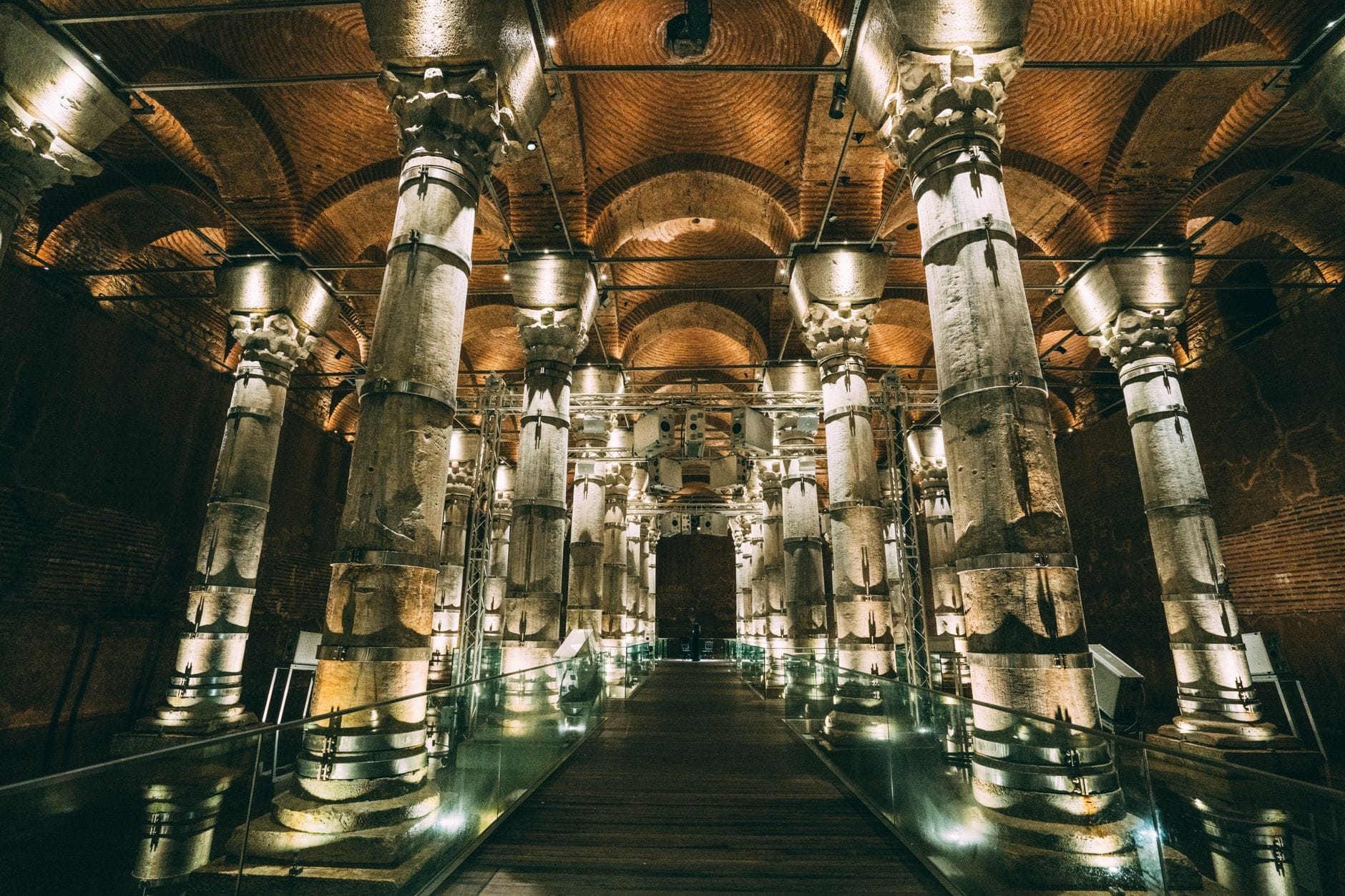
The Basilica Cistern, known in Turkish as Yerebatan Sarnıcı (and sometimes as Yerebatan Sarayı, meaning 'Sunken Palace'), is an ancient underground water reservoir sitting directly beneath the streets of Sultanahmet. It is the largest surviving Byzantine cistern in Istanbul, a subterranean chamber roughly 140 meters long and 70 meters wide, covering approximately 10,000 square meters. At capacity, it could hold up to 80,000 cubic meters of water.
The structure dates to 532 AD, built during the reign of Byzantine Emperor Justinian I. It stands on the site of a large public square called the Stoa Basilica, which is where its modern English name originates. The cistern is supported by 336 marble columns arranged in 12 rows of 28 each, many of them repurposed from older Roman structures across the empire. As part of the 'Historic Areas of Istanbul,' it belongs to a UNESCO World Heritage Site inscribed in 1985.
⚠️ What to skip
As of the time of writing, the official website (yerebatan.com) lists the Basilica Cistern as temporarily closed to visitors. Always check the official site before planning your visit, as reopening dates and ticketing details are subject to change.
Stepping Underground: The Sensory Experience
Nothing quite prepares first-time visitors for the scale of what opens up below street level. You descend a long stone staircase of 52 steps, and the ambient temperature drops noticeably, a welcome 10 to 15 degrees cooler than the street above in summer. The smell changes too: cool stone, faint moisture, old water. There is a particular stillness here that is unusual in a city this dense.
The interior is dim, lit primarily by indirect colored lighting that casts amber and blue tones across the water surface and the column shafts. Wooden walkways float above shallow water, guiding visitors through the forest of columns. The sound of dripping water, a constant soft percussion, echoes across the vaulted ceiling. Carp move slowly through the pools beneath the walkways. The scale is cathedral-like, though the space feels intimate rather than overwhelming.
Photography conditions here are good, even with a smartphone. The long reflections of columns in the still water, the play of warm light against the brickwork arches, and the two famous Medusa heads at the far end of the space provide strong compositional subjects. A small tripod or at least steady hands help, given the low light. Flash photography tends to flatten the atmosphere.
Tickets & tours
Hand-picked options from our booking partner. Prices are indicative; availability and final rates are confirmed when you complete your booking.
Basilica Cistern fast-track entry ticket and optional audio guide
From 34 €Instant confirmationTopkapi Palace and Basilica Cistern fast-track ticket
From 99 €Instant confirmationFree cancellationHagia Sophia, Topkapi Palace and Basilica Cistern Istanbul tour
From 144 €Instant confirmationFree cancellationSkip-the-Line Entrance to Topkapi Palace, Hagia Sophia and Basilica Cistern
From 137 €Instant confirmationFree cancellation
Historical Context: Why Justinian Built This
Constantinople in the 6th century was the largest and most important city in the world, and securing its water supply was a strategic priority. Justinian I, who also commissioned the reconstruction of Hagia Sophia in the same decade, ordered this cistern to supply water to the Great Palace of Constantinople and the surrounding imperial district. Water was channeled from forests north of the city via the Valens Aqueduct system, traveling kilometers before reaching this underground reservoir.
The cistern continued functioning under the Ottomans after the conquest of Constantinople in 1453, though it gradually fell from active use. It was largely forgotten by the wider public until French traveler Petrus Gyllius rediscovered it in the 16th century, reportedly after noticing residents drawing water and catching fish directly through holes in their basement floors. Today it sits adjacent to some of Sultanahmet's most visited monuments. If you are exploring the Sultanahmet district, the cistern fits naturally between visits to Hagia Sophia and the Hippodrome.
The columns themselves are a lesson in late Roman recycling. Most were quarried or salvaged from older structures, which is why they vary in style, capital type, and height. Two columns near the northwest corner rest on carved Medusa heads used as bases, positioned sideways and upside down. Whether this was deliberate or simply practical repurposing of available stone is still debated by scholars, but the Medusa heads have become the cistern's most photographed details.
ℹ️ Good to know
The Valens Aqueduct, which fed water into Istanbul's cistern network, still stands in the Fatih district and is worth seeing as part of a broader day exploring Byzantine infrastructure. It gives useful context for the scale of Justinian-era engineering.
Visiting: Timing, Menschenmengen, and What Changes by Hour
The cistern attracts a significant volume of visitors during peak season, roughly April through October. Midmorning arrivals, between 10:00 and 12:00, tend to coincide with the largest tour groups, whose guides conduct explanations in multiple languages simultaneously. The narrow walkways concentrate crowds at the Medusa column section, where people queue to take photographs. If you have flexibility, arriving when the doors first open gives you a substantially quieter experience, with fewer people in the reflections and more time to absorb the acoustics.
Late afternoon visits have a different quality. By around 16:00, many organized tour groups have moved on to other sites, and the atmosphere becomes more contemplative. The lighting does not change with natural daylight since there are no windows, so the visual experience is consistent at any hour. What changes is the noise level and the density of people on the walkways.
Weather on the street matters very little inside the cistern. Rain, heat, and even heavy snow leave the underground space entirely unaffected. This makes it an unusually reliable attraction for any season. In July and August, when surface temperatures in Istanbul reach the high 20s to low 30s Celsius, the cool underground air is restorative. In winter, the cistern is warmer than the street.
Practical Walkthrough: Layout and What to Look For
The cistern follows a single main route along wooden walkways, so it is not possible to get lost. The entry staircase leads to the northeastern section; the walkway curves toward the western end where the Medusa column bases are located, then loops back toward the exit. The full circuit takes 30 to 45 minutes at a comfortable pace, longer if you stop to photograph or read the interpretive panels.
The two Medusa heads deserve close attention. One is placed on its side, the other upside down. Both are carved in the round and likely date from the 2nd or 3rd century AD, pre-dating the cistern by several centuries. There is also a column toward the center known informally as the 'Hen's Eye' column (Tavuk Gözü), carved with a peacock eye pattern and tear-drop forms, though its exact symbolic meaning remains uncertain.
At various points, you can look down through the walkway grating to see the water below, where carp are clearly visible. The water depth is shallow, generally less than a meter, a remnant of the operational reservoir. A small café operates near the exit on most days, offering coffee and refreshments after the visit.
Accessibility, Tickets, and Getting There
The Basilica Cistern is located at Yerebatan Caddesi No: 1/3, approximately 150 meters southwest of Hagia Sophia. The most direct public transport option is the T1 tram, which stops at Sultanahmet, a short walk from the entrance. The tram connects westward to Eminönü and the Spice Bazaar and eastward toward Bağcılar. An Istanbulkart card covers the fare and is the most efficient way to travel on Istanbul's tram and metro network.
Ticket prices and opening hours should be confirmed directly at yerebatan.com before your visit, as these have changed following renovation periods and are subject to further revision. The Istanbul Museum Pass does not currently include the Basilica Cistern, so a separate ticket is typically required. Check the official site for the most current information on this.
The entrance involves 52 steps downward with no elevator or ramp access noted in current official information. This makes the cistern difficult to access for visitors with mobility limitations or those using wheelchairs. The walkways inside are level and relatively wide, but the descent and ascent remain a barrier. The official website suggests the Theodosius Cistern as an alternative while the Basilica Cistern is temporarily closed.
💡 Local tip
Bring a light layer regardless of the season. The cistern stays cool year-round, and after time in summer heat, the temperature difference can feel dramatic. A thin jacket or sweater makes the visit more comfortable.
How It Fits Into a Sultanahmet Day
The Basilica Cistern pairs well with the major monuments immediately surrounding it. Hagia Sophia stands roughly 150 meters to the northeast and is a natural first stop before descending into the cistern. The Hippodrome of Constantinople is another 200 meters to the southwest, and the Museum of Turkish and Islamic Arts faces it directly. Together, these four sites form a tight circuit that can reasonably be covered in a full day.
If you are planning a broader itinerary covering the historic peninsula, the Byzantine Istanbul guide provides useful context for understanding how the cistern connects to the wider network of Byzantine infrastructure, from the Valens Aqueduct to the fortifications at the edge of the old city. The cistern is also a natural inclusion on any 3-day Istanbul itinerary focused on the historic core.
Who Should Consider Skipping It
The Basilica Cistern is genuinely impressive as an ancient engineering feat, but it is not an interactive museum. There are relatively few interpretive displays, and the walking route is a single loop without significant variation. Visitors seeking deep historical storytelling may find the experience visually striking but contextually thin without prior reading. Children who need constant engagement can become restless once the novelty of the underground space passes, usually within 20 minutes.
Anyone with a strong sensitivity to confined underground spaces may find the low ceilings and enclosed feeling uncomfortable, even though the space is actually quite large. The ambient sounds of dripping water and echoing footsteps, while atmospheric for most, can feel disorienting for some visitors. The cistern is not a place to linger in unprepared if you are prone to claustrophobia.
Insider Tips
- Arrive at opening time to get the Medusa heads almost entirely to yourself. Within an hour, this section becomes the most congested point on the walkway and photographing without other visitors in frame becomes very difficult.
- The cistern's cool air is most welcome in late June through August. If you have flexible afternoon plans, use a midday visit here to escape peak street heat before continuing to outdoor sites later when temperatures drop slightly.
- Standard phone cameras handle the low light reasonably well in Night Mode, but the key is keeping the phone braced against the walkway railing for longer exposures. The column reflections in the water are the most rewarding composition, not just the Medusa heads.
- The official website occasionally posts event announcements for temporary art installations or evening events held inside the cistern. These sell out quickly and offer a very different atmosphere from the standard daytime visit.
- If the cistern is temporarily closed during your trip, the Theodosius Cistern (Şerefiye Sarnıcı) nearby is a smaller but similarly atmospheric Byzantine cistern and is recommended by the Basilica Cistern's own management as an alternative.
Who Is Basilica Cistern For?
- History and archaeology enthusiasts interested in Byzantine engineering
- Photographers looking for atmospheric low-light architectural subjects
- Travelers visiting in summer who want a cool, sheltered midday stop
- First-time Istanbul visitors doing a full Sultanahmet circuit
- Anyone with a broader interest in how ancient cities managed water infrastructure
Nearby Attractions
Other things to see while in Sultanahmet:
- Blue Mosque (Sultan Ahmed Mosque)
The Sultan Ahmed Mosque, known universally as the Blue Mosque, is one of Istanbul's most recognizable landmarks. Built between 1609 and 1616, it remains an active place of worship that welcomes non-Muslim visitors outside prayer times. This guide covers everything you need to plan a smooth, respectful visit.
- Gülhane Park
Gülhane Park sits directly beside Topkapı Palace in Sultanahmet, occupying land that served as the Ottoman court's private outer garden for centuries. Open daily, free to enter, and containing one of Istanbul's oldest surviving monuments, it rewards visitors who take more than a passing glance.
- Hagia Irene
Hagia Irene (Aya İrini Müzesi) is the oldest surviving church structure in Istanbul, predating even Hagia Sophia. Sitting quietly inside the first courtyard of Topkapı Palace, it offers a rare encounter with raw Byzantine architecture — unrestored, unadorned, and old.
- Hagia Sophia
Standing at the heart of Sultanahmet for nearly 1,500 years, Hagia Sophia has been a Byzantine cathedral, an Ottoman mosque, a secular museum, and a mosque again. Nothing in Istanbul quite prepares you for its scale. This guide tells you exactly what to expect, when to go, and how to make the most of your visit.