Hagia Irene Museum: Istanbul's Oldest Church, Hidden Inside Topkapı Palace
Hagia Irene (Aya İrini Müzesi) is the oldest surviving church structure in Istanbul, predating even Hagia Sophia. Sitting quietly inside the first courtyard of Topkapı Palace, it offers a rare encounter with raw Byzantine architecture — unrestored, unadorned, and old.
Quick Facts
- Location
- First courtyard of Topkapı Palace, Sultanahmet, Fatih
- Getting There
- Sultanahmet or Gülhane tram stops (T1 line); ~15-min walk from Sirkeci Marmaray station
- Time Needed
- 45 minutes to 1.5 hours
- Cost
- Included with Topkapı Palace ticket; standalone entry also available (verify current price at muze.gen.tr)
- Best for
- Byzantine history, architecture, classical music concerts, quiet sightseeing
- Official website
- muze.gen.tr/muze-detay/ayairini
What Is Hagia Irene?
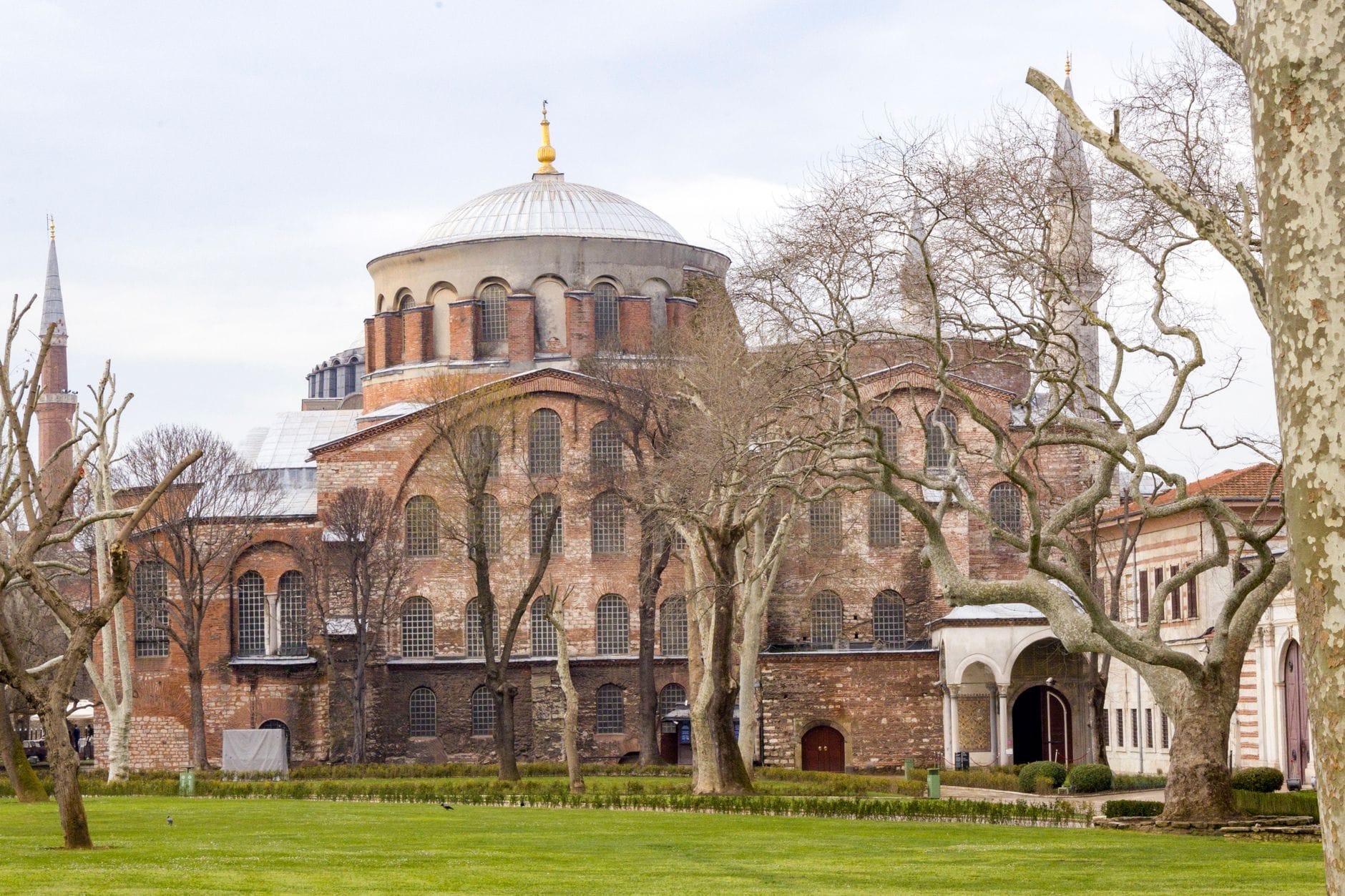
Hagia Irene (Aya İrini in Turkish, officially the Hagia Irene Museum) is the oldest known church structure in Istanbul, and one of only two Byzantine churches in the city that were never converted into a mosque after the Ottoman conquest of 1453. That fact alone makes it extraordinary. While Hagia Sophia draws enormous crowds a few hundred meters away, Hagia Irene sits in relative quiet inside the outer courtyard of Topkapı Palace, receiving a fraction of the attention it deserves.
It is also the second largest historic church in Istanbul after Hagia Sophia, a point that surprises most visitors who arrive expecting something modest. The interior is enormous: a three-naved basilica plan with a naos, narthex, and atrium. Crucially, it holds the distinction of being the only surviving Byzantine church in Istanbul with a standing atrium — a colonnaded forecourt that once gave rhythm to the approach to the nave.
ℹ️ Good to know
Opening hours differ by season. Winter hours: 09:00–18:00. Summer hours: 09:00–18:00. Hagia Irene is closed every Tuesday, on May 1, on the first day of Ramadan, and on the first day of the Feast of Sacrifice. Verify current hours at muze.gen.tr before visiting.
A Brief History: From Constantine to Justinian to the Ottomans
The story of Hagia Irene begins in 330 CE, when Emperor Constantine the Great founded a wooden church on this site, likely on top of an older pagan temple. The name 'Hagia Irene' translates from Greek as 'Holy Peace' — not a dedication to a saint, but to the concept of divine peace itself. For about three decades, it served as the cathedral of Constantinople, functioning as the city's primary Christian church until Hagia Sophia opened in 360 CE.
The structure was severely damaged during the Nika Revolt of 532 — the same urban uprising that destroyed much of Constantinople and nearly toppled Emperor Justinian. Justinian responded by rebuilding Hagia Irene alongside Hagia Sophia, giving both churches their current monumental scale. The building was repaired again after a significant earthquake in 740, under Emperors Leo III and Constantine V, which accounts for some of the visible variations in construction material and masonry style across different sections of the walls.
After 1453, the Ottomans enclosed Hagia Irene within the Topkapı Palace complex rather than converting it for Islamic worship. It was used instead as an armory and later a military museum — which is why so much of the original fabric survived intact. Today it functions as a museum under the Republic of Türkiye Ministry of Culture and Tourism and occasionally as a concert venue, particularly for the Istanbul Music Festival. If you are planning a broader visit to the area, the Topkapı Palace ticket covers entry to Hagia Irene, which makes combining both sites straightforward.
Tickets & tours
Hand-picked options from our booking partner. Prices are indicative; availability and final rates are confirmed when you complete your booking.
Hagia Sophia skip-the-line entry ticket and optional audio guide
From 37 €Instant confirmationSkip-the-line Hagia Sophia and Grand Bazaar tour
From 60 €Instant confirmationFree cancellationHagia Sophia, Topkapi Palace and Basilica Cistern Istanbul tour
From 144 €Instant confirmationFree cancellationSkip-the-Line Entrance to Topkapi Palace, Hagia Sophia and Basilica Cistern
From 137 €Instant confirmationFree cancellation
What the Interior Actually Looks Like
Stepping inside Hagia Irene is one of the more genuinely affecting architectural experiences in Istanbul. The space is stripped of decoration in a way that few historic churches are. There are no gilded mosaics covering every surface, no heavy iconostasis, no incense smell from active worship. What you get instead is raw Byzantine volume: thick brick walls, arched galleries above the nave, and a semicircular apse at the east end bearing a simple mosaic cross on a gold background — one of the earliest surviving examples of post-iconoclast decoration in Byzantine art.
The quality of light shifts considerably depending on the time of day. In the morning, low eastern light filters through the apse windows and catches the texture of the brick in a way that afternoon visits simply don't replicate. The atrium, open to the sky, has a slightly different atmosphere: it feels archaeological rather than ecclesiastical, with exposed stone and the remains of column bases that suggest the complexity of the original building program.
The dome and semi-dome above the apse are more restrained than anything at Hagia Sophia, but their proportions are impressive for a structure this old. The nave arcade uses spolia — columns and capitals repurposed from earlier structures — which gives the interior an uneven but historically dense visual rhythm. Look at the floor level too: sections of the original Byzantine opus sectile paving are still visible in places.
💡 Local tip
Photography tip: The interior is quite dark except near the apse windows. Bring a camera capable of low-light shooting, or use your phone's night mode. The best natural light falls on the apse between roughly 9:00 and 11:00 on clear mornings.
Getting There and Navigating the Site
Hagia Irene sits inside the first (outer) courtyard of Topkapı Palace, between Hagia Sophia and the main Topkapı ticket office. You do not need a separate palace ticket to reach this courtyard — the outer gate (Bab-ı Hümayun, the Imperial Gate) is publicly accessible. However, entering the church itself requires a ticket, either the standalone Hagia Irene admission or the combined Topkapı Palace ticket, which covers both.
The most direct approach from central Sultanahmet is on foot: from Sultanahmet Square, walk northeast past the Hagia Sophia facade and continue along the outer palace wall to the Imperial Gate. It takes about 10 to 15 minutes at a relaxed pace. If you are arriving by tram, take the T1 line to either the Sultanahmet or Gülhane stop — both leave you within comfortable walking distance. From Sirkeci Marmaray station, allow approximately 15 minutes on foot.
The interior involves some steps and uneven stone surfaces. The historic fabric of the building has not been fully adapted for accessibility. Visitors with limited mobility should contact the museum in advance to confirm what accommodations are currently available.
When to Visit and What Affects the Experience
The outer courtyard and church entrance tend to be quieter than the main Topkapı Palace areas, but the site still sees moderate visitor traffic during peak season (roughly June through August and on weekends year-round). Arriving at opening time — 09:00 — gives you the best combination of light, cool temperatures, and minimal crowds. Late afternoon visits in summer are workable but can feel rushed as last-entry approaches.
The most comfortable months for the walk between Sultanahmet monuments are April through June and September through October, when temperatures are mild and the heat of peak summer hasn't set in. For more on timing a broader Istanbul visit, see the best time to visit Istanbul guide.
On days when Hagia Irene is being prepared for a concert, access to the interior may be restricted or the space may be partially set up with seating. If you are visiting specifically for the architecture rather than a performance, it is worth checking the Istanbul Music Festival schedule in advance to avoid overlap, particularly in June when the festival typically runs.
⚠️ What to skip
Hagia Irene is closed every Tuesday. It also closes on May 1, the first day of Ramadan, and the first day of the Feast of Sacrifice. If you are visiting during a religious holiday period, verify opening status before making the trip.
How It Fits Into a Sultanahmet Itinerary
Most visitors combine Hagia Irene with Topkapı Palace on the same day, which makes logistical sense since both share the same ticket and the same courtyard. If you have already visited Topkapı, or if the palace queues are long, Hagia Irene can also anchor a shorter morning or afternoon loop around the Sultanahmet area that includes Hagia Sophia, the Istanbul Archaeology Museums (which are also within the palace complex), and Gülhane Park — all within easy walking distance.
For travelers following a structured Byzantine history route through the city, Hagia Irene is a logical starting point chronologically: it predates Hagia Sophia and represents Constantinople's first cathedral era. From here you can trace the city's Byzantine development outward to the Chora Church on the western edge of the historic peninsula, which preserves the finest surviving Byzantine mosaics in Istanbul. The Istanbul Byzantine history guide maps this broader circuit in detail.
One practical note for expectation management: Hagia Irene is not a museum in the conventional sense. There are no extensive display cases, no multilingual panels on every wall, and no reconstructed interiors. What you are visiting is the building itself. If that kind of unmediated encounter with old architecture is what you are looking for, it is an exceptional experience. If you need interpretive content to feel engaged, you may find it sparse.
Insider Tips
- The Topkapı Palace combined ticket may cover Hagia Irene — if you're already planning to visit the palace, check current bundling at muze.gen.tr before deciding whether to buy a separate church ticket.
- The outer courtyard of Topkapı, where Hagia Irene sits, is freely accessible through the Imperial Gate without buying any ticket. You can approach the building and see its exterior at no cost, which is worth doing even if you visit the interior another time.
- The Istanbul Music Festival, usually held in June, occasionally stages concerts inside Hagia Irene. The acoustics are exceptional for classical and chamber music — if dates align with your trip, attending a performance here is a rare experience.
- The mosaic cross in the apse is one of the key pieces of evidence for post-iconoclasm Byzantine art. It was installed after the period of icon destruction (roughly 730–787 and 814–842), when figurative religious imagery was forbidden and abstract symbols were used instead. Knowing this context makes the bare interior read very differently.
- Visit on a weekday morning rather than a weekend afternoon. Weekend visitor numbers at the Topkapı complex increase substantially, and the short walk from the palace entrance to Hagia Irene passes through areas that can become congested.
Who Is Hagia Irene For?
- Travelers with a specific interest in Byzantine architecture or early Christian history
- Architects, art historians, and students of late antique design
- Classical music fans who can time a visit with an Istanbul Music Festival concert
- Visitors who find Hagia Sophia overcrowded and want a comparable spatial experience with far fewer people
- Anyone doing a full Topkapı Palace day who wants to understand the site's pre-Ottoman layers
Nearby Attractions
Other things to see while in Sultanahmet:
- Basilica Cistern
Built by Emperor Justinian I in 532 AD, the Basilica Cistern is one of Istanbul's most extraordinary ancient structures. Descend beneath Sultanahmet's streets into a vast, column-filled underground reservoir that once supplied water to the Byzantine imperial palace. Few places in the world feel quite like it.
- Blue Mosque (Sultan Ahmed Mosque)
The Sultan Ahmed Mosque, known universally as the Blue Mosque, is one of Istanbul's most recognizable landmarks. Built between 1609 and 1616, it remains an active place of worship that welcomes non-Muslim visitors outside prayer times. This guide covers everything you need to plan a smooth, respectful visit.
- Gülhane Park
Gülhane Park sits directly beside Topkapı Palace in Sultanahmet, occupying land that served as the Ottoman court's private outer garden for centuries. Open daily, free to enter, and containing one of Istanbul's oldest surviving monuments, it rewards visitors who take more than a passing glance.
- Hagia Sophia
Standing at the heart of Sultanahmet for nearly 1,500 years, Hagia Sophia has been a Byzantine cathedral, an Ottoman mosque, a secular museum, and a mosque again. Nothing in Istanbul quite prepares you for its scale. This guide tells you exactly what to expect, when to go, and how to make the most of your visit.