Topkapı Palace: The Heart of the Ottoman Empire
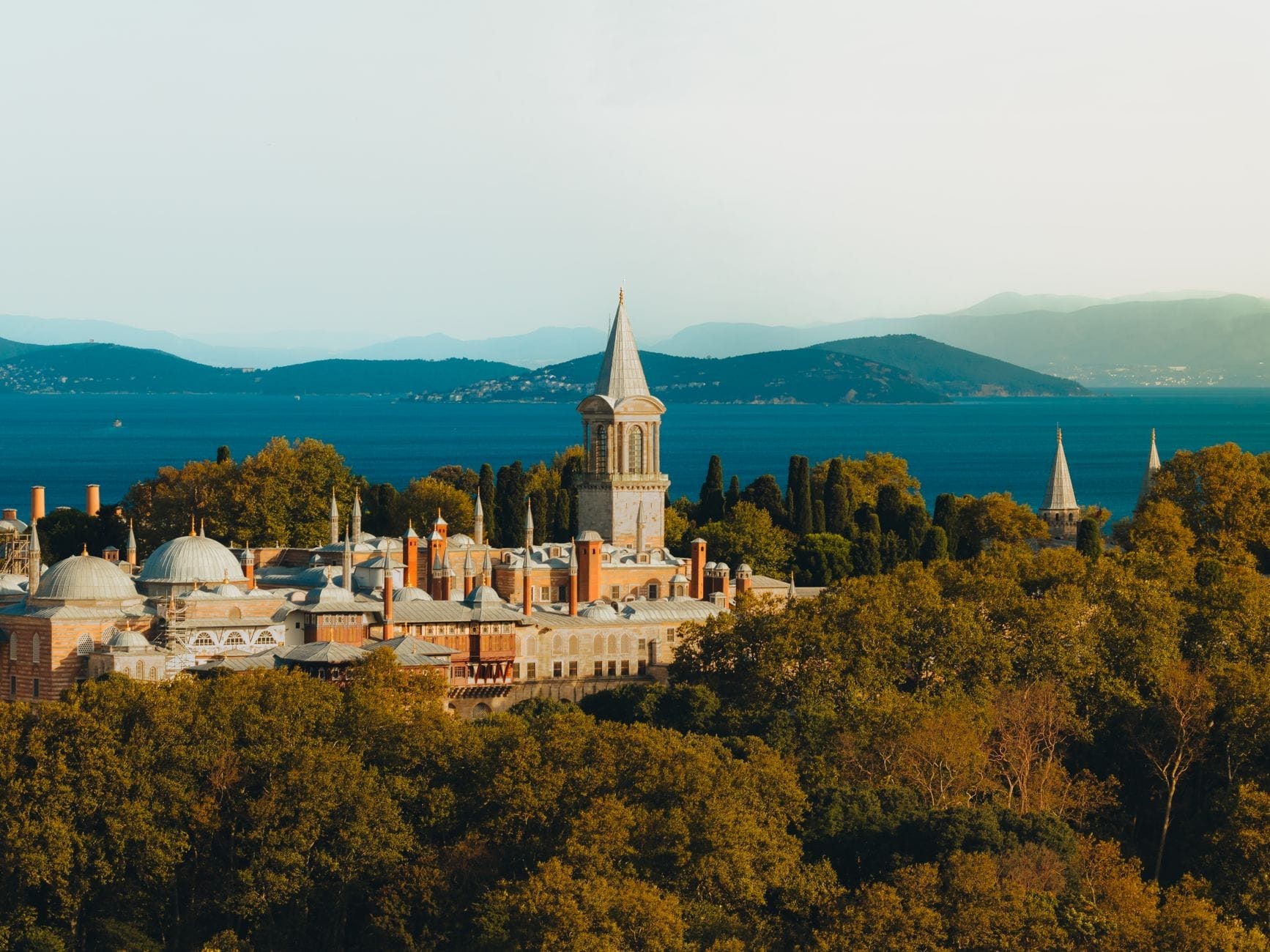
For nearly four centuries, Topkapı Palace was the nerve center of one of history's greatest empires. Today it holds some of the most significant Islamic relics and Ottoman treasures on earth, spread across a sprawling hilltop complex with views over the Bosphorus and the Sea of Marmara.
Quick Facts
- Location
- Sarayburnu (Seraglio Point), Sultanahmet, Fatih, Istanbul
- Getting There
- Gülhane or Sultanahmet stops, T1 tram line
- Time Needed
- 3–5 hours minimum; full day for Harem + all courtyards
- Cost
- 2,750 TL (includes Harem); Museum Pass covers entry to the main palace but not the Harem. Verify current prices before visiting.
- Best for
- History enthusiasts, Ottoman and Islamic art, architecture, panoramic Bosphorus views
- Official website
- muze.gen.tr/muze-detay/topkapi
What Topkapı Palace Actually Is
Topkapı Palace Museum, known in Turkish as Topkapı Sarayı Müzesi, is not a single building. It is a walled city within a city: four sequential courtyards, more than 400 rooms, mosques, kitchens, a treasury, an armory, and a self-contained residential quarter known as the Harem. Built between 1459 and 1478 under Sultan Mehmed II following the Ottoman conquest of Constantinople in 1453, the complex served as the primary residence and seat of government for Ottoman sultans for nearly four centuries. When the court finally relocated to the European-style Dolmabahçe Palace under Sultan Abdülmecid I in the mid-19th century, Topkapı entered a quieter chapter before becoming a museum in 1924, one of the earliest cultural institutions of the Turkish Republic.
Its position on Sarayburnu, the triangular promontory where the Golden Horn meets the Bosphorus and the Sea of Marmara, is not incidental. The Ottomans understood that controlling this point meant commanding the water routes linking Europe and Asia. Standing at the palace terrace on a clear morning, you can see tankers rounding the tip of the peninsula and the Asian shore of Istanbul rising across the strait. The view alone explains why this hill was chosen.
💡 Local tip
Arrive at opening (09:00) on a weekday. The first courtyard fills quickly with tour groups by 10:30, and the Harem queue can grow to 45 minutes or longer by midday. Tuesday is the one day the palace is closed.
Moving Through the Four Courtyards
The palace is organized as a series of progressively more restricted courtyards. The First Courtyard, entered through the Imperial Gate (Bab-ı Hümayun), was historically open to the public and functions today as a large green space. It contains the Byzantine church of Hagia Irene, one of Istanbul's oldest surviving churches, which sits slightly awkwardly in the context of an Ottoman palace but is a reminder of the layered history of this hill.
The Second Courtyard, reached through the Gate of Salutation, is where the administrative machinery of the empire was housed: the Imperial Council (Divan), the palace kitchens, and the stables. The kitchens alone are extraordinary, running in a long row of domed chambers and now displaying one of the world's finest collections of Chinese celadon porcelain and Ottoman silverware. This courtyard is also where you'll find the entrance to the Harem, so if you're planning to visit it, buy your ticket here rather than backtracking later. For more context on exploring this neighborhood, the Ottoman history guide is useful background reading.
The Third Courtyard contains the private quarters of the sultan, the audience chamber where foreign ambassadors were received, and the Treasury. The Treasury is where most visitors spend the longest time: it houses the Topkapı Dagger, a jade-handled weapon encrusted with three large emeralds, and the 86-carat Spoonmaker's Diamond, one of the largest diamonds on public display anywhere in the world. The rooms are relatively small and poorly lit for conservation reasons, which means crowds compress uncomfortably. Go here as early as possible.
The Fourth Courtyard is the least crowded and, for many visitors, the most rewarding. It is a collection of pavilions and gardens spread across the highest point of the promontory. The Baghdad Pavilion and the Circumcision Room are decorated with some of the finest Iznik tile work you will see anywhere in Istanbul. The terrace restaurant here is overpriced, but the view from the adjacent garden terrace, looking northeast over the Golden Horn toward the Galata Tower, is one of the great urban panoramas of the city.
Tickets & tours
Hand-picked options from our booking partner. Prices are indicative; availability and final rates are confirmed when you complete your booking.
Topkapi Palace and Harem skip-the-line tickets with options
From 60 €Instant confirmationTopkapi Palace and Basilica Cistern fast-track ticket
From 99 €Instant confirmationFree cancellationHagia Sophia, Topkapi Palace and Basilica Cistern Istanbul tour
From 144 €Instant confirmationFree cancellationSkip-the-Line Entrance to Topkapi Palace, Hagia Sophia and Basilica Cistern
From 137 €Instant confirmationFree cancellation
The Harem: Worth the Extra Ticket
The Harem section is included in the current standard foreign admission price (as of the most recent available information), but if visiting with a Museum Pass, the Harem requires a separate paid ticket. It is easy to underestimate how large the Harem is: approximately 300 rooms in a labyrinth of corridors, baths, courtyards, and audience halls. The word harem simply means 'forbidden' in Arabic, and this was literally forbidden territory to almost everyone in the empire, including most palace staff.
The Harem housed not only the sultan's concubines but also his mother (the Valide Sultan, who wielded considerable political power), his children, and hundreds of servants and eunuchs. The tiled rooms of the sultan's private quarters are among the most elaborately decorated spaces in the entire complex. The Imperial Hall, used for ceremonies and entertainment, has a gallery for musicians built into the upper walls. Visitors move through a designated route, which covers the most significant spaces but not all 300 rooms.
ℹ️ Good to know
The Harem entrance is in the Second Courtyard. Guided tours of the Harem run at scheduled intervals and are worth joining if you want context, as the room labels inside offer limited explanation of how the social hierarchy functioned.
The Sacred Relics Pavilion
One section that surprises many visitors is the Pavilion of the Sacred Relics in the Third Courtyard. This is one of the most significant collections of Islamic relics in existence, including items associated with the Prophet Muhammad: a tooth, a hair from his beard, his mantle, his seal, and his bow. The swords of the first four caliphs are also displayed here. The atmosphere inside is deliberately meditative: Quranic recitation plays continuously, and Muslim visitors often treat this space with the reverence of a place of worship rather than a museum gallery. Non-Muslim visitors are welcome but should be aware of the tone of the space.
The relics were brought to Istanbul after the Ottoman conquest of Egypt and the Hejaz in the 16th century, when the Ottoman sultans assumed the title of Caliph. Their presence in Istanbul was a cornerstone of Ottoman religious legitimacy for centuries. Whether or not you have a religious connection to these objects, understanding their significance gives the entire palace a different weight.
How the Experience Changes by Time of Day
Early morning arrivals, between 09:00 and 10:00, find the First and Second Courtyards almost empty. The sound of gulls and the smell of stone and cypress trees dominate before the tour groups arrive. The light in the Third Courtyard is good for photography from mid-morning onward, when it angles through the colonnaded arcade. By midday in summer, the open courtyards become intensely hot with very little shade, and the Treasury and Harem queues reach their worst levels.
Late afternoon has its advantages: crowds thin after 15:00, the light on the Bosphorus from the Fourth Courtyard terrace turns golden, and the pace of the visit slows. The palace closes at 18:00 (last entry typically 45 minutes before closing), so arriving after 15:00 is only advisable if you plan to focus on one or two sections rather than the full complex.
⚠️ What to skip
In summer (June through August), midday temperatures in the exposed courtyards regularly exceed 35°C. Bring water, wear a hat, and consider wearing light, breathable layers. There is limited shade between the First and Second Courtyards.
Practical Details for Getting There and Getting Around
The easiest approach is the T1 tram, which runs from Kabataş through Karaköy and Eminönü, stopping at both Gülhane and Sultanahmet. Gülhane is the closer stop if you want to walk through Gülhane Park on your way up; Sultanahmet puts you in front of the Hagia Sophia with a short walk to the palace gate. Both walks are well-signposted. For a full orientation to the surrounding area, the Sultanahmet neighborhood guide covers everything within walking distance.
The palace complex involves significant walking across uneven cobblestone surfaces and sloped paths. Comfortable, closed-toe shoes are strongly advisable. Visitors with mobility limitations should check directly with the museum administration regarding accessible routes, as the historic structure means that not every section is step-free. The Istanbul Museum Pass covers entry to the palace but not the Harem, and is worth calculating against your overall sightseeing plans before purchasing.
Photography is permitted throughout most of the complex without a flash, but specific galleries, particularly the Sacred Relics Pavilion and some Treasury rooms, may restrict photography. Signage inside the gallery indicates restrictions. Video tripods are generally not permitted.
What Topkapı Does Well, and Where It Falls Short
The scale and historical significance of Topkapı are unmatched in Istanbul. It holds more concentrated imperial history than any other single site in the city, including the Hagia Sophia, which rivals it in fame but tells a different kind of story. The palace's collections, particularly the Chinese porcelain, the Iznik tiles, the calligraphy, and the Treasury objects, are world-class.
The museum's weaknesses are real, however. Labeling in English is inconsistent: some rooms have detailed explanations while others have almost nothing. The flow of visitors through certain narrow corridors in the Harem can feel chaotic. The palace's enormous size means that a casual visitor who spends three hours will leave having seen only a fraction of the collection, and potentially feeling underwhelmed by spaces that deserve more context than the signage provides. An audio guide or a good pre-visit read significantly improves the experience.
Travelers who want a single, visually spectacular Ottoman statement may find Dolmabahçe Palace more immediately impressive, as its 19th-century European-influenced design is more cohesive as a single viewing experience. Topkapı rewards patience and curiosity more than it rewards a quick walk-through.
Insider Tips
- Book tickets online through the official museum portal before your visit. On peak summer days, the entrance queue alone can take 30 minutes. Online tickets help you avoid ticket-office lines, but Harem entry slots are managed on-site and cannot typically be reserved in advance.
- The palace restaurant in the Fourth Courtyard charges significantly more than the cafes near Gülhane Park outside the complex. If you need a break, it is more economical to exit through Gülhane, eat near the park, and re-enter if your ticket allows same-day re-entry (confirm this at the ticket desk).
- The Chinese celadon porcelain collection in the palace kitchens is genuinely world-class and routinely overlooked by visitors rushing toward the Treasury. The Ottomans believed celadon would change color if food placed on it was poisoned, which explains the obsessive accumulation of over 10,000 pieces.
- The Fourth Courtyard's Baghdad Pavilion is often quiet even when the rest of the palace is crowded. Its interior tilework, commissioned after the Ottoman capture of Baghdad in 1638, is among the finest decorative work in the entire complex and deserves more time than most visitors give it.
- If you are visiting in April, the tulip gardens along the palace walls and in nearby Gülhane Park are in full bloom. Tulips were originally introduced to western gardens from Ottoman Turkey, and the palace grounds are one of the best places in Istanbul to see the flower in its historic cultural context.
Who Is Topkapı Palace For?
- History and architecture enthusiasts who want depth, not just spectacle
- Visitors with a strong interest in Islamic art, calligraphy, and relics
- Travelers on a first visit to Istanbul who want to understand Ottoman imperial scale
- Photographers interested in Iznik tile work and Bosphorus panoramas
- Families with older children (10+) who can manage extended walking across uneven terrain
Nearby Attractions
Other things to see while in Sultanahmet:
- Basilica Cistern
Built by Emperor Justinian I in 532 AD, the Basilica Cistern is one of Istanbul's most extraordinary ancient structures. Descend beneath Sultanahmet's streets into a vast, column-filled underground reservoir that once supplied water to the Byzantine imperial palace. Few places in the world feel quite like it.
- Blue Mosque (Sultan Ahmed Mosque)
The Sultan Ahmed Mosque, known universally as the Blue Mosque, is one of Istanbul's most recognizable landmarks. Built between 1609 and 1616, it remains an active place of worship that welcomes non-Muslim visitors outside prayer times. This guide covers everything you need to plan a smooth, respectful visit.
- Gülhane Park
Gülhane Park sits directly beside Topkapı Palace in Sultanahmet, occupying land that served as the Ottoman court's private outer garden for centuries. Open daily, free to enter, and containing one of Istanbul's oldest surviving monuments, it rewards visitors who take more than a passing glance.
- Hagia Irene
Hagia Irene (Aya İrini Müzesi) is the oldest surviving church structure in Istanbul, predating even Hagia Sophia. Sitting quietly inside the first courtyard of Topkapı Palace, it offers a rare encounter with raw Byzantine architecture — unrestored, unadorned, and old.