Gülhane Park: Istanbul's Oldest Public Garden and Its Ottoman Secrets
Gülhane Park sits directly beside Topkapı Palace in Sultanahmet, occupying land that served as the Ottoman court's private outer garden for centuries. Open daily, free to enter, and containing one of Istanbul's oldest surviving monuments, it rewards visitors who take more than a passing glance.
Quick Facts
- Location
- Cankurtaran Mah., Kennedy Cad., Fatih, Istanbul
- Getting There
- Gülhane stop, T1 tram line
- Time Needed
- 1 to 2 hours
- Cost
- Free entry
- Best for
- History lovers, families, spring tulip season, a quiet break from sightseeing
- Official website
- goturkiye.com/istanbul/gulhane-park
What Gülhane Park Actually Is
Gülhane Park (Gülhane Parkı) is a public green space occupying the lower slopes of the Topkapı Palace grounds in Sultanahmet, on Istanbul's historic peninsula. For most of the Ottoman period, this land functioned as the sultan's outer garden, walled off from the city and accessible only to the court. It opened to the public in 1912, making it one of the oldest urban parks in Istanbul. The name translates roughly as 'rosehouse' or 'house of roses', and during spring it lives up to that name.
The park is free to enter and open daily from approximately 06:00 to 22:30. It sits along the Bosphorus-facing slope of the peninsula, so the light at different times of day changes the character of the place considerably. If you are planning a full day in Sultanahmet, Gülhane works well as an opening act in the morning or a decompression stop after Topkapı.
💡 Local tip
Get off at the Gülhane stop on the T1 tram. The main park gate is less than a two-minute walk from the platform. Do not confuse it with the Sultanahmet stop, which deposits you near the Blue Mosque instead.
The Experience at Different Times of Day
Early morning, between 07:00 and 09:00, Gülhane belongs to locals. Retired men walk the main allée in slow circuits; a handful of joggers use the perimeter path. The air carries a slightly damp, green smell from overnight irrigation and the Sea of Marmara breeze that filters through the canopy. The sounds at this hour are birdsong and the distant rumble of the T1 tram, not tourist crowds.
By mid-morning, tour groups begin arriving from nearby hotels. The main central path fills, and the benches near the tea garden start to see use. The pace is still relaxed but the park begins to feel like a public destination rather than a neighborhood amenity. Between noon and 15:00 in summer, the southern terraces get direct sun and heat up noticeably. The tree canopy along the central axis offers relief, but if you are visiting July or August, midday is the least comfortable window.
Late afternoon, as Topkapı Palace closes and the tour buses depart, the park quiets again. The Bosphorus-facing viewpoint at the park's northeastern edge catches warm late light, and this is the best window for photography of the strait and the Asian shore. By evening, Istanbul families arrive with children, couples occupy the benches, and the tea garden fills with a different crowd than the daytime visitors. The park after dark has adequate lighting on main paths but feels more intimate than impressive.
Tickets & tours
Hand-picked options from our booking partner. Prices are indicative; availability and final rates are confirmed when you complete your booking.
Bosphorus sunset cruise on luxury yacht with guide
From 55 €Free cancellationIstanbul and Bosphorus cruise on private boat - half day afternoon tour
From 40 €Instant confirmationFree cancellationWhirling Dervishes live show and exhibition
From 29 €Instant confirmationBasilica Cistern fast-track entry ticket and optional audio guide
From 34 €Instant confirmation
Historical Context: An Ottoman Garden and a Document That Changed an Empire
The land occupied by Gülhane was enclosed within the outer walls of Topkapı Palace from the 15th century onward. The palace complex itself, begun under Sultan Mehmed II after the Ottoman conquest of Constantinople in 1453, extended down the slopes toward the Bosphorus, with tiered gardens serving horticultural and ceremonial purposes. Visitors exploring the Topkapı Palace complex will notice how naturally the park flows from the palace's lower gates.
In 1839, Gülhane entered Ottoman political history when Sultan Abdülmecid I proclaimed the Tanzimat Edict (Hatt-ı Şerif of Gülhane) here. The edict launched a sweeping reform programme: equality before the law regardless of religion, restrictions on arbitrary taxation, and guarantees against summary execution. It is often cited as one of the earliest formal moves toward constitutional governance in the Ottoman Empire. The park's role in that moment is easy to overlook as you walk through it today, but understanding it changes how the space feels.
The park was opened to the general public in 1912, in the final years of the Ottoman state, as part of a broader effort to modernise Istanbul's public spaces. Since then it has served as a municipal park under various administrations, with periodic replanting and renovation of its pathways and gardens.
The Column of the Goths: Istanbul's Oldest Surviving Monument
Near the northern edge of the park stands the Column of the Goths, a single marble column approximately 18 metres tall, mounted on a stepped base and topped with a Corinthian capital. The Latin inscription on the base reads 'Fortunae reduci ob devictos Gothos', translated roughly as 'To Fortune who has returned, because of the Goths having been defeated'. It dates to the late 3rd century CE, placing it in the Roman period of the city then known as Byzantium, before Constantine the Great refounded it as Constantinople in 330 CE.
This makes it older than almost anything else visible in Istanbul. The Hagia Sophia, the Hippodrome monuments, the city walls; all came later. The column has stood through Roman, Byzantine, and Ottoman rule, surviving not because anyone actively preserved it but because it was incorporated into successive palace gardens and simply not removed. It stands in the park without much fanfare, no large signage or barriers, and a significant number of visitors walk past it without registering what they are looking at. Pause here.
ℹ️ Good to know
The Column of the Goths predates the Byzantine era of Constantinople entirely. If you are following Istanbul's layered history chronologically, this column represents the oldest fixed point you can stand beside on the historic peninsula.
Seasonal Character: When to Visit and What Changes
Spring transforms Gülhane more dramatically than almost any other season. From late March through April, the park's rose beds and tulip plantings come into colour, and the cherry trees along the upper terraces bloom white and pale pink. Istanbul's annual tulip festival, which takes place across multiple parks in April, includes Gülhane as one of its central venues. The crowds during tulip festival season are real and should be factored in, particularly on weekends. Arrive before 09:30 or after 17:00 if you want photographs without people in every frame.
Autumn brings a quieter version of the park's appeal. The plane trees and chestnuts along the main paths turn amber and brown through October and November, the tourist density drops sharply after mid-October, and the Bosphorus view from the northeastern terrace becomes clearer as the summer haze lifts. This is genuinely one of the better times to sit here undisturbed.
Winter is the honest season. The park loses its colour entirely, morning fog from the Bosphorus sometimes settles across the lower paths, and the tea garden still operates. If you visit Istanbul in winter and want to understand why locals actually use this space, come on a cold clear morning. For a broader view of what Istanbul looks like in the colder months, the Istanbul in winter guide covers the practical considerations.
Practical Walkthrough: What to See and In What Order
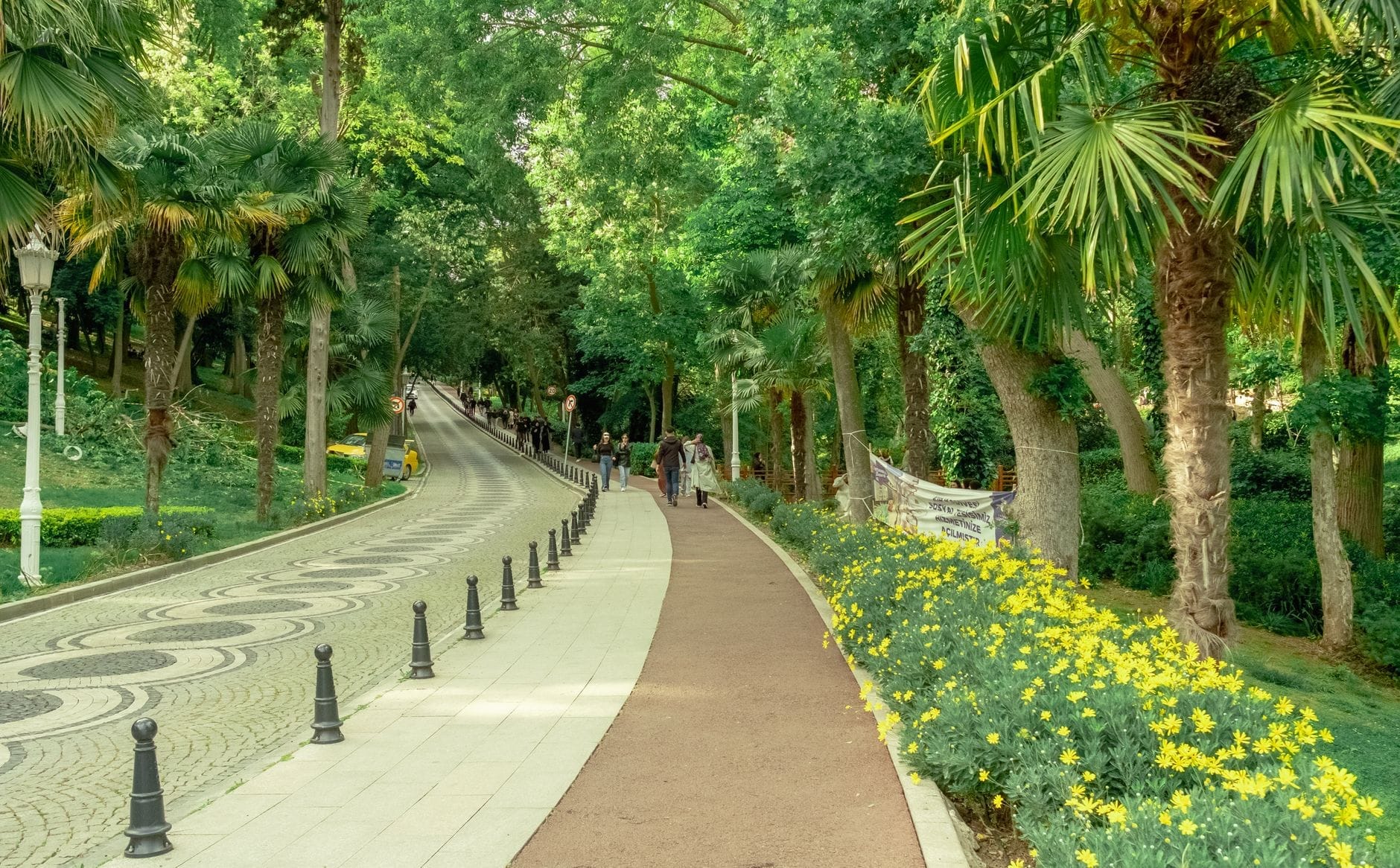
Enter from the main gate off Alemdar Caddesi, a short walk from the Gülhane tram stop. The path ahead leads uphill through the central allée under a high canopy of London plane trees. The Column of the Goths is visible to the left within the first few minutes of walking. Take the detour to examine it before continuing.
Continuing uphill, the paths branch toward the rose gardens in the centre and the upper terraces closer to the Topkapı walls. A tea garden operates near the middle of the park and sells çay (Turkish tea), simit, and light snacks at reasonable prices by Istanbul standards. The seating faces the Bosphorus side, and in good weather it is a functional rest stop between monuments.
At the park's northeastern edge, a viewing terrace overlooks the Bosphorus strait, Üsküdar on the Asian shore, and on clear days the Princes' Islands. The Istanbul Archaeology Museums complex is immediately adjacent to the park's upper northern boundary; the entrance is accessible directly from within the park grounds without returning to the street. This is worth noting if you plan to combine both in one visit.
The park is not large. A purposeful walk from the main gate to the Bosphorus terrace and back takes under 30 minutes. Allow 45 to 90 minutes if you intend to sit at the tea garden, examine the column properly, and explore the rose garden sections at a relaxed pace.
⚠️ What to skip
The paths inside Gülhane include slopes and some uneven cobbled sections, particularly near the upper terraces close to the Topkapı walls. Visitors using wheelchairs or strollers should note that the main central path is relatively accessible but the side paths toward the Bosphorus terrace are less so. Verify current conditions locally before visiting with mobility requirements.
Photography and Practicalities
The park provides several distinct photographic opportunities: the column in morning light when shadows fall long across the stone base; the rose beds in bloom from late March to May; and the Bosphorus view from the upper terrace in afternoon or golden hour light. The canopy of the main allée creates a tunnel effect that works well in any season, and the contrast between the Ottoman palace walls and the green of the garden is sharper in spring than summer.
There are no photography restrictions inside the park. Bring your own water, especially in summer; the tea garden sells drinks but at a markup compared to the small shops on Alemdar Caddesi just outside. Comfortable flat shoes are advisable given the uneven surfaces on some paths.
Insider Tips
- The tea garden inside the park charges slightly more than street cafés just outside, but the Bosphorus-facing seating justifies the difference on a clear day. Order çay and take the table closest to the view.
- The Istanbul Archaeology Museums share a wall with Gülhane Park and can be entered from within the park. Combine both in one visit rather than returning to the street between them.
- During the April tulip festival, the flower beds are at their peak but crowds peak with them on weekends. A Tuesday or Wednesday morning visit before 09:30 gives you the blooms without the tour groups.
- The Column of the Goths has no prominent signage in English and most visitors miss it entirely. It is on the left side of the main path within two or three minutes of the main entrance gate. Look for a single tall marble column on a stepped base.
- Cat colonies are a fixture of Istanbul's historic peninsula, and Gülhane Park is no exception. Regulars who feed them gather in the morning near the central benches. If you are interested in the city's relationship with its street cats, this is one of the calmer observation spots near Sultanahmet.
Who Is Gülhane Park For?
- Travellers who want a free, calm break between major paid attractions like Topkapı Palace and the Archaeology Museums
- History enthusiasts interested in Roman and early Byzantine Istanbul, specifically the Column of the Goths
- Visitors in Istanbul during April who want to see the tulip festival at a centrally located, easily accessible park
- Families with children who need open space to decompress after a morning of indoor sightseeing
- Photographers working on Bosphorus viewpoints or spring foliage in the historic peninsula
Nearby Attractions
Other things to see while in Sultanahmet:
- Basilica Cistern
Built by Emperor Justinian I in 532 AD, the Basilica Cistern is one of Istanbul's most extraordinary ancient structures. Descend beneath Sultanahmet's streets into a vast, column-filled underground reservoir that once supplied water to the Byzantine imperial palace. Few places in the world feel quite like it.
- Blue Mosque (Sultan Ahmed Mosque)
The Sultan Ahmed Mosque, known universally as the Blue Mosque, is one of Istanbul's most recognizable landmarks. Built between 1609 and 1616, it remains an active place of worship that welcomes non-Muslim visitors outside prayer times. This guide covers everything you need to plan a smooth, respectful visit.
- Hagia Irene
Hagia Irene (Aya İrini Müzesi) is the oldest surviving church structure in Istanbul, predating even Hagia Sophia. Sitting quietly inside the first courtyard of Topkapı Palace, it offers a rare encounter with raw Byzantine architecture — unrestored, unadorned, and old.
- Hagia Sophia
Standing at the heart of Sultanahmet for nearly 1,500 years, Hagia Sophia has been a Byzantine cathedral, an Ottoman mosque, a secular museum, and a mosque again. Nothing in Istanbul quite prepares you for its scale. This guide tells you exactly what to expect, when to go, and how to make the most of your visit.