Grant Park: Chicago's Backyard on the Lakefront
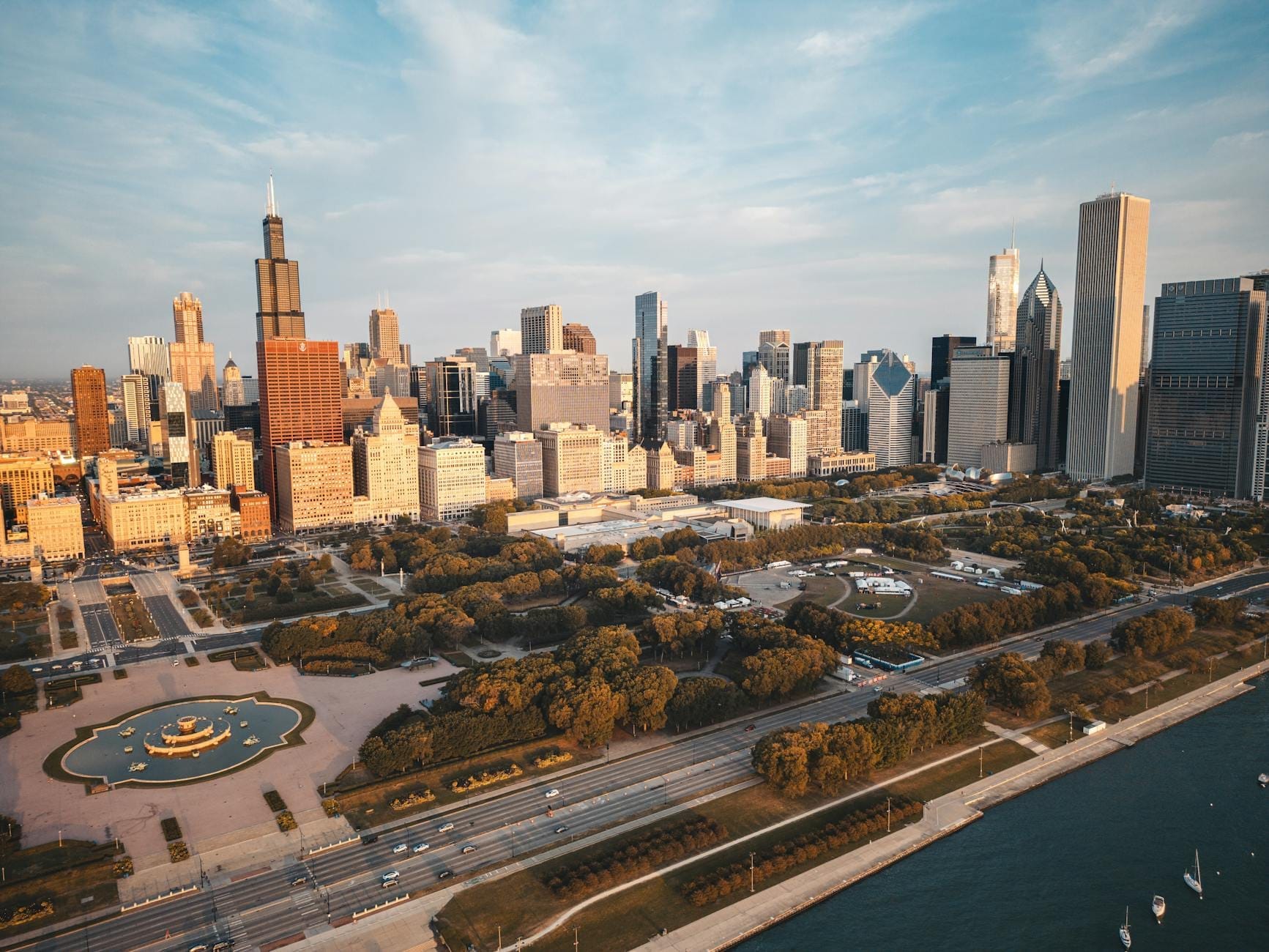
Stretching 319 acres along Lake Michigan, Grant Park is the green spine of downtown Chicago. Free to enter, open year-round, and anchored by landmarks like Buckingham Fountain and Millennium Park, it rewards visitors at every season and hour of day.
Quick Facts
- Location
- 337 E. Randolph St., Chicago, IL 60601 — bounded by Randolph St (north), McFetridge Dr/Roosevelt Rd (south), Michigan Ave (west), and Lake Michigan (east)
- Getting There
- Millennium Station (Metra); Washington/Wabash or Adams/Wabash 'L' stations (Brown, Green, Orange, Pink, Purple lines); multiple CTA bus routes on Michigan Ave
- Time Needed
- 1 hour for a stroll; half a day to explore Millennium Park, Buckingham Fountain, and the Museum Campus edge
- Cost
- Free entry to the park. Separate paid attractions within include the Art Institute of Chicago, Field Museum, Shedd Aquarium, and Adler Planetarium
- Best for
- Lakefront walks, summer festivals, photography, family outings, architecture-watching
- Official website
- www.chicagoparkdistrict.com/parks-facilities/grant-park
What Grant Park Actually Is — and How Big
Grant Park is not a single manicured square. It is a continuous swath of lakefront land roughly 1.29 square kilometers in size, running from Randolph Street in the north all the way down to McFetridge Drive and Roosevelt Road in the south. The park incorporates Millennium Park, Maggie Daley Park, Buckingham Fountain, the formal gardens surrounding it, and the northern edge of the Museum Campus. Each zone has a distinct feel, and most visitors only scratch the surface of one or two sectors during a typical visit.
The land itself has a long history. It was formally designated as Lake Park on April 29, 1844, and renamed Grant Park in 1901 to honor President Ulysses S. Grant. For much of the 20th century, it was a flat expanse of grass and paths — serviceable but unremarkable. The transformation came in 2004 with the opening of Millennium Park on its northern end, which brought Cloud Gate, the Jay Pritzker Pavilion, and the Crown Fountain to a formerly underused rail yard. That renovation reshaped how Chicagoans and visitors relate to the park entirely.
ℹ️ Good to know
Grant Park is generally open daily from 6:00 a.m. to 11:00 p.m., subject to occasional event-related closures. Entry is free. Specific sub-attractions within the park set their own hours.
The Northern Sector: Millennium Park and Maggie Daley
The northern end of Grant Park is where most visitors spend the majority of their time, and rightly so. Millennium Park packs a remarkable density of publicly accessible art into a compact footprint. Cloud Gate — the reflective elliptical sculpture universally known as "the Bean" — is the obvious anchor. On clear mornings, the stainless steel surface catches the Chicago skyline and the sky above Lake Michigan in a single curved reflection. In summer, it is ringed by tourists from the moment the park opens; arriving before 8:00 a.m. gives you the sculpture largely to yourself, with long shadows and warm light from the east.
The Jay Pritzker Pavilion, designed by Frank Gehry, dominates the park's eastern lawn. Its brushed steel ribbons frame an open-air bandshell that seats about 4,000 under cover, with an additional lawn that accommodates thousands more. In summer, the Jay Pritzker Pavilion hosts the Grant Park Music Festival — free classical concerts on most Friday and Saturday evenings from June through August. The sound system extends across the entire great lawn via a trellis of overhead speakers, so even a blanket spot 200 feet from the stage offers surprisingly good audio.
Just east of Millennium Park sits Maggie Daley Park, a more playful and family-focused green space with a seasonal ice skating ribbon (winter) and a large adventure playground designed for different age groups. The two parks connect seamlessly via a pedestrian bridge, so it is easy to move between them without crossing any roads. If you are visiting with children, budget extra time here — the playground equipment is genuinely unusual and tends to hold attention longer than expected. For context on planning a family-focused day, the Chicago with kids guide covers the park alongside other family-friendly stops.
Tickets & tours
Hand-picked options from our booking partner. Prices are indicative; availability and final rates are confirmed when you complete your booking.
Go City | Chicago All-Inclusive Pass
From 127 €Instant confirmationFree cancellationiFLY Chicago Lincoln Park indoor skydiving experience
From 126 €Instant confirmationFree cancellationiFLY Chicago Rosemont indoor skydiving tickets
From 117 €Instant confirmationFree cancellationChicago lakefront neighbourhood bike tour
From 18 €Instant confirmationFree cancellation
Buckingham Fountain and the Central Gardens
Walk south from Millennium Park along the park's main paths and the landscape opens into formal gardens surrounding Buckingham Fountain, one of the largest fountains in the world. The fountain features four ornamental sea horses representing the four states bordering Lake Michigan, and at its peak flow it shoots a central column of water 150 feet into the air. The centerpiece display runs roughly every hour from May through October, typically mid-morning through late evening, with a light and music show after dark.
The formal rose gardens and perennial beds surrounding the fountain bloom from late May through September. On a clear late-May morning, the combination of flowering beds, the fountain mist, and the unobstructed skyline of Michigan Avenue's 'wall of architecture' behind you makes this one of the more photogenic spots in the city. The surrounding space is also notably calmer than Millennium Park — fewer food trucks, less amplified sound, more room to sit on a bench and take stock of where you are.
💡 Local tip
For fountain photos, position yourself on the south side looking north. You get the fountain, the park greenery, and the Michigan Avenue skyline in one frame. The light is best in the afternoon.
The Southern Sector: Museum Campus Edge and Northerly Island
The southern portion of Grant Park, below Congress Parkway, transitions toward the Museum Campus. The landscaping here is less formal and the crowds thin considerably. Paths run close to the lakefront, offering some of the most uninterrupted views of Lake Michigan available from downtown. On a windy day you feel it here — the lake generates its own weather, and the open southern fields have little to break the gusts. This is also where the Chicago Air and Water Show draws its largest crowds every August, filling every inch of lakefront grass with spectators looking north toward the flight corridor.
The southern edge connects to the Museum Campus, which sits just past Roosevelt Road. The Field Museum, Shedd Aquarium, and Adler Planetarium are technically outside Grant Park proper but are a short walk south. If you are combining a museum visit with park time, it is worth treating the whole corridor as a single continuous outing. The Museum Campus and South Loop area rewards a full day if you are not pressed for time.
How the Park Changes Through the Day and Year
Early morning in Grant Park is a different experience from midday. Between 6:00 and 8:00 a.m., the paths fill with runners and cyclists moving along the lakefront. The noise of the city has not yet built up, and you can hear the actual sound of the lake — the low wash of waves on the concrete retaining walls, the occasional cry of a gull. The light from the east is strong and directional, cutting across the park in a way that disappears once the sun climbs above the lake.
By midday in summer, the park becomes genuinely dense. The lawn in front of the Pritzker Pavilion fills with office workers eating lunch. Buckingham Fountain has a ring of tourists three deep. Cloud Gate is surrounded on all sides. None of this makes the park unpleasant, but the experience shifts from meditative to social. If you want to move efficiently and still catch the main landmarks, aim for before 10:00 a.m. or after 4:00 p.m. on summer weekdays.
In winter, Grant Park is a very different proposition. Most of the formal gardens are dormant, the fountain is shut down from November through April, and the open lakefront can be brutally cold when wind comes off the lake. However, the skating ribbon at Maggie Daley Park opens for the season, and Millennium Park takes on a quieter, more intimate atmosphere. The steel of Cloud Gate reflects low winter light in ways that summer photos rarely capture. Visiting in January or February requires real preparation — layered clothing, waterproof boots — but is entirely feasible for the committed visitor.
⚠️ What to skip
Summer weekends during major festivals (Taste of Chicago, Lollapalooza, Chicago Jazz Festival) can make parts of the park effectively impassable for casual visitors. Check the City of Chicago events calendar before planning a summer visit.
Getting There and Moving Around
Grant Park's western edge runs directly along Michigan Avenue, making it one of the most accessible large parks in any American city. Metra's Millennium Station sits underground at Randolph and Michigan, practically underneath the north end of the park. The CTA's Brown, Green, Orange, Pink, and Purple lines stop at Washington/Wabash and Adams/Wabash on the park's northwestern corner. Both stops are a two-minute walk from the park's main entrances.
Parking is available in several underground garages beneath the park itself — including the Millennium Park Garage off Randolph — but driving into the Loop for a park visit is rarely the practical choice. If you are staying along the Magnificent Mile or in the Loop, the park is walkable from almost any hotel. The getting around Chicago guide covers transit options in detail if you are navigating from further afield.
Within the park, the paths are paved, flat, and accessible throughout. Ramps and at-grade entrances are available from Michigan Avenue and from the lakefront side. Cyclists can move through on designated paths, though the central Millennium Park areas around Cloud Gate get too crowded for comfortable cycling on busy summer days. Divvy bike-share docks are located at multiple points around the park perimeter.
Festivals and Events: The Park as Public Stage
Grant Park's role as Chicago's civic gathering place is well established. The park has hosted political rallies, including Barack Obama's 2008 election night event, and it serves as the permanent home for several of the city's largest annual festivals. The Chicago Jazz Festival and Chicago Blues Festival both use the park's main stages and are free to attend, typically running over summer weekends. Taste of Chicago, the large outdoor food festival, transforms the central lawns for several days each summer.
Lollapalooza, the multi-day music festival held every August, takes over much of Grant Park and closes large sections to general public access during the event. If you are visiting Chicago in early August and are not attending Lollapalooza, be aware that access to parts of the park will be restricted. The Chicago Lollapalooza guide covers dates and what remains accessible during the festival.
Insider Tips
- The underground Millennium Park Garage offers some of the most affordable downtown parking on weekends — flat rates often apply after 6:00 p.m. on weekdays and all day Saturday and Sunday. Check the Chicago Park District site for current rates before driving.
- For the cleanest photos of Cloud Gate with no strangers' reflections competing for attention, visit on a weekday morning in April or October — the park is quiet, the light is excellent, and the surrounding trees add color.
- The Grant Park Music Festival offers free classical concerts at the Pritzker Pavilion most Friday and Saturday evenings from mid-June through mid-August. Bringing a blanket and a picnic is not just allowed — it is the standard local approach.
- The lakefront path that runs along the park's eastern edge connects directly north toward Navy Pier and south all the way through the Museum Campus. If you want to see multiple lakefront landmarks without crossing any streets, this path is your route.
- Buckingham Fountain's light and music show runs after dark (roughly 9:00 p.m. in summer) and is far less crowded than the daytime fountain display. The combination of lit water and the city skyline behind it is worth staying out for.
Who Is Grant Park For?
- Architecture enthusiasts who want to absorb the Michigan Avenue skyline from across the park's open lawns
- Families looking for free outdoor space with a genuine children's playground at Maggie Daley Park
- Festival-goers using the park as a base for Chicago's free summer music events
- Runners and cyclists wanting a flat, scenic lakefront route in the heart of the city
- Photographers seeking skyline, fountain, and sculpture shots at golden hour
Nearby Attractions
Other things to see while in The Loop:
- Art Institute of Chicago
One of the largest and most visited art museums in the United States, the Art Institute of Chicago anchors the eastern edge of the Loop with a collection of over 300,000 works spanning 5,000 years. From Georges Seurat's pointillist masterpiece to Grant Wood's American Gothic, the highlights alone demand the better part of a day.
- Buckingham Fountain
The Clarence Buckingham Memorial Fountain is one of the largest decorative fountains in the world, sitting at the heart of Grant Park since 1927. Free to visit during its seasonal run from spring through mid-October, it puts on hourly water displays and a nightly illuminated show that draws crowds from across the city.
- Chicago Architecture Center
Housed in Mies van der Rohe's One Illinois Center on the Chicago River, the Chicago Architecture Center packs nearly 10,000 square feet of exhibition space, a landmark scale model of the city, and access to some of the country's most informative architecture tours. It's the most comprehensive entry point into understanding what makes Chicago's skyline one of the world's most significant.
- Chicago Architecture Foundation River Cruise
The Chicago Architecture Center River Cruise aboard Chicago's First Lady is the most authoritative way to read the city's skyline. In 90 minutes, trained docents walk you through more than 40 landmark buildings across all three branches of the Chicago River, connecting architectural styles to the human decisions that shaped them.