Chicago Architecture Center River Cruise: The Gold Standard for Seeing the City from the Water
The Chicago Architecture Center River Cruise aboard Chicago's First Lady is the most authoritative way to read the city's skyline. In 90 minutes, trained docents walk you through more than 40 landmark buildings across all three branches of the Chicago River, connecting architectural styles to the human decisions that shaped them.
Quick Facts
- Location
- 112 E. Wacker Drive, at the southeast corner of Michigan Ave & Wacker Dr, Chicago, IL 60601
- Getting There
- CTA Red/Blue/Green/Orange/Pink/Purple lines to Washington/Wabash or State/Lake; short walk to the Riverwalk dock
- Time Needed
- 90 minutes on the water; arrive 30 minutes before departure
- Cost
- Adult tickets from approx. US$57; tickets required for all passengers including children and infants; non-refundable
- Best for
- Architecture enthusiasts, first-time visitors, photographers, history buffs, couples
- Official website
- www.architecture.org/city-tours/river-cruise
What This Cruise Actually Is
The Chicago Architecture Center River Cruise aboard Chicago's First Lady is not a sightseeing boat with recorded narration piped through a tinny speaker. It is a guided architectural lecture delivered from the water, led by volunteer docents trained by the Chicago Architecture Center, one of the country's foremost organizations dedicated to architecture education. The distinction matters: you will leave with a framework for understanding Chicago's built environment, not just a memory of looking at tall buildings.
The cruise departs from the Riverwalk at 112 E. Wacker Drive, close to the southeast corner of Michigan Avenue and Wacker Drive. Look for the black awning at the stairway entrance leading down to the dock. The boats in Chicago's First Lady fleet can carry up to 250 passengers and feature both an open-air upper deck and a climate-controlled indoor cabin, making the experience genuinely viable across a wide range of weather.
⚠️ What to skip
Tickets are non-refundable and non-exchangeable if you miss your departure. Arrive at least 30 minutes before your scheduled time. The dock is below street level on the Riverwalk, and navigating the staircase from Wacker Drive can take longer than it looks on a map.
The Route: Three Branches, Fifty-Plus Buildings
The tour covers all three branches of the Chicago River: the main stem running east-west through the heart of the Loop, the North Branch curving up toward Goose Island, and the South Branch passing beneath the soaring steel structures of the financial district. This triangular itinerary is deliberate. Each branch has its own architectural character, its own period of development, and its own relationship to the city's industrial and commercial history.
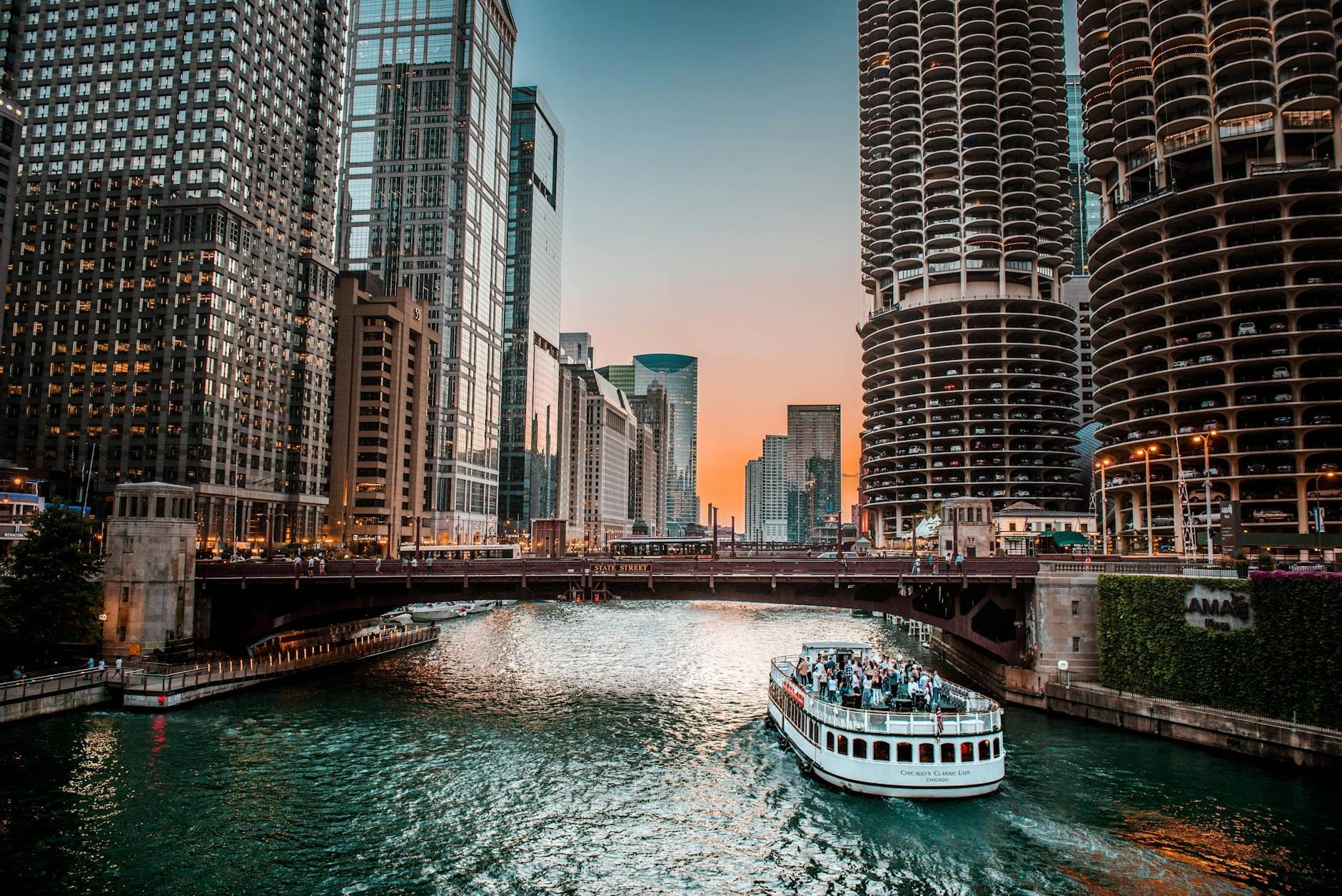
Along the way, docents reference more than 40 landmark buildings. Expect extended commentary on Marina City, those corncob towers completed in 1967 that were designed as a city within a city to keep residents from fleeing to the suburbs. Tribune Tower, a 1925 Gothic Revival competition winner studded with stones from famous structures worldwide, also gets significant attention. Willis Tower appears on the South Branch, framed in a way you simply cannot replicate from street level.
The docent-led format means the quality of your experience depends partly on your guide, but the CAC training program is extensive and consistent. Most guides are genuinely passionate about the subject, and questions are actively encouraged. The best docents shift their commentary based on what passengers find interesting, which makes no two cruises quite the same.
Tickets & tours
Hand-picked options from our booking partner. Prices are indicative; availability and final rates are confirmed when you complete your booking.
Chicago's River and Lake architecture speedboat cruise
From 37 €Instant confirmationWendella's 90 minute Chicago River architecture tour
From 39 €Instant confirmationFree cancellation45-Minute Chicago Architecture River Cruise
From 24 €Instant confirmationFree cancellationArchitecture cruise on the Chicago River from Michigan Ave
From 39 €Instant confirmationFree cancellation
How the Experience Changes by Time of Day
Morning departures, typically the first boats of the day, offer the coolest temperatures and the softest light. The river surface is calmer, and the upper deck is genuinely pleasant even in July. The buildings photograph well in morning light from the east, and the crowds on the Riverwalk are thinner when you board.
Midday cruises are the most popular, which means the boats fill up fastest and the upper deck can feel warm in summer. The light is harsher for photography but the city feels alive in a way that morning cruises don't quite capture: water taxis darting under bridges, kayakers weaving around the pylons, office workers eating lunch on the riverbanks.
Evening cruises are the most atmospheric option. As the sun drops behind the western towers, the canyon walls of the river take on a warm amber tone that makes even buildings you've seen a hundred times look different. The cocktail bar on board becomes a genuine draw rather than an afterthought. If you're deciding between a daytime and an evening departure, and the weather looks cooperative, the evening cruise tends to produce stronger memories.
💡 Local tip
For photography, bring a wide-angle lens or use your phone's ultrawide mode. The river is narrow in places and buildings rise steeply on both sides. A standard or telephoto lens will cut off the tops of structures in the dense downtown sections.
Historical and Architectural Context
Chicago's relationship with its river is one of the stranger stories in American urban history. In 1900, the city completed the reversal of the Chicago River's flow, pushing it away from Lake Michigan rather than into it, to protect the city's drinking water supply. That engineering feat changed the river's ecology permanently and opened the entire waterway to commercial barge traffic. The industrial era that followed left its mark on the riverbanks, which is why the lower portions of the river are flanked by massive foundations and service infrastructure rather than elegant promenades. The transformation of those industrial banks into the Chicago Riverwalk you see today began seriously in the 2000s and continued through the 2010s.
The architecture you see from the water spans roughly a century of innovation. The early skyscrapers of the 1880s and 1890s, built by the architects of the First Chicago School, established the steel-frame structural logic that every subsequent tall building would inherit. The postwar modernism of Mies van der Rohe, whose influence is visible in the clean glass and steel towers along the South Branch, gave the city a second identity. And the postmodern experiments of the 1980s and 1990s, including the neoclassical crowns and playful historicism of buildings like 333 W. Wacker Drive with its curved green-glass facade following the river bend, added a third layer. The CAC docents connect these threads in a way that makes the skyline legible rather than overwhelming. If architecture is a topic you want to explore more deeply before or after the cruise, the Chicago architecture guide covers the city's major movements and buildings in detail.
Practical Walkthrough: Getting There, Boarding, and What to Expect
The dock is at 112 E. Wacker Drive. From the street, you descend to the Riverwalk level via stairs near the black awning. If you are arriving by CTA, most L lines serving the Loop drop you within a short walk. Driving is possible: the garage at 111 E. Wacker Drive offers discounted parking for up to four hours with validation from the CAC box office or the dockside box office.
Wheelchair users should note that the main staircase entrance is not accessible. The Chicago Architecture Center indicates an ADA-compliant ramp to the Riverwalk at State Street and Wacker Drive, and accessible drop-off is available at Lower Wacker Drive. However, accessibility varies by specific vessel, so confirm current arrangements directly with the CAC before booking if this is a concern for your group.
Seating is general admission, so there is no reserved spot. If you want a specific position on the upper deck, board as early as boarding allows. The bow of the upper deck offers the widest forward views and is the most coveted position, but it is also the windiest and most exposed to spray when the boat turns. The indoor cabin is comfortable and allows you to follow the commentary without distraction, but the experience of being on the open upper deck on a clear day is not easily replicated from inside.
ℹ️ Good to know
The cruise operates rain or shine, and the indoor cabin means bad weather does not necessarily ruin the experience. That said, a cold rainy day will significantly reduce the pleasure of the upper deck. Check the forecast and dress in layers, especially for morning and evening departures in spring and fall.
Is the Cruise Worth the Price?
At roughly $57 per adult, this is one of the more expensive single-activity purchases a visitor to Chicago will make. Whether it justifies that cost depends on what you are after. For architecture enthusiasts, there is simply no comparable 90-minute experience in the city. The combination of moving perspective, expert commentary, and the physical scale of the buildings seen from water level delivers information and understanding that no guidebook or self-guided walk fully replicates.
For general visitors, the calculus is more personal. If you are in Chicago for two or three days and want a structured introduction to the city's most defining feature, this cruise is one of the highest-value ways to spend an afternoon. It works well as an orientation activity on a first day, before you start exploring neighborhoods on foot. The architecture boat tour guide breaks down the various tour operators if you want to compare options, though the CAC cruise is widely considered the most educational of the available choices.
Travelers who find lectures tedious, who prefer wandering independently, or who have already taken the cruise on a previous visit may get more value from a self-guided kayak trip on the river or simply walking the Riverwalk at their own pace. This is not an experience designed for passive sightseeing. If you tune out, you will still see the buildings, but you will lose most of what makes the cruise worth its price.
Season, Weather, and When to Book
The cruise operates seasonally, generally from March through November, with daily departures including evenings during peak season. Chicago's summer runs warm, with July averaging around 23-24°C (75°F), but the river creates its own microclimate and the upper deck can feel significantly cooler once the boat is moving. A light layer is sensible on any departure, and near-essential for evening cruises in May, September, and October.
Peak demand runs from late May through August. Weekend departures during this window sell out well in advance. Book online as soon as you know your dates, particularly if you are traveling with a group. The best time to visit Chicago is generally considered late May through early June or September, when temperatures are moderate and crowds are slightly thinner than peak July. Both windows are excellent for the cruise.
Insider Tips
- The departure dock is below street level and easy to walk past. The black awning on the Wacker Drive sidewalk is your landmark. If you see the Michigan Avenue Bridge, you have gone slightly too far east.
- Evening cruises in September are a particular sweet spot: the summer crowds have thinned, the light is warm and golden as the sun tracks lower on the horizon, and the temperatures are comfortable without requiring a heavy jacket.
- If you are traveling with someone who has mobility limitations, call the CAC directly rather than relying solely on the website for accessibility information. Specific boats in the fleet have different setups, and staff can match you to the most suitable departure.
- The indoor cabin offers a cleaner audio experience for the commentary if you have hearing difficulties or if wind noise is a concern. Many passengers start inside and move to the upper deck once the boat clears the densest downtown section.
- Combine the cruise with a visit to the Chicago Architecture Center's exhibition space and bookshop at 111 E. Wacker Drive before or after your departure. The exhibition adds useful context and the bookshop carries a genuinely good selection of architectural titles specific to Chicago.
Who Is Chicago Architecture Foundation River Cruise For?
- First-time visitors who want a structured introduction to Chicago's skyline and architectural history
- Architecture enthusiasts seeking expert-guided commentary on more than 50 landmark buildings
- Photographers wanting perspectives of downtown buildings that are inaccessible from street level
- Couples looking for a scenic evening experience on the water
- Travelers on a multi-day itinerary who want to orient themselves before exploring neighborhoods on foot
Nearby Attractions
Other things to see while in The Loop:
- Art Institute of Chicago
One of the largest and most visited art museums in the United States, the Art Institute of Chicago anchors the eastern edge of the Loop with a collection of over 300,000 works spanning 5,000 years. From Georges Seurat's pointillist masterpiece to Grant Wood's American Gothic, the highlights alone demand the better part of a day.
- Buckingham Fountain
The Clarence Buckingham Memorial Fountain is one of the largest decorative fountains in the world, sitting at the heart of Grant Park since 1927. Free to visit during its seasonal run from spring through mid-October, it puts on hourly water displays and a nightly illuminated show that draws crowds from across the city.
- Chicago Architecture Center
Housed in Mies van der Rohe's One Illinois Center on the Chicago River, the Chicago Architecture Center packs nearly 10,000 square feet of exhibition space, a landmark scale model of the city, and access to some of the country's most informative architecture tours. It's the most comprehensive entry point into understanding what makes Chicago's skyline one of the world's most significant.
- Chicago Blues Festival
Held each June in Millennium Park, the Chicago Blues Festival is the largest free blues festival in the world. Spread across multiple outdoor stages in the Loop, it draws tens of thousands of listeners for three days of core performances rooted in one of America's most influential musical traditions.