Buckingham Fountain: Chicago's Grand Water Show in Grant Park
The Clarence Buckingham Memorial Fountain is one of the largest decorative fountains in the world, sitting at the heart of Grant Park since 1927. Free to visit during its seasonal run from spring through mid-October, it puts on hourly water displays and a nightly illuminated show that draws crowds from across the city.
Quick Facts
- Location
- 301 S. Columbus Dr., Grant Park, Chicago, IL 60605
- Getting There
- CTA Red and Blue Lines to Monroe, or Brown/Green/Orange/Pink/Purple Lines to Adams/Wabash; short walk east into Grant Park from the Loop
- Time Needed
- 30–60 minutes; longer if you stay for the evening light display
- Cost
- Free
- Best for
- Families, architecture fans, evening strollers, photography
What Is Buckingham Fountain?
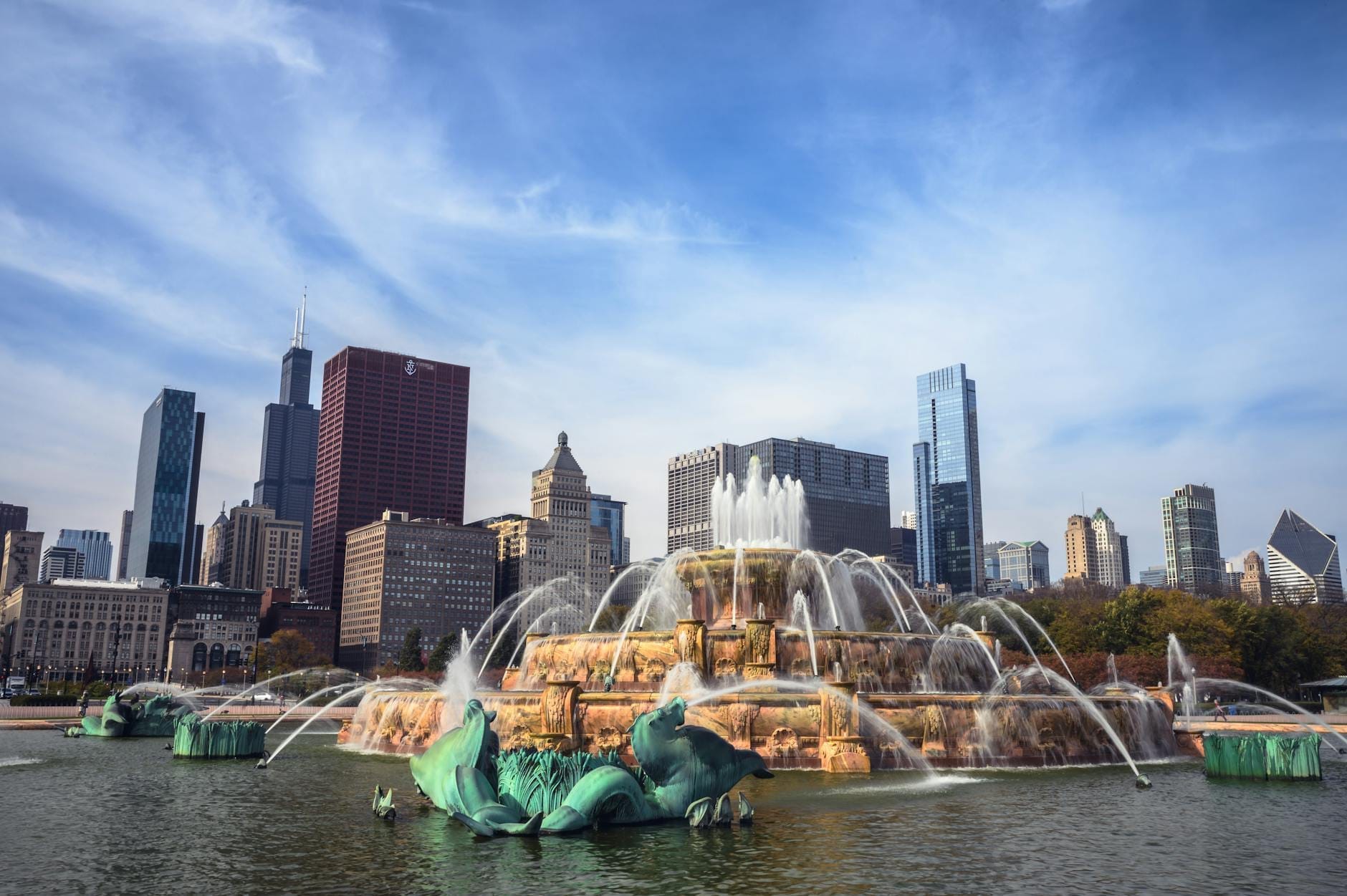
The Clarence Buckingham Memorial Fountain, dedicated in 1927, is one of the defining features of Chicago's lakefront and one of the largest decorative fountains anywhere in the world. It sits at the geographic and symbolic center of Grant Park, flanked by Columbus Drive to the west and a broad esplanade of paths and lawns that connect downtown to the lakeshore. The fountain was donated to the city by Kate Sturges Buckingham in memory of her brother Clarence, and it was designed in the rococo style by Edward Bennett, the architect who co-authored the 1909 Plan of Chicago alongside Daniel Burnham.
The design draws directly from the Latona Fountain at the Palace of Versailles, scaled up considerably. Four pairs of bronze sea horses ring the central basin, each representing one of the four states that border Lake Michigan: Illinois, Indiana, Wisconsin, and Michigan. The tiered structure rises in what is often described as a wedding cake silhouette, with each successive basin becoming narrower and more ornate as it ascends toward the central jet.
ℹ️ Good to know
Buckingham Fountain operates seasonally, typically from early May through mid-October, daily from 8:00 a.m. to 11:00 p.m. While in operation, the Fountain produces a major water display for 20 minutes every hour on the hour beginning at 9:00 a.m., and an evening light and music show takes place every hour after dusk during the operating season. The fountain is turned off outside this seasonal window.
The Water Display: What to Expect
For most of the day, the fountain runs in a continuous ambient mode: water cascades down the concentric basins and the central jet rises steadily, creating a constant hiss and mist that is audible from 50 feet away. The real event is the choreographed display that begins on the hour, when the pump system dramatically increases pressure and the central column of water shoots up to 150 feet into the air. On a still day, the spray drifts wide enough to reach anyone standing close to the outer rim, so keeping a short distance back is worth knowing in advance.
The evening light show is a different experience entirely. After dusk, colored lights illuminate the water from below, cycling through sequences that shift the appearance from cool white to deep blue, amber, and rose. Music plays over outdoor speakers during these evening displays, and this tends to draw the largest crowds of the day. If seeing the light show is a priority, arriving around 9:00 p.m. during peak summer evenings gets you a good position without a long wait.
💡 Local tip
Stand on the east side of the fountain, facing west toward the skyline, for the most dramatic combination of lit water and downtown towers in a single frame. This angle is particularly effective at the evening display.
Tickets & tours
Hand-picked options from our booking partner. Prices are indicative; availability and final rates are confirmed when you complete your booking.
Go City | Chicago All-Inclusive Pass
From 127 €Instant confirmationFree cancellationiFLY Chicago Lincoln Park indoor skydiving experience
From 126 €Instant confirmationFree cancellationiFLY Chicago Rosemont indoor skydiving tickets
From 117 €Instant confirmationFree cancellationChicago lakefront neighbourhood bike tour
From 18 €Instant confirmationFree cancellation
How the Experience Changes by Time of Day
Morning visits, particularly on weekdays before 9:00 a.m., are quieter than almost any other time. The fountain runs on its standard mode, the light is cool and direct, and you can walk up to the outer rim without navigating through groups. The sound of the water is clear and steady against a relatively quiet park. Joggers use the surrounding paths, and the skyline to the west catches the early eastern light at an angle that emphasizes the depth of the tower facades.
Midday in summer is the most crowded window. Lunch-hour foot traffic from the nearby Loop combines with tourists, and the hourly water display draws clusters of people who gather and then disperse. The area around the fountain can feel congested during display times in July and August. If you want to photograph the fountain without dense crowds in the foreground, early morning or a weekday afternoon in May or September are substantially better options.
Late afternoon brings a softer quality of light and a gradual increase in people heading through the park toward the lakefront. The transition from afternoon to evening, roughly 7:00–9:00 p.m. in summer, is arguably the most photogenic period: the sky holds color in the west, the fountain is still clearly lit by ambient light, and the building lights begin to activate without yet dominating. By the time full dark arrives and the official evening light-and-music displays are underway each hour, the crowd has grown but the atmosphere is noticeably more festive.
Historical and Cultural Context
When Buckingham Fountain opened in 1927, it was already an architectural statement about Chicago's ambitions. The city had been shaped by the 1909 Plan of Chicago, which envisioned Grant Park as the city's "front yard": a green buffer between the dense Loop and the lake, accessible to all residents. The fountain was placed at the park's axial center by design, positioned along Congress Parkway (now Ida B. Wells Drive) to create a formal terminus visible from Michigan Avenue.
The scale was intentional and significant. At the time of its construction, the central jet could pump roughly 14,000 gallons of water per minute, making it one of the most powerful fountain systems in the world. The bronze sea horses surrounding the basin are each more than a story tall, a detail that tends to surprise first-time visitors who expect the sculptural elements to be modest compared to the water display. Up close, the patina on the bronze is dense and detailed, with scales and fins that reward close examination.
Buckingham Fountain sits within Grant Park, which itself connects directly to the broader lakefront culture of Chicago. It is a short walk from Millennium Park and Cloud Gate to the north, and positioned at the edge of the Museum Campus corridor to the south. Understanding this geography helps frame the fountain not as a standalone stop but as a natural waypoint on any walk along the lakefront. For context on how it fits into the larger park system, the Grant Park guide covers the surrounding area in detail.
Getting There and Getting Around
The fountain is accessible from multiple directions. From the Loop, the most direct route on foot is east along Ida B. Wells Drive (formerly Congress Parkway), which terminates at the fountain's main plaza. This walk takes about 10 minutes from the State Street corridor. From Millennium Park to the north, a straightforward path leads south through the park in roughly 15 minutes, passing the Jay Pritzker Pavilion lawns along the way.
By CTA, the closest train stops are Monroe (Red and Blue Lines on the subway) and Adams/Wabash (Brown, Green, Orange, Pink, and Purple elevated Lines). The walk from either station is under 15 minutes. If you are building a longer itinerary, the fountain pairs naturally with a visit to the nearby Art Institute of Chicago, which sits just one block north on Michigan Avenue. For a full day in the area, the Chicago lakefront guide maps out how to connect the fountain with the trail, beaches, and museum campus to the south.
Parking in Grant Park is available in underground garages accessible from Columbus Drive and Michigan Avenue, but driving specifically to see the fountain is rarely the most efficient choice given traffic patterns around the Loop. The park is designed for pedestrian access, and the surrounding streets are straightforward to navigate on foot or by bike. The Divvy bike-share network has multiple docking stations near the park perimeter.
⚠️ What to skip
The fountain's seasonal shutdown means that visiting between late October and late April will leave you looking at an empty basin. Check the operating season before planning your trip around the water display specifically.
Photography and Practical Notes
The fountain is a well-documented subject, which means originality requires some thought. The standard tourist frame, shot from the main western approach with the skyline behind the fountain, is effective but extremely common. More interesting compositions come from the eastern side, shooting back toward the city, or from low angles at the outer rim during an active display when water fills the lower third of the frame. A wide-angle lens handles the full structure comfortably at about 30 feet of distance; getting the entire fountain plus a meaningful skyline in one shot requires more distance and a focal length below 35mm on a full-frame body.
Smartphone photography works well for the evening display because the colored light is bright enough to expose correctly without long shutter speeds. Daytime photography in direct summer sun can flatten the sculpture's detail; slightly overcast conditions produce more even light across the white limestone and bronze. If you bring a tripod for long-exposure night photography, be aware that the fountain plaza is a pedestrian thoroughfare and you will need to manage foot traffic around your setup.
Accessibility around the fountain is generally good: the surrounding plaza is paved and flat, with wide paths suitable for strollers and wheelchairs. The fountain itself is not interactive in the way that Crown Fountain or other splash features in the park are, so it functions primarily as a viewing attraction rather than an activity. For travelers with children looking for something more hands-on, Crown Fountain in Millennium Park offers a more interactive water experience for kids.
When to Visit and What to Expect by Season
Late spring, specifically May and early June, is a strong window to visit. The fountain has recently opened for the season, the park's plantings are fresh, and temperatures typically sit in the 15–22 °C range (60–70 °F), comfortable for extended outdoor time. Summer, from late June through August, is the peak tourist season and the evening displays draw the largest audiences, but daytime heat and crowds can make the experience feel congested. September is arguably the best month overall: temperatures moderate, tourist volume drops, and the light takes on the lower angle that defines autumn photography.
For a broader picture of how seasonal conditions affect the entire city experience, the best time to visit Chicago guide covers monthly weather, events, and crowd patterns in detail. If you are planning a summer visit specifically, the Chicago in summer guide details what else is happening in and around Grant Park during the warmer months.
Insider Tips
- Arrive 5 minutes before the top of the hour and position yourself on the east side of the fountain to watch the pressure build before the full display launches. The ramp-up from ambient flow to the full 150-foot central jet takes about 30 seconds and is more dramatic than most people expect.
- The mist from the display drifts noticeably on windy days, often covering a wide radius around the fountain. In warm weather this is refreshing; if you are carrying camera gear or wearing something you do not want wet, check the wind direction before positioning yourself.
- The stretch of Columbus Drive between the fountain and the Art Institute is one of the better vantage points for photographing the fountain with depth: the flanking trees frame the shot and the distance compresses the scale relationship between the fountain and the tower facades behind it.
- During the evening light show on weekends in July and August, the area immediately surrounding the fountain fills quickly. If you want a clear view of the display without crowds, visit on a weeknight or aim for the second or third display of the evening rather than the first after dark.
- The fountain appears as a background element in the opening credits of the television series Married with Children, which ran from 1987 to 1997, giving it a pop-culture reference point that resonates with a specific generation of American visitors.
Who Is Buckingham Fountain For?
- Families wanting a free outdoor landmark that holds a child's attention during the hourly water display
- Architecture and urban design enthusiasts interested in the 1909 Plan of Chicago and Beaux-Arts civic design
- Photographers looking for a subject that rewards different times of day, especially at dusk and during the evening light show
- Travelers building a lakefront walking route between the Loop, Millennium Park, and the Museum Campus
- Anyone visiting Chicago in late summer who wants a central, no-cost gathering point in the city's most accessible park
Nearby Attractions
Other things to see while in The Loop:
- Art Institute of Chicago
One of the largest and most visited art museums in the United States, the Art Institute of Chicago anchors the eastern edge of the Loop with a collection of over 300,000 works spanning 5,000 years. From Georges Seurat's pointillist masterpiece to Grant Wood's American Gothic, the highlights alone demand the better part of a day.
- Chicago Architecture Center
Housed in Mies van der Rohe's One Illinois Center on the Chicago River, the Chicago Architecture Center packs nearly 10,000 square feet of exhibition space, a landmark scale model of the city, and access to some of the country's most informative architecture tours. It's the most comprehensive entry point into understanding what makes Chicago's skyline one of the world's most significant.
- Chicago Architecture Foundation River Cruise
The Chicago Architecture Center River Cruise aboard Chicago's First Lady is the most authoritative way to read the city's skyline. In 90 minutes, trained docents walk you through more than 40 landmark buildings across all three branches of the Chicago River, connecting architectural styles to the human decisions that shaped them.
- Chicago Blues Festival
Held each June in Millennium Park, the Chicago Blues Festival is the largest free blues festival in the world. Spread across multiple outdoor stages in the Loop, it draws tens of thousands of listeners for three days of core performances rooted in one of America's most influential musical traditions.