Chicago Blues Festival: Four Days of Free Blues in the Heart of the City
Held each June in Millennium Park, the Chicago Blues Festival is the largest free blues festival in the world. Spread across multiple outdoor stages in the Loop, it draws tens of thousands of listeners for three days of core performances rooted in one of America's most influential musical traditions.
Quick Facts
- Location
- Millennium Park, 201 E. Randolph St., Chicago, IL 60602 (The Loop)
- Getting There
- CTA 'L': Washington/Wabash (Green, Pink, Orange, Brown lines) or Millennium Station (Metra Electric). Multiple CTA bus routes along Michigan Ave.
- Time Needed
- 2–6 hours per day; many visitors return on multiple days
- Cost
- Free admission. No tickets required.
- Best for
- Music lovers, first-time Chicago visitors, families, budget travelers
What the Chicago Blues Festival Actually Is
The Chicago Blues Festival is an annual, multi-day outdoor event organized by the City of Chicago's Department of Cultural Affairs and Special Events (DCASE). It is widely described as the largest free blues festival in the world, drawing hundreds of thousands of attendees across its run. In 2026, the festival is scheduled for Thursday, June 4 through Sunday, June 7, with a June 4 kickoff event at Ramova Theatre followed by June 5–7 performances in Millennium Park — multiple stages, zero admission cost.
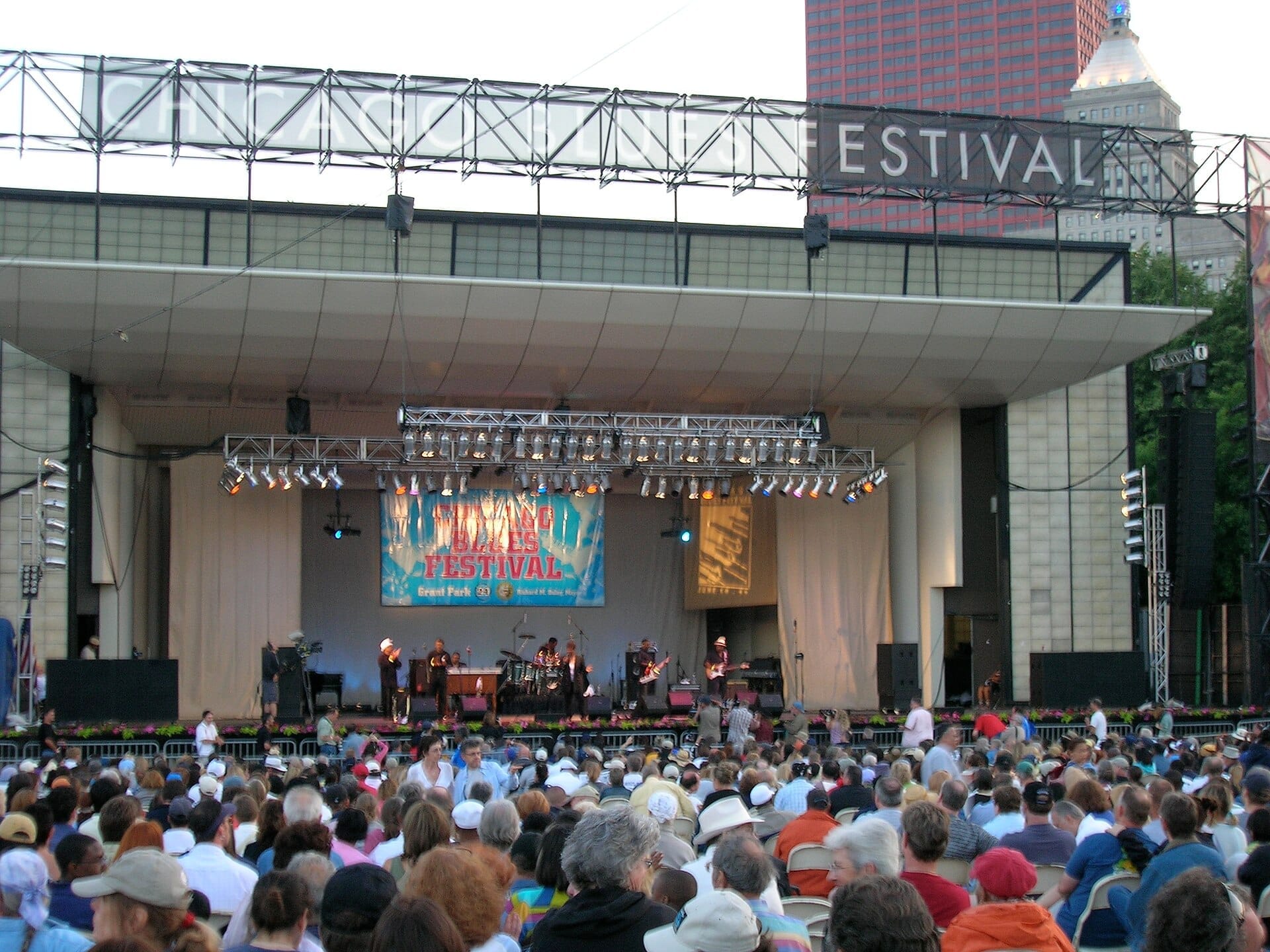
Since 2017, the festival has been staged in Millennium Park, placing it inside one of the most architecturally significant public spaces in the United States, with the downtown skyline forming a literal backdrop to the performances. Before that, it was held in nearby Grant Park for decades. The move to Millennium Park concentrated the festival into a more intimate layout without reducing its scale.
ℹ️ Good to know
Admission is free for all official festival performances in Millennium Park. You generally do not need to register or collect a wristband for park shows, though special kickoff events at venues like Ramova Theatre may require advance (but free) reservations. Simply arrive, find a spot, and listen.
The Sound and Feel of Being There
Blues music has a physical quality that comes through differently outdoors than in a bar or club. At Millennium Park, with the Jay Pritzker Pavilion's steel bandshell projecting sound across the Great Lawn, the low end of a resonator guitar or the rasp of an amplified harmonica travels through the air with unusual clarity. When the wind comes off Lake Michigan — just a few blocks east — it mixes with the smell of food vendor smoke and carries the sound in unpredictable directions. You may hear a set most clearly from 30 rows back rather than at the rail.
The crowd is genuinely mixed in a way that few large urban events manage. You will find older Black Chicagoans who grew up with the South Side blues tradition, young festival-goers who discovered the genre through a streaming algorithm, international tourists comparing notes in three languages, and local families who have been coming every June for years. By Sunday afternoon, the crowd at the main stage often includes a contingent of dedicated listeners who have staked out spots on the lawn with folding chairs and coolers, treating the whole thing like a neighborhood gathering.
The smaller side stages tend to offer more exploratory programming: deeper cuts, regional artists, and styles like electric Delta blues or Chicago soul that complement the headliners. If you want to understand why Chicago specifically matters to blues history, those stages are where you learn more than the main stage will teach you. For context on how blues fits into Chicago's broader musical identity, the Chicago blues and jazz guide covers the South Side clubs and venues that shaped the tradition long before it reached a festival stage.
Tickets & tours
Hand-picked options from our booking partner. Prices are indicative; availability and final rates are confirmed when you complete your booking.
Go City | Chicago All-Inclusive Pass
From 127 €Instant confirmationFree cancellationiFLY Chicago Lincoln Park indoor skydiving experience
From 126 €Instant confirmationFree cancellationiFLY Chicago Rosemont indoor skydiving tickets
From 117 €Instant confirmationFree cancellationChicago lakefront neighbourhood bike tour
From 18 €Instant confirmationFree cancellation
Historical Context: Why Chicago and Why Blues
Chicago's relationship with blues music is not incidental. The Great Migration brought hundreds of thousands of African Americans from the Deep South to Chicago between roughly the 1910s and 1970s, and with them came musical traditions rooted in Mississippi Delta and other Southern styles. Musicians like Muddy Waters, Howlin' Wolf, and Buddy Guy arrived in Chicago and transformed those acoustic traditions into an electrified urban sound that would influence rock, soul, and eventually almost every major popular genre of the 20th century.
The Chicago Blues Festival was first held in 1984, launched in part as a tribute to the recently deceased Muddy Waters and as a civic acknowledgment of the music's cultural importance to the city. What began as a weekend event has grown into a multi-day affair with several stages running simultaneously. The festival does not just celebrate blues as nostalgia — its programming consistently includes contemporary artists carrying the tradition forward, alongside legends and historical tributes.
If the festival sparks a deeper interest, Buddy Guy's Legends — the club owned by the Grammy-winning Chicago guitarist — is one of the best places in the city to hear live blues in an intimate indoor setting, year-round.
How the Days Differ: Morning vs. Evening, Weekday vs. Weekend
Thursday and Friday tend to be the least crowded days, especially during the early afternoon. If you want to get close to a stage without battling for position, an early weekday session is your window. The park feels almost relaxed: people spread out on the lawn, some office workers eating lunch nearby, the vendor queues manageable. Sound checks and opening acts run lower energy sets, but the production quality is already full.
Saturday and Sunday draw the largest crowds, particularly in the late afternoon and evening hours before the main stage headliner. By 4 p.m. on Saturday, the Great Lawn fills quickly, and the areas around the Pritzker Pavilion's overhead trellis speaker system become densely packed. The atmosphere shifts: vendors sell out of popular items, the noise level rises between sets, and navigating between stages requires patience. That said, the energy is also at its peak — these are the sessions where the crowd responses become part of the performance.
💡 Local tip
Arrive by 1 p.m. on weekend days if you want a seated position on the main lawn with a clear sightline. By 3 p.m. on Saturday or Sunday, standing room only is common near the Pritzker Pavilion stage.
Getting There and Navigating the Site
Millennium Park sits at the northeast corner of the Loop, bounded roughly by Michigan Avenue to the west and Columbus Drive to the east, between Randolph and Monroe Streets. The park has multiple entry points; for festival purposes, the main entrances are off Randolph Street (north) and Monroe Street (south).
By CTA 'L', the most direct stop is Washington/Wabash on the elevated loop, served by Green, Pink, Orange, and Brown lines — about a five-minute walk to the park. The Millennium Station underground Metra commuter rail stop on Randolph Street puts you directly at the park's north edge. Multiple bus routes along Michigan Avenue also serve the area. For a broader look at moving around the city during festival weekend, the guide to getting around Chicago covers CTA passes and transit options in detail.
Driving is possible but parking near Millennium Park is expensive and fills quickly on weekend afternoons. Rideshare drop-offs are best arranged on side streets rather than Michigan Avenue, which sees significant traffic during the festival. The CTA is genuinely the more practical option.
Inside the park, the festival uses the Jay Pritzker Pavilion as the primary main stage. Smaller secondary stages are positioned around the park's layout. Wayfinding signage is posted throughout, but the park is compact enough that you can walk between stages in under five minutes. Food and beverage vendors line the perimeter of the event footprint. Chairs are permitted on the Great Lawn; blankets work well on the grass areas.
⚠️ What to skip
June in Chicago can bring sudden afternoon thunderstorms. The festival has historically paused or delayed performances during lightning. Check weather forecasts on the morning of each day you plan to attend, and bring a compact rain layer.
Practical Details: What to Bring, Accessibility, and Photography
Because the festival is free and outdoors, the logistics are simpler than most ticketed events. General park security screening is in place and large bags or coolers may be restricted or subject to additional inspection, and policies can change year to year, but large backpacks reliably draw security attention. A lightweight daypack with water, sunscreen, a portable phone charger, and a folding blanket covers most needs. Comfortable shoes matter: you will be standing on pavement and grass for hours.
Millennium Park is wheelchair accessible, with paved paths throughout and accessible viewing areas at the Pritzker Pavilion. The City of Chicago's accessibility page for the park confirms accessible entrances and routes. Festival-specific accessibility services such as designated viewing areas and ASL interpretation vary by year and are typically detailed on the official DCASE event page ahead of the festival.
Photography with personal cameras and smartphones is permitted throughout the festival grounds. The Pritzker Pavilion's geometric steel frame provides strong compositional context for photos taken from behind the crowd, looking toward the stage. For photography of the park itself outside festival hours, the Cloud Gate sculpture nearby offers some of Chicago's most distinctive reflective imagery — worth visiting before or after a festival session.
Who Will Love This and Who Might Not
The Chicago Blues Festival suits people who are comfortable in large outdoor crowds and who have at least a passing interest in roots music. It is one of the few events in Chicago where budget is not a barrier to a genuinely high-quality experience: the lineup regularly features internationally recognized artists, and the production values at the main stage are professional. For families, it is accessible and low-pressure — children are common, there is open space to move around, and the schedule is self-directed.
Visitors with no tolerance for heat, crowds, or variable acoustics may find the experience frustrating, particularly on peak weekend afternoons. If you prefer discovering blues in a smaller, more controlled environment, a weeknight at a South Side or Near North club will serve you better. The Green Mill Cocktail Lounge and Kingston Mines offer that kind of intimacy year-round, and the festival itself is a good reason to plan an entire music-focused trip around Chicago in early June.
Insider Tips
- The secondary stages tend to feature less commercially known artists who often give technically sharper, more emotionally raw performances than the headliners. Budget at least one session entirely at a side stage rather than the Pritzker Pavilion main stage.
- Weekday (Thursday or Friday) afternoons are significantly less crowded. If your schedule allows flexibility, an early Friday session gives you a close-up experience of artists who will draw massive crowds by Sunday.
- Food vendors inside the festival perimeter are convenient but pricy. The Loop has dozens of quick-service options within a few blocks — pick up a meal before entering and bring it in. Sealed water bottles are generally permitted.
- The park's overhead speaker trellis at the Pritzker Pavilion distributes sound evenly across the Great Lawn. Sitting 20–40 rows back from the stage often produces better audio than pressing against the front rail, where stage monitors can create an uneven mix.
- Check the DCASE official event page for the daily schedule before each morning of the festival. Set times are released in advance and some high-demand sets fill the sightlines quickly — knowing the schedule lets you position yourself early for the performances that matter most to you.
Who Is Chicago Blues Festival For?
- Music lovers seeking world-class blues performances without a ticket cost
- First-time Chicago visitors who want to experience the city's cultural identity in a single afternoon
- Budget travelers looking for a full-day, high-quality experience with no admission barrier
- Families with older children comfortable in outdoor crowd settings
- International visitors curious about the African American musical traditions that shaped Chicago's South Side
Nearby Attractions
Other things to see while in The Loop:
- Art Institute of Chicago
One of the largest and most visited art museums in the United States, the Art Institute of Chicago anchors the eastern edge of the Loop with a collection of over 300,000 works spanning 5,000 years. From Georges Seurat's pointillist masterpiece to Grant Wood's American Gothic, the highlights alone demand the better part of a day.
- Buckingham Fountain
The Clarence Buckingham Memorial Fountain is one of the largest decorative fountains in the world, sitting at the heart of Grant Park since 1927. Free to visit during its seasonal run from spring through mid-October, it puts on hourly water displays and a nightly illuminated show that draws crowds from across the city.
- Chicago Architecture Center
Housed in Mies van der Rohe's One Illinois Center on the Chicago River, the Chicago Architecture Center packs nearly 10,000 square feet of exhibition space, a landmark scale model of the city, and access to some of the country's most informative architecture tours. It's the most comprehensive entry point into understanding what makes Chicago's skyline one of the world's most significant.
- Chicago Architecture Foundation River Cruise
The Chicago Architecture Center River Cruise aboard Chicago's First Lady is the most authoritative way to read the city's skyline. In 90 minutes, trained docents walk you through more than 40 landmark buildings across all three branches of the Chicago River, connecting architectural styles to the human decisions that shaped them.