Art Institute of Chicago: What to Know Before You Go
One of the largest and most visited art museums in the United States, the Art Institute of Chicago anchors the eastern edge of the Loop with a collection of over 300,000 works spanning 5,000 years. From Georges Seurat's pointillist masterpiece to Grant Wood's American Gothic, the highlights alone demand the better part of a day.
Quick Facts
- Location
- 111 S Michigan Ave, Chicago, IL — Grant Park, The Loop
- Getting There
- CTA Brown, Green, Orange, Pink, Purple lines to Adams/Wabash; or Red/Blue lines to Monroe or Jackson
- Time Needed
- 2–5 hours depending on focus; a full sweep takes most of a day
- Cost
- Adults $32 (non-resident); Chicago residents $20; under-14 always free; select Thursday evenings are free for Illinois residents
- Best for
- Art lovers, architecture fans, rainy-day culture seekers, families with older children
- Official website
- www.artic.edu
What You're Walking Into
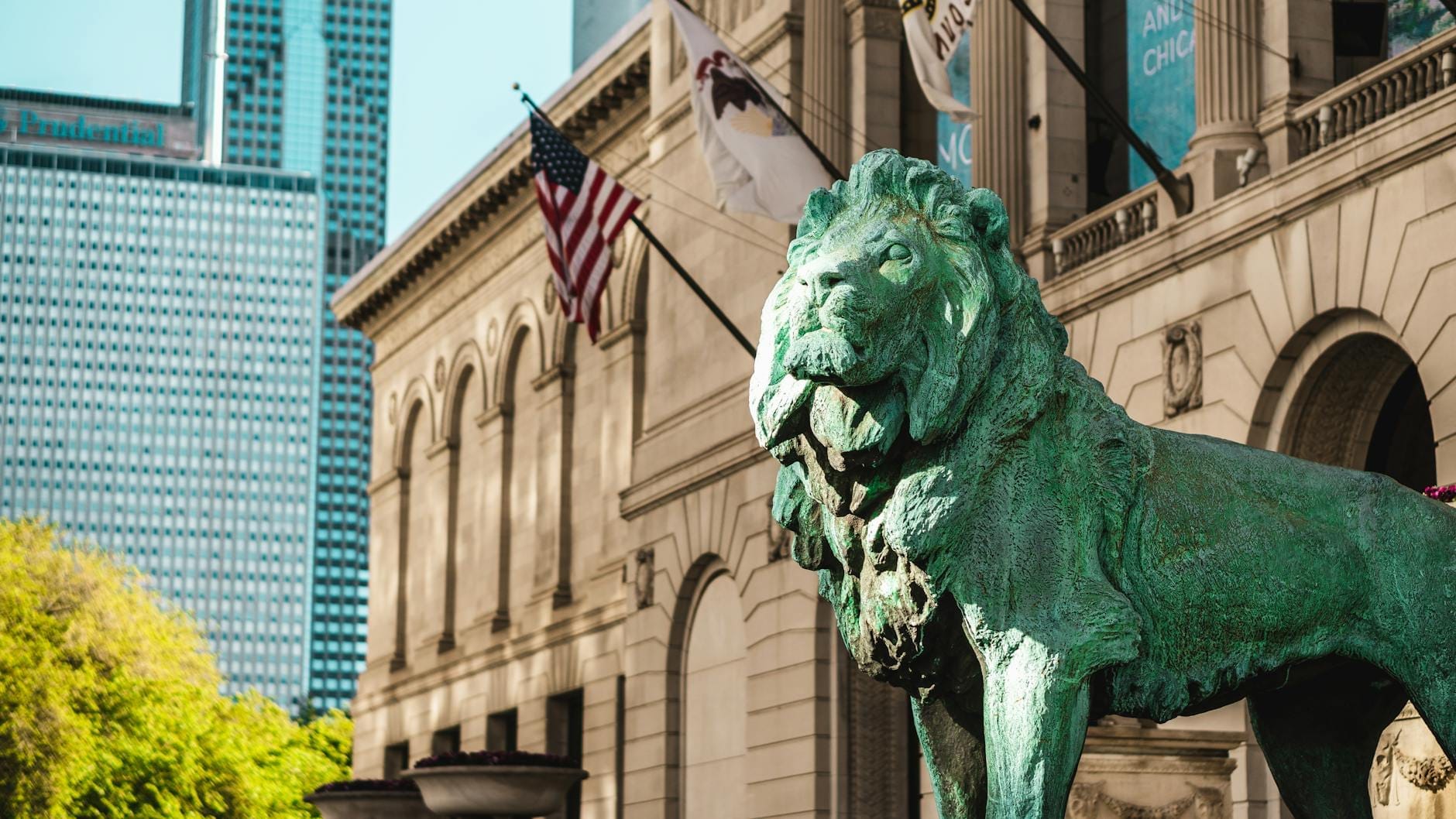
The Art Institute of Chicago is not a single building so much as a layered campus that has grown outward from its 1893 Beaux Arts core. That original structure, designed by Boston firm Shepley, Rutan & Coolidge for the World's Columbian Exposition, still forms the main entrance on South Michigan Avenue: two bronze lions flank the staircase, worn smooth by decades of photographs and the occasional impromptu hat from sports championship celebrations. Step through and you're inside one of the largest art museums in the country, housing roughly 300,000 works across departments covering everything from ancient Egyptian artifacts to contemporary video installation.
The building has expanded eight times since 1893. The most transformative addition is the Modern Wing, designed by Renzo Piano and opened in 2009, which added 264,000 square feet and increased gallery space by about 30 percent. Piano's structure connects to Millennium Park via the pedestrian Nichols Bridgeway, creating a cultural corridor that most visitors don't fully appreciate until they're walking it. The Modern Wing reads as a deliberate counterpoint to the Beaux Arts original: white steel, filtered light, and an open floor plan that makes navigation feel intuitive rather than maze-like.
💡 Local tip
Buy tickets online in advance, especially on weekends and during summer. Walk-up lines at the admissions desk can add 20–30 minutes to your arrival. The museum's own website (artic.edu) is the most reliable source for current pricing and any promotional free days.
The Collection: Where to Focus Your Time
With 300,000 objects across multiple floors and wings, the Art Institute rewards deliberate visitors more than those who try to see everything. A few anchors are genuinely worth orienting your day around. In the Impressionist and Post-Impressionist galleries on the second floor of the original building, you'll find one of the strongest concentrations of French Impressionist painting outside of Paris, including Georges Seurat's A Sunday on La Grande Jatte (1884), which commands its own wall and draws a near-constant crowd. Up close, the sheer mechanical precision of the pointillist dots is more striking than any reproduction suggests.
American art occupies a substantial floor of the original wing. Grant Wood's American Gothic and Edward Hopper's Nighthawks are here, two of the most recognized images in American visual culture, both smaller in person than people expect. Nighthawks in particular benefits from extended attention: the painting's light source has no visible origin, a detail that becomes unsettling once you notice it. Mary Cassatt, Winslow Homer, and Georgia O'Keeffe are well represented in adjacent galleries, making this section a genuine survey of American painting rather than just a shrine to two famous canvases.
The Thorne Miniature Rooms, tucked on the lower level, are consistently undervisited and reliably fascinating: 68 miniature interior spaces recreating European and American room design from the 13th century through the 1930s, built at 1:12 scale with period-accurate furnishings. The rooms reward the kind of slow, close-up looking that larger galleries rarely encourage. For architecture specifically, the Trading Room from Adler & Sullivan's Chicago Stock Exchange (1893, demolished 1972) was salvaged and reconstructed inside the museum and remains one of the finest examples of Louis Sullivan's ornamental work in existence.
Tickets & tours
Hand-picked options from our booking partner. Prices are indicative; availability and final rates are confirmed when you complete your booking.
Go City | Chicago All-Inclusive Pass
From 127 €Instant confirmationFree cancellationArt Institute of Chicago tickets and self-guided audio tour
From 49 €Instant confirmationArt Institute of Chicago Guided Tour with Skip-the-Line Tickets
From 63 €Instant confirmationFree cancellationThe Art Institute of Chicago: private skip-the-line tour
From 124 €Instant confirmationFree cancellation
Hours, Prices, and Free Admission Options
The Art Institute is open Monday, Wednesday, Friday, Saturday, and Sunday from 11:00 to 17:00, with extended hours on Thursday until 20:00; it is currently closed on Tuesdays. Members get an additional hour from 10:00 to 11:00 on open days, which is worth noting if you're considering a membership for a longer stay in Chicago.
General admission for non-resident adults is $32. Chicago residents pay $20 with proof of residency, and Illinois residents pay $27. Seniors (65+), students, and teens 14–17 qualify for reduced rates across all residency categories. Children under 14 are always free. Chicago teens under 18 also enter free. LINK and WIC cardholders receive free admission, as do Illinois educators on any open day. On select Thursday evenings, Illinois residents can enter for free, though these dates vary and should be confirmed directly with the museum before your visit.
ℹ️ Good to know
A Fast Pass ticket (currently $40 for non-resident adults) allows timed entry without the admissions queue, worth considering on summer weekends or when a major ticketed exhibition is running alongside the permanent collection.
If your Chicago itinerary already includes several paid attractions, check whether the Chicago CityPASS covers the Art Institute in its current bundle — it has in past editions, though inclusions change annually.
How the Experience Changes by Time of Day
Arriving right at opening (11:00 on most days) gives you the quietest experience of the popular galleries. The Impressionist rooms in particular are noticeably less crowded in the first hour, and the overhead skylights in several of the original wing's galleries cast a different quality of light in the morning than in the early afternoon, when it becomes more diffuse. The Seurat is best seen without a crowd pressing behind you.
Midday, roughly noon to 14:00, is peak volume. School groups are most common on weekday late mornings. If you arrive during this window, the Modern Wing galleries and the Photography and Media Arts departments tend to be calmer than the Impressionist and American rooms. The museum's restaurant, formerly Terzo Piano, was on the third floor of the Modern Wing with views toward Millennium Park and Lake Michigan, though on-site dining offerings and names can change; check the museum’s website for the current restaurant setup. A cafe is also available at lower-level access for lighter options.
Thursday evenings are worth considering independently of any free-admission benefit. Extended hours until 20:00 mean lower visitor counts in the late afternoon as day visitors cycle out. The lighting in the galleries shifts perceptibly after 17:00, and the atmosphere becomes noticeably calmer. The main entrance staircase after dark, with the bronze lions lit from below, is an entirely different visual experience from the midday scene.
Getting There and Navigating the Neighborhood
The Art Institute sits at the intersection of South Michigan Avenue and East Adams Street, directly across from the elevated 'L' tracks. The closest CTA stations are Adams/Wabash (Brown, Green, Orange, Pink, and Purple lines) and Monroe or Jackson on the Red Line. The museum is about a 10-minute walk from Millennium Park, which makes it easy to combine both in a single afternoon. For the broader Loop context, the Loop neighborhood is compact and walkable, with most major architecture and public art within a 15-minute radius.
If you're combining the Art Institute with outdoor time, Grant Park directly surrounds the museum to the south and east, and the lakefront is a 10-minute walk. The Renzo Piano bridge from the Modern Wing connects directly to Millennium Park, making it the most elegant way to transition between the two without returning to street level.
Parking in this area is expensive and congested, particularly on weekends and during summer events in Grant Park. Public transit or rideshare drop-off on Michigan Avenue is strongly preferable. Bicycle parking is available near the Michigan Avenue entrance. For visitors with mobility considerations, the museum has elevator access throughout both wings; the checkroom is free for all visitors, which is useful if you're arriving with a bag or coat.
⚠️ What to skip
The North and South Gardens adjacent to the Michigan Avenue entrance may close during major downtown events such as Lollapalooza or other Grant Park programming. Check the museum's website if your visit falls during a large outdoor event weekend.
Architecture as Part of the Visit
The building itself deserves attention alongside the collection. The 1893 Beaux Arts facade is one of Chicago's most photographed exterior surfaces, particularly the granite staircase and the arched entrance portal. Inside, the Trading Room from the demolished Chicago Stock Exchange is a designated landmark interior: Louis Sullivan's geometric and botanical ornament covers the ceiling and capitals in a palette of gold and forest green that has to be seen at close range to appreciate. For visitors interested in Chicago's architectural significance more broadly, the Chicago architecture guide provides context on how the Art Institute fits into the city's design history.
Renzo Piano's Modern Wing is a case study in how to add contemporary architecture to a historic institution without either deferring too meekly or dominating too aggressively. The natural light system, designed to diffuse direct sunlight through a steel-and-glass ceiling structure Piano calls a 'flying carpet,' means the galleries on clear days have a quality of illumination that feels closer to a studio than a conventional museum. The transition between the 1893 wing and the 2009 wing, which you cross through Griffin Court, is one of the more interesting moments of spatial contrast available to the general public in Chicago.
Who Should Reconsider and What to Set Aside
The Art Institute is large enough that museum fatigue is a genuine concern. Visitors who arrive expecting to 'do' the whole collection in two hours will find themselves skimming rather than seeing. If your interest is primarily in a few specific works or departments, identify those in advance on the museum's online collection search tool and route your visit deliberately. The building's multiple wings and floor levels can feel disorienting on a first visit without a plan.
Families with very young children will find the scale challenging, though children under 14 enter free. The Ryan Learning Center on the lower level has age-oriented programming and interactive displays that can anchor a visit for younger visitors while adults spend time in the galleries. The museum is not recommended as a quick stop between other Loop activities — the entry price and the building's sheer scale mean it functions best as the primary focus of a half-day or full day.
For visitors whose primary interest is the city's physical fabric rather than fine art, the Chicago Architecture Foundation River Cruise and the Chicago Architecture Center a few blocks north may represent a better use of limited time.
Insider Tips
- The Thorne Miniature Rooms on the lower level are consistently overlooked by first-time visitors and almost never crowded — plan at least 20 minutes there even if miniatures aren't your usual interest.
- Thursday evenings (open until 20:00) offer the best combination of low crowds and fully lit galleries. If you're an Illinois resident, check current free Thursday Evening dates on the museum website before your trip.
- The Griffin Court bridge connecting the Modern Wing to Millennium Park is the quietest exit route after a visit and deposits you directly near Cloud Gate — use it rather than doubling back to Michigan Avenue.
- The museum's online collection database (artic.edu/collection) lets you search and favorite specific works before your visit, which makes it far easier to plan a focused route through a building with 300,000 objects.
- Audio guides are available via the museum's free mobile app. Download it on WiFi before entering — cellular connectivity can be inconsistent in the lower-level galleries.
Who Is Art Institute of Chicago For?
- Art and design enthusiasts who want depth, not just highlights
- Architecture-focused visitors: the Sullivan Trading Room alone is worth the admission
- Rainy or cold days when outdoor Chicago itineraries need a full-day indoor anchor
- Families with children over 8 who can handle longer gallery time
- Solo travelers who want to spend a half-day in close contact with major works without a fixed itinerary
Nearby Attractions
Other things to see while in The Loop:
- Buckingham Fountain
The Clarence Buckingham Memorial Fountain is one of the largest decorative fountains in the world, sitting at the heart of Grant Park since 1927. Free to visit during its seasonal run from spring through mid-October, it puts on hourly water displays and a nightly illuminated show that draws crowds from across the city.
- Chicago Architecture Center
Housed in Mies van der Rohe's One Illinois Center on the Chicago River, the Chicago Architecture Center packs nearly 10,000 square feet of exhibition space, a landmark scale model of the city, and access to some of the country's most informative architecture tours. It's the most comprehensive entry point into understanding what makes Chicago's skyline one of the world's most significant.
- Chicago Architecture Foundation River Cruise
The Chicago Architecture Center River Cruise aboard Chicago's First Lady is the most authoritative way to read the city's skyline. In 90 minutes, trained docents walk you through more than 40 landmark buildings across all three branches of the Chicago River, connecting architectural styles to the human decisions that shaped them.
- Chicago Blues Festival
Held each June in Millennium Park, the Chicago Blues Festival is the largest free blues festival in the world. Spread across multiple outdoor stages in the Loop, it draws tens of thousands of listeners for three days of core performances rooted in one of America's most influential musical traditions.