Millennium Park: Chicago's 24-Acre Rooftop Park Explained
Millennium Park sits at the northern edge of Grant Park in the Loop, covering 24.5 acres above underground parking garages and a commuter rail line. Admission is free, the art is world-class, and the crowds are predictable once you know when to arrive. Here is everything worth knowing before you go.
Quick Facts
- Location
- 201 E. Randolph St., Chicago Loop — bounded by Michigan Ave, Columbus Dr, Randolph St, and Monroe St
- Getting There
- Multiple CTA 'L' stations at the Loop perimeter (Brown, Green, Orange, Pink, Purple lines at Randolph/Wabash); Metra Millennium Station on Randolph St
- Time Needed
- 1–2 hours for a relaxed walk; 3+ hours if attending a Pritzker Pavilion concert or exploring Lurie Garden in depth
- Cost
- Free admission to the park; some special events require separate tickets
- Best for
- Architecture lovers, families with young children, photography, free outdoor concerts, picnics in warm weather
- Official website
- www.chicago.gov/city/en/depts/dca/supp_info/millennium_park.html
What Millennium Park Actually Is
Millennium Park opened on July 16, 2004, on a site that had been a railyard and surface parking lot for decades. The transformation was radical: a 24.5-acre public space built as a rooftop garden above two multi-level parking garages holding roughly 4,000 cars and an active Metra commuter rail line below. By that engineering logic alone, the ground you walk on here is technically one of the largest green roofs on earth.
The park sits in the Loop — Chicago's central business district — forming the northern section of historic Grant Park between Michigan Avenue and the lakefront. From street level it reads as open, flat, and accessible. From above (or on a map) the geometry is more impressive: a tightly programmed rectangle containing a major performance venue, three signature public artworks, a formal garden, a skating rink, and a covered pedestrian bridge, all within walking distance of each other.
Admission is free, and the park hosts over 500 cultural programs annually. If you are planning a broader day in this part of the city, Millennium Park connects naturally to the rest of the Loop and sits minutes on foot from the Art Institute of Chicago and the Chicago Architecture Center.
💡 Local tip
Hours: The park is generally open daily 6:00 a.m. to 11:00 p.m., though access can vary during major events and winter programming. Check the official city site before visiting if you have a specific time in mind.
Cloud Gate: The Sculpture Everyone Comes For
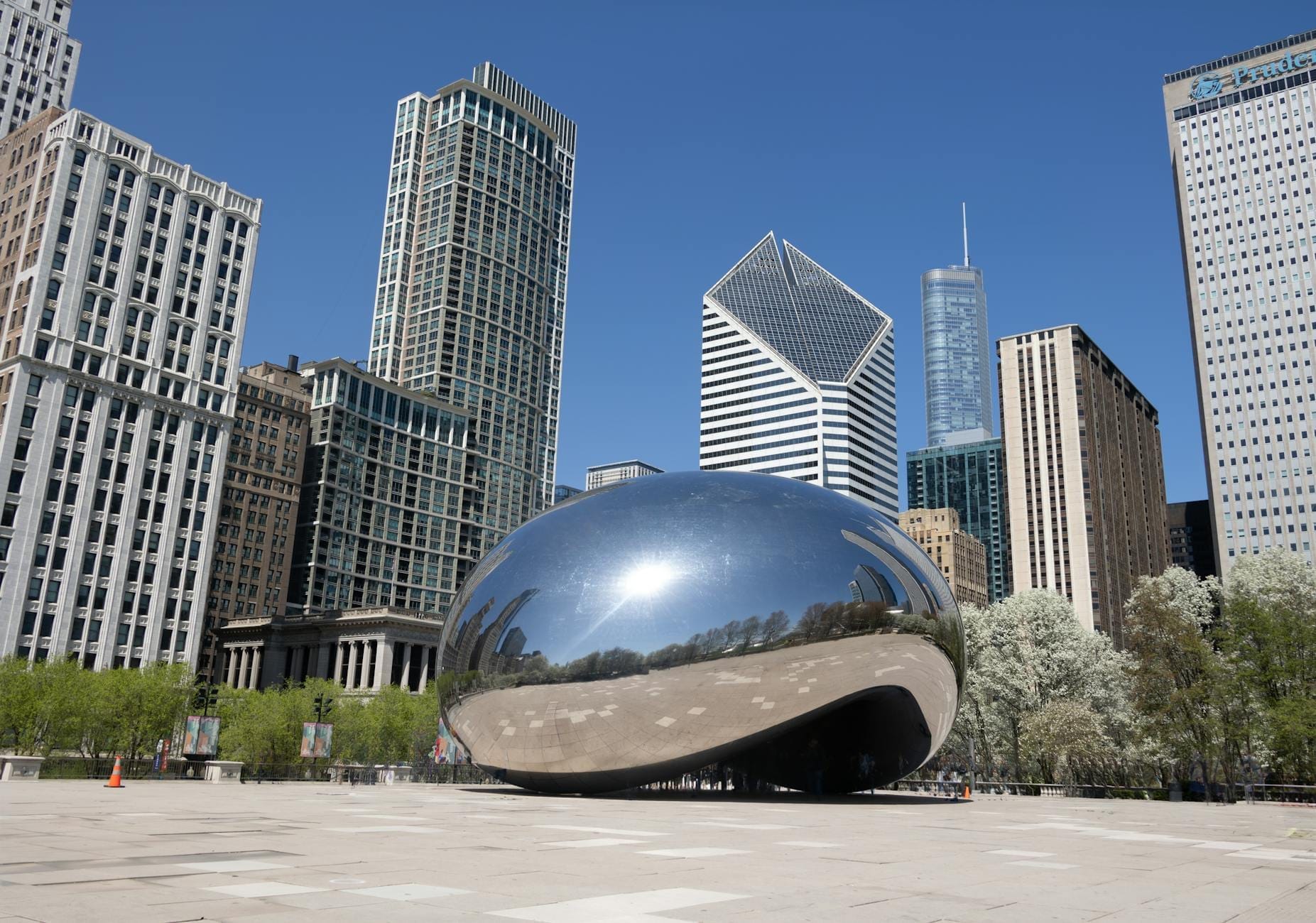
Anish Kapoor's Cloud Gate — universally nicknamed 'The Bean' — is the park's gravitational center. The 110-ton polished stainless steel ellipse reflects the Chicago skyline in a curved mirror that distorts the city, the sky, and your own face simultaneously. Up close, the reflections become abstract and layered; from a distance, the sculpture reads as a mercury droplet sitting in the middle of a wide granite plaza.
The best photography happens in the first two hours after sunrise, when the light hits the eastern face of the sculpture and the skyline to the west still carries some warmth. By late morning on weekends, the area around Cloud Gate fills with tour groups and families, and getting a clean photo becomes difficult. On weekdays between 8:00 and 9:00 a.m., the plaza can be nearly empty: just the sculpture, the skyline, and a few joggers passing through.
Walk underneath the central arch (called 'the omphalos') to see the kaleidoscopic overhead reflection — a detail many visitors miss entirely because they photograph from the outside and move on. The curved underside creates a disorienting tunnel of compressed reflections that is genuinely worth pausing for.
💡 Local tip
Photography tip: Shoot from the south end of the AT&T Plaza for the classic skyline-plus-Bean composition. Kneel low to include more sky reflection. Overcast days produce even, glare-free reflections that are often more interesting than direct sunlight.
Tickets & tours
Hand-picked options from our booking partner. Prices are indicative; availability and final rates are confirmed when you complete your booking.
Millennium Park self-guided walking audio tour in Chicago
From 7 €Instant confirmationFree cancellationGo City | Chicago All-Inclusive Pass
From 127 €Instant confirmationFree cancellationiFLY Chicago Lincoln Park indoor skydiving experience
From 126 €Instant confirmationFree cancellationiFLY Chicago Rosemont indoor skydiving tickets
From 117 €Instant confirmationFree cancellation
Jay Pritzker Pavilion and the Great Lawn
Frank Gehry's Jay Pritzker Pavilion is the park's performance anchor. The bandshell's stainless steel ribbons curl outward in the same architectural vocabulary as Gehry's Guggenheim Bilbao, and the trellis overhead — a 4,000-seat covered seating area opening onto a Great Lawn that holds up to 11,000 more — distributes sound via a networked speaker system that makes outdoor concerts feel closer to an indoor hall than most amphitheaters.
The Grant Park Music Festival runs free classical concerts at Pritzker Pavilion on Wednesday and Friday evenings and Saturday afternoons throughout summer. These are among the genuinely underrated free experiences in any American city: a full symphony orchestra, excellent acoustics, and a lawn full of people who brought blankets and wine from nearby restaurants. Arrive 30 minutes early to secure a good patch of grass.
On non-concert days, the pavilion space is quiet and worth examining architecturally. If you want deeper context on Gehry's design choices and how it fits into the city's broader architectural story, the Chicago Architecture Foundation River Cruise covers many of the same themes and pairs well with a Millennium Park visit on the same day.
Crown Fountain and Lurie Garden
Jaume Plensa's Crown Fountain consists of two 50-foot glass block towers at the southern edge of the plaza, facing each other across a shallow black granite basin. The towers display slow-dissolving video portraits of Chicago residents, and in warm months, water spouts from each face's pursed lips into the basin below. Children wade in the ankle-deep water constantly from late spring through early fall. The basin drains and the water feature shuts off in winter, but the towers continue displaying the face reel year-round.
The Lurie Garden occupies 2.5 acres at the southeast corner of the park. Designed by the Gustafson Guthrie Nichol partnership with plantsman Piet Oudolf — the same Dutch designer behind the planting at New York's High Line — the garden divides into a 'dark plate' of shade plants and a 'light plate' of sun-loving perennials and grasses. It peaks visually in late July and August when the grasses are tall and the coneflowers and prairie dropseed are fully in bloom. In winter, the dried seed heads and skeletal plant structures create a muted, sculptural quality that rewards slower visitors.
The Lurie Garden is free to enter and has its own dedicated page worth reading if native plant ecology interests you. It sits adjacent to the park's signature sculptural works and makes a logical final stop before heading south into the broader Grant Park area.
How the Park Changes Through the Day and Year
Early morning — roughly 6:00 to 8:30 a.m. — is the park at its quietest. Runners use the paths, a few photographers work Cloud Gate, and the relative emptiness makes the scale of the design easier to read. The smell of cut grass and the sound of the L trains overhead on Wabash are both noticeable at this hour.
Midday on weekends from late June through August brings the largest crowds. The AT&T Plaza around Cloud Gate can feel congested, and the Crown Fountain basin is packed with children. If you are visiting in summer and crowds bother you, arrive before 9:00 a.m. or after 6:00 p.m. Summer evenings, especially on concert nights at Pritzker Pavilion, offer a different atmosphere entirely: the lawn fills with a genuine cross-section of Chicago residents, and the city skyline at dusk behind the stage makes for a memorable scene.
In winter, the McCormick Tribune Ice Rink operates just west of Cloud Gate along Michigan Avenue from mid-November through mid-March. Skate rental is available and the rink is free to use. The surrounding architecture takes on a different quality in snow, and the crowds drop sharply — this is one of the better times to spend time near Cloud Gate without a scrum of tourists.
ℹ️ Good to know
Chicago's weather is variable. Summer highs average around 29°C (84°F) but humidity can make afternoons uncomfortable. Winter temperatures regularly drop well below freezing, with January means around -3°C (27°F). Layer appropriately, and note that the open plaza around Cloud Gate offers no shade in summer.
Getting There and Getting Around
Millennium Park is accessible by multiple CTA 'L' lines. The Brown, Green, Orange, Pink, and Purple lines all stop at Washington/Wabash, a few minutes’ walk from the park's northwest corner. The Red and Blue lines stop at Washington/State and Monroe/State respectively, each about a 5-minute walk via Randolph or Monroe Street. Metra's Millennium Station on Randolph Street deposits commuters directly at the park's northern edge.
There is no need to drive here. Parking exists in the underground garages beneath the park (entrance on Columbus Drive), but rates in downtown Chicago are high and the transit connections are genuinely convenient. If you are arriving from O'Hare, the Blue Line takes approximately 35–45 minutes to downtown. From Midway, the Orange Line takes about 25–30 minutes.
On foot, the park connects west across Michigan Avenue toward the Loop's main retail and architectural corridors, and south toward the Museum Campus — home to the Field Museum, Shedd Aquarium, and Adler Planetarium. Plan for 20–25 minutes of walking between Millennium Park and the Museum Campus.
Accessibility, Practical Notes, and Who Might Skip It
The park's surfaces are largely flat and paved, designed to handle heavy pedestrian traffic. The BP Bridge — Gehry's serpentine stainless-steel pedestrian bridge connecting Millennium Park to Daley Bicentennial Plaza — has a gentle grade but is fully accessible. The Lurie Garden has some uneven garden paths worth noting for mobility device users.
Restrooms are available in the park near the Crown Fountain and at the Harris Theater. Food and coffee options are available on-site at the Park Grill (a sit-down restaurant fronting the skating rink area) and at seasonal kiosks. Prices are typical of downtown Chicago tourist areas — bring water and snacks if you prefer not to pay premium rates.
Travelers whose primary interest is fine art, natural history, or neighborhood food culture may find Millennium Park a somewhat thin visit on its own. The park is an excellent introduction to the city and a pleasant place to spend an hour, but it does not offer the depth of experience that the Art Institute of Chicago next door provides. Visitors looking for a quieter outdoor escape might also find the park's central sections — particularly around Cloud Gate on summer weekends — more crowded than they expected from photos. Those who are sensitive to large, camera-wielding crowds during peak hours should visit early or in late afternoon on a weekday.
Insider Tips
- The BP Bridge on the park's eastern edge is one of Gehry's quieter designs and nearly always less crowded than the main Cloud Gate plaza. Walk across it even if you have no destination on the other side — the views of the Pritzker Pavilion bandshell from mid-bridge are excellent.
- Free classical concerts at the Jay Pritzker Pavilion (Grant Park Music Festival, summer) are among the best free experiences in Chicago. Bring a blanket and food — picnicking on the Great Lawn is permitted and very much part of the culture.
- The park's underground parking garages are accessible from Columbus Drive and Michigan Avenue and tends to be cheaper per hour than street-level options nearby, though public transit is a better option whenever possible.
- In late October and November, the Lurie Garden's seed heads and late-season grasses are visually interesting and the crowds are thin. This is genuinely one of the best times to walk that section of the park slowly.
- The Harris Theater for Music and Dance, on Randolph Street just inside the park's northern border, programs affordable performances by mid-size dance and music companies throughout the year. Check listings if you want an indoor evening option in the same footprint.
Who Is Millennium Park For?
- First-time visitors to Chicago who want an orientation to the city's public art and lakefront geography
- Families with young children, especially during Crown Fountain's active water season (late spring through early fall) and winter ice skating
- Architecture and design enthusiasts interested in Gehry, Kapoor, Plensa, and Oudolf's work in a single concentrated space
- Anyone attending a free Grant Park Music Festival concert on a summer evening
- Photographers working early mornings when the Cloud Gate plaza is nearly empty and the light is favorable
Nearby Attractions
Other things to see while in The Loop:
- Art Institute of Chicago
One of the largest and most visited art museums in the United States, the Art Institute of Chicago anchors the eastern edge of the Loop with a collection of over 300,000 works spanning 5,000 years. From Georges Seurat's pointillist masterpiece to Grant Wood's American Gothic, the highlights alone demand the better part of a day.
- Buckingham Fountain
The Clarence Buckingham Memorial Fountain is one of the largest decorative fountains in the world, sitting at the heart of Grant Park since 1927. Free to visit during its seasonal run from spring through mid-October, it puts on hourly water displays and a nightly illuminated show that draws crowds from across the city.
- Chicago Architecture Center
Housed in Mies van der Rohe's One Illinois Center on the Chicago River, the Chicago Architecture Center packs nearly 10,000 square feet of exhibition space, a landmark scale model of the city, and access to some of the country's most informative architecture tours. It's the most comprehensive entry point into understanding what makes Chicago's skyline one of the world's most significant.
- Chicago Architecture Foundation River Cruise
The Chicago Architecture Center River Cruise aboard Chicago's First Lady is the most authoritative way to read the city's skyline. In 90 minutes, trained docents walk you through more than 40 landmark buildings across all three branches of the Chicago River, connecting architectural styles to the human decisions that shaped them.