Field Museum of Natural History: What to Know Before You Go
One of the largest natural history museums in the world, the Field Museum of Natural History sits at the heart of Chicago's Museum Campus with over 20 million specimens spanning ancient Egypt, dinosaur fossils, and indigenous cultures from every continent. Whether you have three hours or a full day, this guide helps you make the most of it.
Quick Facts
- Location
- 1400 S. DuSable Lake Shore Drive, Museum Campus, Chicago, IL
- Getting There
- CTA Buses 130 and 146 stop nearby; closest 'L' stations are Roosevelt (Red/Green/Orange Lines) with a 15-minute walk south along the lakefront
- Time Needed
- 3–5 hours minimum; a full day for serious visitors
- Cost
- Around US$46–$50 per adult for basic admission (check fieldmuseum.org for current pricing); Chicago residents and members receive discounts
- Best for
- Families, history enthusiasts, science lovers, rainy-day visits
- Official website
- www.fieldmuseum.org
What the Field Museum Actually Is
The Field Museum of Natural History is not a local curiosity. It is one of the largest and most comprehensive natural history museums on Earth, holding a collection of over 20 million specimens covering anthropology, geology, zoology, and botany. The building itself, a commanding neoclassical structure in white Georgia marble, dominates the northern end of Museum Campus like a Roman temple dropped onto the lakefront. On a bright morning, the facade catches the light off Lake Michigan and looks almost luminous from a distance.
The museum was founded in 1893 specifically to house natural history and ethnographic collections gathered for the World's Columbian Exposition, one of the most influential world's fairs in history. Marshall Field, the Chicago retail magnate, provided the major gift that secured its future, and the institution was renamed the Field Museum of Natural History in 1905. That origin story still shapes the place: this is a museum built to make the world's cultures and natural wonders accessible to a broad public, not just to specialists.
ℹ️ Good to know
Hours: Typically 9:00 am to 5:00 pm, with last entry around 4:00 pm; check fieldmuseum.org for seasonal variations. Closed Thanksgiving and Christmas Day. Arrive by 9:30 am on weekdays to beat school groups, which typically arrive mid-morning.
Stanley Field Hall: The First Impression
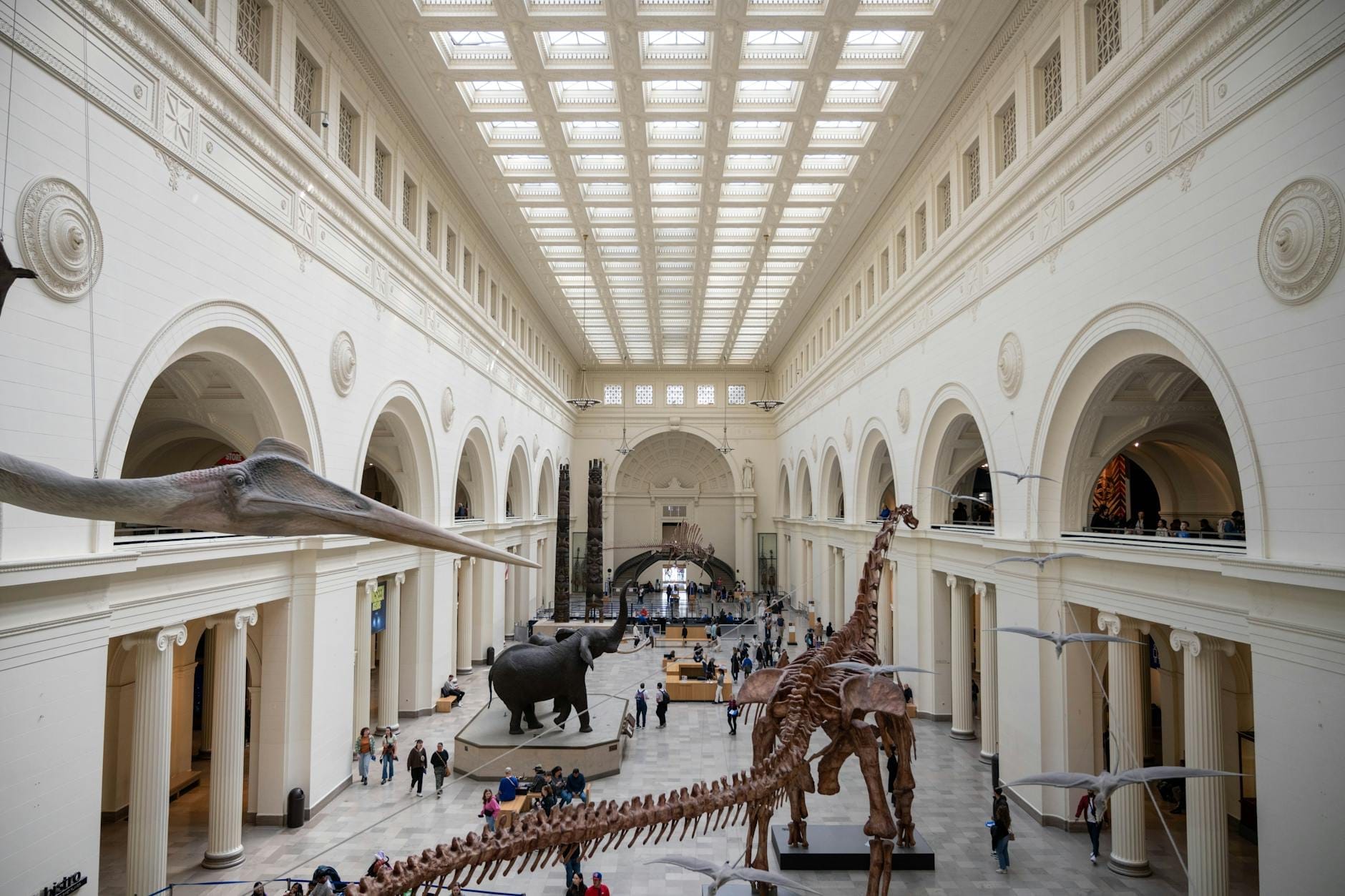
You enter through the main south entrance and walk directly into Stanley Field Hall, a cavernous marble atrium that stretches nearly the full length of a city block. The ceiling soars overhead, and the acoustic quality of the space means a mid-morning crowd produces a low, echoing hum rather than chaos. Two full-skeleton dinosaur mounts anchor the hall, and depending on the current exhibition calendar, you may encounter rotating large-scale installations suspended from the ceiling or positioned in the center of the room. It is one of the more genuinely impressive interior spaces in Chicago, and worth pausing in before you start moving through galleries.
Staff and security are positioned throughout the hall from opening. If you have questions about where a specific gallery is, this is the easiest place to ask. Floor maps are available at the information desks near both the north and south ends.
Tickets & tours
Hand-picked options from our booking partner. Prices are indicative; availability and final rates are confirmed when you complete your booking.
Chicago Bears football game ticket at Soldier Field
From 278 €Instant confirmationField Museum of Natural History tickets and audio tour
From 44 €Instant confirmationGo City | Chicago All-Inclusive Pass
From 127 €Instant confirmationFree cancellationiFLY Chicago Lincoln Park indoor skydiving experience
From 126 €Instant confirmationFree cancellation
The Collections: What You Are Actually Seeing
The Field Museum's permanent exhibitions cover four major themes: ancient Egypt, the ancient Americas, natural environments and ecology, and the diversity of human cultures. The Egypt galleries on the upper floor contain one of the more significant mummy collections in the Western Hemisphere, including human and animal mummies with detailed interpretive material that explains the science of preservation rather than just displaying the objects. The low lighting in this section and the close quarters of the cases create a noticeably different atmosphere from the rest of the museum.
Underground Adventure is a perennially popular ticketed experience within the museum, shrinking visitors to the scale of a soil organism to explore what lives beneath a patch of Illinois ground. It skews heavily toward families with young children, but the ecological science behind it is presented accurately and without condescension. Budget an extra 20 to 30 minutes and a separate ticket fee if you want to include it.
The Grainger Hall of Gems includes nearly 600 gemstones and minerals, among them a collection of meteorites that receives less attention than it deserves. For visitors interested in the geology angle, this is a quieter gallery that rewards slow browsing. Families drawn to the Adler Planetarium next door often loop through the gems and meteorites section as a natural extension of the same science thread.
How the Experience Changes by Time of Day
The museum opens at 9:00 am, and the first 90 minutes are consistently the calmest. Stanley Field Hall still carries a cool morning stillness, the marble floors reflect the light from the south windows, and the galleries are navigable without crowds bunching around the most popular cases. If you are visiting with children old enough to focus, this window is worth prioritizing.
By 11:00 am on weekdays and 10:30 am on weekends, school groups and tour buses begin to fill the main floor and the Egypt galleries. The popular Sue the T. rex exhibit draws the densest clusters throughout the middle of the day. If crowds around the big-ticket displays frustrate you, use the midday period to work through the ground-floor ethnographic galleries and the gem hall, which tend to stay quieter.
Late afternoon, roughly from 3:00 pm onward, sees the crowd thin noticeably as families with young children leave. The last entry is 4:00 pm, and the galleries grow quieter in that final hour. This is a good time to revisit anything you felt rushed through earlier in the day.
💡 Local tip
Weekday mornings in late September through November are the least crowded period of the year. Summer weekends see the highest visitor volumes, particularly when combined with events at the nearby Shedd Aquarium or Adler Planetarium.
Museum Campus Context: Planning Your Day Around the Area
The Field Museum sits on Museum Campus, a 57-acre lakefront park that also contains the Shedd Aquarium and the Adler Planetarium. The three institutions are within comfortable walking distance of each other, though doing all three in a single day is genuinely exhausting and rarely satisfying for any of them. If you are choosing between them, the Field Museum is the one that rewards the most time and repays multiple visits.
Grant Park and its iconic Buckingham Fountain are a 15-minute walk north along the lakefront. The Lakefront Trail runs directly past Museum Campus, making it easy to combine a museum visit with a walk or bike ride along the water. In warmer months, the open space between the three institutions is a pleasant place to eat a packed lunch between galleries.
By car, parking is available in the Museum Campus garage, though it fills quickly on summer weekends. CTA buses 130 (Museum Campus shuttle, summer & select event days only) and 146 serve the area from the Loop. If you take the Red, Green, or Orange Line to Roosevelt, the walk south through Grant Park takes about 15 minutes and is flat and straightforward.
Practical Details: Food, Accessibility, and Photography
The museum has a cafe on the lower level and a larger dining area in the main building. The food is serviceable and priced for a captive audience. If budget matters, bring your own food. There are outdoor benches and lawns around Museum Campus where a packed lunch is a reasonable and pleasant option in good weather. In Chicago winters, temperatures on the lakefront can be brutal, and the interior seating areas of the museum become genuinely valued retreats.
Accessibility is well managed. The museum is wheelchair accessible throughout, strollers are accommodated, and service animals are welcome. Elevators connect all floors and the signage is clear. The ground-floor restrooms near Stanley Field Hall are the most convenient and least crowded in the morning.
Photography without flash is permitted in most permanent galleries. The marble surfaces and high ceilings of Stanley Field Hall create interesting light for architectural shots early in the morning. For visitors interested in Chicago's wider architectural context, the Chicago architecture guide covers the neoclassical tradition that produced this building, including contemporaries like the Art Institute and the Chicago Cultural Center.
Honest Assessment: Is It Worth the Price?
At around US$46–$50 per adult for basic admission, the Field Museum is one of Chicago's more expensive cultural institutions. That price point requires honest consideration. For visitors who engage seriously with the collections, read the interpretive panels, and spend a full day, it represents genuine value. For visitors who want a quick walk-through of the highlights, it may feel like a lot for three hours of content.
Chicago residents receive discounted admission and should check the website for details. The Chicago CityPASS bundle includes the Field Museum alongside the Shedd Aquarium and other institutions, and is worth calculating against individual ticket prices if you plan to visit multiple Museum Campus attractions. See our analysis of whether Chicago CityPASS is worth it for a breakdown.
Who should skip it: visitors with very limited time in Chicago who have already committed to the Art Institute and other major cultural stops may find one natural history museum is the practical ceiling for a short trip. Travelers who are not engaged by museums at all will not be converted by scale alone. But for anyone with genuine curiosity about natural history, ancient cultures, or the science of the natural world, this is one of the best institutions of its type in North America.
⚠️ What to skip
The museum is closed on Thanksgiving and Christmas Day. Hours and ticket prices are subject to change; always verify at fieldmuseum.org before your visit.
Insider Tips
- Book tickets online in advance, particularly for summer weekends. Timed entry tickets help manage the morning rush and occasionally sell out for peak days.
- The lower-level Grainger Hall of Gems is consistently one of the quietest galleries in the building, even during peak hours. If you need a break from crowds, this is the place to go.
- The museum store near the main entrance has a surprisingly good selection of academic and natural history books, not just souvenir merchandise. It is worth browsing even if you do not plan to buy.
- If you are visiting with children, the hands-on areas tend to be in the lower level and the dedicated family galleries. Check the day's schedule at the information desk when you arrive, as demonstrations and programming vary.
- For photographers, the exterior is best shot in the late afternoon when the light comes from the west and illuminates the facade. The reflection pool in front of the building is a useful foreground element.
Who Is Field Museum of Natural History For?
- Families with school-age children who want science content beyond a typical zoo or aquarium
- Travelers on rainy or cold days who want a full-day indoor destination
- History and anthropology enthusiasts drawn to ancient Egypt or pre-Columbian Americas
- First-time Chicago visitors combining Museum Campus with a lakefront walk
- Adults visiting without children who want a serious, unhurried museum experience
Nearby Attractions
Other things to see while in Museum Campus & South Loop:
- Adler Planetarium
Opened in 1930 as the first planetarium in the Western Hemisphere, the Adler Planetarium combines immersive sky shows, serious astronomy collections, and one of the best unobstructed views of the Chicago skyline. Perched at the tip of a peninsula on Museum Campus, it rewards both science enthusiasts and casual visitors who stumble onto its lakefront terrace.
- Buddy Guy's Legends
Opened in 1989 by the legendary guitarist himself, Buddy Guy's Legends on South Wabash Avenue is the city's most historically significant blues club. This is where raw Chicago blues plays out in real time, where the walls are covered in signed memorabilia, and where any given Tuesday night can turn into a master class in American music.
- Glessner House Museum
The Glessner House Museum is a surviving residential commission by architect H.H. Richardson in Chicago, completed in 1887 and now a National Historic Landmark. Guided tours of the granite fortress on Prairie Avenue reveal one of the most thoughtfully designed domestic interiors in American architectural history.
- Northerly Island Park
Once an airfield, once a World's Fair site, Northerly Island Park is now 119.7 acres of restored prairie and savanna tucked onto a Lake Michigan peninsula steps from the Museum Campus. Entry is free, the trails are uncrowded, and the skyline views are genuinely hard to beat.