Glessner House Museum: Inside Chicago's Most Important Gilded Age Landmark
The Glessner House Museum is a surviving residential commission by architect H.H. Richardson in Chicago, completed in 1887 and now a National Historic Landmark. Guided tours of the granite fortress on Prairie Avenue reveal one of the most thoughtfully designed domestic interiors in American architectural history.
Quick Facts
- Location
- 1800 S Prairie Ave, Chicago, IL 60616 (Near South Side / South Loop)
- Getting There
- Cermak–McCormick Place (CTA Green Line), approx. 10-minute walk
- Time Needed
- 1.5–2 hours (guided tour runs approx. 75 minutes)
- Cost
- Adults $20 / Seniors & Students (13–18) $17 / Children (5–12) $12. Free tours for Illinois residents 1st & 3rd Thursday monthly (except January) at 1:00pm, first-come first-served.
- Best for
- Architecture enthusiasts, design history lovers, visitors with a serious interest in the Gilded Age
- Official website
- www.glessnerhouse.org
What Is Glessner House?
The Glessner House Museum is, simply put, one of the most architecturally significant buildings in the United States that you can actually walk through. Completed in 1887 on what was then among Chicago's most prestigious residential streets, the house was designed by Henry Hobson Richardson for farm equipment manufacturer John Jacob Glessner and his wife Frances. Richardson died before seeing his creation finished, making this one of the final works of the architect who almost single-handedly invented a uniquely American approach to monumental building.
From the outside, the house is deliberately forbidding. A rough-faced granite facade curves inward around an interior courtyard, presenting almost no windows to Prairie Avenue. Neighbors were reportedly furious. The architect George Pullman, who lived across the street, allegedly said he could not bear to look at it. That tension between public severity and private warmth is the central drama of the building, and the guided tour exists to resolve it.
ℹ️ Good to know
Self-guided tours are not available. All visits require a guided tour. Tours run Wednesday, Friday, and Saturday at 11:30am, 1:00pm, and 2:30pm. The entrance is via the large green door on 18th Street, which leads into the former coach house now used as the Visitors Center. Book in advance, especially for weekend slots.
The Architecture: Why Architects Still Make Pilgrimages Here
Richardson developed what became known as Richardsonian Romanesque, a style drawing on 11th-century French and Spanish church architecture but reinterpreted through American materials and spatial logic. The Glessner House is its finest domestic example. The exterior granite has a rough, almost geological quality — heavy and grounded, as if the building grew from the earth rather than being constructed on it. The arched entry recessed into the courtyard facade signals protection rather than welcome, a deliberate inversion of the typical Victorian townhouse formula.
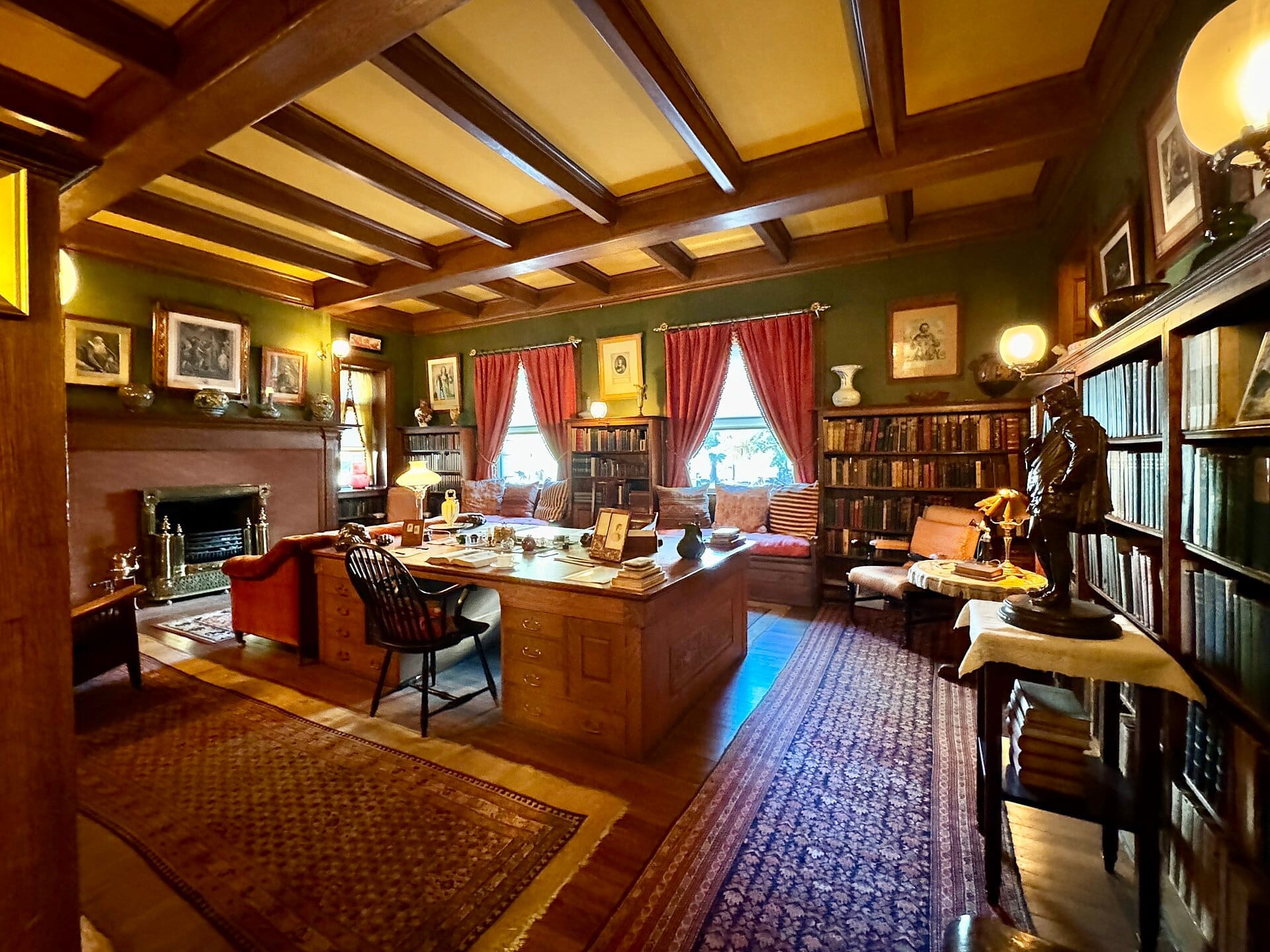
Inside, the spatial sequence is equally calculated. Rooms flow into one another in ways that felt radical in 1887, with the primary living spaces oriented toward the private courtyard garden rather than the street. Natural light enters from above and from the courtyard side, giving the interior rooms a quality that is simultaneously sheltered and luminous. The main hall, the library, and the parlor are filled with original Arts and Crafts furniture and decorative objects, some of it commissioned from William Morris and his associates in England. The house served as a functioning salon for Chicago's cultural life for decades.
Richardson's influence on subsequent American architecture is difficult to overstate. Louis Sullivan studied his work carefully. Frank Lloyd Wright, who worked for Sullivan, absorbed the spatial ideas that Richardson had begun to articulate. Visiting Glessner House alongside the Robie House in Hyde Park gives a clear sense of this architectural lineage, from Richardson's Romanesque mass to Wright's horizontal Prairie synthesis.
Tickets & tours
Hand-picked options from our booking partner. Prices are indicative; availability and final rates are confirmed when you complete your booking.
Go City | Chicago All-Inclusive Pass
From 127 €Instant confirmationFree cancellationiFLY Chicago Lincoln Park indoor skydiving experience
From 126 €Instant confirmationFree cancellationiFLY Chicago Rosemont indoor skydiving tickets
From 117 €Instant confirmationFree cancellationChicago lakefront neighbourhood bike tour
From 18 €Instant confirmationFree cancellation
The Tour Experience: What to Expect Room by Room
Tours begin in the former coach house, where the Visitors Center provides context about the Glessner family and Richardson's career before you enter the main residence. The guides are well-informed and specific, not the kind to recite a memorized script without engagement. Questions are welcomed and usually generate the most interesting parts of the tour.
The house contains original furniture, textiles, and objects from the Glessner occupancy, which makes it different from many historic house museums where interiors have been reconstructed from scratch. You are seeing a space that was actually lived in, rearranged, debated, and loved by a real family over several decades. Frances Glessner kept detailed journals about the house, its contents, and the dinner parties she held for Chicago's intellectual elite, and tour guides draw on this primary source material regularly.
Acoustics in the stone rooms carry sound in unexpected ways. The kitchen areas and service spaces are included on the tour, which is less common in house museums of this type and reveals how the household actually functioned. Stairways are narrow and steep by modern standards. The tour covers multiple floors.
⚠️ What to skip
Glessner House is not ADA accessible. The tour involves stairs and narrow passages. Children under 5 are not permitted on tours. If mobility is a concern, contact the museum before booking to discuss what areas may or may not be reachable.
Prairie Avenue: The Neighborhood That Was and Wasn't
In the 1880s, Prairie Avenue between 16th and 22nd Streets was where Chicago's richest families built their houses. The Glessners, the Pullmans, the Armours, the Fields — the industrial fortunes that made Chicago's South Side the economic engine of the continent were concentrated on this single stretch of pavement. Within two decades, proximity to the rail yards and the noise of the city's expanding industry pushed most families north to the Gold Coast, and Prairie Avenue transitioned through warehouses, light manufacturing, and eventual vacancy.
Today the street exists in a kind of preserved isolation. The Glessner House is one of only a few surviving mansions from that original corridor, including the nearby Clarke House Museum to the south, which predates Glessner House by roughly fifty years and is often described as Chicago's oldest surviving house. The surrounding blocks are a mix of newer residential development, parking, and the occasional older industrial building. It is not a neighborhood in any conventional sense, but the contrast between the granite bulk of the Glessner House and its present-day context is itself informative.
The area sits within easy reach of the Museum Campus and South Loop, and a visit here can be logically paired with the Field Museum or the Chicago History Museum further north in Lincoln Park for a fuller picture of Chicago's 19th-century urban character.
Practical Visit Planning
Full house tours are held Wednesday, Friday, and Saturday at 11:30am, 1:00pm, and 2:30pm. The museum does not offer walk-in self-guided access at any time, so arriving without a reservation on a day or at a time when tours are not scheduled means you will not get in. Book through the official website at glessnerhouse.org. Group bookings and private tours on other days can be arranged in advance.
Admission is $20 for adults, $17 for seniors (60 and over) and students aged 13–18, and $12 for children aged 5–12. Illinois residents can attend free tours on the first and third Thursday of each month (except January) at 1:00pm, on a first-come, first-served basis. Tours are free for members of Glessner House and the National Trust for Historic Preservation, but reservations are required. Credit cards are accepted.
Getting here by public transit is straightforward. The CTA Green Line stops at Cermak–McCormick Place, roughly a ten-minute walk north along Michigan Avenue and then east to Prairie Avenue. Rideshare drop-off on 18th Street is convenient. Street parking exists in the surrounding blocks but the area is not heavily trafficked on weekdays. The walk from the Green Line passes through an area that is industrial in character rather than tourist-ready, but it is direct and safe during daylight hours.
💡 Local tip
The 11:30am tour on a weekday tends to have the smallest group size, which often means more time with the guide and more space to examine objects closely. Weekend afternoon slots fill faster, particularly in October and during Chicago Architecture Biennial years when interest in the building spikes.
If you are planning a broader architecture day in Chicago, the Chicago Architecture Center in the Loop is an excellent starting point for context before coming to Glessner House, and their Chicago architecture guide covers the city's broader built environment in depth.
Photography and Sensory Notes
The interior lighting is predominantly warm and low by modern museum standards — this is a house, not a gallery, and it is presented as one. Smartphone cameras in automatic mode tend to overexpose the stone surfaces and lose the texture that makes the architecture interesting. Manual or pro mode with a slightly lower exposure setting produces more accurate results. Wide-angle lenses struggle with the relatively intimate room sizes; a standard or short telephoto focal length captures proportions more honestly.
The courtyard garden, when visited in late spring or early summer, has a particular quality of contained calm that is genuinely unlike the surrounding city. The stone walls absorb sound rather than reflecting it. The interior rooms smell faintly of old wood, textile, and stone — not in a musty way, but in the specific way of a building that has been continuously cared for rather than sealed off. On a cold day, the tour through heated rooms creates a physical sense of enclosure and shelter that reinforces what Richardson designed the building to feel like from the outside.
Insider Tips
- Illinois residents should check the first and third Thursday schedule carefully: these free tours at 1:00pm fill on a first-come, first-served basis with no advance reservation. Arriving 20–30 minutes early ensures entry.
- The coach house Visitors Center contains a small but well-stocked library and shop with architecture books you will not easily find elsewhere in Chicago. Worth browsing even after the tour ends.
- Ask your guide about Frances Glessner's journal entries describing the house's construction and her disagreements with Richardson's decisions. The primary source material humanizes the building in ways the physical tour alone cannot.
- The Clarke House Museum, nearby at 1827 S Indiana Ave, is operated by the Chicago Department of Cultural Affairs and Special Events. A combined visit to both houses on the same day gives the fullest picture of Prairie Avenue's history, though hours and tour times differ — check both before visiting.
- Photography of the courtyard facade from 18th Street at midday in summer produces the clearest images of the granite texture. The building faces roughly northwest into the courtyard, so morning light falls on the street facade more directly.
Who Is Glessner House Museum For?
- Architecture students and professionals seeking direct contact with Richardsonian Romanesque at its residential peak
- History enthusiasts interested in Gilded Age Chicago and the lives of its industrial families
- Design-focused visitors who appreciate original period interiors with documented provenance
- Travelers pairing a Museum Campus visit with an architectural detour to the Near South Side
- Illinois residents looking for a substantive free cultural experience on the first or third Thursday of most months
Nearby Attractions
Other things to see while in Museum Campus & South Loop:
- Adler Planetarium
Opened in 1930 as the first planetarium in the Western Hemisphere, the Adler Planetarium combines immersive sky shows, serious astronomy collections, and one of the best unobstructed views of the Chicago skyline. Perched at the tip of a peninsula on Museum Campus, it rewards both science enthusiasts and casual visitors who stumble onto its lakefront terrace.
- Buddy Guy's Legends
Opened in 1989 by the legendary guitarist himself, Buddy Guy's Legends on South Wabash Avenue is the city's most historically significant blues club. This is where raw Chicago blues plays out in real time, where the walls are covered in signed memorabilia, and where any given Tuesday night can turn into a master class in American music.
- Field Museum of Natural History
One of the largest natural history museums in the world, the Field Museum of Natural History sits at the heart of Chicago's Museum Campus with over 20 million specimens spanning ancient Egypt, dinosaur fossils, and indigenous cultures from every continent. Whether you have three hours or a full day, this guide helps you make the most of it.
- Northerly Island Park
Once an airfield, once a World's Fair site, Northerly Island Park is now 119.7 acres of restored prairie and savanna tucked onto a Lake Michigan peninsula steps from the Museum Campus. Entry is free, the trails are uncrowded, and the skyline views are genuinely hard to beat.