Northerly Island Park: Chicago's Unlikely Prairie on the Lake
Once an airfield, once a World's Fair site, Northerly Island Park is now 119.7 acres of restored prairie and savanna tucked onto a Lake Michigan peninsula steps from the Museum Campus. Entry is free, the trails are uncrowded, and the skyline views are genuinely hard to beat.
Quick Facts
- Location
- Museum Campus, Near South Side, Chicago — near 1300 S. Linn White Drive, IL 60605
- Getting There
- No direct 'L' stop; CTA Bus 146 serves the Museum Campus area near the Adler Planetarium. Walking distance from Roosevelt/State Red Line (~20 min on foot via lakefront path).
- Time Needed
- 1–2 hours for a full loop; add 30 min if you stop at the Visitor Center (open weekdays 10am–4pm)
- Cost
- Free entry. Some programs (guided tours, youth nature programs, paddling) require registration and may charge fees.
- Best for
- Birdwatchers, joggers, picnickers, skyline photographers, and anyone wanting a break from museum interiors
What Northerly Island Park Actually Is
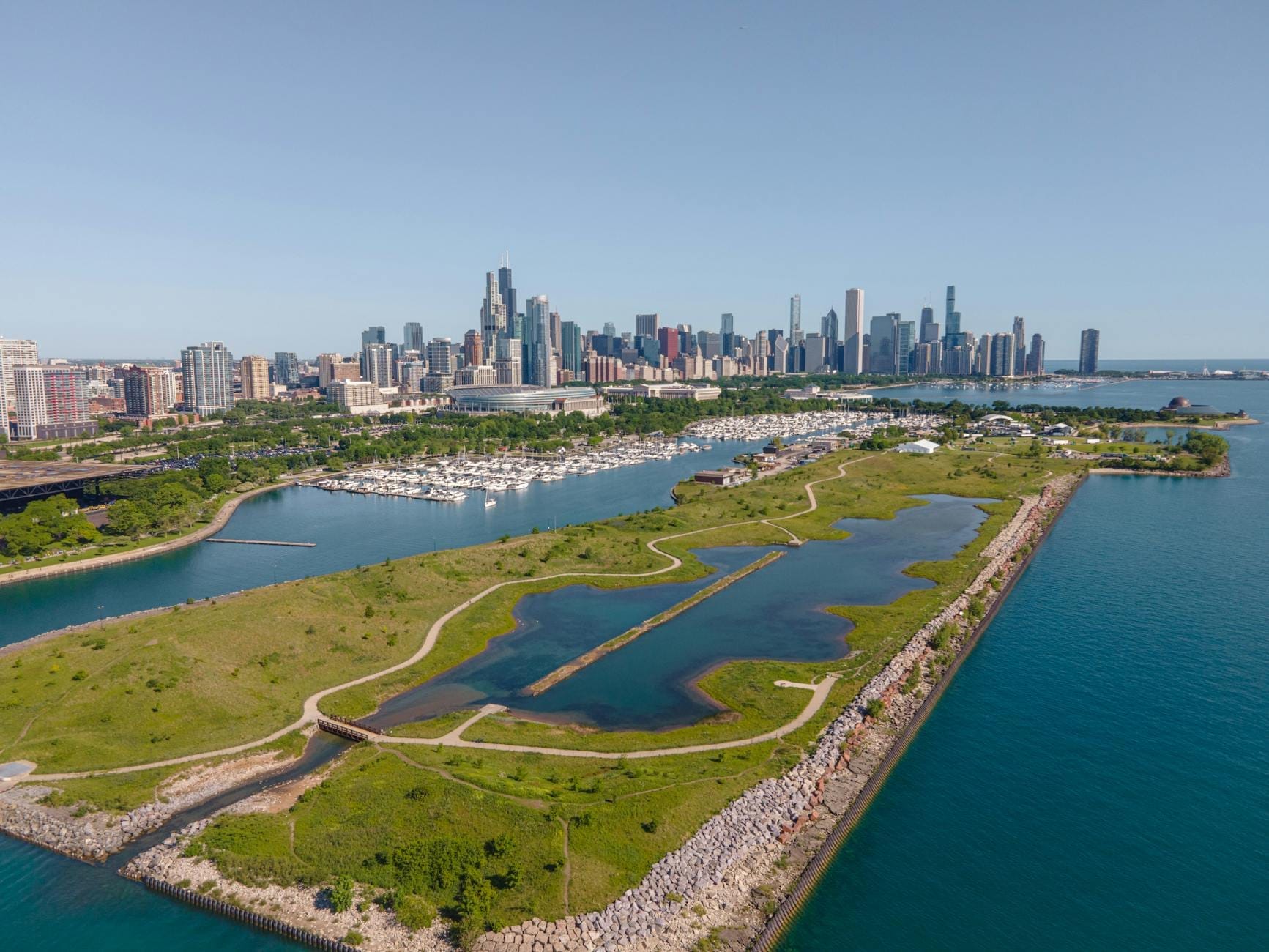
Northerly Island Park is a 119.7-acre peninsula jutting into Lake Michigan on Chicago's Museum Campus, sitting directly southeast of the Adler Planetarium and north of 12th Street Beach. Despite being minutes from one of the densest concentrations of tourist attractions in the Midwest, the park absorbs visitors quietly. Most people at the Museum Campus spend their day indoors at the Field Museum or Shedd Aquarium and never walk the five minutes south to the trail loop here. That oversight works in your favor.
The landscape is a restored prairie and savanna preserve, not a manicured park with benches arranged along paved paths. The vegetation is tall and seasonally wild, the 5-acre pond draws waterfowl year-round, and the trail surface is compacted gravel rather than concrete. Think less Grant Park, more Illinois grassland that happens to share a zip code with downtown.
💡 Local tip
Metered parking is available in a lot on Northerly Island, which is useful if you're coming from outside the city. But if you're already visiting the Museum Campus, the park is an easy walk south past the Adler Planetarium.
A Layered History: World's Fair, Airport, Prairie
The island's story is genuinely surprising. It was conceptualized in the 1909 Plan of Chicago, Daniel Burnham's sweeping urban vision, as the northernmost link in a proposed chain of offshore island parks extending along the lakefront. Construction via dredging was completed in 1925, but the chain-of-islands concept was never fully realized.
The landform's first major moment came in 1933 and 1934, when it served as the primary site of the Century of Progress World's Fair, which drew more than 39 million visitors to Chicago during the depths of the Great Depression. After the fair, the island became home to Merrill C. Meigs Field, a single-runway airport that grew to become one of the busiest one-runway airports in the United States by 1955. Meigs Field operated for decades, offering short-hop flights for business travelers and regional commuters, and became a minor point of civic controversy over whether the land should be returned to public parkland.
The controversy ended abruptly in March 2003 when Mayor Richard M. Daley ordered bulldozers to destroy the runway overnight, preventing legal challenges from stopping the closure. The airfield was demolished, and the lengthy process of ecological restoration began. The current prairie-and-savanna design, realized from plans by Chicago architect Jeanne Gang's firm Studio Gang, reached substantial completion around 2015. What you walk through today is the result: native plantings, a constructed pond, and a perimeter trail with unobstructed water views.
The island's architectural and planning legacy connects to a broader story of lakefront development. If you want deeper context on how Chicago has shaped its shoreline, the Chicago architecture guide covers the Burnham Plan's long reach, and the lakefront guide maps the full trail from Edgewater to the South Side.
Tickets & tours
Hand-picked options from our booking partner. Prices are indicative; availability and final rates are confirmed when you complete your booking.
Go City | Chicago All-Inclusive Pass
From 127 €Instant confirmationFree cancellationiFLY Chicago Lincoln Park indoor skydiving experience
From 126 €Instant confirmationFree cancellationiFLY Chicago Rosemont indoor skydiving tickets
From 117 €Instant confirmationFree cancellationChicago lakefront neighbourhood bike tour
From 18 €Instant confirmationFree cancellation
The Trail Loop: What You'll See and When
The main path forms a loose loop around the peninsula and takes between 40 and 60 minutes to walk at a relaxed pace. The eastern edge faces open Lake Michigan, and on clear days the horizon is uninterrupted water. The western side faces back toward the Museum Campus and the city, giving you a clean sightline to the downtown skyline across the harbor. Both views are worth the walk.
Early morning, roughly from 6am to 8am, is the best time for wildlife observation. The pond at the center of the preserve sees herons, egrets, and migratory waterfowl depending on the season. Northerly Island sits directly in the Mississippi Flyway, making it a legitimate birdwatching stop during spring and fall migration (April-May and late August through October). Experienced birders treat the island seriously; casual walkers will still notice more activity here than in more developed parks.
By midday on weekends in summer, the trail picks up joggers, cyclists, and visitors spilling over from the nearby museum complex. It never feels packed the way the lakefront path around Navy Pier does, but it loses the meditative quality of the morning hours. Late afternoon light in fall turns the prairie grasses amber and makes for the best photographs of the season. Sunset from the eastern shore, facing the lake with no buildings in frame, is one of the quieter pleasures this far into the city.
ℹ️ Good to know
The Visitor Center is typically open weekdays 10am to 4pm and can provide trail maps and information on upcoming programs. It is not open on weekends, so pick up a map on a weekday visit or check the Chicago Park District website before you go.
Seasonal Differences: When to Come and What Changes
Summer (June through August) brings the most visitors, largely because the Huntington Bank Pavilion concert venue on the southern end of the island draws evening crowds on show nights. If a concert is scheduled, the road and parking area near the venue will be congested in the late afternoon. The prairie trails themselves remain accessible and are unaffected by concerts, but the parking lot fills fast. Check the venue's calendar before you plan to drive in.
Spring is when the park is most ecologically active. Migratory birds pass through in high numbers from April into May, the native plantings start greening after winter, and the pond surface is often busy with waterfowl. Temperatures are unpredictable (Chicago's spring can include 60-degree days and late-season cold snaps within the same week), so layering is practical.
Winter is underrated. The peninsula empties almost entirely. Ice occasionally forms at the shoreline, and the bare prairie grasses have a stripped-back visual quality that reads differently from summer's dense growth. Wind off the lake is genuinely cold, sometimes brutal, and a windproof outer layer is not optional. But the solitude and the quality of winter light on the water make it a worthwhile visit for those willing to dress appropriately.
For a full picture of what Chicago's seasons mean for outdoor visits, the guides to Chicago in summer and Chicago in winter offer practical seasonal planning advice.
Practical Walkthrough: Getting There and On-Site
From the Museum Campus, you walk south past the Adler Planetarium and follow the path that curves around the tip of the peninsula. No signage is needed; the trail is straightforward. From downtown, CTA Bus 146 (Inner Drive/Michigan Express) serves the Museum Campus area. There is no direct 'L' station at the Museum Campus; the closest Red Line stop is Roosevelt (about a 20-minute walk via the lakefront path, which is pleasant in good weather).
If you're driving, metered parking is available in the lot on Northerly Island. On summer concert evenings, that lot is claimed early. Arriving before noon on those days avoids the crunch. Cyclists can lock up at the Museum Campus bike racks and walk in; the Lakefront Trail passes close by and connects to the island path.
The trail surface is compacted gravel. Sturdy walking shoes are more comfortable than sandals, particularly after rain when sections can be muddy. Restroom facilities exist on site; confirm current availability with the Park District. There are no food vendors inside the park itself, so bring water, especially in summer. The Museum Campus campus nearby has food options if you need to refuel before or after.
⚠️ What to skip
On nights when the Huntington Bank Pavilion hosts a concert, Linn White Drive closes to general traffic and the entire southern end of the island is cordoned for the event. If you're visiting purely for the nature trails, come in the morning or confirm there's no show that evening.
Photography and the Skyline View
The western shoreline of Northerly Island offers one of the cleaner skyline angles in Chicago, with the city reflected across the inner harbor and no elevated freeway or parking structure interrupting the frame. The shot works in both directions: face west for the skyline, face east for open lake with nothing between you and Michigan.
Golden hour before sunset, roughly one hour before the sun drops behind the city, lights the skyline from the west while the water in the foreground stays calm. Mid-morning in summer, the light is already high and harsh; overcast days often produce softer, more even tones on the water. For the prairie itself, late summer and early fall (August through October) are when the native grasses reach full height and color, giving the landscape texture that photographs well at ground level.
If skyline photography is a priority, compare angles from Northerly Island with what's available from other vantage points covered in the Chicago views and viewpoints guide.
What the Park Is Not (and Who Might Be Disappointed)
Northerly Island Park is not a beach. There is no designated swimming area here; 12th Street Beach is immediately adjacent to the south and offers sand and lake access if that's what you need. The park is also not a botanical garden or a formal landscape. The prairie plantings are ecologically intentional but not labeled or curated for educational self-guided tours in the way a conservatory would be.
Visitors expecting a polished lakefront experience with concessions, rentals, and crowd energy should head to Navy Pier or North Avenue Beach. Those looking for a fully programmed outdoor experience with constant activity will find the park understimulating on a quiet Tuesday. This is, fundamentally, a place for a walk near water with a reasonable amount of nature and minimal commercial infrastructure.
Insider Tips
- Bring binoculars during spring (April-May) and fall (late August-October) migration windows. The island sits in the Mississippi Flyway and attracts more species diversity than its small size suggests.
- The parking lot on Northerly Island is often overlooked by Museum Campus visitors who use the main campus lots. It can be cheaper and less chaotic on non-concert days.
- The Visitor Center (open weekdays only, 10am-4pm) occasionally posts trail notes about recent wildlife sightings. Worth a quick check if you're visiting on a weekday.
- For the clearest skyline reflection photograph, visit on a calm morning before the lake surface gets textured by wind. The window is usually 7am to 9am in summer.
- If you're combining Northerly Island with a Museum Campus visit, do the park first in the morning while energy and light are both good, then move indoors to the Field Museum or Shedd Aquarium as midday heat builds.
Who Is Northerly Island Park For?
- Birdwatchers and wildlife observers, particularly during migration seasons
- Runners and walkers wanting a lakefront loop away from the main Lakefront Trail crowds
- Photographers seeking skyline-and-water compositions without crowds in the foreground
- Families with children who need outdoor time between museum visits
- Travelers on a tight budget looking for a free, genuinely interesting outdoor space near downtown
Nearby Attractions
Other things to see while in Museum Campus & South Loop:
- Adler Planetarium
Opened in 1930 as the first planetarium in the Western Hemisphere, the Adler Planetarium combines immersive sky shows, serious astronomy collections, and one of the best unobstructed views of the Chicago skyline. Perched at the tip of a peninsula on Museum Campus, it rewards both science enthusiasts and casual visitors who stumble onto its lakefront terrace.
- Buddy Guy's Legends
Opened in 1989 by the legendary guitarist himself, Buddy Guy's Legends on South Wabash Avenue is the city's most historically significant blues club. This is where raw Chicago blues plays out in real time, where the walls are covered in signed memorabilia, and where any given Tuesday night can turn into a master class in American music.
- Field Museum of Natural History
One of the largest natural history museums in the world, the Field Museum of Natural History sits at the heart of Chicago's Museum Campus with over 20 million specimens spanning ancient Egypt, dinosaur fossils, and indigenous cultures from every continent. Whether you have three hours or a full day, this guide helps you make the most of it.
- Glessner House Museum
The Glessner House Museum is a surviving residential commission by architect H.H. Richardson in Chicago, completed in 1887 and now a National Historic Landmark. Guided tours of the granite fortress on Prairie Avenue reveal one of the most thoughtfully designed domestic interiors in American architectural history.