Chicago History Museum: What to Expect, How to Visit, and Why It Matters
Founded in 1856 as the Chicago Historical Society, the Chicago History Museum is the city's oldest cultural institution. Located at the edge of Lincoln Park, it traces the full arc of Chicago's story, from its earliest Indigenous inhabitants to the Great Fire, the labor movement, and beyond. It rewards curious visitors who want more than skyline photos.
Quick Facts
- Location
- 1601 N Clark St, Chicago, IL 60614
- Getting There
- CTA buses on North Ave & Clark St; short walk from Brown and Purple Line 'L' stations at Sedgwick
- Time Needed
- 2 to 3 hours for a thorough visit; 90 minutes if focused
- Cost
- Paid admission for adults; discounts for seniors, students, and ages 12–18; children under 12 free with paid adult; Illinois residents 18 and under free. Check the museum website for current prices.
- Best for
- History enthusiasts, architecture fans, curious locals, families with older kids
- Official website
- www.chicagohistory.org
What the Chicago History Museum Actually Is
The Chicago History Museum is not a tourist attraction in the conventional sense. There are no IMAX screens, no simulators, and no theatrical gimmicks. What you get instead is one of the most thoroughly curated regional history collections in the United States, covering more than three centuries of a city that has consistently been at the center of American transformation.
Founded in 1856 as the Chicago Historical Society, it is Chicago's oldest cultural institution. It formally adopted the name Chicago History Museum in September 2006, though the organization behind it has been collecting, preserving, and interpreting Chicago's past for nearly 170 years. The museum and its research library have occupied this Lincoln Park site since the 1930s, with the building expanded multiple times since.
If you are trying to understand why Chicago looks, sounds, and feels the way it does today, this is the place to start. It provides context that no architecture boat tour or neighborhood walk can fully replace. For a broader sense of what the city offers culturally, the best museums in Chicago guide is worth reading before you plan your day.
ℹ️ Good to know
The museum is closed on Mondays. Typical hours are Tuesday through Saturday, 9:30 am to 4:30 pm, and Sunday, 12:00 pm to 5:00 pm, but hours can shift around holidays and special events. Check the official website before visiting.
Arriving and First Impressions
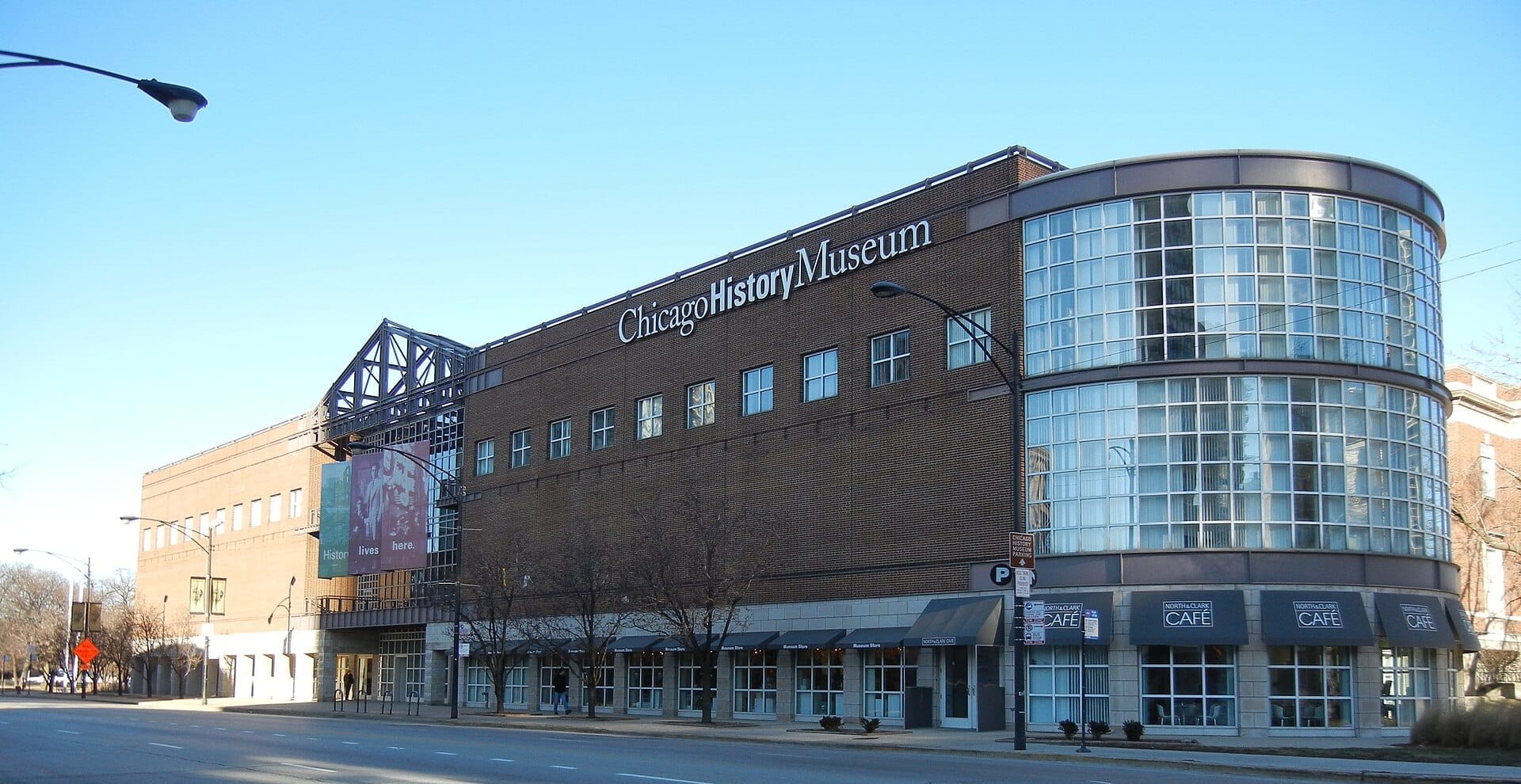
The museum sits at the corner of North Avenue and Clark Street, right where Lincoln Park's green space meets the Old Town neighborhood grid. The building itself is a brick structure with a Georgian Revival character, formal without being intimidating. When you approach from the Clark Street side, the entrance plaza is quiet even on busy weekend afternoons. There is no queue stretching down the block, no street vendor noise, no urgency. This is a deliberate, unhurried kind of place.
The lobby is spacious and naturally lit. A large gift shop sits to one side, stocked with Chicago-specific books, prints, and design objects that are notably better curated than the typical museum store. Coat check is available near the entrance, which matters in winter when the walk from the nearest 'L' stop arrives with a full blast of Lake Michigan wind.
Parking is available in a paid lot adjacent to the museum, which makes this one of the more car-accessible cultural institutions in the city. CTA buses running along North Avenue and Clark Street stop within a short walk. From the Brown or Purple Line at Sedgwick, expect about an 8- to 10-minute walk; from the nearest Red Line station, the walk is longer. The building is fully wheelchair accessible with elevators to all exhibition floors and accessible restrooms throughout.
Tickets & tours
Hand-picked options from our booking partner. Prices are indicative; availability and final rates are confirmed when you complete your booking.
Chicago's Gold Coast Hidden History: A Self-Guided Audio Walk
From 5 €Instant confirmationFree cancellationGo City | Chicago All-Inclusive Pass
From 127 €Instant confirmationFree cancellationiFLY Chicago Lincoln Park indoor skydiving experience
From 126 €Instant confirmationFree cancellationiFLY Chicago Rosemont indoor skydiving tickets
From 117 €Instant confirmationFree cancellation
The Permanent Collection: What You Will See
The museum's permanent galleries move chronologically and thematically through Chicago's history. Early galleries address Indigenous peoples of the region and the fort-era origins of the settlement. From there, the narrative accelerates through the explosive growth of the mid-19th century, the catastrophe and reconstruction of the Great Chicago Fire of 1871, and the city's rise as a global industrial and commercial center.
The labor history sections are among the most substantive in the building. Chicago was the site of the Haymarket affair in 1886, the Pullman Strike of 1894, and the stockyards that shaped American working conditions for decades. The museum does not shy away from the complexity of these events. Display cases hold original documents, union cards, photographs, and personal artifacts that make abstract historical forces feel concrete.
One of the most visited objects in the collection is a historic locomotive from the Chicago and North Western Railway, displayed on the ground floor. It is the kind of object that stops people mid-stride. Large-scale artifacts like this, alongside an original Chicago 'L' car from the early transit system, give the museum a physical scale that purely document-based history museums can lack.
The museum also holds significant collections related to Chicago's architectural history, which pair well with the broader story told on an architecture river cruise. If you are serious about the built environment of Chicago, the research library here is one of the best resources in the country, though library access is separate from general admission.
Atmosphere by Time of Day
Weekday mornings before noon are the quietest window. School groups occasionally arrive mid-morning, but outside of peak field-trip season they are not overwhelming. The galleries feel almost private between 9:30 and 11:00 am on a Tuesday or Wednesday. You can stand in front of large photographic murals of the 1893 World's Columbian Exposition without anyone standing in your sightline.
Weekend afternoons between 1:00 and 3:00 pm are the busiest stretch, particularly in spring and fall when Lincoln Park draws heavy foot traffic. Even then, the museum never reaches the shoulder-to-shoulder density of the Art Institute or the Field Museum. Rooms feel comfortably occupied rather than crowded. The sound environment is low, mostly whispered conversation and the occasional audio component from an interactive display.
Late afternoon, in the final hour before 4:30 pm closing, the light shifts noticeably in the street-facing galleries. If you are arriving in summer, this timing gives you a natural transition from the museum directly into Lincoln Park, where the late-day light across the green lawns and the pond makes for an easy, unstructured end to the afternoon.
Practical Walkthrough: How to Structure Your Visit
The ground floor handles ticketing, the gift shop, and large-format artifact displays. Plan to spend at least 15 minutes here before heading to the main galleries. The upper floors carry the core chronological and thematic exhibitions. There is no single prescribed route, but starting at the earliest historical period and moving forward is the most coherent approach.
💡 Local tip
Pick up a printed floor map at the ticket desk even if you prefer to wander. The gallery layout is not entirely intuitive, and the map helps you ensure you have not missed a significant section before closing time.
Budget around 45 minutes for the permanent collection overview, another 30 to 45 minutes for any temporary exhibition currently on display, and time at the beginning or end for the ground floor artifacts. If you want to spend time in the research library or access archival collections, contact the museum in advance as that visit requires separate arrangement.
Children under 12 enter free with a paying adult, and children 12 to 18 qualify for a discounted rate. Illinois residents 18 and under are admitted free regardless of accompanying adult status. For families with kids under 10, some of the exhibition material is text-heavy and assumes a certain level of historical background. The museum is best experienced by children who are already comfortable reading and asking questions rather than those looking for hands-on play.
The museum sits close to the Lincoln Park Zoo, which is free to enter and a natural pairing for a half-day itinerary, particularly for families. If you are building a full Lincoln Park afternoon, see the Lincoln Park and Old Town neighborhood guide for nearby dining and other stops.
Photography and What to Look For
Non-flash photography for personal use is generally permitted in the permanent galleries. The large-format historic photographs in several gallery sections are worth close attention. Many are printed at near-mural scale and reward time spent examining individual details, workers' faces, street layouts, storefronts. These are not decorative reproductions but documentary records.
The locomotive on the ground floor photographs well from a low angle with a wide lens. The 'L' car creates a strong sense of scale when photographed from the front. In the upper galleries, window light can be harsh mid-afternoon in summer, so morning visits produce cleaner interior light for photography.
⚠️ What to skip
Flash photography and tripods are not permitted inside the museum. Some items in temporary exhibitions may be restricted from photography entirely. Look for posted signs near individual display cases.
Honest Assessment: Who This Is For and Who Might Skip It
The Chicago History Museum rewards visitors with genuine interest in how cities develop, how labor and capital interact, how disasters shape urban policy, and how immigration reshapes culture. If you are in Chicago for a weekend focused on architecture, food, and waterfront activity, this museum is unlikely to be your first priority and that is a reasonable choice.
Travelers who have already been to Chicago several times and feel they have covered the main landmarks, this museum offers something genuinely different. It fills in the story behind the skyline, behind the neighborhoods, behind the political history. Pair it with a visit to the Chicago Cultural Center for a broader sense of the city's civic and cultural identity.
Young children who need interactive, sensory-forward experiences may find the largely text-and-artifact format challenging. The museum is serious in tone. There is nothing wrong with that, but it is worth knowing before you bring a five-year-old expecting the scale and energy of the Museum of Science and Industry.
Insider Tips
- The museum's research library holds one of the largest collections of Chicago-related photographs, maps, and documents in existence. If you have a specific research interest, contact the Archival Collections staff before your visit to arrange access. General admission does not include library access.
- The gift shop carries a selection of out-of-print and hard-to-find Chicago history books that are genuinely difficult to find elsewhere in the city. Budget 10 minutes to browse even if you are not a typical gift shop person.
- Combine your visit with a walk south through Lincoln Park toward the Alfred Caldwell Lily Pool, a lesser-known landscape design gem that most visitors walk past without realizing what it is.
- Illinois residents 18 and under are admitted free at all times, no special days or registration required. If you live in Illinois and have never brought a teenager here, the labor history and Great Fire galleries in particular are worth the trip.
- Temporary exhibitions here tend to be well-researched and change every few months. Check the current exhibitions page before your visit. The temporary gallery programming sometimes outperforms the permanent collection in terms of original material and storytelling ambition.
Who Is Chicago History Museum For?
- First-time visitors who want genuine historical depth beyond the iconic landmarks
- Repeat Chicago visitors ready to move past the obvious and understand the city's layers
- Architecture and urban planning enthusiasts who want the context behind the built environment
- Families with children aged 10 and older who enjoy reading-based museum experiences
- Solo travelers interested in American labor, immigration, and urban history
Nearby Attractions
Other things to see while in Lincoln Park & Old Town:
- Alfred Caldwell Lily Pool
Tucked inside Lincoln Park, the Alfred Caldwell Lily Pool is a 3-acre National Historic Landmark redesigned in 1936–1938 in the Prairie School style. Admission is free, crowds are thin, and the experience is unlike anything else on Chicago's standard tourist circuit.
- Green City Market
Green City Market is Chicago's only year-round sustainable farmers' market, drawing top chefs, local farmers, and serious food lovers to Lincoln Park on Wednesdays and Saturdays during the outdoor season. Free to enter at both its outdoor Lincoln Park and indoor winter locations and rich with seasonal produce, artisan goods, and chef demos, it's one of the most authentic food experiences the city offers.
- Kingston Mines
Founded in 1968, Kingston Mines on North Halsted Street is the largest and oldest continuously operating blues club in Chicago. Two stages run simultaneously on weekends, keeping the music going until 4 a.m. This is where the city's blues tradition stays alive on a weekend night.
- Lincoln Park
Stretching seven miles along Lake Michigan, Lincoln Park is Chicago's largest public park and one of the most generously stocked urban green spaces in the United States. Entry is free, the zoo is free, and the range of things to do here can absorb a full day without spending a dollar.