Chicago Cultural Center: The Loop's Free Architectural Masterpiece
Opened in 1897 as Chicago's first public library, the Chicago Cultural Center is a Beaux-Arts landmark in the Loop offering free admission, two breathtaking Tiffany art glass domes, rotating exhibitions, and hundreds of live performances each year. It sits directly across Michigan Avenue from Millennium Park, making it one of the most accessible and rewarding stops in downtown Chicago.
Quick Facts
- Location
- 78 E Washington St, The Loop, Chicago, IL 60602
- Getting There
- Multiple CTA 'L' stations in the Loop; walk from Randolph/Wabash or Washington/Wabash stops
- Time Needed
- 45 minutes to 2 hours depending on current exhibitions
- Cost
- Free admission — no tickets required
- Best for
- Architecture lovers, art enthusiasts, rainy-day escapes, budget travelers
What the Chicago Cultural Center Actually Is
The Chicago Cultural Center is one of those places that rewards visitors who walk in without knowing exactly what to expect. From the outside, the 1897 Beaux-Arts building on East Washington Street presents a composed, civic grandeur: ornate stonework, arched windows, and a presence that says institutional importance without shouting it. Step through the Washington Street entrance, however, and the interior unfolds into something genuinely arresting.
The building was originally constructed as Chicago's first public library, designed by the Boston firm Shepley, Rutan and Coolidge in the Beaux-Arts style. It served that function until 1991, when the main library moved to the newly constructed Harold Washington Library Center; the building had already begun its transition after being renovated, reopened, and renamed as the Chicago Cultural Center in 1977, becoming the nation's first free municipal cultural center. Today it is operated by the City of Chicago's Department of Cultural Affairs and Special Events and functions as the city's official reception hall, where mayors have welcomed presidents, heads of state, and royalty.
💡 Local tip
Admission is completely free, every day. No advance tickets, no timed entry. Walk in from Washington Street or Randolph Street and start exploring immediately.
The Architecture: Two Domes Worth Craning Your Neck For
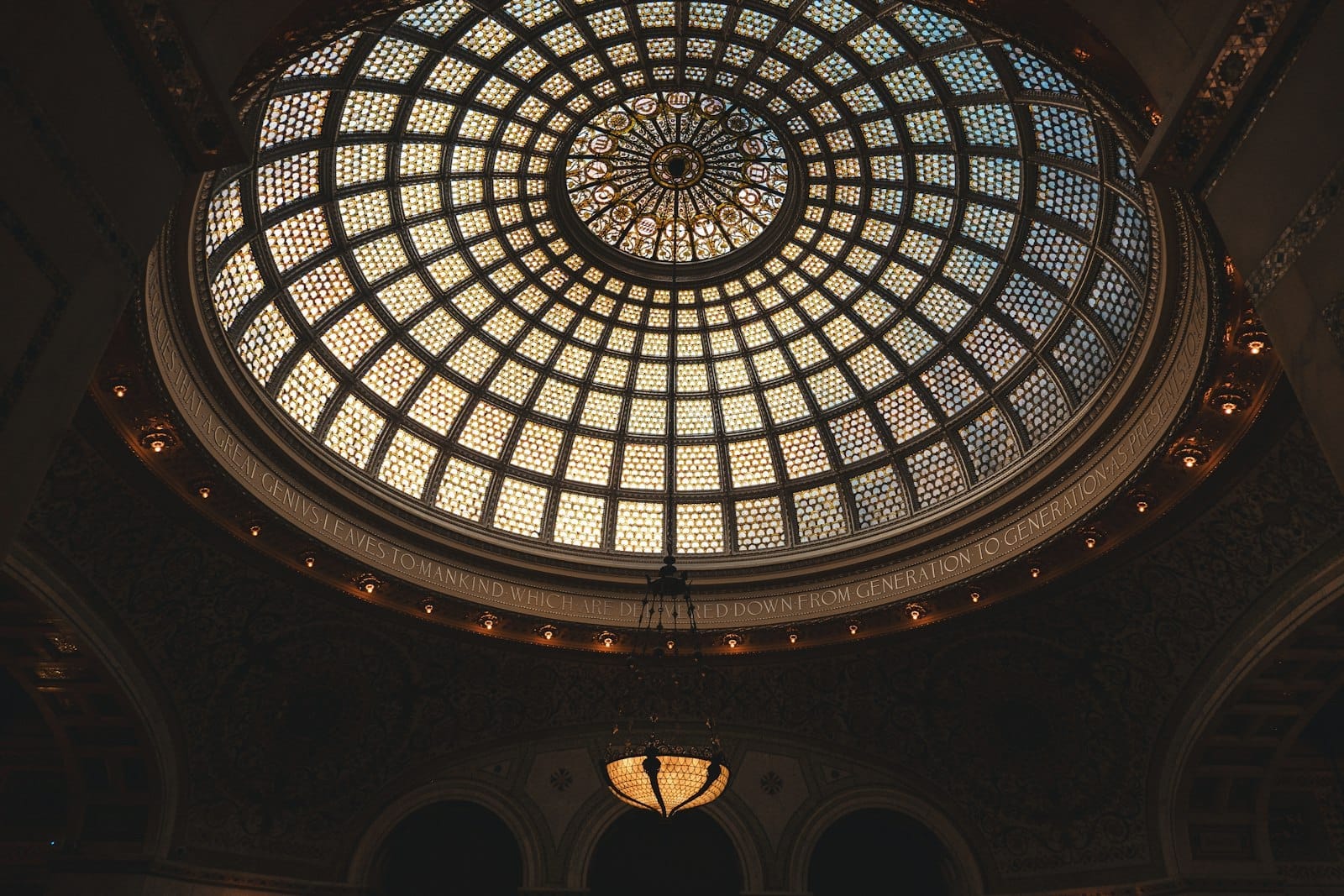
Most visitors come for the Tiffany art glass domes, and rightly so. The Preston Bradley Hall dome, on the north end of the building, is one of the largest Tiffany glass domes in the world. Spanning 38 feet in diameter, it cascades natural light through intricate geometric and floral patterns in deep greens, blues, and golds. On a bright morning, the colors saturate the interior below in a way that feels more like standing inside a jewel box than a civic building.
The Claudia Cassidy Theater lobby (often associated with the former Grand Army of the Republic rooms) features a second dome, smaller but equally detailed, with mother-of-pearl inlay and polychrome glass. The two rooms anchor opposite ends of the building's upper floor and are connected by marble-clad corridors with mosaic floors, grand staircases, and vaulted archways trimmed in gilded plaster. The material palette throughout draws on Carrara marble, onyx, brass, and mosaic tile work inspired by ancient Greek and Roman civic architecture.
Lighting conditions matter significantly here. The domes look their best when direct sunlight passes through them, which happens most consistently in the late morning and midday hours on clear days. On overcast afternoons, the glass reads as darker and flatter. If seeing the domes at their most luminous is a priority, aim for a weekday morning between 10:00 and noon during summer or early fall.
The building sits within the broader architectural fabric of the Loop, a district defined by its concentration of landmark buildings. For visitors already interested in Chicago's built environment, the Cultural Center works well as a starting point before exploring the surrounding blocks.
Tickets & tours
Hand-picked options from our booking partner. Prices are indicative; availability and final rates are confirmed when you complete your booking.
Chicago city center walking audio tour
From 5 €Instant confirmationChicago walking tour with culinary and cultural highlights
From 33 €Instant confirmationFree cancellationArchitecture cruise on the Chicago River from Michigan Ave
From 39 €Instant confirmationFree cancellationGo City | Chicago All-Inclusive Pass
From 127 €Instant confirmationFree cancellation
Exhibitions, Performances, and What's On
The programming model here is built around free access. The Chicago Cultural Center presents hundreds of exhibitions and performances each year across its gallery spaces, including solo and group shows by emerging and established artists, photography, installation work, and design. Exhibitions rotate regularly, so the specific content you encounter will depend on when you visit. The quality varies, but the curatorial range is genuinely broad.
Beyond visual art, the center hosts live music, lectures, film screenings, and community events throughout the week. Occasional special programming may extend the building's regular hours, but core visiting hours typically end in the late afternoon. The Randolph Cafe on the ground floor provides a practical stop for coffee before or after exploring.
Free exhibitions here complement Chicago's broader museum landscape. If you are building a multi-day itinerary, the Cultural Center pairs naturally with the Art Institute of Chicago two blocks south, and Millennium Park directly across Michigan Avenue.
ℹ️ Good to know
Check the Department of Cultural Affairs and Special Events website before visiting to see what exhibitions and performances are scheduled during your visit. The programming is not static.
How the Experience Changes by Time of Day
Weekday mornings from 10:00 to around noon offer the quietest conditions. The building fills primarily with Loop office workers passing through, architecture students sketching, and a smaller number of deliberate visitors exploring the galleries. The domes are uncrowded and the marble corridors carry sound at a low murmur.
Lunchtime, roughly 11:30 to 1:30, brings the most activity. The proximity to downtown offices means the ground floor fills with people using it as a shortcut, a lunch break stop, or a meeting point. The exhibition floors stay relatively calm even during this window.
Weekend afternoons are busier, particularly in summer and during events in Millennium Park next door. Families with children, tourists finishing Grant Park walks, and event attendees cycle through the building. Even at peak times, though, the space is large enough that the upper gallery floors feel uncrowded compared to the ticketed museums on Museum Campus.
💡 Local tip
The building offers genuine warmth in winter and air conditioning in summer, making it a practical refuge during Chicago's weather extremes. Chicago's January mean temperature sits around -3°C (27°F), and summer afternoons regularly reach about 29°C (84°F) or above.
Getting There and Getting Around Inside
The building is located at 78 E Washington Street, on the east side of the Loop, between Michigan Avenue and Garland Court. The main Washington Street entrance faces north toward Millennium Park and Michigan Avenue. The Randolph Street entrance faces north. Both lead directly into the ground floor lobby.
By CTA, the Washington/Wabash station on the elevated 'L' system is the closest stop, within a short walk. The Green, Brown, Orange, Pink, and Purple lines, as well as some Loop-running Orange and Pink trains, serve Washington/Wabash. From O'Hare, take the Blue Line to Clark/Lake and walk a few minutes east. From Midway, the Orange Line terminates at the Loop with multiple stations nearby. Check the CTA trip planner for current route details and fares, as these are periodically updated.
The Cultural Center is an easy walk from several key Loop attractions. Cloud Gate and the rest of Millennium Park begin directly across Michigan Avenue. The Chicago Architecture Center is a few blocks southwest along the Chicago River.
Inside, the building has two primary floors of exhibition space plus the landmark rooms. Elevators are available for accessibility. The upper floors require navigating marble staircases to reach the dome rooms fully, but the main gallery floors are accessible from the elevator. Visitors with specific mobility requirements should contact the Department of Cultural Affairs and Special Events in advance to confirm current arrangements.
Photography and Practical Notes
The domes are among the most photographed interiors in Chicago. Wide-angle lenses or smartphone wide modes work well from standing position in the center of Preston Bradley Hall. The challenge is that the interior is tall and the dome is directly overhead, so shooting upward with a standard lens produces significant distortion. A 16-24mm equivalent focal length produces the most complete captures.
Personal photography for non-commercial use is generally permitted throughout the public areas. Commercial shoots require prior authorization from the city. Flash photography in the galleries is typically discouraged, though the natural light from the domes is often sufficient for handheld shots during morning hours.
If you are building a photography itinerary of Chicago architecture, combine this stop with the Rookery Building on LaSalle Street and the Chicago Architecture Foundation River Cruise for a full day of interior and exterior landmark architecture.
Who Should Skip It (and Who Should Not)
Visitors whose primary interest is high-octane activity, thrill-based attractions, or large-scale interactive exhibits will find the Cultural Center underwhelming. It is a quiet, contemplative building. Children under eight may find the pacing slow unless there is a specific family event scheduled during their visit.
Anyone with even a passing interest in historic architecture, public art, or civic buildings will find it worth the time. The fact that it is free and requires no booking removes most friction from the decision. For budget-conscious travelers building a Loop day, it offers high visual return with no cost.
The Cultural Center is one of the genuinely underutilized stops on the standard Chicago itinerary. It appears in the free things to do in Chicago category almost by default, but the architecture alone earns it more sustained attention than most visitors give it.
Insider Tips
- The Preston Bradley Hall dome on the north end of the building is the more spectacular of the two Tiffany glass domes. Walk to the center of the room and look up before doing anything else.
- Weekday mornings between 10:00 and 11:30 offer the emptiest conditions. You can stand beneath the domes in near-silence, which is impossible to replicate during busier periods.
- The building functions as a climate refuge in both directions: genuinely warm in January when the wind cuts through the Loop, and consistently air-conditioned on August afternoons. Keep this in mind for weather-planning.
- Current exhibition information is not always prominently advertised at street level. Check the Department of Cultural Affairs and Special Events website the morning of your visit to know which galleries are active and whether any free performances are scheduled.
- The Randolph Street entrance (north side) is less trafficked than the Washington Street entrance and drops you directly near the staircase to the upper dome floors, cutting out some of the ground-floor navigation.
Who Is Chicago Cultural Center For?
- Architecture and design enthusiasts wanting to see landmark Tiffany glass domes up close
- Budget and free-admission travelers building a Loop day itinerary
- Art visitors seeking rotating contemporary and visual art exhibitions without admission fees
- Weather refugees needing a warm or cool indoor stop during Chicago's temperature extremes
- Photographers looking for dramatic architectural interiors in natural light
Nearby Attractions
Other things to see while in The Loop:
- Art Institute of Chicago
One of the largest and most visited art museums in the United States, the Art Institute of Chicago anchors the eastern edge of the Loop with a collection of over 300,000 works spanning 5,000 years. From Georges Seurat's pointillist masterpiece to Grant Wood's American Gothic, the highlights alone demand the better part of a day.
- Buckingham Fountain
The Clarence Buckingham Memorial Fountain is one of the largest decorative fountains in the world, sitting at the heart of Grant Park since 1927. Free to visit during its seasonal run from spring through mid-October, it puts on hourly water displays and a nightly illuminated show that draws crowds from across the city.
- Chicago Architecture Center
Housed in Mies van der Rohe's One Illinois Center on the Chicago River, the Chicago Architecture Center packs nearly 10,000 square feet of exhibition space, a landmark scale model of the city, and access to some of the country's most informative architecture tours. It's the most comprehensive entry point into understanding what makes Chicago's skyline one of the world's most significant.
- Chicago Architecture Foundation River Cruise
The Chicago Architecture Center River Cruise aboard Chicago's First Lady is the most authoritative way to read the city's skyline. In 90 minutes, trained docents walk you through more than 40 landmark buildings across all three branches of the Chicago River, connecting architectural styles to the human decisions that shaped them.