The Rookery Building: Chicago's Oldest Skyscraper and Its Stunning Wright-Designed Lobby
Built in 1888 by Burnham and Root and remodeled by Frank Lloyd Wright beginning in 1905, the Rookery Building is Chicago's oldest standing high-rise. The lobby's two-story light court, a white marble and gilded ironwork marvel, is free to enter on weekdays and represents one of the most photographed interiors in American architecture.
Quick Facts
- Location
- 209 S LaSalle St, The Loop, Chicago, IL 60604
- Getting There
- CTA 'L': Quincy (Brown/Orange/Purple/Pink) or LaSalle (Blue Line), both a short walk
- Time Needed
- 20–30 min for self-guided lobby visit; 60–75 min for a Frank Lloyd Wright Trust guided tour
- Cost
- Lobby entry free on weekdays during business hours; guided tours ticketed through the Frank Lloyd Wright Trust — check current prices at flwright.org
- Best for
- Architecture enthusiasts, design history fans, photography, anyone curious about the Chicago School
- Official website
- www.therookerybuilding.com
What Is the Rookery Building?
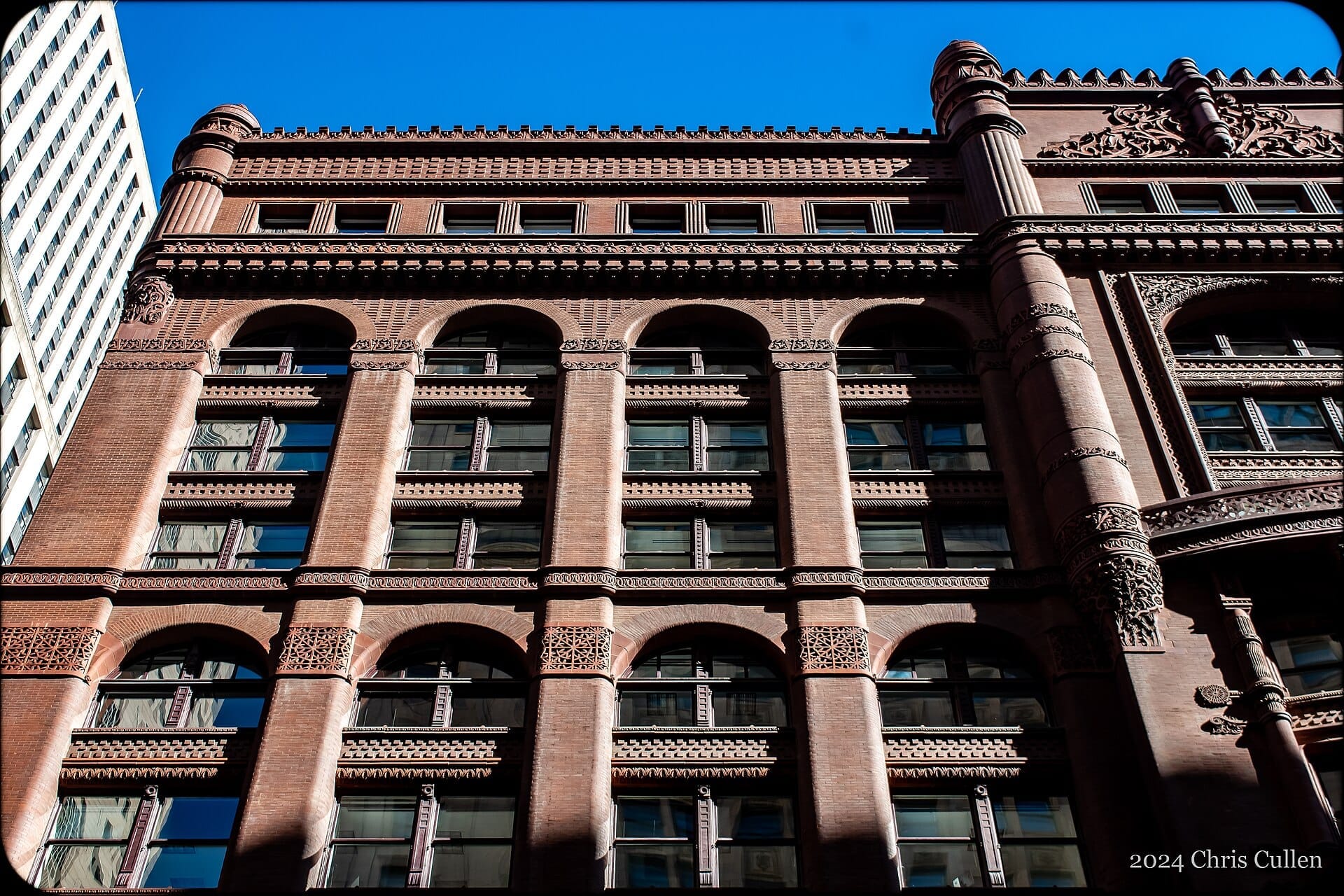
The Rookery Building at 209 S LaSalle Street is the oldest standing high-rise in Chicago, completed in 1888 by the architectural firm Burnham and Root. At twelve stories and roughly 181 feet tall, it was one of the tallest buildings in the world at the time of its completion. It remains a working commercial office building today, which means the lobby is a living architectural space rather than a museum gallery frozen in amber.
What makes the Rookery singular is that it contains the work of three defining figures in American architectural history: Daniel Burnham and John Wellborn Root created the original structure, and Frank Lloyd Wright remodeled the interior light court beginning in 1905, his only surviving interior project in downtown Chicago. The result is a layered space where late Victorian masonry meets Wright's characteristic use of ornamental geometry and natural light.
The building sits at the corner of LaSalle and Adams, at the heart of Chicago's financial district. It is a few blocks south of the Chicago River and surrounded by other historic towers. If you are exploring the Loop on foot, the Rookery is a natural stop on any architecture-focused route through the neighborhood.
The Architecture: Three Layers of History in One Building
From the outside, the Rookery presents a Romanesque Revival and Queen Anne facade in pink granite and pressed brick, with heavy arched windows and deeply carved stonework. The exterior has the muscular weight typical of Root's design sensibility: bold, load-bearing masonry on the lower floors combined with an early iron skeleton frame in the upper stories. This hybrid construction was a technical innovation at the time, allowing larger windows and more open floor plans than purely masonry buildings.
Pass through the entrance on LaSalle Street and the atmosphere shifts immediately. The ground-floor lobby opens into a two-story light court covered by a glass and iron skylight roof. This is the space Wright transformed between 1905 and 1907, covering Root's original ironwork with white marble and gilded ornamental panels in the geometric, nature-derived patterns that define Wright's Prairie Period style. The staircase that curves up through the court is Wright's most theatrical gesture here: its white balusters and flat landing rails feel almost like furniture scaled to a civic space.
In 1931, architect William Drummond added Art Deco detailing and made further modifications to the lobby. This third layer of intervention means that what visitors see today is not a pristine single-author space, but an evolving dialogue between three architects across roughly four decades. Architecture critics debate endlessly about which version is more authentic, but for most visitors the layering itself is the story.
ℹ️ Good to know
The Rookery was added to the National Register of Historic Places in 1970 and designated a National Historic Landmark in 1975 and designated a Chicago Landmark in 1972. A major restoration in the 1990s returned much of Wright's white marble work to its intended appearance after decades of darkening patina.
Tickets & tours
Hand-picked options from our booking partner. Prices are indicative; availability and final rates are confirmed when you complete your booking.
Go City | Chicago All-Inclusive Pass
From 127 €Instant confirmationFree cancellationiFLY Chicago Lincoln Park indoor skydiving experience
From 126 €Instant confirmationFree cancellationiFLY Chicago Rosemont indoor skydiving tickets
From 117 €Instant confirmationFree cancellationChicago lakefront neighbourhood bike tour
From 18 €Instant confirmationFree cancellation
What It Feels Like to Visit: Morning vs. Midday
Because the Rookery is an active office building, visiting on a weekday morning between 8:30 and 10:00 AM gives you the best combination of natural light and relatively manageable foot traffic. The glass skylight above the light court channels sunlight directly into the two-story space, illuminating the white marble panels and casting pale geometric shadows across the mosaic floor. Early in the morning, the quality of light is softer and more diffuse; by late morning on a clear day, it can become sharp and contrasty — excellent for photography of the staircase ironwork.
Midday brings office workers moving through the lobby between meetings and lunch errands. The space never becomes genuinely crowded, but you will be sharing it with people who are not there as visitors. This is actually part of the Rookery's appeal: it is not a monument behind velvet ropes. The sound of footsteps on the marble floor, the occasional ring of a phone echoing in the light court, the smell of coffee drifting from a nearby tenant space — these sensory details remind you that this is a nearly 140-year-old building in continuous daily use.
After roughly 5:00 PM and on weekends, lobby access may be restricted or unavailable entirely, as this is a private commercial building rather than a public institution. Do not plan a visit outside standard business hours without confirming access in advance.
⚠️ What to skip
Weekend and evening access is not guaranteed. The Rookery is a private office building, and lobby entry is at the discretion of building security. Guided tours typically run Monday through Friday. Confirm current hours before your visit at therookerybuilding.com or flwright.org.
The Frank Lloyd Wright Trust Tours
Self-guided lobby visits are free during weekday business hours and require only that you check in with the security desk near the entrance. You are welcome to look around the ground-floor light court, but upper floors are private office space and not accessible to the general public.
For a proper understanding of what you are looking at, the guided tours offered by the Frank Lloyd Wright Trust are worth the ticket price. Tours run Monday through Friday in the morning and early afternoon, with start times that often begin around 10:00 AM but vary by season and schedule. A knowledgeable guide walks you through the architectural history of all three design layers, explains the technical innovations of the original construction, and points out details most visitors miss entirely — the transition between Root's original ironwork and Wright's marble cladding, for example, is visible in specific sections if you know where to look.
Tickets must be booked in advance through the Frank Lloyd Wright Trust at flwright.org. If you are planning a deeper architectural itinerary, the Trust also offers tours of Frank Lloyd Wright's Home and Studio in Oak Park, which gives useful context for understanding Wright's design vocabulary before visiting the Rookery.
Photography and Practical Walkthrough
The light court is one of the most photogenic interiors in Chicago. The white marble walls act as reflectors, reducing harsh shadows that plague darker stone interiors. A standard smartphone camera handles the space well in the morning, but a wide-angle lens (or the ultra-wide mode on recent phones) is the better tool for capturing the full two-story height of the court in a single frame. The view from the second-floor landing looking down at the mosaic floor is a reliable composition.
Tripods are generally not permitted in working office lobbies, and the Rookery is no exception for unscheduled visits. Handheld shooting is fine. Security staff are generally courteous but will ask you to keep moving if you linger in a way that inconveniences the flow of office traffic.
Photography enthusiasts planning a broader visual tour of Loop architecture might also want to pair this stop with the Chicago Architecture Foundation River Cruise, which provides aerial perspectives of the city's exterior facades that ground-level exploration cannot replicate.
Context: Where the Rookery Fits in Chicago's Architectural Story
The Rookery is one of the defining buildings of the Chicago School, the late 19th-century movement that essentially invented the modern skyscraper. Understanding the building benefits from understanding its neighbors: the nearby Chicago Board of Trade Building a few blocks south shows what the next generation of Loop commercial architecture looked like, while a boat tour through the Chicago River corridor puts the whole district in geographic perspective.
Burnham's influence on Chicago extended far beyond a single building. The same firm that built the Rookery went on to design much of the 1893 World's Columbian Exposition and, later, Burnham's ambitious 1909 Plan of Chicago, which shaped the lakefront parks and boulevard system still in use today. For travelers who want to follow this story systematically, the Chicago architecture guide provides a structured overview of where each major period and style is best represented across the city.
The Rookery also occupies a specific role in Chicago's street grid. LaSalle Street was Chicago's financial spine, home to the Board of Trade, multiple banking institutions, and the law firms that worked with them. The building's original tenants included the offices of Burnham and Root themselves, on the upper floors. This was not purely a speculative office block: it was the workplace of the people building the city around it.
Honest Assessment: Who Should Go and Who Might Not
If architectural history is not your primary interest, the Rookery visit lasts about 20 minutes. The light court is genuinely beautiful, but the experience is brief. Travelers who want a long, immersive attraction experience will find the Rookery supplementary rather than central to their itinerary.
Families with young children may find the logistics slightly awkward: this is a working office building where strollers and loud children will attract attention, and there is no dedicated visitor amenity like a gift shop, café, or seating area oriented toward tourists. It is a quick stop, best combined with other nearby attractions rather than treated as a standalone destination for a family day out.
For architecture enthusiasts, design students, and anyone with a serious interest in how American cities were built, the Rookery is essential. Combined with a walk through the rest of the Loop's historic blocks and a visit to the Chicago Architecture Center on Wacker Drive, it forms part of one of the most concentrated architectural education experiences available anywhere in the country.
Insider Tips
- Visit between 8:30 and 9:30 AM on a weekday for the best natural light in the light court and the fewest people. The skylight is at its most effective in the hour after the building opens for business.
- Look closely at the base of the staircase balusters: you can see the seam where Wright's white marble overlay meets Root's original dark ironwork below. It is one of the few places where the building literally shows its own history.
- Book Frank Lloyd Wright Trust tours at least a few days in advance — they frequently sell out, especially in summer and during architecture-focused events like the Chicago Architecture Biennial.
- The building's LaSalle Street entrance is the main visitor entry. The Adams Street entrance is used primarily by office tenants and may not always be open to walk-in visitors.
- If you are visiting during winter, the light court is noticeably warmer and brighter than the street outside, making it a genuinely pleasant mid-walk stop on a cold gray Chicago day.
Who Is Rookery Building For?
- Architecture and design enthusiasts who want to see the Chicago School and Prairie Style in direct conversation
- Photographers looking for one of the finest naturally lit historic interiors in the Midwest
- History travelers following the story of Daniel Burnham, John Root, or Frank Lloyd Wright
- Anyone on a Loop walking tour who wants to step inside a landmark rather than just photograph it from the street
- Visitors with limited time who want a high-quality, free architectural experience without a major time commitment
Nearby Attractions
Other things to see while in The Loop:
- Art Institute of Chicago
One of the largest and most visited art museums in the United States, the Art Institute of Chicago anchors the eastern edge of the Loop with a collection of over 300,000 works spanning 5,000 years. From Georges Seurat's pointillist masterpiece to Grant Wood's American Gothic, the highlights alone demand the better part of a day.
- Buckingham Fountain
The Clarence Buckingham Memorial Fountain is one of the largest decorative fountains in the world, sitting at the heart of Grant Park since 1927. Free to visit during its seasonal run from spring through mid-October, it puts on hourly water displays and a nightly illuminated show that draws crowds from across the city.
- Chicago Architecture Center
Housed in Mies van der Rohe's One Illinois Center on the Chicago River, the Chicago Architecture Center packs nearly 10,000 square feet of exhibition space, a landmark scale model of the city, and access to some of the country's most informative architecture tours. It's the most comprehensive entry point into understanding what makes Chicago's skyline one of the world's most significant.
- Chicago Architecture Foundation River Cruise
The Chicago Architecture Center River Cruise aboard Chicago's First Lady is the most authoritative way to read the city's skyline. In 90 minutes, trained docents walk you through more than 40 landmark buildings across all three branches of the Chicago River, connecting architectural styles to the human decisions that shaped them.