Chicago Board of Trade Building: The Crown of LaSalle Street
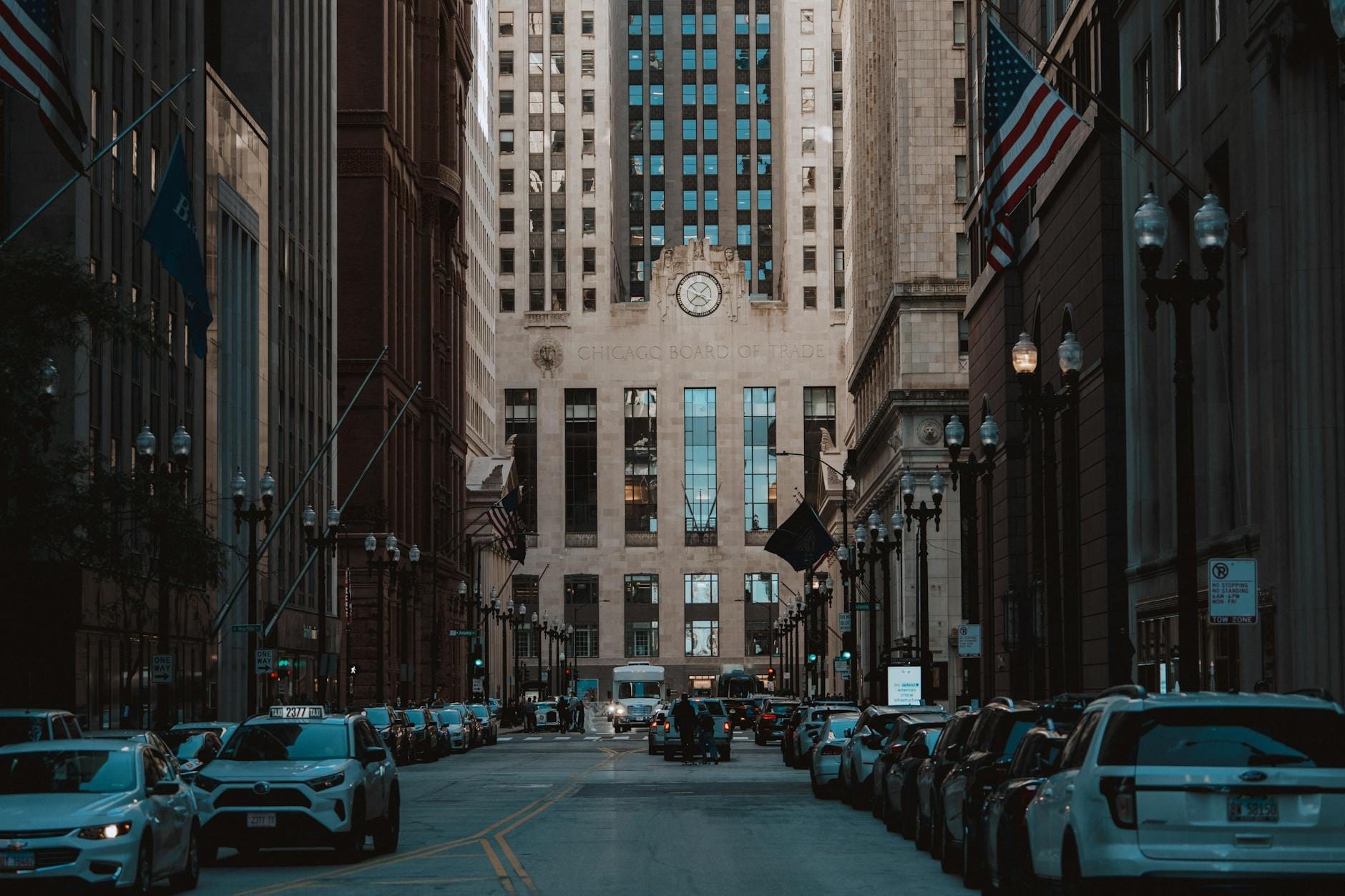
Standing 604 feet tall at the foot of LaSalle Street, the Chicago Board of Trade Building is one of the finest Art Deco skyscrapers in the United States. Designed by Holabird & Root and completed in 1930, it anchors the Loop's financial canyon with a stainless-steel goddess at its summit and a lobby that feels like stepping into a Prohibition-era fever dream of ambition and ornament.
Quick Facts
- Location
- 141 W Jackson Blvd, Chicago Loop (at LaSalle St)
- Getting There
- CTA Brown/Purple/Orange/Pink Lines – Quincy station; Blue/Red Lines – Jackson (short walk)
- Time Needed
- 30–60 minutes for exterior and lobby; longer with a guided architectural tour
- Cost
- Exterior and lobby access free (weekday business hours); guided tour fees vary by operator
- Best for
- Architecture enthusiasts, history buffs, photographers, anyone doing a Loop walking tour
- Official website
- www.cbotbuilding.com
What You're Actually Looking At
The Chicago Board of Trade Building is not a museum you walk through at your own pace. It is, first and foremost, a functioning commercial office tower that happens to be one of the most architecturally significant buildings in the Midwest. Completed in 1930 at the height of the Art Deco movement, it was designed by Chicago firm Holabird & Root and stood as the city's tallest building from its completion in 1930 until 1965, when it was surpassed by the Richard J. Daley Center. At 44 stories and 604 feet (184 meters), it still dominates the southern terminus of LaSalle Street with a presence that newer glass towers simply cannot replicate.
The building's crowning feature is a 31-foot stainless-steel statue of Ceres, the Roman goddess of grain, sculpted by John Storrs (1885–1956). The choice of Ceres was deliberate: the Board of Trade was then the world's oldest and largest futures exchange, trading agricultural commodities like wheat and corn. She stands faceless, a stylistic decision Storrs made because, at that height, no one would ever be able to read her expression anyway. That cool pragmatism feels very Chicago.
ℹ️ Good to know
The building was designated a Chicago Landmark in 1977 and added to the National Register of Historic Places in 1978. It has two connected sections: the original 1930 tower and a 1980 addition to the north, also by Holabird & Root.
The LaSalle Street Canyon: Approaching the Building
The best way to experience the Chicago Board of Trade Building is to approach it from the north, walking south down LaSalle Street from around Randolph or Washington. This stretch of LaSalle is one of the great urban corridors in the United States. The street runs dead-straight through the Loop's financial district, flanked by cliff faces of limestone and granite, and the CBOT tower snaps into view at the far end like a period at the end of a very long sentence.
On weekday mornings, the canyon fills with office workers moving quickly, the smell of coffee wafting from food carts near the intersections, the rumble of CTA trains audible from the elevated tracks a block over. The light changes dramatically depending on the time of day: at midday in summer, direct sun reaches the street floor and the building's limestone facade turns almost white. In the late afternoon, LaSalle falls into shadow and the upper tower catches warm golden light while the street level stays cool and grey. This contrast is worth planning for if you are photographing the building.
💡 Local tip
For the classic LaSalle Street canyon shot with the CBOT tower in the background, position yourself near the intersection of LaSalle and Adams and use a moderately wide lens. Early morning on a weekday gives you the financial district's energy without impenetrable crowds blocking the frame.
Tickets & tours
Hand-picked options from our booking partner. Prices are indicative; availability and final rates are confirmed when you complete your booking.
Go City | Chicago All-Inclusive Pass
From 127 €Instant confirmationFree cancellationiFLY Chicago Lincoln Park indoor skydiving experience
From 126 €Instant confirmationFree cancellationiFLY Chicago Rosemont indoor skydiving tickets
From 117 €Instant confirmationFree cancellationChicago lakefront neighbourhood bike tour
From 18 €Instant confirmationFree cancellation
The Lobby: Art Deco at Its Most Serious
Lobby access is possible during standard weekday office hours, though this is a working building and the interior is not a public attraction in the conventional sense. What you find inside is worth the brief detour. The lobby features multi-colored marble floors, elaborate bas-relief panels, and ceiling details that are richly geometric. The overall effect is of tremendous institutional confidence, a building that expected to matter for centuries and designed accordingly.
The scale of the lobby feels larger than it actually is, partly because of the soaring ceiling height and partly because the ornamentation draws your eye upward. It is a quiet space on most weekday mornings, occupied mainly by building tenants moving between floors. Security personnel are present, and while the lobby is accessible, the building is not a tourist attraction in the way that a museum is. Behave as you would in any professional office building: move through calmly, do not linger in traffic areas, and ask before photographing in areas near the security desk.
⚠️ What to skip
Access to floors above the lobby is restricted to tenants and their guests. Do not expect to ride elevators to upper floors or access the trading floor areas without a scheduled tour or prior arrangement with building management.
History and Cultural Weight
The Chicago Board of Trade was founded in 1848, making it one of the oldest commodity futures exchanges in the world. By the time this tower was built in 1930, Chicago was the grain-trading capital of the planet, and the building was intended to express that dominance in stone and steel. The trading floor, which once filled the building with the deafening noise of open-outcry pit trading, has been largely silent since electronic trading displaced floor traders over the past two decades.
In 2007, the CBOT merged with the Chicago Mercantile Exchange to form the CME Group, which operates the world's largest derivatives exchange by trading volume. The building's identity shifted as a result, from active exchange to prestige office address. Some traders still work in the building, but the frantic energy that once defined it is largely gone. What remains is the architecture, and architecture this good does not require activity to justify itself.
The building fits naturally into a broader exploration of Chicago's architectural heritage. If the CBOT sparks your interest in the city's commercial buildings, the nearby Rookery Building on LaSalle offers a completely different architectural moment: an 1888 Burnham and Root structure with a Frank Lloyd Wright-renovated lobby. Both buildings are within a few minutes' walk of each other, and together they trace a half-century of Chicago's commercial architectural ambition.
Guided Tours and Architectural Context
The most rewarding way to engage with the Chicago Board of Trade Building as a visitor is through a structured architectural tour. Several operators offer Loop walking tours that include the CBOT as a centerpiece, providing access to lobby areas and detailed commentary on the building's design, history, and place in Chicago's broader architectural story.
The Chicago Architecture Center on the Riverwalk is the best starting point for planning this kind of visit. They offer both walking tours of the Loop and architecture river cruises that put the CBOT in context alongside dozens of other significant structures. Tour guides here tend to be exceptionally well-informed, drawing on decades of institutional knowledge about the city's built environment.
Self-guided visits are also practical. The Chicago Architecture Center sells a detailed Loop walking tour map, and the building's exterior is accessible at any hour. Night visits are underrated: the tower is lit from below after dark, and the Ceres statue catches light at the top while the street level around you empties out. The LaSalle Street canyon at 10pm on a weekday, with the CBOT tower glowing at the far end, is one of the genuinely striking urban views in Chicago.
Photography, Weather, and Practical Logistics
Chicago's climate affects the experience here more than at most indoor attractions. In winter, LaSalle Street becomes a wind tunnel, and temperatures regularly drop below freezing. The canyon geometry that makes the street so photogenic also concentrates cold air from the lake. Dress warmly and keep your camera in a bag between shots so the lens does not fog when you bring it indoors. In summer, the same canyon geometry creates shade for much of the day, which is welcome during the city's hot July afternoons (average high around 29°C/85°F).
Spring and early autumn are the most comfortable seasons for a walking visit. May and September offer moderate temperatures, good light, and a Loop that is active without the tourist volume of summer weekends. Rain is distributed fairly evenly throughout the year, so an umbrella is always worth having in a bag.
The CBOT sits in the heart of the Loop, which means transit access is excellent. The CTA Brown, Purple, Orange, and Pink lines stop at Quincy, roughly a two-minute walk. The Blue and Red lines stop at Jackson, about a four-minute walk. If you are combining this with other Loop sights, the Chicago Riverwalk is about ten minutes north on foot, and Millennium Park is roughly fifteen minutes northeast.
Who Should Skip This
Travelers primarily interested in interactive experiences, live performances, or activities-based tourism will find little here beyond an exterior and a lobby. The trading floor that once made this building electric is not open to the public in any general-access format. If architecture leaves you cold and you are working through a limited number of Chicago hours, the CBOT is skippable without missing something irreplaceable. That said, for anyone with even a passing interest in 20th-century urban design, it earns its time easily.
Insider Tips
- Walk south down LaSalle from Randolph Street rather than approaching from Jackson. The full-canyon approach is the only way to understand why this building was designed to terminate a straight corridor rather than stand in open space.
- The 1980 north addition is worth examining closely. It deliberately echoes the 1930 building's massing and setbacks rather than contrasting with them, which was an unusual choice for the era and is more successful than it gets credit for.
- The Ceres statue is best visible in the late afternoon when the sun moves around to illuminate the upper tower from the west. From the LaSalle and Jackson intersection, look straight up and slightly south.
- If you want lobby access with actual context rather than a quick look around, book an architectural walking tour in advance. Several operators visit on weekday mornings when the building is at its most active and lobby access is most straightforward.
- For a different angle on the building's massing, walk around to the Quincy Street side. The building reads very differently from the east, where the 1980 addition and the original tower sit in relation to each other more clearly.
Who Is Chicago Board of Trade Building For?
- Architecture enthusiasts doing a Loop landmark walk
- Photographers seeking classic Chicago urban canyon shots
- History and finance buffs interested in the city's commodity trading past
- First-time visitors on a structured architectural tour of the Loop
- Travelers combining multiple Loop sights in a half-day itinerary
Nearby Attractions
Other things to see while in The Loop:
- Art Institute of Chicago
One of the largest and most visited art museums in the United States, the Art Institute of Chicago anchors the eastern edge of the Loop with a collection of over 300,000 works spanning 5,000 years. From Georges Seurat's pointillist masterpiece to Grant Wood's American Gothic, the highlights alone demand the better part of a day.
- Buckingham Fountain
The Clarence Buckingham Memorial Fountain is one of the largest decorative fountains in the world, sitting at the heart of Grant Park since 1927. Free to visit during its seasonal run from spring through mid-October, it puts on hourly water displays and a nightly illuminated show that draws crowds from across the city.
- Chicago Architecture Center
Housed in Mies van der Rohe's One Illinois Center on the Chicago River, the Chicago Architecture Center packs nearly 10,000 square feet of exhibition space, a landmark scale model of the city, and access to some of the country's most informative architecture tours. It's the most comprehensive entry point into understanding what makes Chicago's skyline one of the world's most significant.
- Chicago Architecture Foundation River Cruise
The Chicago Architecture Center River Cruise aboard Chicago's First Lady is the most authoritative way to read the city's skyline. In 90 minutes, trained docents walk you through more than 40 landmark buildings across all three branches of the Chicago River, connecting architectural styles to the human decisions that shaped them.