Cloud Gate (The Bean): Chicago's Mirror in the Park
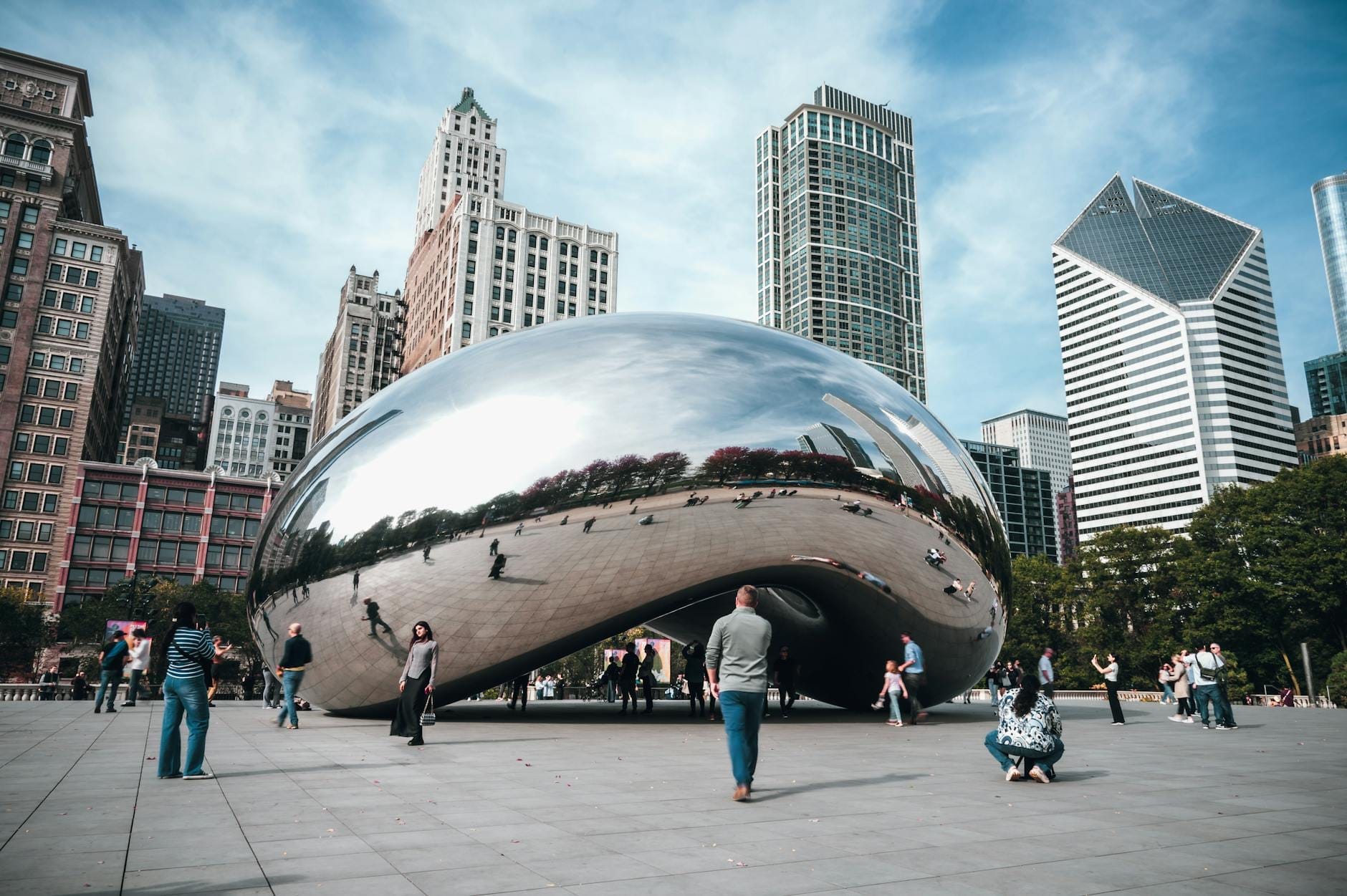
Cloud Gate, the 110-ton polished steel sculpture known locally as 'The Bean,' sits at the heart of Millennium Park in Chicago's Loop. Free to visit and open daily, it reflects the city skyline, the sky, and everyone who stands beneath it in one seamless, mercury-like surface.
Quick Facts
- Location
- Grainger Plaza, Millennium Park, 201 E. Randolph St., Chicago, IL 60602
- Getting There
- Washington/Wabash 'L' station (~4–5 min walk); Adams/Wabash (~6–7 min walk)
- Time Needed
- 20–45 minutes at the sculpture; longer if exploring Millennium Park
- Cost
- Free — no ticket required
- Best for
- Architecture lovers, photographers, families, first-time Chicago visitors
- Official website
- loopchicago.com/listings/cloud-gate
What Cloud Gate Actually Is
Cloud Gate is a public sculpture by British-Indian artist Anish Kapoor, installed in Grainger Plaza (formerly AT&T Plaza) within Millennium Park in Chicago's Loop. The piece stands approximately 33 feet tall, stretches 66 feet in length, and weighs around 110 tons. It is constructed from 168 stainless steel plates welded together and then polished to a finish so seamless that no seam line is visible to the naked eye. Kapoor has said the form was inspired by liquid mercury, and standing in front of it, that comparison is immediately clear: the surface reads not as solid metal but as something poured and frozen mid-motion.
The piece was commissioned in 1999, installed in 2004, and fully unveiled after its final polishing in 2006. It is permanently sited in the open air on a flat stone plaza, with no fence or barrier separating visitors from the sculpture. You can walk directly up to it, touch it, crouch beneath the 12-foot arch at its center, and look straight up into the concave interior, known as the omphalos, where your reflection multiplies and distorts in strange, looping patterns.
💡 Local tip
The arch at the center of Cloud Gate (the omphalos) is the most rewarding spot most visitors skip. Stand directly underneath, look up, and you will see a tunnel of distorted reflections radiating outward. It works best with fewer people around you — early morning is the clearest.
The Experience: Morning, Midday, and After Dark
The sculpture changes entirely depending on when you arrive. In the early morning, typically before 9 a.m., the plaza is near empty. The steel surface reflects a cool, pale sky and the sharp silhouettes of the surrounding Loop skyscrapers. The light is soft and directional. Sounds are minimal: footsteps on stone, distant traffic on Randolph Street, occasionally birdsong from the park. This is the best hour for photography without strangers in frame, and it is also the most atmospheric, with a quality that feels almost private despite being a public space in a major city.
By midday on a summer weekend, the plaza fills quickly. Families cluster around the perimeter taking photos. Children press their palms flat against the cool metal. Tour groups narrate. The reflective surface becomes a mirror of crowds, a compressed panorama of people and sky that is chaotic in an interesting way, but far less contemplative. The sculpture does not suffer from the crowds; it absorbs them and reflects them back. But if your goal is a clean photograph or a quiet moment, midday from June through August is the wrong time.
In the evening, particularly as the sun drops toward the western skyline, the steel takes on a warm amber cast. The cloud reflections slow and deepen. After sunset, the surrounding park lights and the glow of nearby buildings create a completely different effect: the surface becomes darker and more abstract, punctuated by points of light. Cloud Gate is an outdoor sculpture in an unfenced plaza, but Millennium Park itself closes at 11 p.m., and visitors are expected to leave the park at that hour.
Tickets & tours
Hand-picked options from our booking partner. Prices are indicative; availability and final rates are confirmed when you complete your booking.
Go City | Chicago All-Inclusive Pass
From 127 €Instant confirmationFree cancellationiFLY Chicago Lincoln Park indoor skydiving experience
From 126 €Instant confirmationFree cancellationiFLY Chicago Rosemont indoor skydiving tickets
From 117 €Instant confirmationFree cancellationChicago lakefront neighbourhood bike tour
From 18 €Instant confirmationFree cancellation
Getting There and Getting Around the Plaza
Cloud Gate sits within Chicago's Loop, the city's central business district. The most straightforward transit option is the CTA 'L': the Randolph/Wabash station is approximately a four-minute walk from the sculpture, and the Adams/Wabash station is about six minutes away. Multiple 'L' lines serve these stops, making access easy from nearly any neighborhood in the city. From O'Hare, take the Blue Line to Clark/Lake and transfer or walk south through the Loop. From Midway, the Orange Line terminates at the Loop.
The plaza itself is paved and completely flat, making it fully wheelchair accessible. The arch at the center of the sculpture is 12 feet high, easily passable for any visitor. There are no steps, barriers, or ticketing areas. You arrive, you walk in, you look around. On warm days, the stone surface heats up considerably, so comfortable shoes are useful. In winter, the same stone can be icy near the edges of the plaza if there has been recent precipitation.
Directly east of Cloud Gate is Crown Fountain, another of Millennium Park's signature public artworks. To the north, the Jay Pritzker Pavilion hosts free concerts through the summer. Budget extra time to walk through the park itself, which connects south toward Grant Park and the lakefront.
Architecture and Cultural Context
Millennium Park opened in 2004 on a roughly 24.5-acre plot above a working rail yard and parking structure, transforming what had been an industrial gap in the Chicago lakefront into a civic and cultural space. Cloud Gate was one of the first major commissions for the park and quickly became its defining image. Anish Kapoor, already internationally recognized for his work with reflective and void-like forms, was selected through a competitive process. The technical challenge of fabricating a seamless polished surface at this scale was unprecedented: the welding and polishing work required to eliminate all seam lines involved years of specialized labor.
The broader context of Chicago's public architecture matters here. The city has one of the most significant collections of architectural landmarks in North America, from the steel-and-glass towers of the Loop to the Prairie Style houses of Frank Lloyd Wright. Cloud Gate fits into that tradition not by mimicking it but by using the city itself as its material: the sculpture shows you Chicago's skyline reflected and compressed, offering a panoramic view of the surrounding buildings in a form you can walk around and underneath. If the architecture of Chicago interests you beyond Millennium Park, the Chicago Architecture Center is a short walk away and provides context that significantly deepens any exploration of the city.
Photography: Practical Notes
Cloud Gate is probably the most photographed object in Chicago, and for good reason: the reflective surface produces genuinely strange and interesting images that are difficult to replicate elsewhere. A few observations on making the most of it. The golden hour before sunset produces the warmest light and the most dramatic color in the steel surface. Overcast days flatten the reflections but eliminate harsh shadows and lens flare, making it easier to capture the full curvature of the sculpture cleanly. On bright midday sun, the glare on the upper surface can be severe.
Wide-angle lenses allow you to capture the full form from close range and include interesting foreground distortion. For the interior omphalos shot, a standard or slightly wide lens works better. Shoot from low to the ground to capture the reflection of the surrounding skyline in the lower third of the sculpture. The edges where the steel meets the stone are worth photographing: you can find your own reflection stretched to almost comic proportions along the outer perimeter.
ℹ️ Good to know
Cloud Gate does not have any commercial photography restrictions for personal use. Professional shoots, film crews, or commercial photography in Millennium Park may require a permit from the Chicago Park District.
Seasonal Considerations and Weather
Chicago has a humid continental climate, which means genuine winters. January temperatures average around -3 °C (27 °F), and wind coming off Lake Michigan can drive the effective temperature well below that. In winter, Cloud Gate takes on a completely different character. Snow on the surrounding plaza, low grey skies, and a near-absence of tourists create an atmosphere far removed from the summer crowds. The steel surface in freezing conditions is stunning: pale and cold, reflecting a monochrome version of the city. Dress warmly, because there is no shelter on the open plaza.
Late spring (May to early June) and early autumn (September to early October) offer the best balance: moderate temperatures, manageable crowds, and changing light conditions. Summer (June through August) brings the largest crowds but also the most activity in Millennium Park as a whole, including free concerts at the Pritzker Pavilion. For a guide to timing your broader Chicago trip, see the best time to visit Chicago for seasonal breakdowns.
Rain does not significantly diminish the experience, though the stone plaza can become slippery. Avoid the area during lightning storms, as the open plaza offers no cover. High winds off the lake are frequent and can make extended outdoor time uncomfortable.
Honest Assessment: Worth Your Time?
Cloud Gate is not overhyped. That is an unusual thing to say about an attraction that draws millions of visitors annually, but the sculpture consistently delivers what photographs suggest it will. It is genuinely strange and spatially interesting in person in a way that static images do not fully capture. Walking around it, ducking beneath it, and watching the skyline compress and warp in the curved steel is a specific experience you cannot replicate at home or from a screen.
That said, it is a single outdoor sculpture. The experience of the sculpture itself takes fifteen to thirty minutes. If you are in Chicago for several days, it belongs on the list but does not need to anchor a full afternoon. Pair it with the surrounding park, the nearby lakefront, and the architectural context of the Loop to make the trip worthwhile.
Visitors who may not enjoy it: those with limited mobility who find cold or uneven stone difficult in winter; travelers visiting specifically for interior exhibits or controlled environments; and anyone who finds large, photo-focused crowds frustrating and cannot visit outside peak hours.
Insider Tips
- Arrive before 8 a.m. on weekdays if you want the plaza nearly to yourself. By 10 a.m. on any warm day, the crowd has established itself and will not thin until evening.
- Look for the point on the outer edge where you can align your reflection perfectly with the Chicago skyline behind you — a small step to one side shifts the composition entirely.
- In winter, the Millennium Park ice rink operates just north of the sculpture, and the combination of skaters and the steel surface creates a setting unlike anything you will find in summer.
- The omphalos interior works best when there are four or fewer people standing inside it simultaneously. The reflections multiply based on how many figures are present, and a quiet moment inside alone (or nearly alone) is worth waiting for.
- From the south edge of Grainger Plaza, you can capture Cloud Gate with the entire row of Loop skyscrapers in the background — a wider composition than most visitors attempt from the north or east side.
Who Is Cloud Gate For?
- First-time Chicago visitors wanting an orientation to the city's skyline from a single point
- Architecture and design enthusiasts interested in large-scale public art and fabrication
- Photographers looking for a technically interesting subject with variable light conditions
- Families with children, who consistently respond well to the tactile, interactive quality of the sculpture
- Anyone exploring the Loop on foot and looking for a natural anchor point for a walking route through Millennium Park
Nearby Attractions
Other things to see while in The Loop:
- Art Institute of Chicago
One of the largest and most visited art museums in the United States, the Art Institute of Chicago anchors the eastern edge of the Loop with a collection of over 300,000 works spanning 5,000 years. From Georges Seurat's pointillist masterpiece to Grant Wood's American Gothic, the highlights alone demand the better part of a day.
- Buckingham Fountain
The Clarence Buckingham Memorial Fountain is one of the largest decorative fountains in the world, sitting at the heart of Grant Park since 1927. Free to visit during its seasonal run from spring through mid-October, it puts on hourly water displays and a nightly illuminated show that draws crowds from across the city.
- Chicago Architecture Center
Housed in Mies van der Rohe's One Illinois Center on the Chicago River, the Chicago Architecture Center packs nearly 10,000 square feet of exhibition space, a landmark scale model of the city, and access to some of the country's most informative architecture tours. It's the most comprehensive entry point into understanding what makes Chicago's skyline one of the world's most significant.
- Chicago Architecture Foundation River Cruise
The Chicago Architecture Center River Cruise aboard Chicago's First Lady is the most authoritative way to read the city's skyline. In 90 minutes, trained docents walk you through more than 40 landmark buildings across all three branches of the Chicago River, connecting architectural styles to the human decisions that shaped them.