Jay Pritzker Pavilion: Frank Gehry's Open-Air Concert Hall in the Heart of Chicago
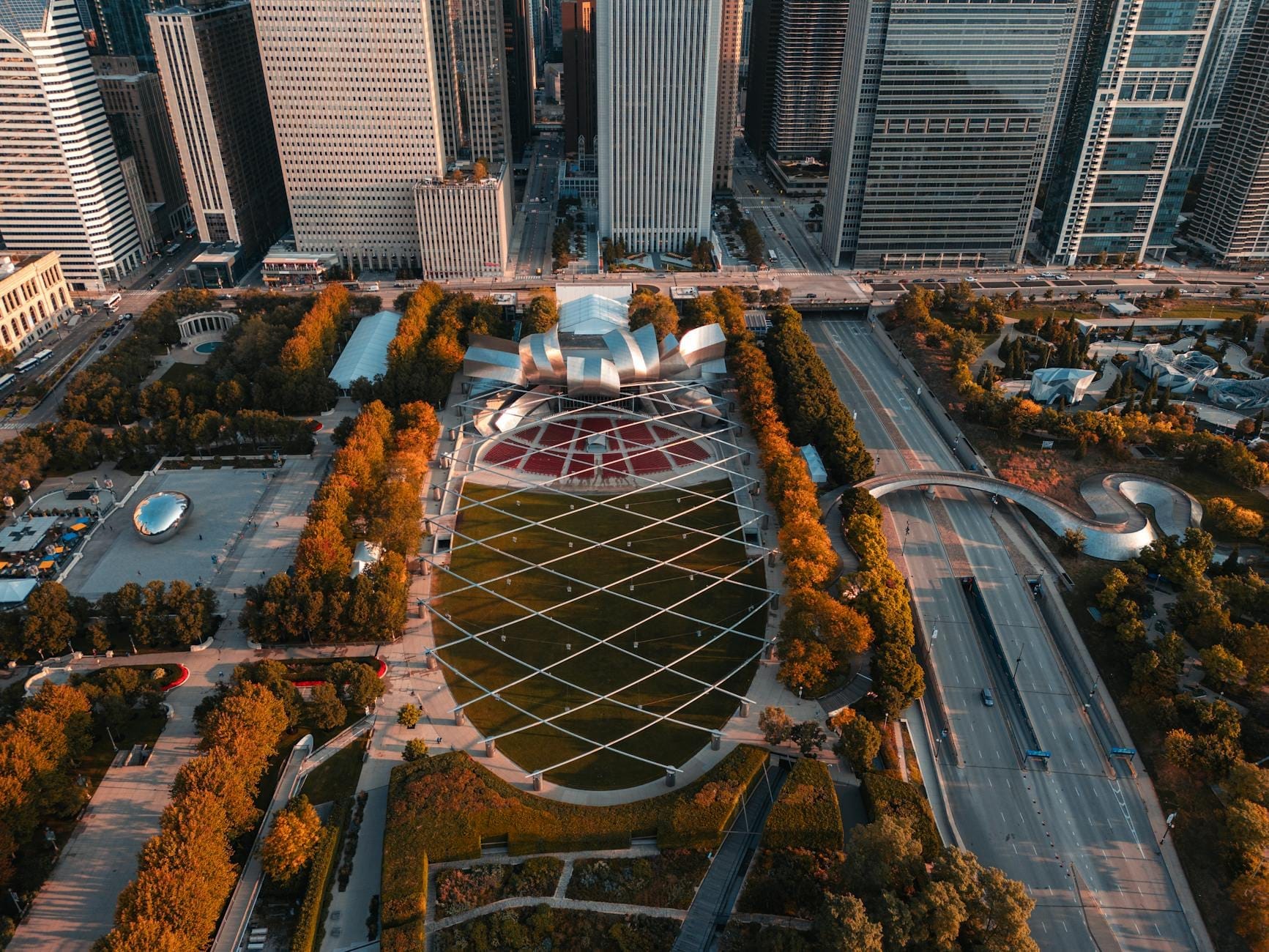
The Jay Pritzker Pavilion is a 52,000-square-foot deconstructivist performance shell at the center of Millennium Park, designed by Frank O. Gehry and completed in 2004. With 4,000 fixed seats and a Great Lawn that holds up to about 7,000 people, bringing total capacity to roughly 11,000, it hosts the Grant Park Music Festival's free summer concerts alongside major ticketed events. The architecture alone is worth the trip.
Quick Facts
- Location
- 201 E. Randolph St, Millennium Park, The Loop, Chicago, IL 60601
- Getting There
- CTA 'L' — Washington/Wabash (all ‘L’ lines except Yellow) or Lake (Red Line); multiple bus routes along Michigan Ave; multiple bus routes along Michigan Ave
- Time Needed
- 30–45 min to walk through and photograph; 2–3 hours for a full concert
- Cost
- Free for Great Lawn and back seating bowl; Grant Park Music Festival reserved seats require a One Night Pass or Membership; ticketed shows vary by event
- Best for
- Architecture lovers, classical music fans, families on a budget, summer evening outings
- Official website
- www.grantparkmusicfestival.com/plan-your-visit/our-venue
What the Jay Pritzker Pavilion Actually Is
The Jay Pritzker Pavilion is not a building you can walk past without stopping. Its signature bandshell erupts from the flat green lawn of Millennium Park as a tangle of brushed stainless-steel ribbons, curling outward from a central performance shell like a flower pulled apart mid-bloom. Designed by Frank O. Gehry and Associates and completed in 2004, the structure covers 52,000 square feet and features hundreds of individual curved steel panels that catch and scatter light differently depending on the hour and the season.
The pavilion is the architectural centerpiece of Millennium Park and one of the most photographed structures in the city. But unlike many landmark buildings in Chicago, this one is built entirely around use. It hosts the resident Grant Park Music Festival, one of the last free municipally sponsored orchestras in the United States, as well as a rotating calendar of ticketed concerts, film screenings, and civic events throughout the warmer months. The seating bowl holds 4,000 fixed seats; the Great Lawn behind it adds space for about 7,000 more listeners, bringing total capacity to roughly 11,000.
💡 Local tip
Entrances to the pavilion during Grant Park Music Festival concerts typically open about 60 minutes before showtime. Arrive early to claim lawn space and pass through the security screening and bag check at the gate. The primary concert entrances are from Randolph Street or Monroe Street rather than directly off Michigan Avenue.
The Architecture Up Close
Gehry's deconstructivist style — the same vocabulary seen in his Guggenheim Bilbao and Walt Disney Concert Hall in Los Angeles — reaches a different conclusion here. Where those buildings are enclosed, the Pritzker Pavilion is deliberately open, designed to dissolve the boundary between a performance hall and a public park. The steel headdress framing the stage has no structural role; it exists purely as sculptural expression, a kind of frozen gesture that reads differently from every angle.
Less celebrated but arguably more technically impressive is the trellis of steel pipes that rises roughly 60 feet overhead at its highest points across the Great Lawn, supporting a distributed speaker system. This network allows the pavilion to deliver sound quality approximating an indoor concert hall to audience members sitting on a blanket 200 feet from the stage — a genuine engineering achievement for an open-air space. When you lie on the grass during a performance, the sound arrives from directly above rather than from a distant point source. The effect is surprisingly intimate.
The pavilion received the 2005 Barrier-Free America Award from the Paralyzed Veterans of America, which cited it as one of the most accessible outdoor performance spaces in the world. Accessibility ramps, level pathways, and designated areas are integrated throughout. If you are building a full day around Millennium Park, note that Cloud Gate and Crown Fountain are a short walk away — all three are part of the same park complex.
Tickets & tours
Hand-picked options from our booking partner. Prices are indicative; availability and final rates are confirmed when you complete your booking.
Go City | Chicago All-Inclusive Pass
From 127 €Instant confirmationFree cancellationiFLY Chicago Lincoln Park indoor skydiving experience
From 126 €Instant confirmationFree cancellationiFLY Chicago Rosemont indoor skydiving tickets
From 117 €Instant confirmationFree cancellationChicago lakefront neighbourhood bike tour
From 18 €Instant confirmationFree cancellation
How the Experience Changes by Time of Day
On a weekday morning, the pavilion seating area is almost entirely empty. The steel panels catch the low eastern light and take on a warm amber tone that disappears by midday. You can walk down through the fixed seating rows, read the acoustics information plaques, and stand at the stage lip to look back at the downtown skyline framing the lawn. It is one of the genuinely quiet moments available in the center of a major city.
By late afternoon on a summer weekend, the mood shifts. Families spread blankets on the lawn well before showtime for Grant Park Music Festival concerts, and the lawn fills from the front back. The smell of food from nearby vendors drifts over. There is a particular pleasure to watching the city's skyline turn gold behind the stage as the orchestra warms up — the contrast between formal classical music and an informal outdoor crowd is one of the most distinctively Chicago experiences on offer.
Evening performances after dark transform the pavilion again. The steel panels are lit from below and glow silver-white against a black sky, and the canopy of speaker pipes overhead becomes invisible. The acoustics tighten as the surrounding noise drops. If you have only one evening free, this is one of the better ways to spend it — especially during June through August when the Grant Park Music Festival is in session.
ℹ️ Good to know
Chicago's summer weather is genuinely unpredictable. A concert that starts in warm sunshine can turn cold and breezy by the second half. Bring an extra layer even on warm days, especially for evening performances. Rain cancellations are possible — check the Grant Park Music Festival website on the day of your visit.
The Grant Park Music Festival: What You Need to Know
The Grant Park Music Festival is the main resident programming at the Jay Pritzker Pavilion. Running from mid-June through mid-August, it presents the Grant Park Orchestra and Chorus in a series of concerts, most of which are free to the public. The back half of the seating bowl and the entire Great Lawn are free on a first-come, first-served basis. The front half of the seating bowl is reserved, accessible through a One Night Pass or an annual Membership.
The programming is genuinely serious — full orchestral programs with guest soloists, not background music. If you expect a casual atmosphere and end up next to a subscriber who knows every movement of the piece, do not be surprised. The audience is a mix of regulars with lawn chairs and wine, first-time visitors sitting on the grass with takeout, and Chicago families with young children who fall asleep before intermission. All of this coexists without apparent friction.
Beyond the Festival, the pavilion hosts other ticketed concerts across genres, as well as events tied to festivals like the Chicago Jazz Festival and the Chicago Blues Festival, both of which take place in Grant Park and have historically used the pavilion as a main stage. Check the City of Chicago's Department of Cultural Affairs calendar for current programming.
Getting There and Practical Details
The pavilion sits inside Millennium Park at the northern end of Grant Park, in the Loop. The Washington/Wabash CTA station serves the Brown, Green, Orange, Pink, and Purple Lines and deposits you directly onto Randolph Street, a two-minute walk from the park's north entrance. Washington/Wabash is equally close. Multiple bus routes run along Michigan Avenue and State Street. The Millennium Garages beneath the park are accessible from Columbus Drive if you are driving, though parking costs can be substantial during events.
The Loop neighborhood surrounding the park is walkable and dense with other worthwhile stops. The Art Institute of Chicago is directly south along Michigan Avenue, and the Chicago Riverwalk is a ten-minute walk north. If you are planning a full day in the area, see our guide to Chicago architecture for context on what you are seeing as you move through the neighborhood.
Photography at the pavilion is straightforward. The steel panels photograph best in direct sun, when the reflections are most active. Wide-angle lenses from ground level looking up at the headdress produce the most dramatic compositions. For stage shots during performances, low-light performance photography rules generally apply — check event-specific policies before using flash or professional camera equipment.
⚠️ What to skip
Most visitors enter Millennium Park via Randolph Street to the north, Monroe Street to the south, or Columbus Drive to the east, with additional access points along Michigan Avenue near Madison and other cross streets. First-time visitors frequently try to enter from the Michigan Avenue side and end up walking an unnecessary extra block.
Is It Worth Your Time If There Is No Concert?
Yes, with realistic expectations. The pavilion as a pure architectural object is worth 20 to 30 minutes even on a quiet afternoon with nothing scheduled. The scale of the steel headdress is genuinely surprising in person — photographs do not communicate the forward thrust of the ribbons overhead. Walking down into the seating bowl and then back out onto the lawn gives you a good sense of Gehry's spatial thinking.
That said, the pavilion without a performance is a backdrop rather than a destination. It does not have interior spaces, exhibits, or programming that functions independently of scheduled events. Visitors who spend their only afternoon in Chicago here without a concert will find it satisfying for a short stop but should not plan their itinerary around it as a standalone half-day activity. It works best as part of a broader Millennium Park visit or as an evening concert destination.
For travelers trying to fit multiple priorities into limited time, our one-day Chicago itinerary explains how to combine the pavilion with other Loop-area highlights efficiently.
Insider Tips
- The acoustic sweet spot on the Great Lawn is roughly the first third of the open grass area, directly under the center of the speaker trellis. The distributed audio system is most effective here — further back toward the lawn's edge, the sound degrades noticeably.
- Grant Park Music Festival concerts are free but security lines can be long on Friday evenings and weekends. Arriving 45 to 60 minutes before showtime usually means manageable lines while still allowing you to claim good lawn space.
- On the east side of the pavilion, near the BP Bridge, there is an elevated view looking back at the steel headdress with the skyline behind it. This angle is less crowded for photographs than the straight-on view from the seating bowl.
- Bring a blanket rather than a low beach chair for Great Lawn concerts — tall chairs block sight lines for people sitting behind you and can create friction with other audience members. Folding low-back stadium seats are a better option.
- If you visit in winter, the pavilion looks completely different: stripped of crowds and color, the steel panels take on a colder, more industrial quality. The seating bowl fills with snow and the structure reads more clearly as a sculpture. It is not accessible for events but is worth seeing from the perimeter paths.
Who Is Jay Pritzker Pavilion For?
- Architecture enthusiasts who want to see Gehry's deconstructivist language applied at urban scale
- Budget travelers and families: Grant Park Music Festival concerts offer professional orchestral programming at zero cost for lawn seats
- Visitors who want a quintessential Chicago summer evening — skyline, live music, grass, and a cooler of drinks
- Photographers working the golden hour, when the steel panels shift from silver to warm amber
- Travelers who want to combine multiple Millennium Park landmarks in a single efficient visit
Nearby Attractions
Other things to see while in The Loop:
- Art Institute of Chicago
One of the largest and most visited art museums in the United States, the Art Institute of Chicago anchors the eastern edge of the Loop with a collection of over 300,000 works spanning 5,000 years. From Georges Seurat's pointillist masterpiece to Grant Wood's American Gothic, the highlights alone demand the better part of a day.
- Buckingham Fountain
The Clarence Buckingham Memorial Fountain is one of the largest decorative fountains in the world, sitting at the heart of Grant Park since 1927. Free to visit during its seasonal run from spring through mid-October, it puts on hourly water displays and a nightly illuminated show that draws crowds from across the city.
- Chicago Architecture Center
Housed in Mies van der Rohe's One Illinois Center on the Chicago River, the Chicago Architecture Center packs nearly 10,000 square feet of exhibition space, a landmark scale model of the city, and access to some of the country's most informative architecture tours. It's the most comprehensive entry point into understanding what makes Chicago's skyline one of the world's most significant.
- Chicago Architecture Foundation River Cruise
The Chicago Architecture Center River Cruise aboard Chicago's First Lady is the most authoritative way to read the city's skyline. In 90 minutes, trained docents walk you through more than 40 landmark buildings across all three branches of the Chicago River, connecting architectural styles to the human decisions that shaped them.