Crown Fountain: Chicago's Most Playful Public Artwork
Completed in 2004, Crown Fountain stands at the southwest corner of Millennium Park as two 50-foot glass block towers displaying the faces of 1,000 Chicagoans. The shallow reflecting pool between them turns into a water play area from spring through fall, drawing children, photographers, and curious visitors in equal measure. Admission is always free.
Quick Facts
- Location
- Millennium Park, Michigan Ave & Monroe St, Chicago, IL 60603
- Getting There
- CTA Brown, Green, Orange, Pink, Purple lines to Washington/Wabash; Red Line to Monroe
- Time Needed
- 20–45 minutes
- Cost
- Free, always
- Best for
- Families, photography, architecture enthusiasts, hot summer days
What Crown Fountain Actually Is
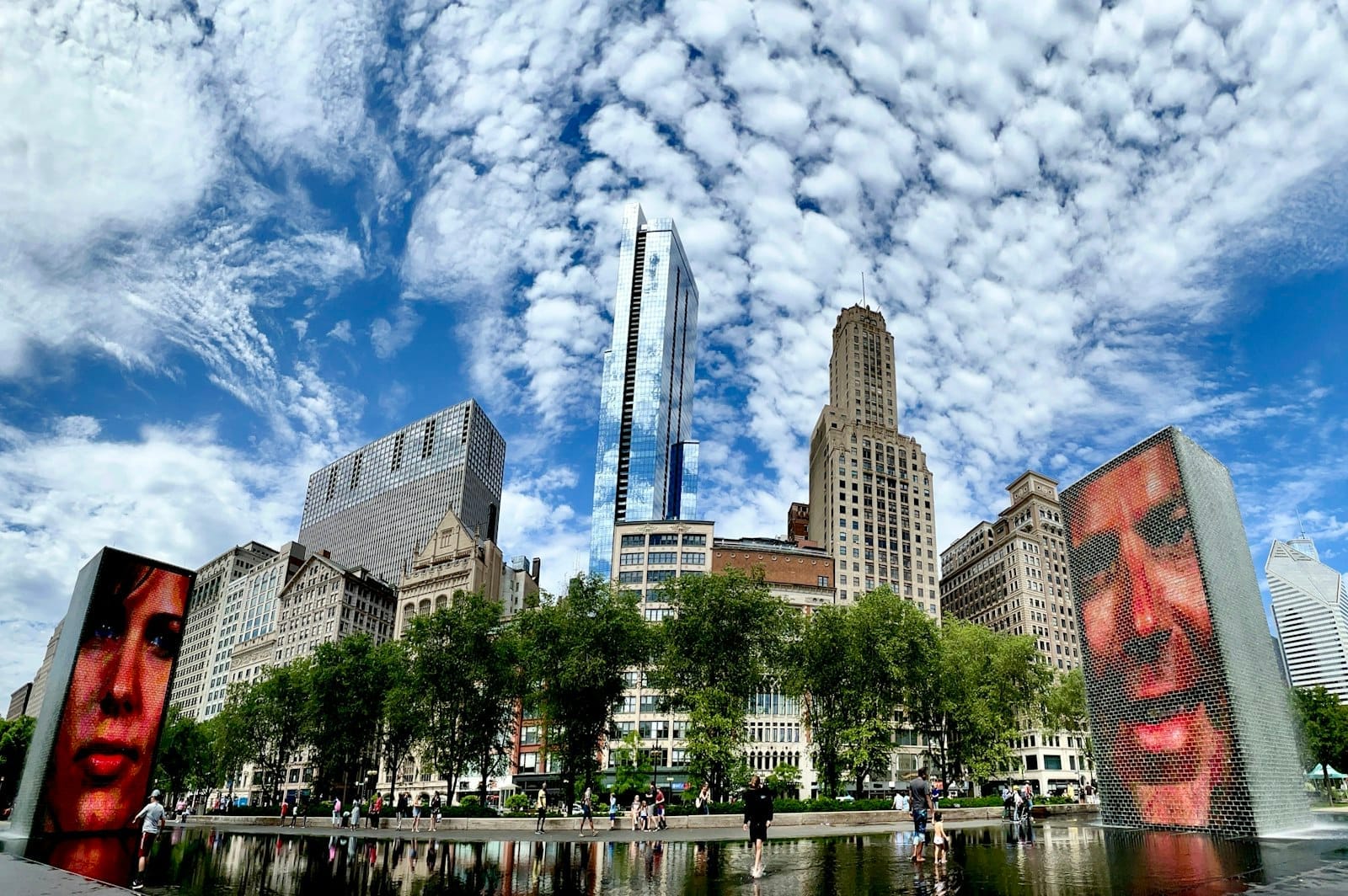
Crown Fountain is a public artwork by Spanish sculptor Jaume Plensa, opened in July 2004 at the southwest corner of Millennium Park. It consists of two 50-foot glass block towers standing at opposite ends of a black granite reflecting pool that measures 232 feet long, 48 feet wide, and just one-eighth of an inch deep. That shallow depth is deliberate: it creates a mirror surface when still, and becomes safe wading water for children when the feature is active.
The towers are not static sculpture. Each one functions as a large LED screen displaying slow-motion video portraits of 1,000 Chicago residents, cycling through faces from every background and age group in the city. Every several minutes, a face purses its lips and water spouts from a nozzle in the tower's face, arcing into the pool below. This moment, equal parts amusing and strange, tends to produce shrieks from wading children and quiet smiles from everyone watching from the surrounding granite benches.
ℹ️ Good to know
Millennium Park is open daily from 6:00am to 11:00pm. The water feature operates from spring through fall, weather permitting. The video displays run year-round.
Plensa's concept draws on a long tradition of fountain gargoyles that spout water from their mouths, but replaces stone with living faces. The 1,000 portraits were photographed between 1999 and 2004. The effect is that the fountain represents Chicago's actual population in a way few public artworks in any city manage.
How the Experience Changes by Time of Day
Early morning, before 9am, Crown Fountain is nearly deserted. The granite surface reflects the faces on the towers cleanly, and the surrounding park is quiet enough that you can hear the low hum of the LED panels. Photographers regularly arrive at this hour to capture clean reflections without the blur of passing strollers and tourists. The light is best on the east-facing side in morning.
By midday in summer, the pool fills with children who have come prepared in swimsuits, sometimes with parents who have not. The scene becomes genuinely joyful in a way that is hard to manufacture: strangers end up in each other's photos, a toddler sits directly beneath a spouting face, a group of teenagers take turns positioning themselves for the water arc. The granite benches on the perimeter fill with people eating lunch from the park's vendors nearby.
Evening visits offer a different quality altogether. As daylight fades, the illuminated towers become more dramatic against the sky. The faces glow with an almost cinematic weight, and the pool's reflection doubles the effect. Foot traffic is lighter than midday, and the fountain takes on a meditative, slightly surreal quality.
💡 Local tip
For the best photos with no crowds, visit on a weekday morning before 9am in late spring or early fall. Midday in July and August is peak crowd time, especially on weekends.
Tickets & tours
Hand-picked options from our booking partner. Prices are indicative; availability and final rates are confirmed when you complete your booking.
Go City | Chicago All-Inclusive Pass
From 127 €Instant confirmationFree cancellationiFLY Chicago Lincoln Park indoor skydiving experience
From 126 €Instant confirmationFree cancellationiFLY Chicago Rosemont indoor skydiving tickets
From 117 €Instant confirmationFree cancellationChicago lakefront neighbourhood bike tour
From 18 €Instant confirmationFree cancellation
Getting There and Getting Around
Crown Fountain sits within Millennium Park, which occupies a full block along Michigan Avenue between Randolph and Monroe Streets. The fountain is at the Monroe Street end, near the park's southwest corner. From the CTA, the most convenient stops are Washington/Wabash on the Brown, Green, Orange, Pink, and Purple lines, or Monroe on the Red Line. Both are under a five-minute walk.
If you are arriving from outside the Loop, the Blue Line to Washington/Dearborn puts you within a 10-minute walk. Metra trains stop at Millennium Station on Randolph Street, essentially adjacent to the park's northeast corner. Street parking along Michigan Avenue is limited and expensive; the nearest garages are on Columbus Drive and Wacker Drive.
The fountain is very close to several other central park landmarks. Cloud Gate (the mirrored sculpture commonly called 'The Bean') is a three-minute walk to the north. Jay Pritzker Pavilion is a short walk east across the park's central lawn.
Architecture and Materials
The towers are constructed from translucent glass bricks with LED panels embedded behind them. The glass diffuses the screen light in a way that makes the images appear to glow from within rather than display from a flat surface. At night, particularly, this gives the portraits an unusual depth. The construction contractor was W.E. O'Neil, and the lighting technology was integrated by Color Kinetics. The towers reach approximately 16 meters in height.
The surrounding plaza and pool are finished in polished black granite. The material choices are precise: the dark granite maximizes the reflective pool effect, making the towers appear to extend downward into the earth as well as upward. When the water is still and the light is right, the reflection is close to perfect, effectively doubling the apparent height of the installation.
Plensa is a Barcelona-born sculptor known internationally for text-based and portrait sculptures. Crown Fountain remains one of his most recognized works and a reference point for discussions of interactive public art in the 21st century. For broader context on the architectural ideas that shaped the park it inhabits, the Chicago architecture guide offers a useful overview.
Seasonal Considerations and Weather
Chicago's climate shapes how Crown Fountain is experienced dramatically. In July and August, with temperatures commonly reaching 29°C (84°F), the ankle-deep water in the pool becomes a genuine draw for anyone overheated from walking the park. The fountain operates through the warmer months but is turned off in winter to prevent ice damage.
In winter, from roughly November through March, the water is off. The face portraits on the towers are still worth seeing on a cold, clear day, particularly when snow covers the surrounding granite and the faces appear suspended in an unusually quiet urban landscape. Dress in proper layers: Chicago winters are serious, with mean January temperatures around -2.8°C (27°F) and occasional wind chill far below that.
Late spring (May to June) and early fall (September to early October) hit a middle ground: the water feature is typically active, temperatures are moderate, and tourist crowds are lighter than peak summer. For a broader view of when to time your trip, see the best time to visit Chicago guide.
⚠️ What to skip
In summer, the granite surface around the pool gets extremely hot in direct midday sun. If you are visiting with young children, sandals or water shoes are strongly recommended for the walk to the pool edge.
Photography Tips
Crown Fountain is one of the more technically interesting subjects in Millennium Park. The reflective pool, when calm, gives you effective symmetry shots. The LED portrait displays respond well to longer exposures in low light conditions, particularly at dusk when the illumination from the towers begins to compete with the ambient sky.
The water spout sequence happens approximately every few minutes per tower. If you want to catch the arc of water and a face mid-spout, position yourself at the side of the pool at a low angle, use a fast shutter speed, and wait. With patience it is a fairly reliable shot. The faces cycling on each tower change slowly enough that you have time to frame before the sequence resets.
One underused angle: stand between the two towers at the center of the pool and shoot down the full 232-foot length with a tower framing each end. At golden hour, the reflected light turns this corridor into a remarkably composed image.
Who This Attraction Is Right For (and Who Can Skip It)
Crown Fountain is genuinely one of the more distinctive public artworks in any American city, and it is free. That combination makes it worth at least a short stop for almost any visitor to Millennium Park. It is particularly well-suited to families with young children: the interactive water element is safe, free, and delights most kids immediately.
Architecture and art enthusiasts will find the construction and conceptual framework interesting enough to warrant reading about before arriving. Photographers have plenty to work with at various times of day. People watching here in summer is excellent: it is one of the more genuinely diverse cross-sections of Chicago's population you will see gathered in one small space.
Travelers who are primarily interested in major indoor museums or specific Chicago experiences may find it makes more sense to pass through briefly rather than build time around it specifically. Crown Fountain is best understood as part of a broader Millennium Park visit that also includes Cloud Gate and, in the evening, the Chicago lakefront just a short walk east. Visitors who are wholly uninterested in public art and have no children in tow may find 10 minutes sufficient.
Insider Tips
- The water spout from each tower face happens on a cycle. If you watch for a minute or two, you will see the face on screen begin to close its eyes and pucker slightly before the water emerges. Once you know the tell, timing your photo becomes much easier.
- The pool is one-eighth of an inch deep by design, but after heavy rain the surrounding drainage can leave standing water on the granite approaches. Wear shoes you do not mind getting wet on a rainy day.
- Each tower displays different faces simultaneously, so walking from one end of the pool to the other gives you a completely different viewing experience. Most people stand at one end only.
- In winter, the fountain area is often nearly empty even on weekends. The illuminated towers against a grey Chicago sky or after snowfall make for striking photos without a single other person in frame.
- Restrooms in Millennium Park are available at the Crown Fountain pavilion building on the south side of the installation. This is one of the more centrally located restroom facilities in the park.
Who Is Crown Fountain For?
- Families with young children looking for safe, free outdoor play
- Photographers interested in reflective surfaces, portrait lighting, and long exposures
- Architecture and public art enthusiasts who want context beyond Cloud Gate
- Summer visitors looking for a free way to cool off in the park
- Anyone building a self-guided Millennium Park walkthrough
Nearby Attractions
Other things to see while in The Loop:
- Art Institute of Chicago
One of the largest and most visited art museums in the United States, the Art Institute of Chicago anchors the eastern edge of the Loop with a collection of over 300,000 works spanning 5,000 years. From Georges Seurat's pointillist masterpiece to Grant Wood's American Gothic, the highlights alone demand the better part of a day.
- Buckingham Fountain
The Clarence Buckingham Memorial Fountain is one of the largest decorative fountains in the world, sitting at the heart of Grant Park since 1927. Free to visit during its seasonal run from spring through mid-October, it puts on hourly water displays and a nightly illuminated show that draws crowds from across the city.
- Chicago Architecture Center
Housed in Mies van der Rohe's One Illinois Center on the Chicago River, the Chicago Architecture Center packs nearly 10,000 square feet of exhibition space, a landmark scale model of the city, and access to some of the country's most informative architecture tours. It's the most comprehensive entry point into understanding what makes Chicago's skyline one of the world's most significant.
- Chicago Architecture Foundation River Cruise
The Chicago Architecture Center River Cruise aboard Chicago's First Lady is the most authoritative way to read the city's skyline. In 90 minutes, trained docents walk you through more than 40 landmark buildings across all three branches of the Chicago River, connecting architectural styles to the human decisions that shaped them.