Alfred Caldwell Lily Pool: Chicago's Quietly Extraordinary Prairie Garden
Tucked inside Lincoln Park, the Alfred Caldwell Lily Pool is a 3-acre National Historic Landmark redesigned in 1936–1938 in the Prairie School style. Admission is free, crowds are thin, and the experience is unlike anything else on Chicago's standard tourist circuit.
Quick Facts
- Location
- 125 W. Fullerton Pkwy, Lincoln Park — south edge of Lincoln Park Zoo
- Getting There
- CTA Brown/Purple Line to Fullerton; buses 151, 156 stop nearby
- Time Needed
- 45 minutes to 1.5 hours
- Cost
- Free (no admission fee)
- Best for
- Architecture lovers, birdwatchers, photographers, and anyone needing a genuine pause
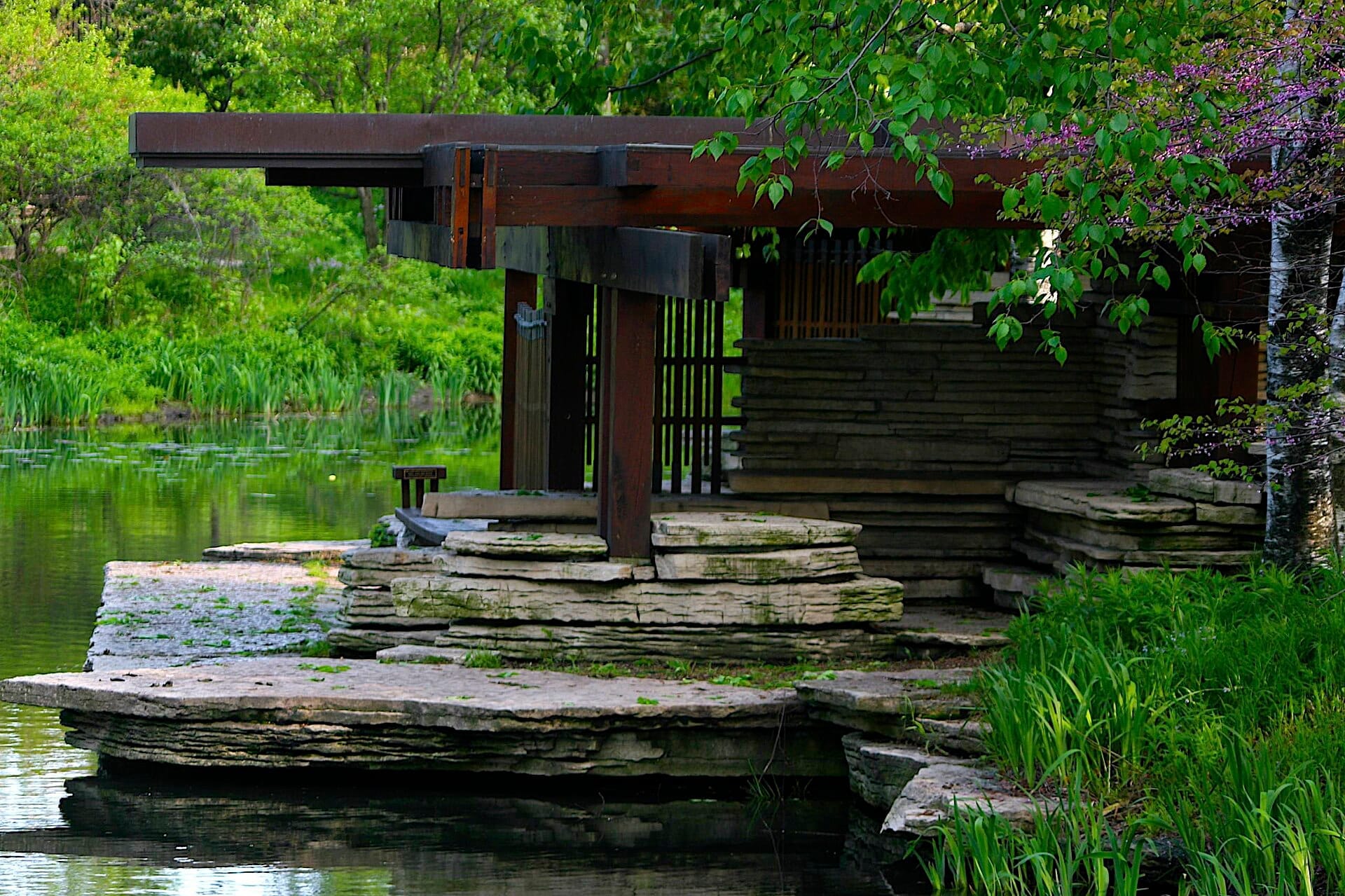
What the Alfred Caldwell Lily Pool Actually Is
The Alfred Caldwell Lily Pool is a 3-acre fenced garden inside Lincoln Park, a short walk south of the Lincoln Park Zoo's main entrance. It is simultaneously one of Chicago's most historically significant designed landscapes and one of its least-visited attractions. Most people walk straight past the low stone entrance without realizing it exists.
The site was originally built in 1889 as a Victorian water garden for growing tropical lilies. Its current form dates to 1936–1938, when Alfred Caldwell — a protégé of the Prairie School movement and deeply influenced by Jens Jensen, Chicago's great landscape philosopher — transformed the Victorian ornamental into something radical for its era: a naturalistic American landscape modeled on the Midwest's own ecology rather than European garden traditions.
The design draws directly from Prairie School principles: native plantings, horizontal lines echoing the flat Midwestern terrain, rough-cut limestone boulders, and a council ring fireplace inspired by Jensen's own democratic design philosophy. If you have spent time with Chicago's broader architectural legacy, the Lily Pool reads as a missing chapter — one written in soil and stone rather than steel and glass.
ℹ️ Good to know
The Lily Pool is open daily from mid-April through early October, typically 7:30 a.m. to 7:30 p.m. (or dusk). It closes for winter and is also shut on select holiday weekends including July 4th and the Air and Water Show weekend. Confirm current dates with the Chicago Park District or Lincoln Park Conservancy before visiting.
The Landscape: What You Actually See
The central feature is a still, irregularly shaped pond ringed with native aquatic plants. In summer, the surface is thick with lily pads and, from June into August, the blooms themselves: creamy whites and pale yellows floating against the dark water. The reflections of overhanging hawthorns and cottonwoods make the pond appear much deeper and more remote than the surrounding city would suggest.
A low waterfall feeds the northern end of the pool. The sound is barely audible at midday when traffic on Fullerton Parkway bleeds in, but in the early morning it is the dominant note — steady, almost mechanical, cutting through birdsong. The stone channel that carries the water was hand-laid and, even after the 2001 restoration, retains the feeling of something assembled without plans, just patience.
Caldwell placed flat limestone slabs as stepping surfaces and overlooks around the perimeter, and a council ring — a circle of low stone seats around a central firepit — sits on a slight rise to the west. The council ring is no longer used for fires, but its geometry is arresting: low, circular, deeply deliberate. On weekday mornings you might find a single person reading there, or no one at all.
Tickets & tours
Hand-picked options from our booking partner. Prices are indicative; availability and final rates are confirmed when you complete your booking.
Go City | Chicago All-Inclusive Pass
From 127 €Instant confirmationFree cancellationiFLY Chicago Lincoln Park indoor skydiving experience
From 126 €Instant confirmationFree cancellationiFLY Chicago Rosemont indoor skydiving tickets
From 117 €Instant confirmationFree cancellationChicago lakefront neighbourhood bike tour
From 18 €Instant confirmationFree cancellation
How the Experience Changes by Time of Day
Early morning, especially on weekdays between 7:30 and 9 a.m., is by far the best time to visit. The light comes in low over the trees to the east, catching the water surface at an angle that turns the lily pads copper at the edges. Birds are active: the Lily Pool is recognized as a reliable stop for warblers during spring migration, and the dense plantings attract a range of species that do not show up in the open lawns of the broader park.
By late morning on weekends in June and July, the garden draws a steady flow of visitors, many of them photographers. The space is small enough that a dozen people with tripods can make the intimate paths feel crowded. If solitude is what you are after, arrive at opening or in the final hour before closing.
Late afternoon in September is arguably the most photogenic window of the season. The plantings are fully mature, the light is warmer and lower than in summer, and the first yellowing begins in the hawthorns. Foot traffic drops significantly after Labor Day.
💡 Local tip
Birdwatching tip: Bring binoculars during May and early September. The Lily Pool sits in a migration corridor and the native shrubs provide cover that draws warblers, thrushes, and sparrows uncommon in the surrounding open parkland.
Historical and Cultural Context
Alfred Caldwell designed the garden between 1936 and 1938 as a Works Progress Administration project during the Depression. This context matters: the budget was minimal, the labor came from federal relief rolls, and yet the result earned designation as a Chicago Landmark in November 2002 and as a National Historic Landmark in 2006. The NPS designation recognizes it as an outstanding example of Prairie School landscape design — the only one of its kind surviving in an urban park setting.
Caldwell's mentor Jens Jensen had pioneered the idea that American urban parks should reflect American landscapes, not imported English or French garden traditions. Caldwell took that idea and applied it here with particular discipline: every plant species is native, every stone is indigenous to the region, and the layout deliberately resists symmetry. The Victorian lily pool it replaced was demolished entirely. Nothing was preserved from the 1889 design.
By the 1990s the garden had deteriorated significantly. The Lincoln Park Conservancy led a multi-year restoration completed in 2001, which rehabilitated the pavilion, council ring, pathways, and waterfall, and introduced accessible ramps. The restoration is widely cited in landscape architecture circles as a model for how to intervene in a historically protected space without destroying what made it significant. If you are already exploring Lincoln Park Zoo next door, the Lily Pool offers a complete tonal counterpoint: structured wildness versus managed spectacle.
Getting There and Moving Through the Space
The Lily Pool entrance is on the south side of Fullerton Parkway, just west of Cannon Drive. It is not prominently signed from a distance — look for a stone gate set slightly back from the path. The CTA Brown and Purple lines stop at Fullerton Station, roughly a 10-minute walk east through Lincoln Park. CTA buses 151 and 156 stop closer, on Stockton Drive near Fullerton.
The interior path is a single looping circuit around the pond, roughly a third of a mile. There are no forks or confusing junctions. The 2001 restoration installed accessible ramps and leveled surface paths at key sections, making most of the loop navigable for visitors with mobility limitations, though some outer paths over limestone slabs remain uneven.
There is no cafe, no gift shop, and no interpretive signage inside the garden. If you want to understand what you are looking at, do your reading before you arrive. The garden pairs naturally with a walk through the broader Lincoln Park grounds or a visit to the Lincoln Park Conservatory, which is a few hundred meters to the south.
⚠️ What to skip
The Lily Pool closes from early October to mid-April. It also closes on certain holiday weekends (including July 4th and Air and Water Show weekend). Always verify the current seasonal schedule with the Chicago Park District before making a special trip.
Photography Guidance
The pond photographs best in calm conditions when the surface holds a clean reflection. Wind, which is common in Chicago, breaks the mirror effect quickly. Early mornings on calm days in June and July offer the most reliable conditions. A polarizing filter helps cut glare on the lily pads in bright midday light.
The council ring is best photographed in autumn when fallen leaves collect between the stones. The pavilion and waterfall photograph cleanly from the northeast corner of the path, with the overhanging hawthorns framing the stonework. Note that commercial and professional photography sessions require a permit from the Chicago Park District. Permit details are available through the Lincoln Park Conservancy.
Honest Limitations
The Lily Pool is not a destination for visitors looking for dramatic spectacle. There is no skyline view, no interactive feature, and no organized programming on a typical visit. It is a quiet, carefully made garden that rewards attention but offers nothing to those in a hurry. Visitors expecting something equivalent to the scale of the Chicago Botanic Garden will be underwhelmed by the compact footprint.
The seasonal closure also limits access. Unlike most Chicago attractions, the Lily Pool is simply shut for six months of the year. Visitors arriving in November through March will find the gate locked. The surrounding Lincoln Park grounds remain open, but the fenced garden interior is inaccessible.
Families with young children in tow will find little here to hold a child's attention for more than 15 minutes. The pond has no interactive edge and the paths are narrow. It functions best as an adult contemplative space, not a family destination.
Insider Tips
- Visit during the last week of April or first week of May if you can time it: the hawthorns are in bloom, migration is at its peak, and summer crowds have not yet arrived. This is the one window when the garden is at its most animated.
- The council ring on the western rise gives the best elevated view across the pond. Most visitors walk the lower path and miss this vantage point entirely — take the slight uphill fork to the left as you enter.
- Wear soft-soled shoes. The limestone slab surfaces are slick after rain and hard on joints if you are on them for a while. The flat accessible sections are the exception, not the rule.
- The Lily Pool is fenced and gated, which means noise stays out more effectively than in the open park. If you sit still near the waterfall for five minutes you will hear the water clearly even when Fullerton Parkway traffic is audible beyond the wall.
- If the main gate appears unstaffed or locked outside stated hours, the garden is simply closed for the day or season. There is no secondary entrance and no buzzer — return another time.
Who Is Alfred Caldwell Lily Pool For?
- Landscape architecture enthusiasts who want to understand the Prairie School movement on the ground, not just in photographs
- Birdwatchers during spring and fall migration windows, particularly for warbler species
- Photographers seeking a quiet, water-reflective subject removed from tourist crowds
- Solo travelers or couples looking for genuine calm between busier Lincoln Park attractions
- Anyone studying or curious about Depression-era public works and WPA design projects
Nearby Attractions
Other things to see while in Lincoln Park & Old Town:
- Chicago History Museum
Founded in 1856 as the Chicago Historical Society, the Chicago History Museum is the city's oldest cultural institution. Located at the edge of Lincoln Park, it traces the full arc of Chicago's story, from its earliest Indigenous inhabitants to the Great Fire, the labor movement, and beyond. It rewards curious visitors who want more than skyline photos.
- Green City Market
Green City Market is Chicago's only year-round sustainable farmers' market, drawing top chefs, local farmers, and serious food lovers to Lincoln Park on Wednesdays and Saturdays during the outdoor season. Free to enter at both its outdoor Lincoln Park and indoor winter locations and rich with seasonal produce, artisan goods, and chef demos, it's one of the most authentic food experiences the city offers.
- Kingston Mines
Founded in 1968, Kingston Mines on North Halsted Street is the largest and oldest continuously operating blues club in Chicago. Two stages run simultaneously on weekends, keeping the music going until 4 a.m. This is where the city's blues tradition stays alive on a weekend night.
- Lincoln Park
Stretching seven miles along Lake Michigan, Lincoln Park is Chicago's largest public park and one of the most generously stocked urban green spaces in the United States. Entry is free, the zoo is free, and the range of things to do here can absorb a full day without spending a dollar.