Marina City: Chicago's Corncob Towers on the River
Marina City is one of Chicago's most recognizable architectural landmarks, a pair of 65-story concrete cylinders rising from the north bank of the Chicago River. Designed by Bertrand Goldberg and opened in stages between 1963 and 1967, the complex blends residential towers, a hotel, restaurants, and a major live music venue into a single riverfront block. Admission is free, access is open, and the views from the riverwalk are among the best in the city.
Quick Facts
- Location
- 300 N State St, Chicago, IL 60654 (north bank of the Chicago River, at State Street and Wacker Drive)
- Getting There
- CTA Red Line – Grand station (short walk southeast); CTA Brown/Purple Lines – Merchandise Mart station (short walk east)
- Time Needed
- 30–60 minutes to walk the exterior and riverfront; longer if dining or attending a show at House of Blues
- Cost
- Free to visit the complex exterior and riverwalk. Individual venues (restaurants, House of Blues concerts) charge separately.
- Best for
- Architecture enthusiasts, photographers, Chicago River walkers, live music fans
- Official website
- www.mymtca.com
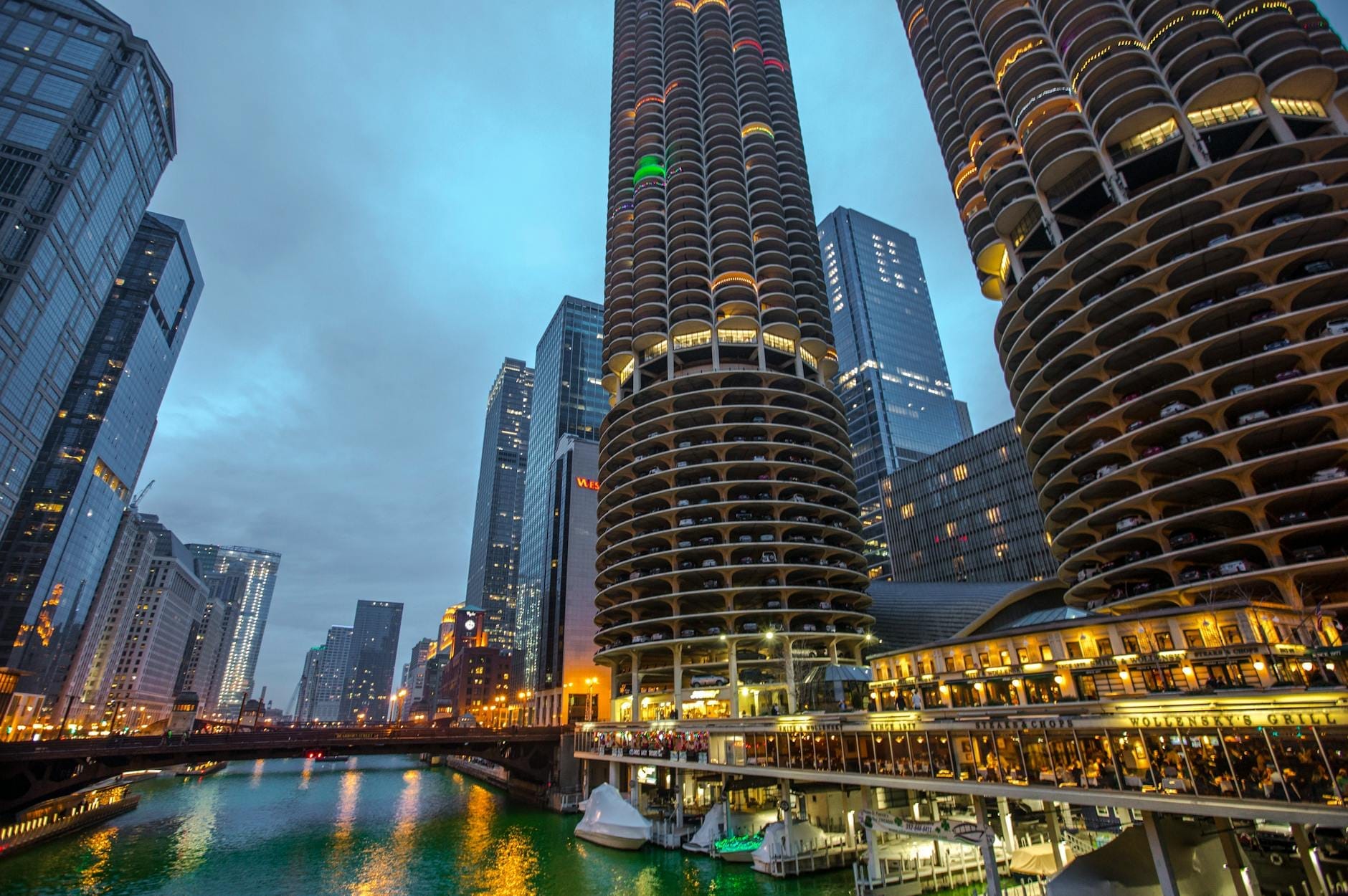
What Marina City Actually Is
Marina City is a full-block mixed-use complex on the Chicago River, anchored by two identical cylindrical residential towers that have become one of the city's most photographed silhouettes. Each tower stands 587 feet (179 meters) tall across 65 stories. The lower 19 floors of each cylinder are a continuous parking helix, with pie-shaped residential units stacked above, each with its own curved balcony. From a distance, the repetitive balcony pattern gives the towers their famous 'corncob' appearance.
The complex was designed by architect Bertrand Goldberg, who conceived it as a self-contained urban village that would give residents everything they needed without leaving the block. The residential towers began opening to residents in 1963. A 10-story office building, later converted to a hotel, opened in 1964. The full complex, including an auditorium and marina berths along the river, was complete by 1967. In 2016, portions of Marina City received official Chicago Landmark designation.
Marina City sits at the crossroads of two neighborhoods: technically addressed to River North but physically straddling the line with The Loop. It shares the riverfront with the Wrigley Building and Tribune Tower just a short walk east, and sits directly across the water from the Chicago Architecture Center, making it a natural stop on any Chicago architecture walk.
💡 Local tip
There is no general admission ticket and no formal visitor entrance. The complex is open to the public at street level and along the riverwalk. Simply walk up from the river or in from State Street.
The Architecture: Why Goldberg's Design Still Matters
Bertrand Goldberg trained under Ludwig Mies van der Rohe at the Bauhaus, but Marina City represented a deliberate rejection of the rectilinear steel-and-glass grid that dominated mid-century American architecture. Goldberg argued that right angles were efficient for manufacturing but not for human living. His circular towers, built entirely in reinforced concrete, were intended to feel organic, more like a living system than a filing cabinet.
The engineering was genuinely novel for its time. The towers use a central concrete core as the primary structural element, with floors cantilevering outward from it like shelves from a pole. This allowed the curved exterior to remain entirely free of load-bearing walls, opening up the interior and making those distinctive balconies structurally possible. When completed, they were among the tallest concrete buildings and the tallest residential structures in the world.
Up close, the concrete has a warmth that photographs rarely capture. The aggregate has a slightly sandy, almost honeyed tone in afternoon light, and the curves of the parking helix, visible through the open bays on the lower floors, create a hypnotic spiral effect. If you are working through Chicago's architectural heritage, the Chicago Architecture Center on the south bank of the river offers excellent context for understanding how Marina City fits into the broader story of the city's built environment.
Tickets & tours
Hand-picked options from our booking partner. Prices are indicative; availability and final rates are confirmed when you complete your booking.
Go City | Chicago All-Inclusive Pass
From 127 €Instant confirmationFree cancellationiFLY Chicago Lincoln Park indoor skydiving experience
From 126 €Instant confirmationFree cancellationiFLY Chicago Rosemont indoor skydiving tickets
From 117 €Instant confirmationFree cancellationChicago lakefront neighbourhood bike tour
From 18 €Instant confirmationFree cancellation
Visiting the Exterior: What to Expect at Ground Level
The most rewarding way to experience Marina City is from the riverwalk on the south side of the complex. Standing at water level, the towers rise straight up from the river's edge, their curved faces and stacked balconies reflecting in the water below. The angle from the east, looking west along the river with the towers framed against the sky, is the one that has appeared on album covers, film posters, and in countless architectural monographs.
Early morning, before 8 a.m., the area is quiet enough that you can hear the river. The low light catches the texture of the concrete and creates strong shadow patterns across the balconies. By mid-morning on weekends, the riverwalk fills with joggers, cyclists, and architecture tour boats. Midday in summer is the busiest period, with outdoor diners at the ground-floor restaurants and boat traffic on the river. Late afternoon, roughly 4 to 6 p.m., brings a particularly good quality of light from the west.
💡 Local tip
For photographs, position yourself on the south bank of the river, east of State Street bridge, and shoot west. The morning light falls directly on the east-facing curves of both towers. Avoid midday in summer when the light goes flat and foot traffic is highest.
The riverwalk in front of Marina City connects east toward the Chicago Riverwalk and ultimately toward the lake. Walking the full length of the riverwalk from here to Michigan Avenue takes under 15 minutes and passes some of the most photographed stretches of the city's waterfront.
What's Inside: Restaurants, Music, and the Hotel
Marina City is a functioning residential and commercial complex, not a tourist attraction in the conventional sense. The ground floor and podium level contain restaurants, a bar, and retail spaces. House of Blues Chicago, one of the city's principal live music venues, occupies a purpose-built space within the complex and hosts concerts most nights of the week, from blues and roots to major touring acts.
There is no public access to the residential floors of the towers. The hotel occupying the converted office building does accept guests, which is the most straightforward way to spend an extended amount of time inside the complex. If you are simply visiting for the architecture and the atmosphere, the ground-level riverfront gives you everything you need.
Individual restaurants and venues maintain their own hours and pricing in USD. There is no central box office or welcome desk for the complex as a whole. For concert tickets at House of Blues or reservations at any of the restaurants, check directly with those businesses before visiting, as hours and programming change regularly.
Getting There and Getting Around
Marina City is easy to reach on the CTA. The Red Line Grand station is the most direct stop, a few minutes walk south toward the river. The Brown and Purple Line Merchandise Mart station, just across the river to the west, is also walkable. From either station, follow State Street toward the river and the towers are visible before you arrive.
The complex sits at 300 N State Street, at the corner of State and Wacker Drive. There is no need to rent a car or take a taxi to reach it. If you are already walking the riverwalk or exploring the Loop, Marina City is likely already on your route. Rideshare drop-off works well on State Street or Dearborn Street.
Marina City is a natural anchor point for a half-day architecture walk. From here, you can head east along the river to see the Wrigley Building and Tribune Tower, then continue south into the Loop to the Rookery Building or the Chicago Cultural Center. Alternatively, board one of the Chicago Architecture Foundation River Cruise boats that depart from nearby docks, which will give you a guided perspective on the towers from the water.
Practical Notes: Weather, Seasons, and Accessibility
The exterior of Marina City can be visited year-round, but the experience changes significantly by season. In summer, the riverwalk is lively and the outdoor seating at ground-floor restaurants is in full use. Winter visits are quieter and often more atmospheric, the towers looming above a grey river with ice floes, but the cold on the open riverwalk is genuine. Chicago winters average around minus 3 degrees Celsius in January, and wind off the river accelerates the chill.
Late spring and early autumn offer the most comfortable conditions for a sustained exterior visit: moderate temperatures, lower crowds than peak summer, and good light for photography. The summer months of July and August bring the warmest weather but also the highest foot traffic, particularly on weekends.
Accessibility at street and riverwalk level is generally good. The sidewalks around the complex and the riverwalk surface are flat and paved. Elevators serve the commercial levels of the complex. For specific accessibility requirements at individual venues inside the complex (step-free entry, accessible restrooms), contact those venues directly, as the 1960s construction has been updated to varying degrees by different tenants.
⚠️ What to skip
Marina City is not a museum or observation deck. You cannot tour the residential floors, ride to the top of the towers, or access most of the interior without a reservation at a restaurant, hotel, or event venue. Visitors expecting an inside experience beyond ground level may be disappointed.
Honest Assessment: Is It Worth Your Time?
If architecture genuinely interests you, Marina City is worth at least 30 minutes of your time, specifically from the riverfront. There are few buildings in Chicago, or anywhere, that reward close looking the way these towers do. The structural logic is visible on the surface in a way that most skyscrapers, hidden behind curtain walls of glass, are not.
If you are primarily interested in interior experiences, observation decks, or interactive attractions, Marina City is probably not a destination in its own right. It works best as part of a broader Loop or riverwalk itinerary rather than as a standalone visit.
Travelers who want to experience Chicago architecture more systematically should consider pairing this visit with the Chicago architecture boat tour, which covers Marina City along with dozens of other significant buildings from the river. For a broader framework on planning your time in the city, the Chicago one-day itinerary places Marina City in context with the most efficient Loop-area route.
Insider Tips
- The open bays of the parking helix on the lower floors are publicly visible from the sidewalk on the north side of the building. Look up through the curved openings to see the spiral ramp structure, which is an architectural feature in its own right and rarely noticed by passing visitors.
- The best single photograph of Marina City is taken from the south bank of the river, standing on or near the DuSable Bridge at State Street and looking west-northwest. You get both towers in full elevation with the river in the foreground and minimal obstruction.
- If you visit during a House of Blues show night, the surrounding streets and riverwalk are noticeably more crowded after 9 p.m. If you want a quieter evening exterior visit, arrive before 7 p.m. or check the House of Blues schedule before planning your timing.
- The concrete of the towers takes on a warm amber tone in the hour before sunset on clear evenings, making late afternoon one of the best times for photography despite the foot traffic.
- Marina City is often included on architecture river cruises as a highlight, so if you have already booked a river tour, you will see it from the water. Save your ground-level visit for a different time of day to get two distinct perspectives on the building.
Who Is Marina City For?
- Architecture enthusiasts who want to see Bertrand Goldberg's concrete modernism at full scale
- Photographers looking for an iconic Chicago River composition
- Travelers building a self-guided Loop architecture walk
- Live music fans attending a House of Blues show in a genuinely distinctive venue
- Visitors who appreciate urban design history and want to understand how Chicago's riverfront developed
Nearby Attractions
Other things to see while in The Loop:
- Art Institute of Chicago
One of the largest and most visited art museums in the United States, the Art Institute of Chicago anchors the eastern edge of the Loop with a collection of over 300,000 works spanning 5,000 years. From Georges Seurat's pointillist masterpiece to Grant Wood's American Gothic, the highlights alone demand the better part of a day.
- Buckingham Fountain
The Clarence Buckingham Memorial Fountain is one of the largest decorative fountains in the world, sitting at the heart of Grant Park since 1927. Free to visit during its seasonal run from spring through mid-October, it puts on hourly water displays and a nightly illuminated show that draws crowds from across the city.
- Chicago Architecture Center
Housed in Mies van der Rohe's One Illinois Center on the Chicago River, the Chicago Architecture Center packs nearly 10,000 square feet of exhibition space, a landmark scale model of the city, and access to some of the country's most informative architecture tours. It's the most comprehensive entry point into understanding what makes Chicago's skyline one of the world's most significant.
- Chicago Architecture Foundation River Cruise
The Chicago Architecture Center River Cruise aboard Chicago's First Lady is the most authoritative way to read the city's skyline. In 90 minutes, trained docents walk you through more than 40 landmark buildings across all three branches of the Chicago River, connecting architectural styles to the human decisions that shaped them.