The Wrigley Building: Chicago's Landmark on the River
Standing at the north end of the Michigan Avenue Bridge since 1924, the Wrigley Building is one of Chicago's most recognizable structures. Its gleaming white terra cotta facade and twin-tower silhouette frame the Chicago River in a way that stops pedestrians in their tracks. Entry to public areas is free, making it one of the most accessible architectural landmarks in the city.
Quick Facts
- Location
- 400–410 N Michigan Avenue, Chicago, IL 60611 (Magnificent Mile, at the Chicago River)
- Getting There
- Multiple CTA bus routes along Michigan Ave; closest 'L' stations are State/Lake or Grand (Red Line), both within walking distance
- Time Needed
- 15–30 minutes for the exterior and plaza; longer if you stop at an onsite restaurant or bar
- Cost
- Free to view exterior and publicly accessible areas; fees apply at interior businesses
- Best for
- Architecture fans, photographers, first-time visitors, evening walkers
- Official website
- zeller.us/thewrigleybuilding
What the Wrigley Building Actually Is
The Wrigley Building is not a museum or an observation deck. It is a functioning office and retail complex that also happens to be one of the most architecturally significant and widely photographed buildings in the United States. Understanding that distinction matters before you visit: there are no timed entry tickets, no audio guides waiting inside, and no gift shop dedicated to the building's history. What you get instead is direct, unmediated access to one of the great facades in American architecture, free of charge, at any time of day.
The complex consists of two towers connected by an elevated walkway and a lower ground-level arcade. The south tower, completed in 1924, came first. The north tower and the connecting link followed in 1924. Both were commissioned by William Wrigley Jr. as the corporate headquarters of his chewing gum empire, and both were designed by the architectural firm Graham, Anderson, Probst and White in a French Renaissance style that was deliberately theatrical and attention-seeking. Wrigley wanted the building to be a billboard as much as an office, and it succeeded.
ℹ️ Good to know
The Wrigley Building sits at 400–410 North Michigan Avenue, directly at the north end of the Michigan Avenue Bridge (officially the DuSable Bridge). Standing on the bridge looking north gives you the full twin-tower composition that appears on thousands of postcards.
The Facade: Why the White Matters
The building's most distinctive feature is its terra cotta cladding, which covers both towers in an almost luminous white. The architects and Wrigley himself specified six different shades of white glazed terra cotta, transitioning from a slightly creamy tone at the base to a brighter, more brilliant white toward the clock tower at the top. The effect on a clear day is striking: the upper portions of the south tower seem to almost dissolve into the sky, while the lower sections read as solid and grounded. On overcast days, the building inverts this drama, glowing faintly against a grey backdrop.
The terra cotta itself has an almost ceramic smoothness. Running your hand along the street-level surface, you feel something closer to glazed pottery than stone. This material choice was practical as well as aesthetic: glazed terra cotta resists the grime and soot that darkened so many early 20th-century Chicago buildings. Nearly a century later, the Wrigley Building still reads as white rather than grey, which is not an accident.
For visitors interested in how this building fits into the broader story of Chicago's built environment, the Chicago Architecture Center on the Riverwalk offers context and walking tours that specifically cover Michigan Avenue's development in the early 20th century.
Tickets & tours
Hand-picked options from our booking partner. Prices are indicative; availability and final rates are confirmed when you complete your booking.
Go City | Chicago All-Inclusive Pass
From 127 €Instant confirmationFree cancellationiFLY Chicago Lincoln Park indoor skydiving experience
From 126 €Instant confirmationFree cancellationiFLY Chicago Rosemont indoor skydiving tickets
From 117 €Instant confirmationFree cancellationChicago lakefront neighbourhood bike tour
From 18 €Instant confirmationFree cancellation
The Building at Different Times of Day
Morning light from the east catches the south tower's clock face directly, making it the best time for detail photography of the upper sections. The plaza between the two towers and North Michigan Avenue is relatively quiet before 9 a.m., and you can stand near the base without competing for space with office workers or tour groups. The smell of the river carries more noticeably in the morning, particularly in warmer months, a slightly mineral scent mixing with coffee from nearby carts.
Midday on weekdays brings a surge of foot traffic. Office workers cross the plaza, delivery cyclists navigate the arcade, and Architectural boat tour groups congregate on the Riverwalk just below. The building is no less impressive, but the experience is more crowded and transactional. If you are trying to photograph the facade without people, avoid 11 a.m. to 2 p.m. on weekdays.
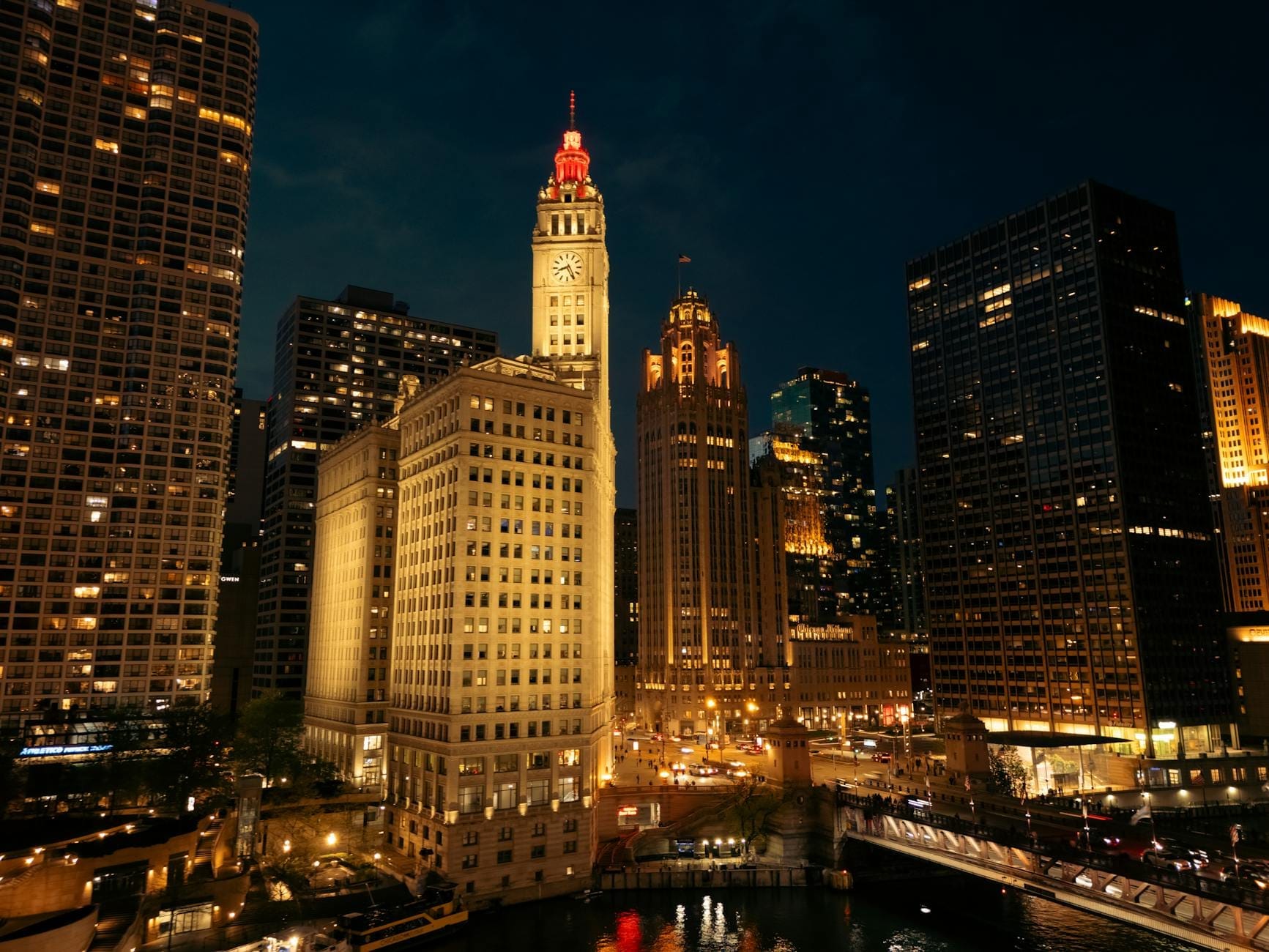
Evening is, by wide consensus, the best time to see the Wrigley Building. After dark, floodlights illuminate the white terra cotta, and the towers appear almost self-luminous against the night sky. The effect from the Michigan Avenue Bridge, with the Chicago River reflecting the lit facade below, is genuinely spectacular. This is one of the few urban scenes in Chicago that consistently rewards the effort of returning after dinner. Arrive around dusk to watch the gradual transition from daylight to artificial illumination.
💡 Local tip
For the classic nighttime shot of both towers reflected in the Chicago River, stand on the south side of the Michigan Avenue Bridge and frame upward. The reflection is clearest on calm evenings when there is little wind. Late spring and early autumn offer the most reliable conditions.
Getting There and Navigating the Area
The building is at the northern end of the Michigan Avenue Bridge, where North Michigan Avenue crosses the Chicago River. Multiple CTA bus routes run along Michigan Avenue, and the Grand Red Line station is roughly a 5-minute walk north. From the Loop, the State/Lake station on the 'L' puts you about 10 to 15 minutes on foot heading north across the bridge. The walk itself is part of the experience: crossing the DuSable Bridge with the Wrigley Building ahead of you is one of Chicago's great pedestrian arrivals.
The building sits at the southern gateway of the Magnificent Mile, the stretch of North Michigan Avenue lined with hotels, flagship stores, and major cultural institutions. If you are coming from the north along Michigan Avenue, the Wrigley Building signals that you have reached the river and the edge of the Near North Side.
Directly across Michigan Avenue stands Tribune Tower, a Gothic Revival skyscraper completed in 1925 that was designed as the home of the Chicago Tribune. The two buildings frame the bridge approach as a kind of architectural gateway, and standing between them offers a concentrated sense of the ambition that defined North Michigan Avenue's development in the 1920s.
Inside: What the Public Can Access
The ground-floor lobby of the south tower and the connecting arcade between the two buildings may be accessible during business hours. The interior spaces retain decorative detailing consistent with the building's period, though the primary draw remains the exterior. Several restaurants and bars have operated within the building over the years; tenants change, so it is worth checking current listings before planning a meal around the building visit specifically.
The building is managed by Zeller Realty Group, and while it functions as a private office complex, the public areas are genuinely open rather than merely tolerated. Security is present but not intrusive. There is no formal guided tour of the building itself, though the Chicago Architecture Center river cruise passes directly in front of it and provides detailed commentary.
The Chicago Architecture Foundation River Cruise departs from the Riverwalk just southwest of the Wrigley Building and gives you a water-level view of the facade that is impossible to replicate from the street or bridge.
⚠️ What to skip
The Wrigley Building is an office building first. Wandering beyond publicly accessible lobby areas or attempting to access upper floors without a legitimate reason will result in being redirected by building security. Plan your visit around the exterior and ground-level public spaces.
Historical Context: What Made This Building Significant
When construction began in 1920, North Michigan Avenue north of the Chicago River was still largely undeveloped. The street had been widened and the bridge rebuilt only a few years earlier, and the Wrigley Building was one of the first major structures to bet on the corridor's future as a commercial and cultural address. That bet paid off: the building's success helped trigger the cascade of development that turned North Michigan Avenue into the Magnificent Mile.
The clock tower on the south building is modeled on the Giralda tower in Seville, Spain. The French Renaissance ornamentation, the white terra cotta cladding, and the illumination system that made it visible across the city at night were all deliberate choices by Wrigley to make his building legible from a distance. In an era before widespread commercial television or digital advertising, a spectacularly lit skyscraper was one of the most effective brand statements a company could make.
Understanding this building also means understanding Chicago's architectural ambitions in the early 20th century. The Chicago architecture guide covers how the city's built environment evolved from the aftermath of the 1871 fire through the skyscraper era and beyond.
Practical Notes for Visitors
There is no admission charge for viewing the building or entering its publicly accessible areas. Photography of the exterior is unrestricted. The surrounding plaza and bridge are publicly accessible around the clock, so night photography is entirely practical. Dress for the weather: the Michigan Avenue Bridge is fully exposed to wind, and Chicago's lake-influenced climate makes the riverfront noticeably colder than surrounding streets, especially in autumn and winter. In winter, the white towers against a slate sky can be exceptional, though you will want layers.
Accessibility at ground level is generally good, with flat approaches from both Michigan Avenue and the Riverwalk below. The building has been modernized with elevators, but detailed accessibility information for specific internal areas is best confirmed with building management at zeller.us/thewrigleybuilding before visiting.
If the Wrigley Building is part of a broader day along the lakefront and downtown core, the Chicago Riverwalk runs directly below and connects westward past a series of bars, kayak rentals, and river vistas that can fill several more hours.
Insider Tips
- The best single vantage point for photographing both towers together is from the southwest corner of the Michigan Avenue Bridge, not from the north side. This angle captures the south tower clock face, the arcade connection, and the north tower in a single frame without excessive distortion.
- Visit on a weekday evening around 7 to 9 p.m. The office crowds have cleared, the floodlights are running, and the Riverwalk below still has enough foot traffic to feel lively without being chaotic. This window also avoids the weekend tourist peak on the bridge itself.
- The Riverwalk level, accessible via stairs at the bridge approach, gives you an upward angle on the facade that most visitors never see. From water level, the south tower's clock tower reads much more dramatically against the sky than it does from Michigan Avenue.
- In winter, light snow on the white terra cotta creates a near-seamless blend that makes the building look almost abstract. Early morning after a snowfall, before foot traffic disturbs the scene, is a genuinely unusual photographic opportunity that almost no one plans for.
- Tribune Tower, directly across Michigan Avenue, has fragments of famous buildings embedded in its base, including pieces of the Great Wall of China, the Colosseum, and the Taj Mahal. Pairing the two buildings makes for a richer 20-minute stop than visiting either one alone.
Who Is Wrigley Building For?
- Architecture enthusiasts looking to understand Chicago's early skyscraper era beyond the Loop
- Photographers targeting the classic Chicago night skyline shot with river reflections
- First-time Chicago visitors doing a Magnificent Mile orientation walk
- Travelers on a tight budget who want genuine architectural drama without an admission fee
- Evening walkers combining the Riverwalk with a Michigan Avenue stroll
Nearby Attractions
Other things to see while in Magnificent Mile & Streeterville:
- 360 CHICAGO Observation Deck
Perched on the 94th floor of 875 North Michigan Avenue, 360 CHICAGO delivers panoramic views stretching across the city grid, Lake Michigan, and on clear days, four states. With the TILT ride, interactive displays, and a full bar, it offers more than just a lookout.
- American Writers Museum
Tucked on the second floor of 180 N. Michigan Avenue, the American Writers Museum makes a persuasive case that literature shaped the United States as much as any battlefield or boardroom. It's compact, thoughtfully curated, and rewards visitors who slow down.
- Centennial Wheel
Standing nearly 196 feet above the Lake Michigan shoreline, the Centennial Wheel at Navy Pier offers enclosed, climate-controlled gondola rides with some of the most expansive views of Chicago's skyline. Opened in 2016 to mark Navy Pier's 100th anniversary, it replaced a beloved predecessor and quickly became one of the city's most recognizable structures.
- Chicago Children's Museum
Perched inside Navy Pier on the lakefront, Chicago Children's Museum has been sparking curiosity in kids since 1982. With hands-on exhibits built for children under 10, it rewards an unhurried half-day visit. Here is exactly what to expect, when to go, and how to make the most of your time.