The Magnificent Mile: Chicago's Most Famous Street, Block by Block
The Magnificent Mile is a 13-block stretch of North Michigan Avenue running from the Chicago River to Oak Street. Free to walk, endlessly layered with architecture, shopping, dining, and history, it anchors Chicago's Near North Side and rewards visitors who look up as much as they look in windows.
Quick Facts
- Location
- North Michigan Avenue, Chicago, IL 60611 (Chicago River to Oak Street)
- Getting There
- CTA Red Line: Grand or Chicago stations; CTA Bus 151/146 along Michigan Ave
- Time Needed
- 1–3 hours for a walk-through; a full day if you shop and dine
- Cost
- Free to walk; individual shops, restaurants, and attractions charge separately
- Best for
- Architecture lovers, shoppers, first-time Chicago visitors
- Official website
- www.themagnificentmile.com
What Is the Magnificent Mile, Exactly?
The Magnificent Mile is a 13-block segment of North Michigan Avenue stretching from the Michigan Avenue Bridge over the Chicago River in the south to Oak Street in the north. The nickname dates to a 1940s promotion by real estate developer Arthur Rubloff, who popularized the phrase to market the avenue's potential as a world-class commercial corridor. The name stuck because the street delivered on its promise.
Today it functions as both a major retail district, with more than 460 shops and several major shopping centers, and an open-air architectural showcase that happens to have the finest concentration of high-rise commercial buildings in Chicago outside of the Loop. There is no ticket to buy and no gate to pass through. It is a public street. The cost of entry is just showing up.
💡 Local tip
Walk the east sidewalk heading north for the best unobstructed views of the Tribune Tower and Wrigley Building simultaneously. Crossing to the west side partway up gives you river views looking back south.
The Architecture: Why You Should Look Up
The streetscape on North Michigan Avenue is one of the most deliberately composed in any American city. At the southern anchor, the Wrigley Building (400 N Michigan Ave) glows white in terracotta cladding modeled after the Giralda tower in Seville. Completed in two phases in 1921 and 1924, it was the first major construction north of the river and signaled the avenue's transformation. Across the street, the Tribune Tower (435 N Michigan Ave), completed in 1925, was the result of an international design competition won by a neo-Gothic scheme from Hood and Howells. Embedded into the tower's base are stones taken from famous structures around the world, including Notre-Dame de Paris, the Parthenon, and the Berlin Wall segment. They are easy to miss from the sidewalk but worth a slow stop.
Further north, the John Hancock Center (now officially 875 North Michigan Avenue) rises 1,128 feet and is one of the defining examples of structural expressionism in American architecture, its black steel X-bracing visible from the street. If you want to go up rather than along, the 360 CHICAGO observation deck occupies the 94th floor and offers a perspective on the Mag Mile that reframes the entire corridor.
For deeper context on how these buildings fit into the city's broader development history, the Chicago Architecture Center is located just south of the Mag Mile near the river and offers excellent walking tour departures directly along this stretch of Michigan Avenue.
Tickets & tours
Hand-picked options from our booking partner. Prices are indicative; availability and final rates are confirmed when you complete your booking.
Go City | Chicago All-Inclusive Pass
From 127 €Instant confirmationFree cancellationiFLY Chicago Lincoln Park indoor skydiving experience
From 126 €Instant confirmationFree cancellationiFLY Chicago Rosemont indoor skydiving tickets
From 117 €Instant confirmationFree cancellationChicago lakefront neighbourhood bike tour
From 18 €Instant confirmationFree cancellation
How the Street Changes by Time of Day
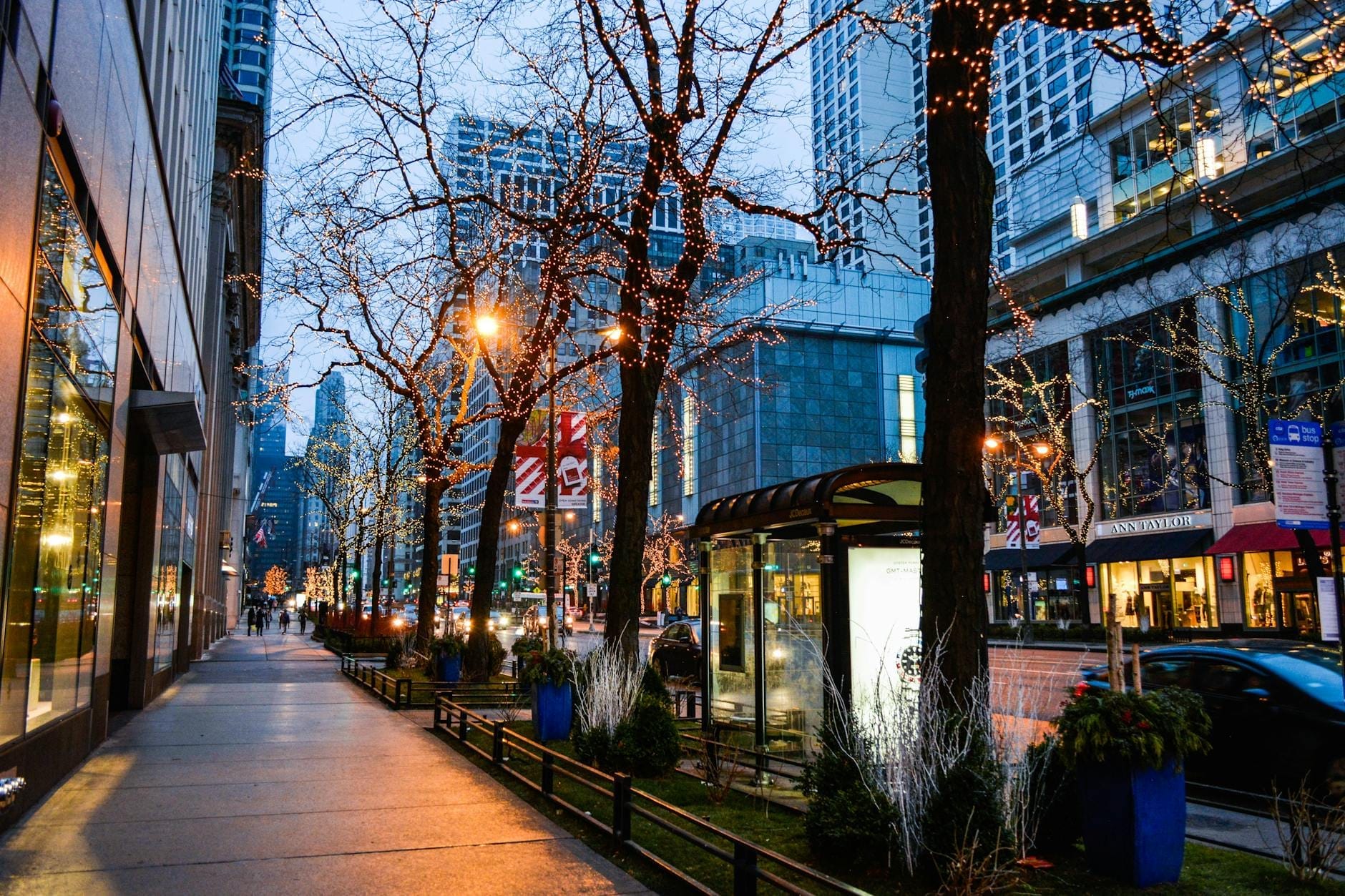
Early morning, before 9 a.m., is the Mag Mile at its most photogenic and least crowded. The Wrigley Building catches direct eastern light and the sidewalks are thin with commuters rather than shoppers. The coffee smell drifting from the handful of open cafes mixes with cool air off the lake, which is only a few blocks east. If you are traveling in winter, this is when the avenue's famous holiday lights, which line the trees from November through January, glow most clearly against the dark sky.
From mid-morning through late afternoon on weekends, especially in summer, the sidewalks become genuinely thick with people. The 13 blocks feel shorter than they are, but moving without stopping to let others pass becomes difficult near the major shopping centers around Michigan and Chicago avenues. Street performers set up at scattered points, and the ambient sound shifts from traffic to a mix of voices, music, and the occasional tour group narration through earpieces.
By evening, the crowd composition shifts. Families thin out, restaurant lines grow outside the midrange spots, and the architectural lighting becomes the main visual event. The Wrigley Building is floodlit at night and appears almost luminous against a clear dark sky. This is also when the hotels along the avenue draw guests to rooftop and lobby bars, and the energy is noticeably more relaxed than during shopping hours.
ℹ️ Good to know
The Magnificent Mile hosts the Magnificent Mile Lights Festival each November, traditionally kicking off Chicago's holiday season with a parade and the ceremonial lighting of more than one million lights and holiday decorations along the avenue. Check the official site for exact dates, which vary by year.
Shopping: What's Actually Here
The retail mix runs from mass-market flagship stores to luxury boutiques, concentrated in three main indoor shopping centers: Water Tower Place, 900 North Michigan Shops, and Water Tower Place and 900 North Michigan Shops. Water Tower Place (835 N Michigan Ave), an eight-story vertical mall anchored by a Macy's, was groundbreaking when it opened in 1975 as one of the first major urban vertical malls in the country. 900 North Michigan leans toward higher-end tenants. Street-level retail along the avenue itself includes a predictable range of global chains alongside a smaller number of independent Chicago retailers.
For visitors more interested in Chicago-specific shopping, independent boutiques, and design-oriented retail, the blocks around Oak Street at the northern end of the Mag Mile have a denser concentration of local and luxury independent shops. The nearby Chicago shopping guide covers additional neighborhoods with stronger independent retail scenes, including Wicker Park and Andersonville.
Getting There and Getting Around
The Magnificent Mile is one of the most transit-accessible points in Chicago. From the CTA Red Line, the Grand station (Grand Ave) deposits you at the southern end of the shopping district, and the Chicago station (Chicago Ave) puts you at the northern third. CTA buses 151 and 146 run along Michigan Avenue and connect to the lakefront and Lincoln Park to the north. From the Loop, it is a short walk north across the Michigan Avenue Bridge.
The stretch is entirely flat and walkable. Sidewalks are wide by Chicago standards and maintained year-round. In winter, the city treats Michigan Avenue early after snowfall, but plan for cold that cuts sharply off the lake, particularly on the exposed bridge over the river. Layering is essential from November through March, and even in May temperatures can drop quickly after sunset.
⚠️ What to skip
Weekend afternoon traffic on the sidewalks between the Wrigley Building and Water Tower Place can be dense enough to make walking slow and frustrating if you are in a hurry. If you need to cover the corridor quickly, the parallel inner streets (Rush Street or Wabash Ave) are faster options.
What Else Is Within Easy Reach
The Mag Mile's position in the Near North Side puts several other significant attractions within a ten-minute walk. The Chicago Water TowerThe Water Tower at Michigan and Chicago avenues is one of the few structures to survive the Great Chicago Fire of 1871 and is worth a two-minute stop even if you don't go inside the adjacent gallery. Navy Pier is a 15-minute walk east along Illinois Street. The Streeterville neighborhood immediately to the east contains the Museum of Contemporary Art Chicago and a quieter grid of streets if you want to step away from the commercial corridor.
South of the river, the Mag Mile connects naturally into the Loop and the broader architectural district. The Chicago Architecture Foundation River Cruise departs from the riverwalk just south of the bridge and is arguably the single best way to understand how the buildings along this corridor relate to the rest of the city's skyline.
Honest Assessment: Is It Worth Your Time?
The Magnificent Mile is not undiscovered or underrated. It is genuinely one of the most visited commercial streets in the United States and it shows. The concentration of chain stores means much of the retail experience is identical to what you would find in any major American city. If you are arriving in Chicago with limited time and primarily want to see something distinctively local, a two-hour walk to take in the architecture and the river view is worthwhile. A full day of shopping here, unless you have specific destinations in mind, is a less efficient use of Chicago time than exploring neighborhoods like the West Loop, Pilsen, or Andersonville.
That said, for first-time visitors, the avenue functions as an excellent orientation point. The views from the bridge looking south toward the Loop skyline, framed by the Wrigley Building on one side and the Tribune Tower on the other, is one of the genuinely iconic Chicago vistas. For architecture tourists, the density of significant 20th-century commercial buildings within 13 blocks is hard to match anywhere in the country.
Insider Tips
- The stones embedded in the base of Tribune Tower, collected from famous global landmarks, are at eye level on the street. Most visitors walk past without noticing them. Slow down at the base of the tower on the east side and look for the labels beneath each stone.
- Michigan Avenue bus stops can have waits, but the 151 and 146 lines are frequent during peak hours. Tap your Ventra card rather than paying cash to save money on each ride.
- The fourth-floor bridge connecting the north and south sections of the Nordstrom building at 55 E Grand Ave provides a free elevated view down Michigan Avenue and a shortcut between streets during cold or rainy weather.
- Late November through early January is visually the most dramatic time on the Mag Mile. The holiday lights along the trees create a tunnel effect after dark that is worth a deliberate evening walk even if you have no interest in shopping.
- If the sidewalk crowd at street level becomes overwhelming during weekend afternoons, the lower-level riverwalk one block south is almost always quieter and offers a completely different perspective on the same buildings from water level.
Who Is The Magnificent Mile For?
- First-time Chicago visitors wanting a geographic and visual orientation to the city
- Architecture enthusiasts interested in 20th-century American commercial design
- Shoppers seeking major flagship retail and vertical malls in a single walkable corridor
- Winter visitors drawn by the holiday lights and seasonal programming
- Travelers combining a lakefront walk with a downtown exploration in a single loop
Nearby Attractions
Other things to see while in Magnificent Mile & Streeterville:
- 360 CHICAGO Observation Deck
Perched on the 94th floor of 875 North Michigan Avenue, 360 CHICAGO delivers panoramic views stretching across the city grid, Lake Michigan, and on clear days, four states. With the TILT ride, interactive displays, and a full bar, it offers more than just a lookout.
- American Writers Museum
Tucked on the second floor of 180 N. Michigan Avenue, the American Writers Museum makes a persuasive case that literature shaped the United States as much as any battlefield or boardroom. It's compact, thoughtfully curated, and rewards visitors who slow down.
- Centennial Wheel
Standing nearly 196 feet above the Lake Michigan shoreline, the Centennial Wheel at Navy Pier offers enclosed, climate-controlled gondola rides with some of the most expansive views of Chicago's skyline. Opened in 2016 to mark Navy Pier's 100th anniversary, it replaced a beloved predecessor and quickly became one of the city's most recognizable structures.
- Chicago Children's Museum
Perched inside Navy Pier on the lakefront, Chicago Children's Museum has been sparking curiosity in kids since 1982. With hands-on exhibits built for children under 10, it rewards an unhurried half-day visit. Here is exactly what to expect, when to go, and how to make the most of your time.