Chicago Water Tower: The Limestone Survivor of the Great Chicago Fire
Standing 182.5 feet tall on North Michigan Avenue, the Chicago Water Tower is one of the most recognized landmarks in the city. Completed in 1869, it survived the Great Chicago Fire of 1871 and formerly housed a free public photography gallery. A compelling stop on any walk down the Magnificent Mile.
Quick Facts
- Location
- 806 N. Michigan Ave, Chicago, IL 60611 (Magnificent Mile, Near North Side)
- Getting There
- CTA Red Line – Chicago station (~7–10-min walk); Grand station (~10–12-min walk)
- Time Needed
- 20–45 minutes for the exterior and City Gallery inside
- Cost
- Free (no admission fee for the City Gallery; verify current hours before visiting)
- Best for
- Architecture lovers, history buffs, photography fans, first-time Chicago visitors
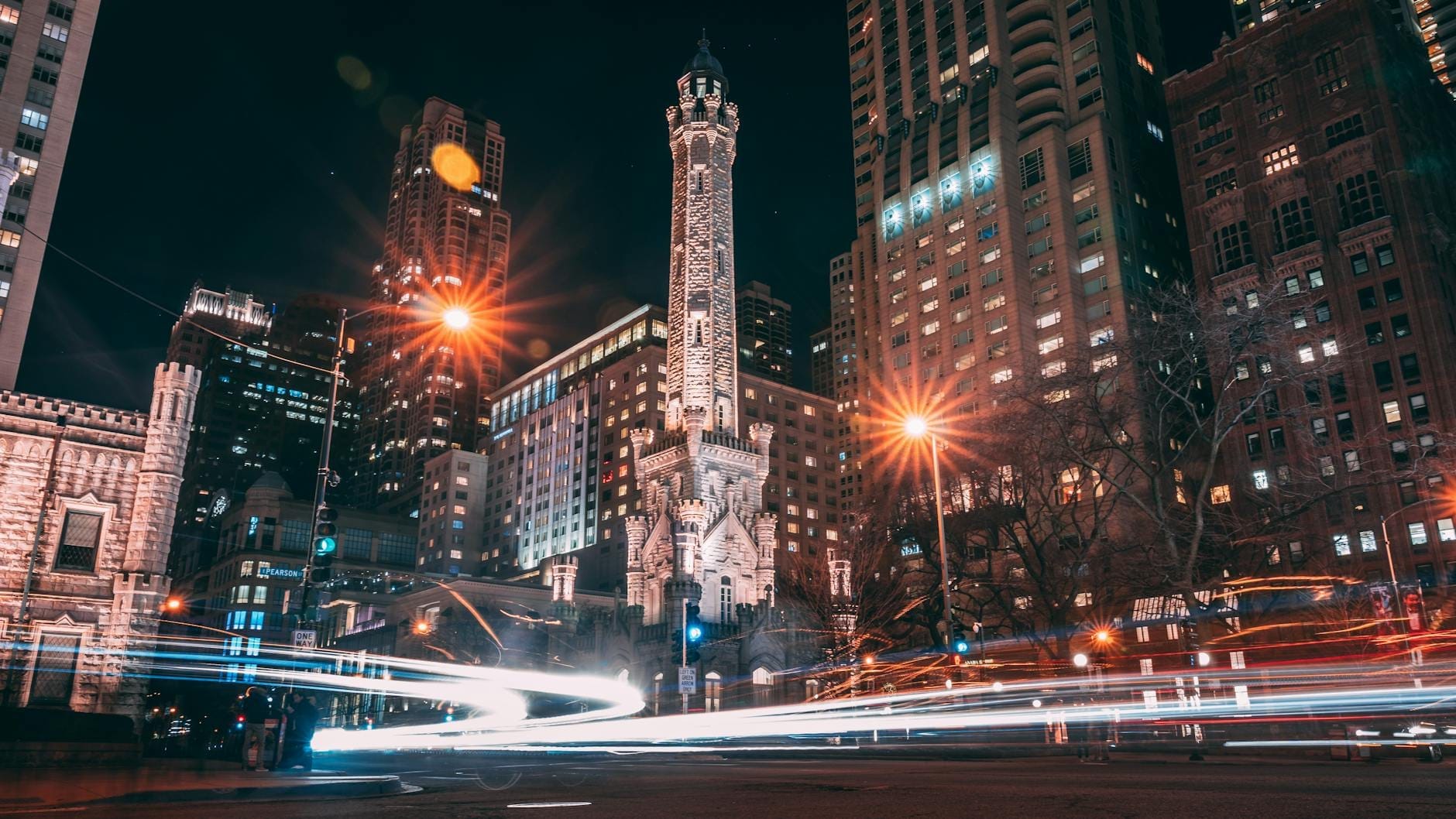
What the Chicago Water Tower Actually Is
The Chicago Water Tower is a Gothic Revival limestone structure completed in 1869, designed by architect William W. Boyington. It stands about 182.5 feet (56 meters) tall at 806 N. Michigan Avenue, right in the middle of the Magnificent Mile corridor, and it functions today primarily as a civic landmark, with its interior gallery space subject to change. Inside the tower, a 138-foot (42-meter) standpipe once regulated pressure for a massive pumping station next door. That pumping function is long gone, but the building has in recent years housed the City Gallery, a free photography exhibition space operated under Chicago's cultural programming.
What gives the tower its weight as an attraction is not just its age or its architecture, but what it represents: this is one of a tiny handful of buildings on the Near North Side that survived the Great Chicago Fire of 1871. The fire destroyed roughly 3.3 square miles of the city, and the Water Tower stood at the edge of that devastation, scorched but intact. That survival made it an instant symbol of resilience. Oscar Wilde, visiting Chicago in 1882, famously called it a castellated monstrosity with pepperbox towers, which says more about Wilde than the building, and which Chicagoans have cheerfully ignored ever since.
ℹ️ Good to know
When operating, the City Gallery inside the Water Tower is free to enter and features rotating exhibits of Chicago-focused photography. Hours can vary and are not always posted online in advance, so check with the City of Chicago or Choose Chicago before making it a primary destination.
The Architecture Up Close
Boyington built the tower from Joliet limestone, a cream-colored sedimentary stone quarried from the Des Plaines River valley southwest of Chicago. Up close, the texture is coarser than it looks from across Michigan Avenue: you can see the grain of the stone and the slight irregularities where blocks meet. The Gothic Revival detailing includes pointed turrets, corbeled battlements, and lancet-arched windows, giving the whole thing a vaguely ecclesiastical quality that sits in peculiar contrast to the glass retail towers surrounding it.
The tower sits within Jane M. Byrne Plaza, a small open plaza that gives pedestrians room to step back and look at the full height of the structure without craning. From the plaza, the scale reads clearly: the tower is genuinely tall, not just a token remnant. The pumping station across the street, also designed by Boyington and also surviving the fire, is built in the same Gothic Revival vocabulary and provides useful context for what the Water Tower originally was: not an ornament, but a working industrial structure dressed up to be presentable on what was then becoming the city's most important street.
For a broader understanding of Chicago's architectural heritage, the Chicago architecture guide covers the city's major movements and key buildings, from the Loop's steel-frame pioneers to the lakefront modernists.
Tickets & tours
Hand-picked options from our booking partner. Prices are indicative; availability and final rates are confirmed when you complete your booking.
Go City | Chicago All-Inclusive Pass
From 127 €Instant confirmationFree cancellationiFLY Chicago Lincoln Park indoor skydiving experience
From 126 €Instant confirmationFree cancellationiFLY Chicago Rosemont indoor skydiving tickets
From 117 €Instant confirmationFree cancellationChicago lakefront neighbourhood bike tour
From 18 €Instant confirmationFree cancellation
The Great Fire Context: Why This Building Matters
The Great Chicago Fire began on the evening of October 8, 1871, and burned for roughly 36 hours. By the time it was extinguished, it had killed an estimated 300 people, left around 100,000 residents homeless, and destroyed approximately 17,450 buildings. The fire moved northeast through the city, driven by strong winds and aided by the predominantly wooden construction of the time.
The Water Tower survived because it was built from stone, not wood, and because its location at what is now Michigan Avenue and Chicago Avenue placed it near the fire's northern edge. The pumping station next door also survived, though both structures were damaged. The survival of these two buildings meant the city retained a water supply capability, which was critical for the rebuilding effort. Within two years, much of the city had been rebuilt, and the Water Tower became a touchstone in Chicago's origin mythology: the thing that held while everything else burned.
That history is well-documented at the Chicago History Museum in Lincoln Park, which has an extensive collection on the fire, including photographs, insurance maps, and survivor accounts. If the Water Tower piques your interest in this period, the museum is worth a dedicated visit.
Visiting: What to Expect at Different Times of Day
The exterior of the Water Tower is accessible around the clock, and the lighting situation changes significantly depending on when you arrive. Early morning, before the Michigan Avenue retail corridor wakes up, the plaza is quiet and the limestone glows in low raking light that emphasizes the texture of the stone and the depth of the carved detail. This is the best window for photography: no heavy foot traffic, no delivery vehicles parked in the sightlines, and the sun coming from the east over Lake Michigan casts long shadows that give the building genuine drama.
Midday and afternoon bring the full weight of Magnificent Mile pedestrian density. The plaza in front of the tower fills with tourists, shoppers, and office workers on lunch breaks. The tower remains photogenic, but you will be sharing the frame with a lot of other people and their phones. The surrounding context, including the Water Tower Place mall directly across the street and the modern glass towers flanking it, becomes more visually dominant as the crowds build.
Evening visits offer a different version of the building again. Artificial lighting illuminates the facade after dark, and the limestone takes on a warmer, almost amber quality under the streetlights. The contrast between the nineteenth-century Gothic stonework and the lit-up retail environment around it is perhaps sharpest at this hour. If you are walking the Magnificent Mile at night, the tower makes a natural pause point.
💡 Local tip
For the cleanest exterior photographs, arrive before 9 AM on a weekday. The plaza is nearly empty, the light is directional, and the surrounding sidewalks have not yet become obstacle courses.
Inside: The City Gallery
The ground level of the Water Tower has housed the City Gallery, a small but thoughtfully curated exhibition space presenting photography focused on Chicago. The exhibitions rotate and have covered subjects including neighborhood documentary photography, historical archival images, and contemporary Chicago-based photographers' work. Entry is free.
The interior is compact. The stone walls and low ceiling create a slightly cave-like atmosphere that is actually well-suited to photography exhibitions: the controlled light and enclosed space focus attention on the images in a way that larger gallery spaces sometimes do not. This is not a major gallery destination, and visitors expecting something at the scale of the Museum of Contemporary Art or the Art Institute will be disappointed. But as a free, twenty-minute cultural stop in the middle of a Magnificent Mile walk, it delivers genuine value.
⚠️ What to skip
The City Gallery keeps limited and sometimes irregular hours. Confirm opening times via the City of Chicago or Illinois tourism sites before planning your visit around it.
Getting There and Getting Around Afterward
The Chicago Water Tower is one of the most accessible landmarks in the city. The CTA Red Line stops at Chicago station on State Street, roughly a 7–10-minute walk west along Chicago Avenue to Michigan Avenue; the Brown Line’s Chicago station is farther west on Wells Street. The Grand Red Line station is about nine minutes on foot, coming from the south along Michigan Avenue. Several CTA bus routes, including the 151 and 147, stop directly on Michigan Avenue near the tower.
The Water Tower sits on the Magnificent Mile, Chicago's most commercially dense stretch of North Michigan Avenue, which runs from the Chicago River north to Oak Street. The tower is roughly in the middle of this corridor, making it a natural waypoint rather than a standalone destination.
If you are building a day around this area, the Magnificent Mile and Streeterville neighborhood extends east toward Navy Pier and the lakefront. The Chicago Architecture Foundation River Cruise departs from the Chicago Riverwalk, about a fifteen-minute walk south, and provides the most comprehensive single introduction to Chicago's built environment available anywhere in the city.
Parking in this area is expensive and often congested, especially on weekends. Transit or rideshare is strongly recommended. If you are driving, the nearest garages are inside Water Tower Place and along East Chestnut Street, but rates reflect the prime location.
Photography Tips and Weather Considerations
The tower photographs well in most conditions, but overcast days can flatten the limestone into a uniform gray that loses the textural detail. Direct sun, particularly in the morning, produces the best results for exterior shots. A wide-angle lens lets you capture the full height from the plaza without excessive distortion, though a standard focal length from the opposite sidewalk compresses the tower pleasantly against the surrounding buildings.
Winter visits are entirely viable and often produce striking images: snow on the battlements, the limestone looking colder and more stark against a gray Lake Michigan sky. Wind on Michigan Avenue in January and February is brutal, however, so dress accordingly. Summer visits are comfortable but crowded. Spring and early autumn, when temperatures sit in the 50s to 60s Fahrenheit range and the crowds are somewhat thinner, offer the most pleasant overall experience for spending time in the plaza.
💡 Local tip
In winter, the city often decorates the plaza area with seasonal lighting. The Water Tower looks particularly striking when lit from below against a dark winter sky, and the Magnificent Mile holiday decorations provide additional context for the surrounding streetscape.
Insider Tips
- The pumping station directly across Michigan Avenue, also built by Boyington in 1869 and also a fire survivor, has housed a small Chicago tourism information center and visitor space. Step inside for free maps and current event information alongside the architectural context of the paired buildings.
- The limestone on the tower's north face tends to hold moisture longer after rain and develops a darker, mottled patina that many photographers find more interesting than the dry cream color. After a morning rain, the north elevation is worth a closer look.
- If you are visiting in summer, the plaza gets shade from the tower itself in the late afternoon, making it a reasonable spot to rest before continuing down Michigan Avenue. The benches in Jane M. Byrne Plaza are less visible than those in larger parks, so they tend to stay less occupied.
- The view looking south from directly in front of the tower, with the Wrigley Building and Tribune Tower visible down Michigan Avenue, is one of the classic Chicago street-level compositions. Stand at the south edge of the plaza and use the tower as a foreground anchor.
- The Water Tower is included in several architectural walking tour routes, including self-guided tours available through the Chicago Architecture Center. If you want deeper context, pick up their map before walking north from the Riverwalk.
Who Is Chicago Water Tower For?
- First-time Chicago visitors building a Magnificent Mile walk and wanting historical context for the corridor
- Architecture enthusiasts interested in pre-fire and post-fire Chicago building history
- Photography travelers looking for textured, historically layered urban subjects
- Families with older children who can engage with the Great Chicago Fire story
- Travelers with limited time who want a free, low-commitment cultural stop integrated into a shopping or sightseeing walk
Nearby Attractions
Other things to see while in Magnificent Mile & Streeterville:
- 360 CHICAGO Observation Deck
Perched on the 94th floor of 875 North Michigan Avenue, 360 CHICAGO delivers panoramic views stretching across the city grid, Lake Michigan, and on clear days, four states. With the TILT ride, interactive displays, and a full bar, it offers more than just a lookout.
- American Writers Museum
Tucked on the second floor of 180 N. Michigan Avenue, the American Writers Museum makes a persuasive case that literature shaped the United States as much as any battlefield or boardroom. It's compact, thoughtfully curated, and rewards visitors who slow down.
- Centennial Wheel
Standing nearly 196 feet above the Lake Michigan shoreline, the Centennial Wheel at Navy Pier offers enclosed, climate-controlled gondola rides with some of the most expansive views of Chicago's skyline. Opened in 2016 to mark Navy Pier's 100th anniversary, it replaced a beloved predecessor and quickly became one of the city's most recognizable structures.
- Chicago Children's Museum
Perched inside Navy Pier on the lakefront, Chicago Children's Museum has been sparking curiosity in kids since 1982. With hands-on exhibits built for children under 10, it rewards an unhurried half-day visit. Here is exactly what to expect, when to go, and how to make the most of your time.