Chicago Air and Water Show: What to Expect at America's Biggest Free Air Show
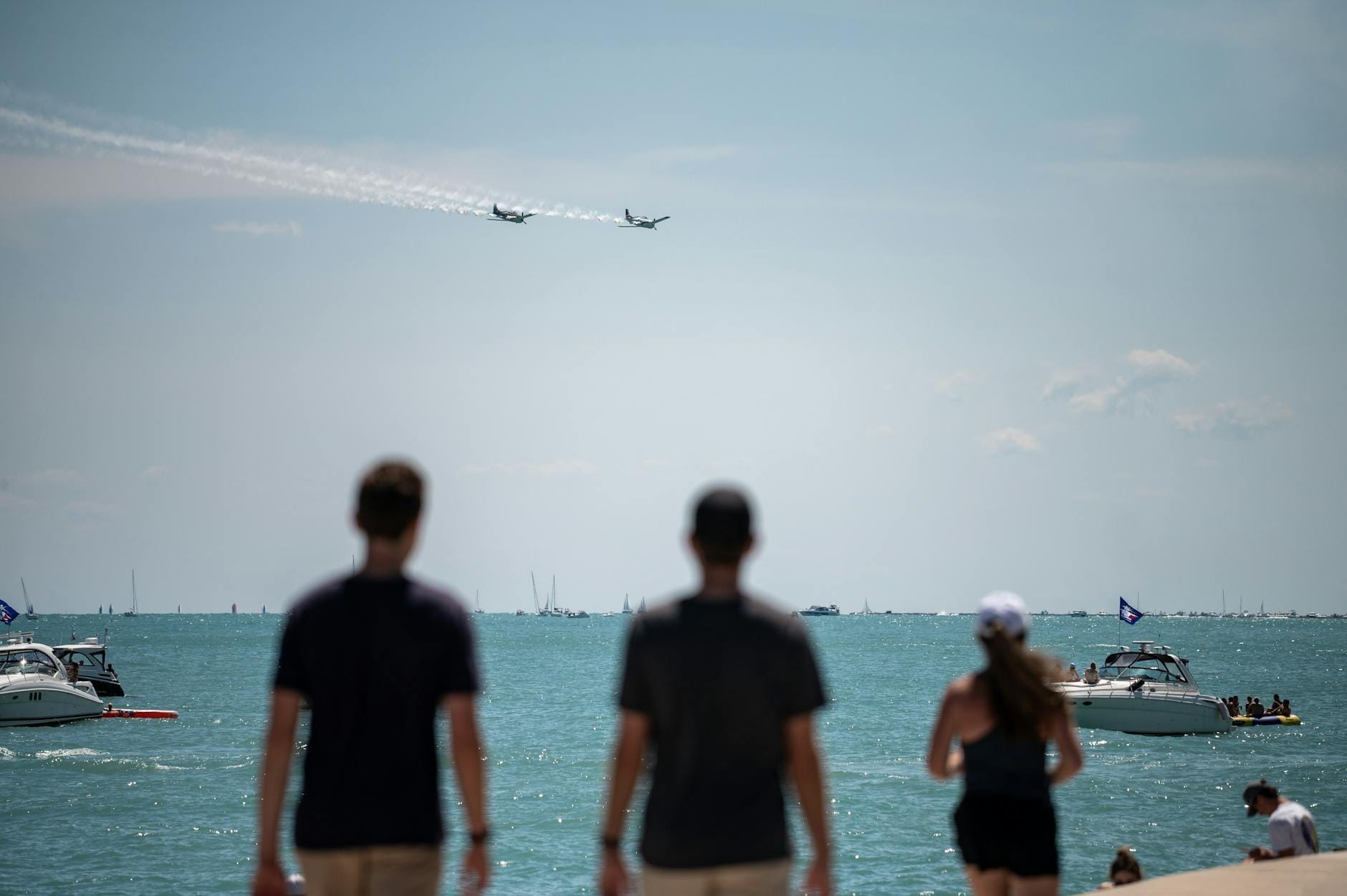
Every August, the Chicago Air and Water Show transforms the lakefront into a grandstand for one of the most spectacular free public events in the United States. Fighter jets, military demonstrations, and precision flying teams perform over Lake Michigan while hundreds of thousands of spectators line the shore from Fullerton to Oak Street.
Quick Facts
- Location
- North Avenue Beach and the lakefront from Fullerton to Oak Street, Chicago, IL 60614
- Getting There
- CTA Bus #72 (North Avenue) to the beach; Red Line to North/Clybourn, Fullerton, or Clark/Division
- Time Needed
- 2–4 hours (show runs 10:30 a.m.–3:00 p.m.; arrive early for good positioning)
- Cost
- Free admission
- Best for
- Families, aviation enthusiasts, first-time Chicago visitors in summer
- Official website
- www.chicago.gov/city/en/depts/dca/supp_info/summer_events.html
What the Chicago Air and Water Show Actually Is
The Chicago Air and Water Show has been a fixture of the city's summer calendar since 1959, making it one of the longest-running free public air shows in the country. It is also, by most measures, the largest free show of its kind in the United States, drawing crowds that routinely reach into the millions across the two-day main event.
The format is straightforward: military and civilian aircraft perform choreographed routines above Lake Michigan while spectators watch from the beach and the grassy stretches of lakefront running between Fullerton Avenue and Oak Street. The "water" portion refers to demonstrations by watercraft and military divers, though the aerial acts are the clear centerpiece. The U.S. Navy Blue Angels or the U.S. Air Force Thunderbirds headline most years, alternating between the two elite demonstration teams.
ℹ️ Good to know
The main show typically runs from 10:30 a.m. to 3:00 p.m. on the designated Saturday and Sunday in August. A public rehearsal typically takes place on the Friday before the main weekend at roughly the same hours — with significantly smaller crowds.
The Experience: What You'll See, Hear, and Feel
The noise is the first thing that resets your expectations. When a formation of F/A-18s crosses the shoreline at low altitude, the sound arrives as a physical sensation in your chest before your brain has fully processed what you're seeing. That contrast — the flat blue calm of Lake Michigan, the pale summer sky, and then the roar — is what gives the show its staying power as an experience rather than just a spectacle.
Aerobatic acts fill the program from the opening moments, mixing solo precision performers with formation teams. Maneuvers include high-speed low passes, vertical climbs, rolls, and the signature opposing-jet passes that produce the loudest crowd reactions. Smoke trails from colored smoke systems mark the trajectories long after the aircraft have moved on, leaving the sky briefly layered with red, white, and blue against Lake Michigan's horizon.
The water demonstrations tend to get less attention, but military parachute teams and rescue diving displays happen throughout the program. If you are positioned near North Avenue Beach, these are visible at closer range than if you stake out a spot further north or south along the viewing corridor.
Tickets & tours
Hand-picked options from our booking partner. Prices are indicative; availability and final rates are confirmed when you complete your booking.
Go City | Chicago All-Inclusive Pass
From 127 €Instant confirmationFree cancellationiFLY Chicago Lincoln Park indoor skydiving experience
From 126 €Instant confirmationFree cancellationiFLY Chicago Rosemont indoor skydiving tickets
From 117 €Instant confirmationFree cancellationChicago lakefront neighbourhood bike tour
From 18 €Instant confirmationFree cancellation
When to Arrive and Where to Stand
North Avenue Beach is the geographic heart of the event. The stretch of sand directly in front of the beach house fills up by 9:00 a.m. on show days, and the grass along the lakefront path fills nearly as quickly. If you want a seated position on the sand with a clear sightline over the water, plan to arrive no later than 8:30 a.m.
The viewing corridor extends north to Fullerton and south to Oak Street Beach, and the crowd thins considerably as you move toward either end. The trade-off is worth knowing: the closer to North Avenue Beach, the denser the crowd but the more central the view. Further north near Fullerton, you get more personal space and the aircraft are still audible and clearly visible — they fly a wide path over the lake. Oak Street Beach at the southern end offers a slightly different angle on the patterns but remains well within range.
💡 Local tip
Friday rehearsal day is one of the most underrated ways to see the show. The same aircraft fly nearly the full program, the beach is a fraction as crowded, and you can reposition freely. It is worth considering if your travel dates allow it.
For a completely different perspective, some visitors watch from rooftop bars and apartment buildings in the Gold Coast and Streeterville neighborhoods, where the aircraft are visible against a downtown skyline backdrop. The 360 Chicago observation deck on Michigan Avenue sits roughly in the right zone to watch aircraft approaching from the lake, though it is several blocks west of the primary action.
Getting There Without the Headache
Driving to the show is technically possible and practically inadvisable. Lake Shore Drive backs up well before the event starts, parking near the beach is extremely limited, and the walk from any viable parking area adds significant time. The people who arrive stress-free almost universally take public transit.
CTA Bus #72 (North Avenue) runs directly to North Avenue Beach and is the most direct option. The Red Line stops at North/Clybourn and Fullerton, each within a walkable distance of the lakefront. From the Fullerton stop, it is roughly a 10–15-minute walk east to the lakefront; from North/Clybourn, closer to 15–20 minutes depending on your pace. Expect buses and trains to be crowded during the 8:00–10:00 a.m. window before the show and again between 3:00–5:00 p.m. when crowds disperse.
Rideshare drop-offs are better requested a few blocks west of the beach — drivers will have difficulty reaching the lakefront itself. For a full picture of getting around Chicago during major summer events, the Chicago transit guide covers the CTA system in detail.
What to Bring and How to Prepare
August in Chicago is warm and can be genuinely hot, with temperatures in the upper 20s Celsius (low-to-mid 80s Fahrenheit) common during show weekend. Sun exposure on an open beach for several hours is significant. Sunscreen, a wide-brimmed hat, and sunglasses are not optional extras — they are the difference between a comfortable morning and a miserable afternoon.
- Sunscreen (SPF 30 or higher) and a hat — shade is scarce on the beach
- A blanket or folding chair if you want to sit; the beach has no permanent seating
- Water and snacks — food vendors set up along the lakefront, but lines get long; bringing your own is faster
- Ear protection for children and anyone sensitive to loud noise — the jet passes are genuinely loud at close range
- A light layer — lake breezes can cool things down quickly after 2:00 p.m.
- Binoculars — optional but useful for reading aircraft livery and watching detail maneuvers
⚠️ What to skip
Weather can cancel or reschedule portions of the show. Low cloud ceilings and storms will ground aircraft; check the City of Chicago's event announcements the morning of if there is any uncertainty about conditions. The rehearsal day is equally vulnerable to weather cancellations.
Historical Context and Cultural Significance
The show launched in 1959, early in the Cold War era when public military aviation demonstrations carried a particular weight — a statement about American air power as much as an entertainment event. Over more than six decades, it has evolved into something more purely celebratory, but the military component remains central to the programming. The presence of the Blue Angels or Thunderbirds each year connects the show to a national tradition of military demonstration teams that date back to the late 1940s.
The event takes place against the backdrop of Chicago's famous lakefront — itself one of the city's most significant public assets, preserved from private development by an 1836 land ordinance. The same stretch of shore you stand on during the air show is also the route of the Lakefront Trail, one of the longest continuous urban recreational paths in the country.
The Air and Water Show sits alongside events like the Chicago Blues Festival and Taste of Chicago as one of the defining free summer events that the city's Department of Cultural Affairs and Special Events produces annually. It is a point of genuine civic pride, and the crowds reflect that — this is very much a local event that visitors walk into, not a tourist attraction that locals tolerate.
Photography: Getting the Shots
Aircraft photography at an air show rewards preparation. The planes move fast — a phone camera with no burst mode will produce mostly empty sky with a blurry dot somewhere in the frame. If you have a DSLR or mirrorless camera, set it to continuous shooting and use shutter speeds of at least 1/1000s to freeze motion. That said, a slightly slower shutter (1/250s) on propeller-driven aircraft gives the propeller blur that reads as movement rather than a frozen disc.
The light is best in the first half of the show. By early afternoon, the sun is directly overhead, which flattens aircraft detail and makes the sky less interesting as a background. Morning positions with the sun at your back and the lake in front produce the cleanest results. The smoke trail maneuvers are photogenic from any position — the colored contrails catch the light well and give your images a sense of scale.
For skyline-and-aircraft compositions, positions near Oak Street Beach give you a southern angle where the aircraft pass with downtown towers visible in the background. This takes some luck with flight paths but produces the kind of dramatic image that places the show specifically in Chicago rather than at a generic lakefront.
Who Should Consider Skipping It
The Air and Water Show is a genuinely exceptional event, but it is not for everyone. If you are noise-sensitive, the jet passes at low altitude are genuinely jarring — not just loud but physically startling on the first pass if you are not prepared. Families with very young children or infants should bring ear protection and be ready to step back from the beach if it becomes overwhelming.
If you are visiting Chicago for architecture, food, or arts, spending an entire show-day morning locked into a fixed position on a crowded beach may not be the best use of limited time — especially if the show is not already a personal interest. In that case, the Friday rehearsal offers a lighter-commitment version of the same experience. Travelers who dislike large crowds in confined areas should also weigh their comfort level: the beachfront on main show days is very densely packed by 10:00 a.m.
Insider Tips
- The Friday rehearsal is the single best way to see essentially the full show with a fraction of the crowd. Mark it in your calendar when planning travel for mid-August.
- Arrive early enough to claim a position, then use the time before the show to walk north or south along the lakefront and scout your final spot before the action starts. You have flexibility until about 10:15 a.m.
- Food and drink vendors set up along the lakefront path but move slowly during peak demand. Bring a full water bottle and snacks for the family and skip the queues entirely.
- The aircraft circle wide over the lake between passes. Watch the lake horizon rather than staring directly overhead — you will spot incoming formations earlier and have a few extra seconds to raise your camera or binoculars.
- If you have children under ten, the roar of a low-altitude jet pass is much louder in person than it sounds in videos. Foam earplugs or noise-canceling headphones for kids make the difference between delight and distress.
Who Is Chicago Air and Water Show For?
- Families with children who are interested in aircraft, military history, or anything that moves fast
- First-time summer visitors who want a quintessential Chicago lakefront experience at no cost
- Aviation enthusiasts and military history buffs seeking close-range observation of elite demonstration teams
- Photographers looking for a dynamic, visually complex subject against a dramatic urban and lakefront backdrop
- Travelers building a full summer weekend itinerary around free Chicago events
Nearby Attractions
Combine your visit with:
- Bahá'í House of Worship
The Bahá'í House of Worship in Wilmette, Illinois, is one of the most architecturally singular buildings in North America. Free to enter, open daily, and reachable by CTA from downtown Chicago, it rewards visitors with a 135-foot lace-like dome, meditative silence, and an unusual kind of spiritual calm that transcends denomination.
- Brookfield Zoo Chicago
Brookfield Zoo Chicago is one of the largest and most historically significant zoos in the United States, covering 216 acres about 14 miles west of downtown. With more than 511 species, landmark indoor exhibits, and a genuine conservation mission, it rewards a full day of exploration. But it takes planning to get the most out of it.
- Chicago Botanic Garden
A living museum spread across 385 acres and nine islands north of Chicago, the Chicago Botanic Garden offers 27 gardens, four natural areas, and six miles of lake shoreline in Glencoe, Illinois. Whether you visit for a single seasonal bloom or spend a full day exploring Japanese landscapes and native prairies, this guide covers everything you need to plan a worthwhile trip.
- Devon Avenue (Little India)
Devon Avenue is Chicago's most culturally layered commercial street, stretching through the West Ridge neighborhood on the city's far north side. Its core South Asian mile, running roughly between Ridge Boulevard and Kedzie Avenue, packs in sari boutiques, Bollywood music shops, halal butchers, sweet shops, and some of the best Indian and Pakistani food in the Midwest. There is no ticket to buy and no itinerary to follow — the experience is entirely your own.