Bahá'í House of Worship: Chicago's Most Extraordinary Sacred Space
The Bahá'í House of Worship in Wilmette, Illinois, is one of the most architecturally singular buildings in North America. Free to enter, open daily, and reachable by CTA from downtown Chicago, it rewards visitors with a 135-foot lace-like dome, meditative silence, and an unusual kind of spiritual calm that transcends denomination.
Quick Facts
- Location
- 100 Linden Ave, Wilmette, IL (approx. 14 miles north of downtown Chicago)
- Getting There
- CTA Purple Line to Linden Station — a few blocks walk to the temple
- Time Needed
- 1–2 hours including gardens and Welcome Center
- Cost
- Free admission, no tickets required
- Best for
- Architecture lovers, seekers of quiet, families, photographers
- Official website
- www.bahai.us/bahai-temple-welcome/bahai-temple
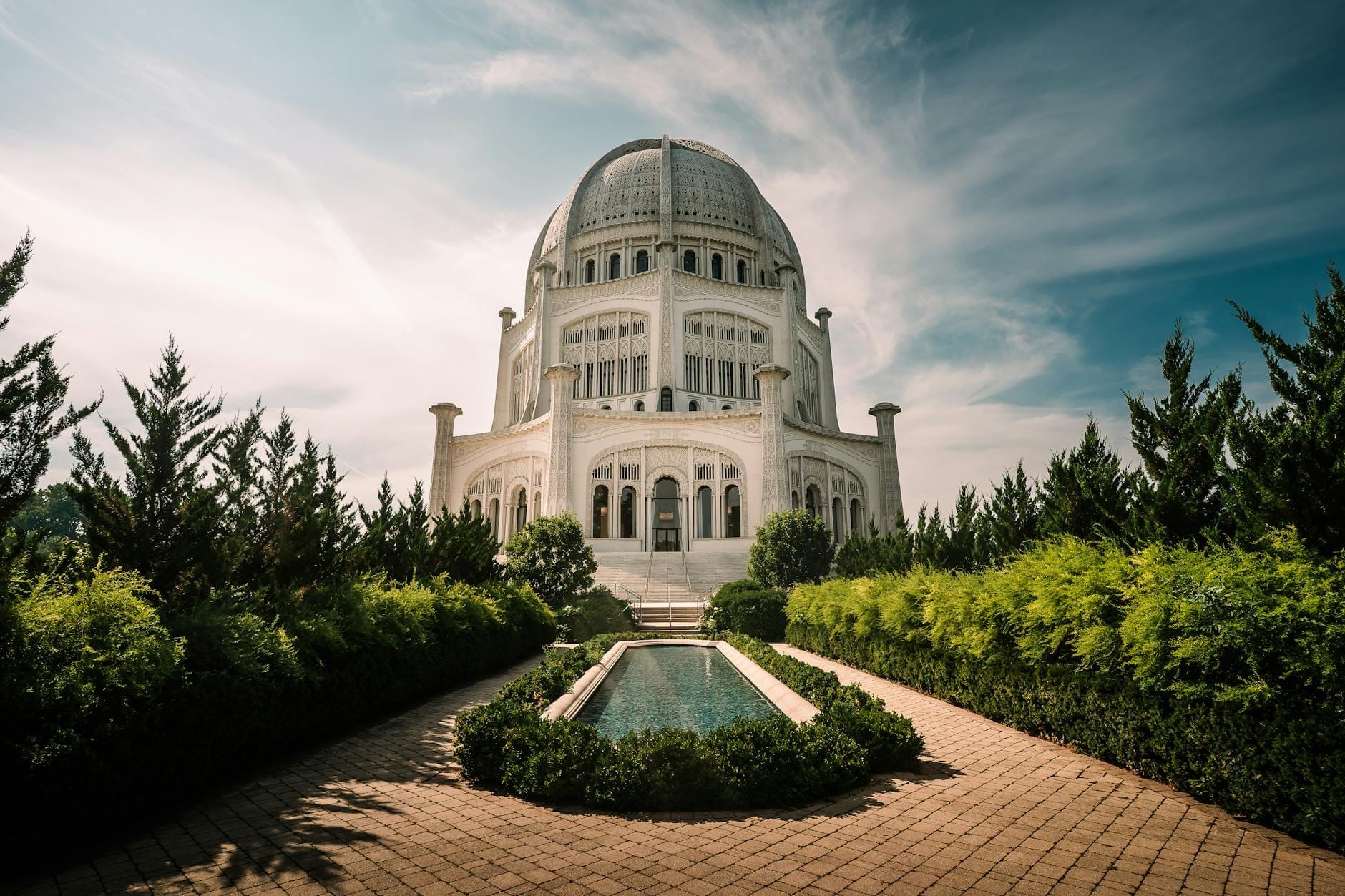
What Is the Bahá'í House of Worship?
The Bahá'í House of Worship in Wilmette, Illinois, is not a church, mosque, or cathedral in any conventional sense. It is a sacred space open to people of every religion and none, designed specifically for quiet reflection and prayer. Known informally as the Chicago Baháʼí Temple, it sits at 100 Linden Ave in Wilmette, a lakefront suburb about 15 miles north of The Loop.
What earns this building its reputation is a combination of architectural ambition and sheer improbability. The dome rises 135 feet above the main floor and is clad in an interlocking lattice of poured concrete, laced with quartz aggregate that catches light differently at every hour of the day. From a distance, the structure reads almost like an enormous piece of lacework placed on a formal garden terrace. Up close, the detail becomes overwhelming in the best possible way.
Historically, it holds a significant place: this is the second Bahá'í House of Worship ever constructed and, crucially, the oldest one still standing anywhere in the world. Construction began in 1920 and was completed in 1953 — a 33-year project that survived two world wars and the Great Depression.
ℹ️ Good to know
The Temple Auditorium is open daily from 6:00 a.m. to 6:00 p.m. The Welcome Center opens at 10:00 a.m. In winter, the auditorium's accessibility can be affected — check the official website or call ahead before making the trip specifically to go inside.
The Architecture: A Dome Unlike Any Other in the Midwest
The building was designed by French-Canadian architect Louis Bourgeois, who spent years developing a vocabulary for what a Bahá'í temple should look like — something that synthesized Eastern and Western influences without belonging to either tradition. The result defies easy categorization. The nine-sided plan (the number nine is sacred in the Bahá'í Faith) rises through three ornamental tiers before converging at the dome, each surface covered in geometric and floral motifs drawn from Islamic, Gothic, and Indigenous American design sources.
The concrete lace was cast using a unique mixture containing crushed white quartz, which gives the exterior a pale, almost crystalline appearance in bright sun. On overcast mornings, the building reads as silver-grey and almost austere. At golden hour in summer, the quartz catches warm light and the entire structure seems to glow from within. Photographers specifically time visits around late afternoon for this effect, though the 6:00 p.m. closing limits flexibility.
If architectural detail is what draws you, pair this visit with Chicago's broader architectural heritage. The Chicago Architecture Center downtown offers context for understanding why this building matters in the arc of American architectural history, and the Chicago architecture guide maps out other landmarks worth adding to the same trip.
Tickets & tours
Hand-picked options from our booking partner. Prices are indicative; availability and final rates are confirmed when you complete your booking.
Go City | Chicago All-Inclusive Pass
From 127 €Instant confirmationFree cancellationiFLY Chicago Lincoln Park indoor skydiving experience
From 126 €Instant confirmationFree cancellationiFLY Chicago Rosemont indoor skydiving tickets
From 117 €Instant confirmationFree cancellationChicago lakefront neighbourhood bike tour
From 18 €Instant confirmationFree cancellation
Inside the Auditorium: Silence as the Main Attraction
Stepping inside the auditorium is one of the more disorienting experiences available in the greater Chicago area — in a good sense. The interior is almost completely unadorned. There are no altars, no religious images, no pews in the traditional sense, just concentric rows of simple wooden chairs arranged beneath the soaring dome. The acoustics reward the silence: you can hear the faint sound of air moving through the space, and the distant murmur of the surrounding gardens when a door opens.
Bahá'í scripture is sometimes read aloud during devotional programs, which are open to everyone. Outside of those times, visitors are asked to maintain quiet and treat the space as a place of personal contemplation. It is genuinely unusual to encounter this kind of stillness inside a publicly accessible, free-entry building in a major metropolitan area. Even visitors with no religious affiliation consistently report finding the experience unexpectedly moving.
💡 Local tip
Arrive before 10:00 a.m. to have the auditorium largely to yourself. The Welcome Center does not open until 10:00, so early visitors enter a quieter experience without tour group foot traffic.
The Gardens and Grounds
The formal gardens surrounding the temple are laid out in a circular pattern with nine pathways radiating outward, echoing the nine-sided geometry of the building itself. In late spring and summer, the beds are planted with annuals and perennials that provide color from May through October. The setting is Lake Michigan suburban: quiet residential streets, mature trees, and the faint smell of fresh water on days when the wind comes off the lake.
The grounds are worth at least 30 minutes on their own. The temple reads very differently from the garden level looking up than it does from the street. Walk the perimeter to see how the lace pattern shifts as your angle changes, and how the nine ornamental niches along the base each carry different carved scriptural references. On busy summer weekends, visitors tend to cluster near the main entrance, so looping around to the eastern side often provides a more isolated vantage point.
In winter, the gardens are stripped back and the white dome against a grey Chicago-area sky produces an almost monochrome composition that some photographers prefer over the lush summer version. Cold-weather visits are perfectly viable on clear days, but confirm the auditorium is accessible before making the journey.
Getting There from Chicago
The simplest approach is the CTA Purple Line. Take it north to the Linden Station in Wilmette — the terminus of the line — and walk a few blocks to the temple. The journey from the Loop takes roughly 45–55 minutes depending on your starting station. This is the most stress-free option because parking in the immediate area is available on-site and generally adequate, though it can feel busier on peak summer weekends.
If you are combining this with other North Side stops, the Purple Line passes through Evanston, making it easy to pair the temple visit with a lakefront walk. For broader transit orientation across the city, the getting around Chicago guide covers CTA options in detail.
Rideshare from downtown Chicago typically runs 25–40 minutes depending on traffic, with most of the variability coming from congestion on the lakeshore corridors. Driving is straightforward via Sheridan Road or the Edens Expressway, and on-site parking is free. Note that the address — 100 Linden Ave, Wilmette — is clearly recognized by all major navigation apps.
⚠️ What to skip
Restrooms for visitors are available in the Welcome Center during its open hours (10:00 a.m.–6:00 p.m.). If you arrive very early for the quiet auditorium experience, plan accordingly.
Practical Considerations and Honest Expectations
This is a day-trip addition, not a destination that anchors an itinerary on its own. Most visitors spend 60–90 minutes total, including the auditorium, Welcome Center exhibits, and a walk through the gardens. The Welcome Center provides accessible background on the Bahá'í Faith itself — its founding in 19th-century Persia, its emphasis on the unity of religions, and why the house of worship is structured the way it is. It is genuinely informative without being proselytizing.
Visitors who come expecting a grand tourist spectacle with bustling activity may be underwhelmed. This is a place defined by restraint and calm. If you are in the right frame of mind for it, that restraint is the entire point. If you are traveling with children who need constant engagement, the gardens provide outdoor space but the interior demands quiet behavior.
For visitors planning a full Chicago day that includes major attractions closer to the city center, the temple works well as either a morning opener before heading downtown, or a reflective closing stop before heading back. A Chicago one-day itinerary can help you slot it efficiently alongside other priorities.
Photography is permitted throughout the grounds but is typically not allowed inside the auditorium, though flash and tripods are generally discouraged during any devotional activity. The interior presents a genuine challenge for photography: the light filtering through the latticed dome windows is beautiful but low, requiring either fast lenses or high ISO settings. Wide-angle lenses do the dome more justice than telephoto options.
Insider Tips
- The best exterior photography light falls on the western facade in the late afternoon, roughly 4:00–5:30 p.m. in summer — arrive with enough time before the 6:00 p.m. close.
- Devotional programs are open to everyone and follow a simple format of prayers and readings from different religious traditions. Check the temple website for current schedules if this interests you.
- The CTA Purple Line runs express service during rush hours, skipping several stations — be aware that express Purple Line trains during rush hours may skip some stations, but Linden, as the terminal, is always served.
- Wilmette itself is a pleasant lakefront suburb. A short walk east of the temple leads toward the Wilmette Harbor area, worth a 15-minute detour if the weather is cooperative.
- Winter visits require advance confirmation that the auditorium is open, but clear winter days often mean you will have the interior almost entirely to yourself — an unusually rare and contemplative experience.
Who Is Bahá'í House of Worship For?
- Architecture enthusiasts who want to see a genuinely unique example of 20th-century religious architecture
- Travelers seeking an hour of genuine quiet away from the pace of downtown Chicago
- Photographers interested in complex concrete texture, dome interiors, and formal garden compositions
- Families with older children curious about world religions in an accessible, non-pressured setting
- Anyone building a half-day North Shore itinerary along the CTA Purple Line
Nearby Attractions
Combine your visit with:
- Brookfield Zoo Chicago
Brookfield Zoo Chicago is one of the largest and most historically significant zoos in the United States, covering 216 acres about 14 miles west of downtown. With more than 511 species, landmark indoor exhibits, and a genuine conservation mission, it rewards a full day of exploration. But it takes planning to get the most out of it.
- Chicago Air and Water Show
Every August, the Chicago Air and Water Show transforms the lakefront into a grandstand for one of the most spectacular free public events in the United States. Fighter jets, military demonstrations, and precision flying teams perform over Lake Michigan while hundreds of thousands of spectators line the shore from Fullerton to Oak Street.
- Chicago Botanic Garden
A living museum spread across 385 acres and nine islands north of Chicago, the Chicago Botanic Garden offers 27 gardens, four natural areas, and six miles of lake shoreline in Glencoe, Illinois. Whether you visit for a single seasonal bloom or spend a full day exploring Japanese landscapes and native prairies, this guide covers everything you need to plan a worthwhile trip.
- Devon Avenue (Little India)
Devon Avenue is Chicago's most culturally layered commercial street, stretching through the West Ridge neighborhood on the city's far north side. Its core South Asian mile, running roughly between Ridge Boulevard and Kedzie Avenue, packs in sari boutiques, Bollywood music shops, halal butchers, sweet shops, and some of the best Indian and Pakistani food in the Midwest. There is no ticket to buy and no itinerary to follow — the experience is entirely your own.