Taste of Chicago: Grant Park's Massive Annual Food Festival
Taste of Chicago is the city's longest-running food festival, drawing hundreds of thousands of visitors to Grant Park each summer. Free to enter, the event brings together dozens of Chicago restaurants under one sky, with live music, family programming, and an unofficial rite of summer for locals and visitors alike.
Quick Facts
- Location
- Grant Park, Jackson Blvd & Columbus Dr, Chicago, IL 60602 (The Loop)
- Getting There
- Multiple CTA 'L' lines serve the Loop; Adams/Wabash (Brown/Orange/Pink/Purple), Jackson (Red/Blue), and Roosevelt (Red/Orange/Green) are all walkable to the festival grounds
- Time Needed
- 2–4 hours for a relaxed visit; a full day if you plan to catch live music
- Cost
- Free general admission; food and drinks purchased with coupons/scripts (prices vary by vendor)
- Best for
- Food lovers, families, first-time Chicago visitors, live music fans
- Official website
- www.illinoisrestaurants.org/page/tasteofchicago
What Is Taste of Chicago?
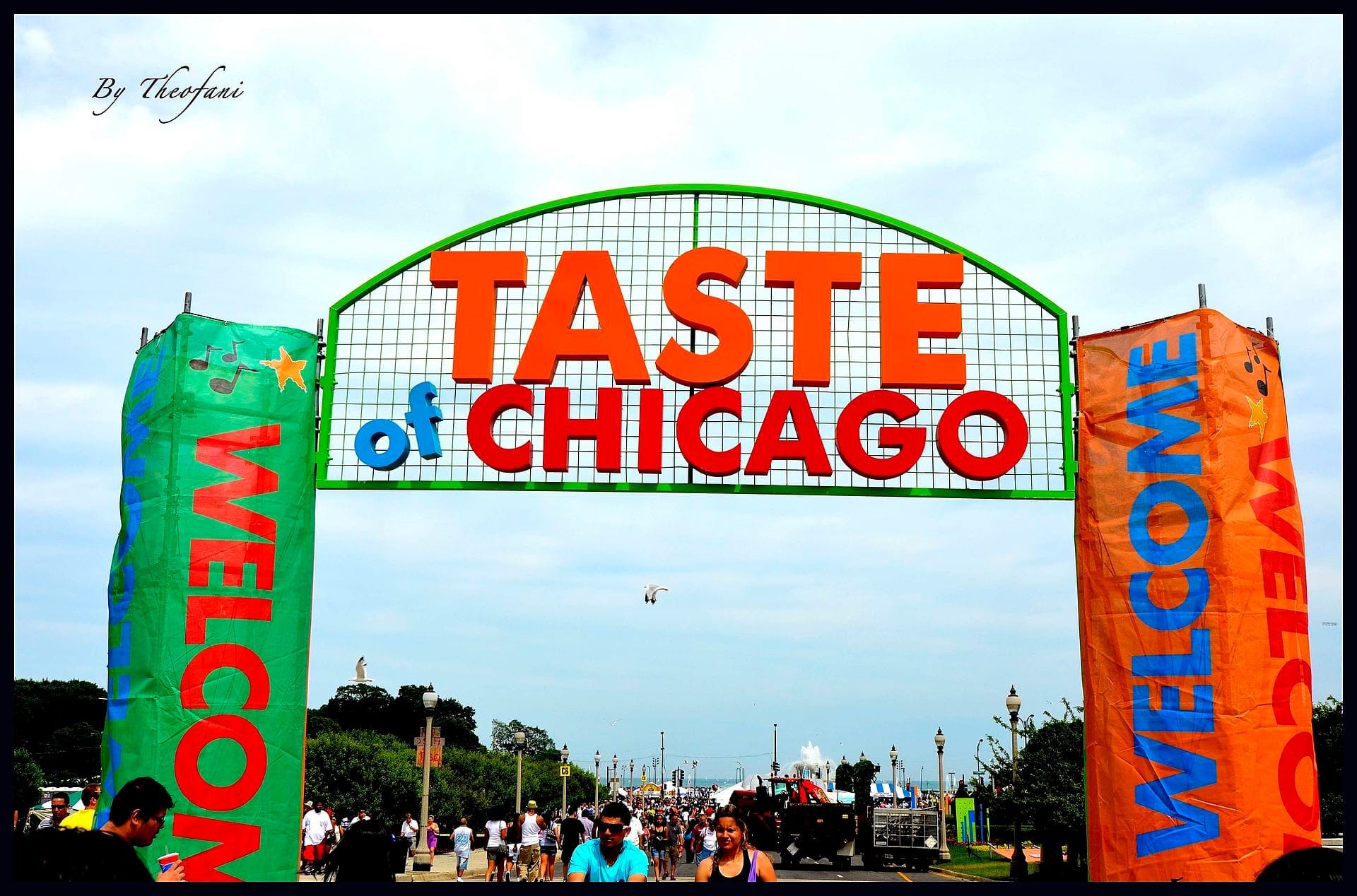
Taste of Chicago is the city's flagship outdoor food festival, held annually in Grant Park and recognized as Chicago's longest-running food festival. The concept is straightforward: dozens of Chicago restaurants set up outdoor booths across the park, visitors purchase coupons or scripts to use as festival currency, and the entire thing is free to walk into. No wristbands, no entry queues, no ticket purchases at the gate.
What started on July 4, 1980 as a single-day event on Michigan Avenue has grown into a multi-day summer celebration that now regularly stretches Wednesday through Sunday, typically in July, though editions have occasionally shifted into early September. Since moving to Grant Park in 1981, the festival has expanded to include multiple performance stages, a dedicated Family Village, and a lineup that reflects Chicago's extraordinary range of cuisines.
The festival sits within the broader Grant Park footprint, placing it in the heart of The Loop with the downtown skyline rising to the west and Lake Michigan visible to the east. That geography alone separates it from most urban food festivals.
ℹ️ Good to know
Dates and hours vary each year. The 46th annual edition is listed for Wednesday–Sunday, July 8–12, 2026, with hours approximately 11:00–21:00 Wednesday–Friday and 10:00–21:00 Saturday–Sunday. Always confirm on the official site before planning your trip.
The Food: What to Expect at the Booths
The restaurant lineup changes from year to year, but the overall spread consistently represents the breadth of Chicago dining: deep-dish pizza, Italian beef sandwiches, jerk chicken, empanadas, pad thai, pierogi, barbecue ribs, and a rotating cast of dessert vendors. Some booths belong to well-established Chicago institutions with decades of history; others are newer names that earn wider exposure through the festival.
For visitors who want to understand Chicago's food identity beyond a single meal, the Taste of Chicago guide festival offers a useful survey. If you're later planning a deeper culinary exploration, the Chicago food guide covers the neighborhoods and restaurants worth tracking down after the festival ends.
Food is ordered using prepaid coupons or scripts rather than cash at individual booths. Coupon books are typically sold at kiosks throughout the festival grounds. The system means you can budget your food spend in advance, though it also means unused coupons are a minor risk if you misjudge your appetite. Exact coupon denominations and prices are set each year, so check the official site before arrival to understand the current pricing structure.
💡 Local tip
Buy a smaller coupon book first and assess portion sizes before committing to a larger one. Booth portions vary considerably, and some of the best value comes from vendors offering smaller 'taste' portions rather than full plates.
Tickets & tours
Hand-picked options from our booking partner. Prices are indicative; availability and final rates are confirmed when you complete your booking.
Taste of Chinatown Chicago Food & Walking Tour
From 68 €Instant confirmationFree cancellationGo City | Chicago All-Inclusive Pass
From 127 €Instant confirmationFree cancellationiFLY Chicago Lincoln Park indoor skydiving experience
From 126 €Instant confirmationFree cancellationiFLY Chicago Rosemont indoor skydiving tickets
From 117 €Instant confirmationFree cancellation
Timing Your Visit: Morning vs. Evening
The festival experience changes significantly depending on when you arrive. Weekday mornings and early afternoons are notably calmer. Booth staff are more relaxed, wait times are shorter, and you can actually walk between stalls without navigating a dense crowd. The Grant Park lawns feel open, and the skyline backdrop is at its clearest before afternoon haze settles in.
By late afternoon on weekdays, and from mid-morning onward on weekends, the crowd density increases substantially. Saturday afternoons, especially when headline acts are performing on the main stage, draw the largest crowds of the festival run. If you are coming primarily for the music and the atmosphere, that energy has its own appeal. If you are coming primarily to eat without waiting in long lines, a Wednesday or Thursday opening hour is the smarter call.
Evening visits carry a distinct mood: the skyline lights up, the temperature drops slightly from the summer peak, and the combination of live music carrying across the park and the smell of grilling meat creates an atmosphere that is genuinely Chicago in summer. Bring a light layer, especially later in the evening when lake breezes pick up off Michigan Avenue.
Getting There and Navigating the Grounds
Grant Park is one of the most transit-accessible locations in Chicago. From the north or south, the Red Line stops at Jackson (one block from the western edge of the park) and Roosevelt (closer to the festival's southern stages). From the west side of the Loop, the Brown, Orange, Pink, and Purple Lines serve Adams/Wabash, which is also walkable. There is no meaningful advantage to driving: parking in the area is expensive and event-day congestion around the park is real.
If you are staying near the Chicago Riverwalk Magnificent Mile or Streeterville, it is an easy walk south through Grant Park. If you are combining the festival with a broader day downtown, the Chicago Riverwalk is a pleasant approach from the north, and Millennium Park is directly adjacent, making it easy to visit both in a single afternoon.
The festival footprint spreads across the central and southern sections of Grant Park, with food vendor areas, performance stages, and the Family Village typically spread out across multiple clusters. A site map is distributed at the entrance and published in advance on the official site. Orient yourself early: the main stage area and food vendor blocks are separate, and first-timers sometimes spend time wandering between them without a clear plan.
⚠️ What to skip
Chicago in July averages highs around 29°C (84°F), with significant humidity. The Grant Park lawns offer limited shade. Sunscreen, a hat, and a water bottle are essential for daytime visits. Hydration stations are typically available on-site, but bring your own water for the first hour before you locate them.
Live Music and Programming
Music has always been a core component of Taste of Chicago, and the main stage typically hosts a mix of nationally recognized acts alongside Chicago-based artists. Genres tend to be broad-reaching: R&B, pop, blues, salsa, and gospel have all appeared on past lineups. The music programming is free with festival entry, meaning you can eat and watch a concert for nothing beyond your food spend.
Chicago's music culture runs deep year-round. If the festival's live lineup whets your appetite for more, the Chicago blues and jazz guide covers the venues that carry that tradition through the rest of the year.
Beyond the main stage, the Family Village programming typically includes interactive cooking demonstrations, activities for children, and kid-focused entertainment. Families with young children find this section genuinely useful as a rest point between food explorations, and the dedicated programming keeps younger visitors engaged during the parts of the day when standing in vendor lines can become tedious.
Photography, Accessibility, and Honest Limitations
For photography, the festival's strongest visual moments come in two windows: early morning when the light is clean and the crowds have not yet arrived, and the hour before sunset when the western-facing skyline turns golden above the food stalls. Mid-afternoon light in July is flat and harsh, and crowds make composed shots difficult.
Grant Park's primary pathways are paved and generally accessible to wheelchairs and strollers. The festival grounds in their main vendor areas are typically flat and manageable, though grass sections between stages can become uneven and muddy after rain. For specific accessibility accommodations, including information about assistive listening or designated viewing areas, the current year's official festival page is the right resource.
An honest note on expectations: Taste of Chicago is an enormous, popular event, and there are limitations that come with that scale. Lines at the most popular booths can be long during peak hours. The coupon system adds a layer of pre-planning compared to a typical food market. And a festival spread across open parkland in July heat requires more physical stamina than a single restaurant visit. None of these are dealbreakers, but they shape the experience significantly. Visitors expecting an intimate food market or a relaxed dining atmosphere will find it here only during the quieter weekday morning hours.
Travelers with very limited time in the city and a full itinerary may find the festival's time-to-reward ratio is better on a standalone day than as an add-on to an already packed schedule. That said, for anyone in Chicago during the festival window who has an afternoon free, the combination of free entry, outdoor music, Grant Park's setting, and genuine Chicago restaurant representation makes it a reasonable use of two to three hours.
Insider Tips
- Arrive at opening on a Wednesday or Thursday to experience the festival at its calmest. Booth staff are more willing to chat about their food, and you can circle the entire vendor area in under an hour without crowd interference.
- Download the festival map from the official site before you arrive. The grounds are larger than they appear on maps, and locating specific restaurants without a plan costs time, especially once crowds build.
- Look for booths offering half-portions or 'tasting' portions rather than full plates. These are deliberately priced lower in coupons and let you sample more restaurants for the same overall spend.
- The main stage area fills quickly before headline acts. If you want a reasonable viewing position for evening concerts, arrive at least 45 minutes before the set you want to see and claim a spot on the lawn early.
- Combine the visit with a walk through Millennium Park, which is directly adjacent. The contrast between the crowded festival grounds and the relative calm of Lurie Garden or the area around Cloud Gate makes for a worthwhile ten-minute detour.
Who Is Taste of Chicago For?
- First-time visitors to Chicago who want a broad sample of the city's restaurant scene in one place
- Families with children, given the dedicated Family Village programming and open outdoor layout
- Live music fans looking for free outdoor concerts in a downtown setting
- Travelers visiting Chicago specifically in summer who want a quintessential local event
- Food-focused travelers building a picture of Chicago's culinary range before exploring individual neighborhoods
Nearby Attractions
Other things to see while in The Loop:
- Art Institute of Chicago
One of the largest and most visited art museums in the United States, the Art Institute of Chicago anchors the eastern edge of the Loop with a collection of over 300,000 works spanning 5,000 years. From Georges Seurat's pointillist masterpiece to Grant Wood's American Gothic, the highlights alone demand the better part of a day.
- Buckingham Fountain
The Clarence Buckingham Memorial Fountain is one of the largest decorative fountains in the world, sitting at the heart of Grant Park since 1927. Free to visit during its seasonal run from spring through mid-October, it puts on hourly water displays and a nightly illuminated show that draws crowds from across the city.
- Chicago Architecture Center
Housed in Mies van der Rohe's One Illinois Center on the Chicago River, the Chicago Architecture Center packs nearly 10,000 square feet of exhibition space, a landmark scale model of the city, and access to some of the country's most informative architecture tours. It's the most comprehensive entry point into understanding what makes Chicago's skyline one of the world's most significant.
- Chicago Architecture Foundation River Cruise
The Chicago Architecture Center River Cruise aboard Chicago's First Lady is the most authoritative way to read the city's skyline. In 90 minutes, trained docents walk you through more than 40 landmark buildings across all three branches of the Chicago River, connecting architectural styles to the human decisions that shaped them.