Ermita de San Antonio de la Florida: Goya's Frescoes and Final Resting Place
A small neoclassical hermitage beside the Manzanares River holds one of the most extraordinary ceiling fresco cycles in Spain, painted by Francisco de Goya in 1798. Entry is free, crowds are light, and the painter himself is buried beneath the dome he decorated.
Quick Facts
- Location
- Glorieta de San Antonio de la Florida 5, 28008 Madrid (Moncloa-Aravaca district)
- Getting There
- Príncipe Pío (Metro Lines 6 and 10, Cercanías); 10-min walk along Paseo de la Florida
- Time Needed
- 45–75 minutes
- Cost
- Free admission. Free guided group visits (up to 25 people, ~20 min) by prior phone booking.
- Best for
- Art lovers, history seekers, anyone wanting a contemplative alternative to the main museum circuit
What This Place Actually Is
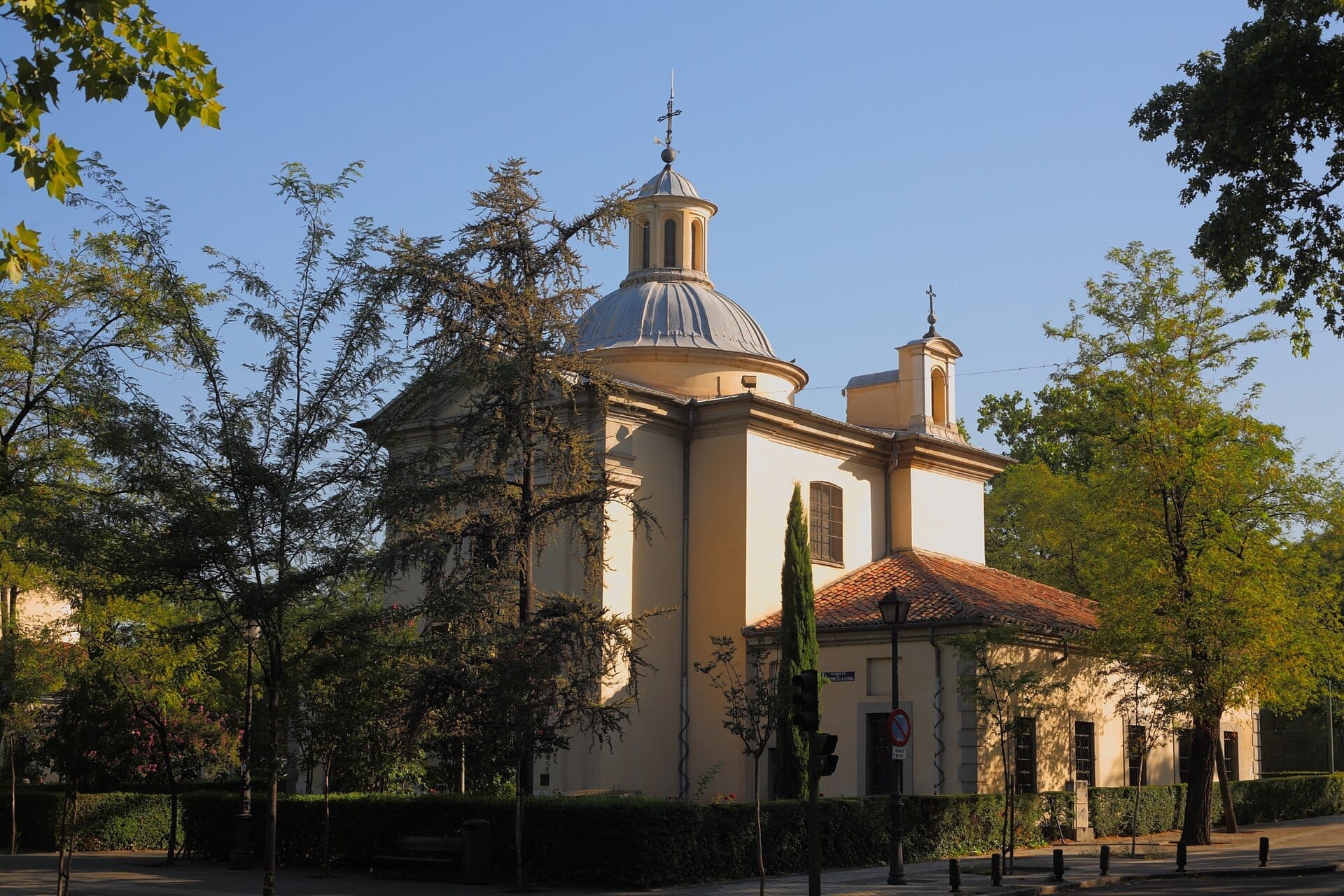
The Ermita de San Antonio de la Florida is a small neoclassical church completed in 1798 on the western edge of Madrid, close to the Manzanares River. It was commissioned by King Charles IV and designed by Italian architect Filippo Fontana. What makes it exceptional is not the building itself, which is modest in scale, but what Goya painted inside it: a continuous fresco cycle covering the dome, the apse, and the arches, depicting the miracle of Saint Anthony of Padua with a cast of earthly figures that looks nothing like traditional religious art.
After the hermitage was declared a National Monument in 1905, the decision was made to preserve it exactly as Goya left it rather than use it as an active place of worship. In 1928 a second, architecturally identical church was built right beside the original so that religious services could continue. The result is an unusual pair of buildings sitting side by side: one for prayer, one for art history. The original hermitage, now managed as part of Patrimonio Nacional within the Royal Palace historical complex, is where Goya's remains have rested since 1919, transferred from Bordeaux, where he died in exile.
ℹ️ Good to know
Opening hours: Tuesday–Sunday 09:30–20:00 (standard); 09:30–19:00 from 15 June to 15 September. Closed Mondays and on 1 and 6 January, 1 May, and 24, 25 and 31 December. Admission is free.
The Frescoes: What Goya Did Here
Goya painted the entire interior between June and December 1798, working at speed and with considerable creative freedom. The subject is the Miracle of Saint Anthony: according to legend, Anthony raised a dead man from his grave in Lisbon to testify that Anthony's father, accused of murder, was innocent. Goya took this devotional story and placed it in a contemporary Madrid setting. The resurrected corpse is there, but so are majas and majos, street types, curious onlookers, children peering through railings, and figures leaning over a painted balustrade as if watching a spectacle from a balcony.
The dome is where the main scene unfolds, painted in warm ochres, browns, and soft greys with passages of bright white. Goya used techniques borrowed from the emerging Romantic tradition and from his own developing style: loose brushwork, figures with expressive faces rather than idealized features, and a sense of actual weight and posture rather than heavenly elevation. The painted sky that fills the lantern above is pale and diffuse, not the gold-saturated firmament of Baroque church painting. Standing directly beneath it and tilting your head back is the only way to take it in properly.
The apse fresco, smaller but equally detailed, shows angels and seraphim that carry the same earthy quality as the human figures in the dome. Goya's angels look less like celestial beings and more like young Madrileños dressed up for the occasion. This was quietly radical in 1798 and it remains visually striking today.
⚠️ What to skip
Interior photography is prohibited. Bring your attention, not your phone. The low ambient light inside makes the frescoes harder to read from photographs anyway — they reward time and direct observation.
Tickets & tours
Hand-picked options from our booking partner. Prices are indicative; availability and final rates are confirmed when you complete your booking.
Royal Monastery of El Escorial and the Valley of the Fallen trip from Madrid
From 64 €Instant confirmationFree cancellationFlexible time Real Madrid: Bernabeu Stadium & Museum Entry
From 42 €Instant confirmationMuseum of Senses Madrid entrance ticket
From 19 €Instant confirmationAvila and Segovia full-day tour from Madrid
From 50 €Instant confirmationFree cancellation
The Experience at Different Times of Day
The hermitage is small enough that its atmosphere shifts entirely depending on how many people are inside. At 10:00 on a weekday morning, you may be one of only a handful of visitors. The light entering through the small windows is cool and directional, picking out the texture of the plaster surface and the dry, chalky quality of Goya's pigments. The attendant on duty will sometimes provide a brief orientation, pointing out specific figures if you show interest.
By midday in spring and autumn, small groups may arrive together, but the space never approaches the density of the major museums. Summer mornings before 11:00 are reliably quiet. The walk from Príncipe Pío station along Paseo de la Florida takes about ten minutes and is largely shaded by trees that line the riverside path, which makes it a reasonable route even on warmer days. On summer afternoons, however, the walk itself can be hot and the reduced summer opening hours (closing at 19:00 rather than 20:00) mean less flexibility in planning.
Late afternoon in autumn, when the lower sun angle sends horizontal light through the west-facing windows, is the most atmospheric time to visit. The ochre tones in the frescoes deepen, and the small interior feels genuinely still. There is no café, no gift shop, no queue management system. You enter, look up, look around, and leave at your own pace.
Goya's Tomb and the Surrounding Site
Francisco de Goya died in Bordeaux in 1828 at the age of 82, having left Spain in voluntary exile after the restoration of absolute monarchy. His remains were repatriated to Madrid in 1919 and interred inside the very hermitage whose dome he had painted 121 years earlier. The tomb is marked simply, set into the floor near the entrance. There is something profoundly affecting about the symmetry: the painter lies beneath the ceiling he decorated, and the ceiling has barely changed since he finished it.
One detail that unsettles some visitors: Goya was buried initially in Bordeaux in a shared grave, and when his remains were exhumed and returned to Spain, the skull was missing and has never been recovered. The tomb in the ermita contains his skeleton, but not his head. For context on Goya's broader place in Madrid's cultural life, the Museo del Prado holds the largest collection of his paintings in the world, including the Black Paintings and the major portraits, and works well as a companion visit.
The duplicate church built in 1928 stands immediately adjacent. It is an active place of worship and is not generally open for tourist visits, though the exterior pairing of two identical neoclassical facades is itself worth a moment of attention. The surrounding area includes the Paseo de la Florida, a tree-lined promenade along the river embankment that connects south toward the Madrid Río park.
Getting There and Practical Logistics
The most straightforward approach is the Metro to Príncipe Pío (Lines 6 and 10, also served by Cercanías commuter rail), followed by a walk north along Paseo de la Florida. The route is flat and takes around ten minutes on foot. Bus stops on Paseo de la Florida at numbers 37 and 8 also serve the area. The hermitage sits at Glorieta de San Antonio de la Florida 5, at the junction of Paseo de la Florida and Avenida de Valladolid. The Madrid Río park lies just to the south, making it easy to combine both in a half-day along the river.
The Moncloa-Aravaca district is not one of Madrid's high-density tourist corridors. The ermita sits in a relatively quiet stretch of the city, closer in character to the Moncloa-Argüelles neighborhood than to the museum district further south. There are few tourist services immediately around it: no souvenir shops, and only a small number of cafés along the riverside. Bring water if you plan to extend the visit into a longer riverside walk.
Accessibility information for the interior should be confirmed directly with the Madrid City Council museum management before visiting, as the original 18th-century building has physical constraints that may affect wheelchair access. The official municipal page lists current contact details.
💡 Local tip
Free guided group visits (up to 25 people, approximately 20 minutes) are available by prior booking by phone with the hermitage directly. These are worthwhile if you want interpretive context: the guide typically explains Goya's technique and points out specific figures in the dome that are easy to miss without direction.
Who Benefits Most, and Who Might Not
The Ermita de San Antonio de la Florida rewards visitors who already have some interest in Goya or in Spanish art history. If you arrive without context, the frescoes are visually engaging but you may not fully understand what you are looking at or why it matters. Reading a short account of Goya's life before visiting, or pairing the trip with a morning at the Museo Thyssen-Bornemisza to see the broader arc of European painting from the same period, sharpens the experience considerably.
Visitors looking for drama, scale, or interactive content will find the space underwhelming. The hermitage is a single small room with frescoes. There are no information panels inside the building beyond minimal labeling, no audio guide available on-site, and no accompanying exhibition space. The visit is short by design. If your travel style tends toward comprehensive museum experiences with curated interpretation, treat this as a supplement to the Prado rather than a standalone destination.
For travelers building an art-focused day, the hermitage pairs well with a walk south along the river to Madrid Río and then east into the historic center. Those interested in the wider religious architecture of the city may also want to visit the Almudena Cathedral or the Real Monasterio de la Encarnación, both of which offer a very different scale and context. For a fuller picture of what Madrid's art scene offers, the best museums in Madrid guide covers the main options with comparable practical detail.
Insider Tips
- Stand at the geometric center of the floor directly beneath the dome and look straight up to see the miracle scene as Goya intended it to read: the central action near the apex, the crowd arranged around the painted balustrade below.
- The duplicate church next door (built 1928) holds active religious services. If you arrive during a service, the original hermitage may be quieter than usual as casual foot traffic is absorbed by the activity next door.
- Weekday mornings between 10:00 and 11:30 are consistently the least crowded window. The hermitage rarely generates queues, but small group tours can briefly fill the tiny interior.
- Combine the visit with a walk south along Paseo de la Florida to the Madrid Río park and its river beaches (Playas de Madrid) in summer — the contrast between the 18th-century hermitage and the contemporary riverbank infrastructure makes for an interesting half-day.
- If you want a printed resource, the Patrimonio Nacional page linked in the quick facts section has downloadable material on the frescoes. There is no bookshop on-site, and postcards or reproductions are not sold at the hermitage itself.
Who Is Ermita de San Antonio de la Florida For?
- Art history enthusiasts wanting close contact with an in-situ Goya fresco cycle rather than a gallery reproduction
- Travelers who have already done the Prado and Reina Sofía and want a quieter, less-visited counterpoint
- Anyone with an interest in Goya specifically, including his burial circumstances and the missing-skull story
- Visitors combining a riverside walk through Madrid Río with a cultural stop
- Budget travelers: free entry, no booking required, and easily combined with other free nearby attractions
Nearby Attractions
Other things to see while in Moncloa & Argüelles:
- Casa de Campo
Once a royal hunting ground reserved for Spanish kings, Casa de Campo is now Madrid's largest public park, covering 1,535.52 hectares west of the Royal Palace. Free to enter year-round, it offers a lake, forest trails, a cable car connection, and two family attractions, all within reach of the city centre.
- Madrid Río
Madrid Río is a roughly 150-hectare linear park stretching about 7 kilometres along the Manzanares River, built on top of the buried M-30 motorway. Free to enter and open around the clock, it offers cycling paths, playgrounds, riverside promenades, and views of the Royal Palace — all within walking distance of central Madrid.
- Faro de Moncloa
At 92 metres above street level, the Faro de Moncloa observation deck delivers sweeping 360-degree views of Madrid for as little as €4. Built in 1992, this slender 110-metre tower is one of the most affordable viewpoints in the city, and one of the least crowded.
- Museo Cerralbo
Museo Cerralbo is a rare thing: a 19th-century aristocratic palace preserved almost exactly as its owner left it, filled with over 50,000 objects across paintings, armour, ceramics, and gilded ballrooms. Located in the Argüelles neighbourhood near Plaza de España, it offers an unusually personal window into aristocratic Madrid life at a fraction of the price of the city's blockbuster museums.