Madrid Río: The Riverfront Park That Transformed a City
Madrid Río is a roughly 150-hectare linear park stretching about 7 kilometres along the Manzanares River, built on top of the buried M-30 motorway. Free to enter and open around the clock, it offers cycling paths, playgrounds, riverside promenades, and views of the Royal Palace — all within walking distance of central Madrid.
Quick Facts
- Location
- Manzanares riverbanks, Paseo de la Ermita del Santo 14–16, 28011 Madrid
- Getting There
- Puerta del Ángel (Line 6) – approx. 5 min walk to the park
- Time Needed
- 1.5–3 hours for a casual walk; a full day for cycling the entire length
- Cost
- Free (open public park, 24 hours)
- Best for
- Cycling, family outings, jogging, riverside picnics, and escaping the inner-city heat
- Official website
- www.esmadrid.com/en/tourist-information/madrid-rio-park
What Madrid Río Actually Is
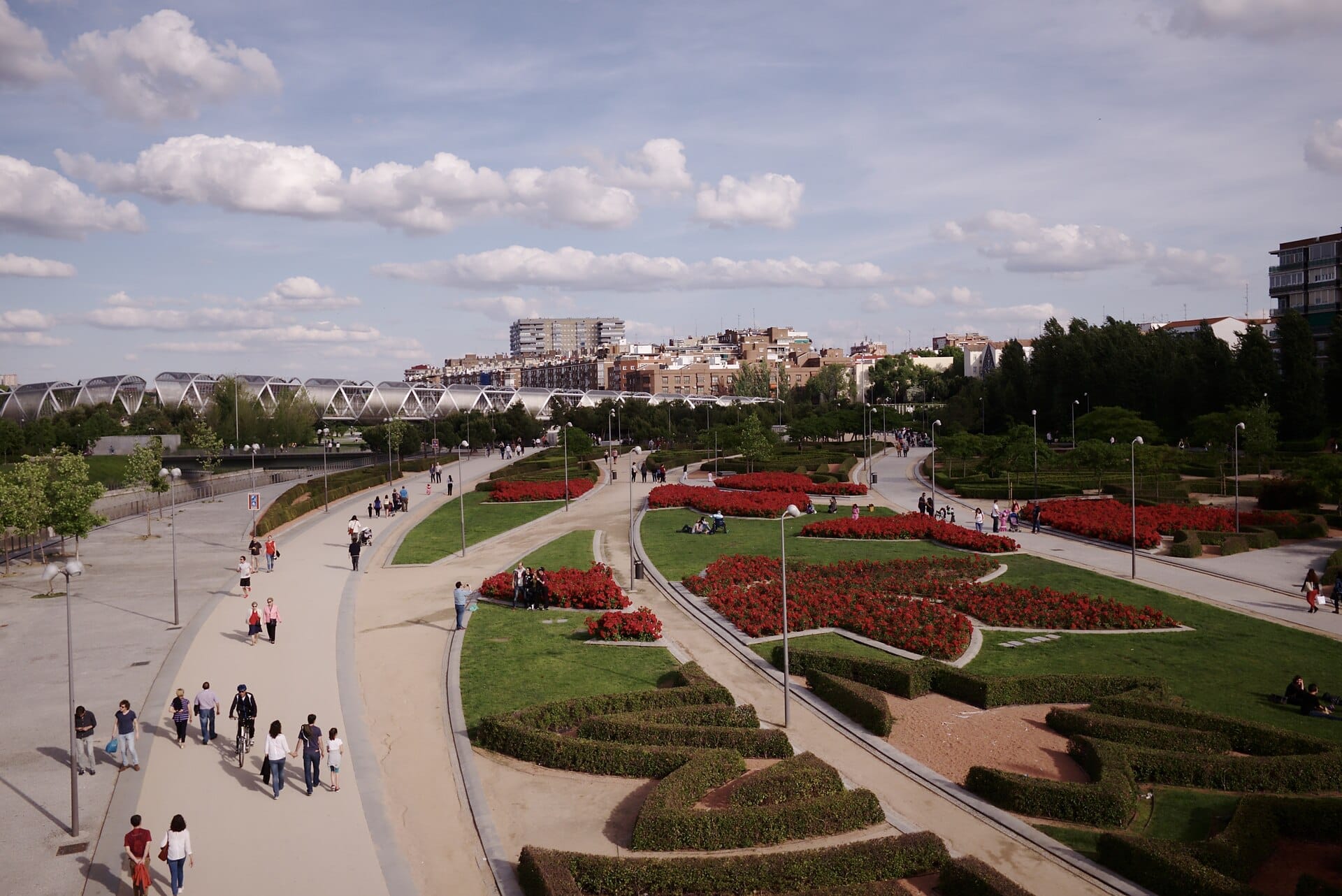
Madrid Río is not a traditional park. It is a linear urban greenway that runs for roughly 7 kilometres along both banks of the Manzanares River, stretching from the Puente de los Franceses in the north to the Pasarela de Legazpi in the south. The project opened in phases from 2011 and was completed in April 2015, adding roughly 1.5 million square metres of public space, over 33,000 trees, and a network of cycling and pedestrian paths to a city that had, for decades, cut off its own riverfront with a roaring urban motorway.
The M-30 ring road, which previously ran above ground along the Manzanares, was buried in a large tunnelling project carried out by Madrid City Council in the mid‑2000s. What replaced the motorway on the surface was handed to Dutch-Spanish landscape architects West 8 and a team of Madrid-based firms, who transformed roughly 150 hectares of former infrastructure corridor into the largest new park Madrid had seen in over a century. The result is a park that feels designed for daily life: wide promenades, generous plazas, shallow wading beaches, and enough open grass that the city exhales.
💡 Local tip
Madrid Río is open 24 hours a day with no admission charge. However, specific facilities within the park, such as Matadero Madrid, have their own hours and may charge for certain events. Check individual venue websites before visiting.
The Experience at Different Times of Day
Early mornings on Madrid Río belong to runners and dog walkers. By 7am on a weekday, the Paseo de la Virgen del Puerto path is already moving with people in shorts and earphones, their footsteps soft on the rubberized track surface. The air is cooler here than in the city centre — the proximity to the river and the tree canopy make a measurable difference in summer, when Madrid's inland heat can feel punishing 667 metres elevation. The sound of the Manzanares itself is modest; this is not a dramatic alpine river, but there is moving water, and the willows along the banks lean into it.
Weekend mornings bring a different crowd. Families with children arrive at the Playa de Madrid (the shallow man-made beach areas along the river), cyclists rent bikes at BiciMAD docking stations nearby, and the wide plazas fill with skaters. By midday in summer, the grass slopes are covered in people lying under the poplar and elm trees. It is worth knowing that Madrid Río is one of the few places in the city where you can feel legitimately comfortable sitting on grass — a small thing that matters enormously in a capital built primarily of stone and asphalt.
Evenings are arguably the best time for a first visit. Around sunset, the western-facing sections of the park catch the light in a way that turns the Manzanares gold, and the silhouette of the Palacio Real and the Almudena Cathedral rising above the bluff to the east makes for one of the more underappreciated views in Madrid. Families promenade, teenagers gather on the bridge parapets, and the pace slows down considerably. In winter, the same light hits lower and the park takes on a clean, almost Nordic quality.
Tickets & tours
Hand-picked options from our booking partner. Prices are indicative; availability and final rates are confirmed when you complete your booking.
Royal Monastery of El Escorial and the Valley of the Fallen trip from Madrid
From 64 €Instant confirmationFree cancellationFlexible time Real Madrid: Bernabeu Stadium & Museum Entry
From 42 €Instant confirmationMuseum of Senses Madrid entrance ticket
From 19 €Instant confirmationAvila and Segovia full-day tour from Madrid
From 50 €Instant confirmationFree cancellation
How to Walk or Cycle the Park
Most visitors enter from the north, arriving at Puente de los Franceses near the Casa de Campo, and walk or cycle southward. This direction keeps the Royal Palace in view for much of the early stretch, which provides both orientation and a sense of Madrid's centuries-long relationship with this riverbank. The Puerta del Ángel metro station, a five-minute walk from the park's central section, is the most convenient entry point if you are arriving by public transport.
The park's cycling infrastructure is well-maintained and separated from pedestrian paths for most of its length. BiciMAD, Madrid's electric bike-share scheme, has docking stations on streets adjacent to the park including Paseo de la Florida and Paseo de la Chopera. For those who prefer to walk, the full 7-kilometre north-to-south route takes roughly 90 minutes at an easy pace and requires no significant elevation change. The path connects, at its southern end, with the Matadero Madrid arts centre, making it a logical pairing for an afternoon visit.
Multiple pedestrian bridges span the Manzanares at regular intervals, allowing you to switch banks mid-walk without retracing your steps. The bridge designs vary considerably — some are spare and functional, others are architectural statements in steel and timber. The Puente del Rey, a wide stone and iron structure built in the 18th century and subsequently restored, is the most historically significant crossing in the park.
What You See Along the Banks
From the northern stretches near the Ermita de San Antonio de la Florida, you can look up the bluff toward the Palacio Real de Madrid — the full western facade is visible from a distance that most visitors never encounter. The palace looks larger and more imposing from this vantage point than it does from the more photographed Plaza de Oriente, precisely because you are far enough away to take it in whole. The green slopes of the Campo del Moro gardens cascade down from the palace toward the riverbank, though access to those gardens is through a separate entrance on the park's eastern edge.
Moving south, the park becomes more recreational and less scenic in a classical sense. There are designated picnic areas, outdoor gym equipment, basketball courts, and the series of shallow beach areas along the Manzanares known collectively as Madrid Playa. In summer, these attract families with small children for whom paddling in the river is a genuine treat. The water is clean by modern standards — a significant improvement over the state of the Manzanares just two decades ago, when the river was largely degraded.
The southern end of the park, near the Legazpi footbridge, transitions into the Arganzuela district and opens up toward Matadero Madrid, the former municipal slaughterhouse converted into one of the city's principal contemporary arts spaces. If you are interested in pairing outdoor time with culture, this end of the park rewards the longer walk. Those interested in how this transformation fits Madrid's broader architectural ambitions will find useful context in the city's architecture guide.
Weather, Seasons, and When to Go
Spring (April to May) and autumn (September to October) offer the most comfortable conditions for a long walk or cycle along Madrid Río. Temperatures are typically in the 18–25°C range, the park's flowering trees are at their best in April, and the afternoon light is warm without being exhausting. These are also the periods when the park feels most alive: every section has activity, but not the weekend-summer crowds that can make the picnic areas feel congested.
Summer visits are manageable if you go early or late. Midday in July and August, when Madrid regularly exceeds 35°C, makes any extended outdoor walk uncomfortable regardless of how much shade is available. The tree canopy along the river does provide relief compared to the city centre, but it is not enough to compensate for full sun in peak heat. If you are visiting in summer, aim for 8 to 10am or after 7pm.
⚠️ What to skip
In summer, bring water. The park has drinking fountains at intervals, but they are not always easy to find. The nearest cafés and kiosks are clustered near the playgrounds and the Matadero end of the park, not distributed evenly along the entire 7km route.
Winter on Madrid Río is quiet and often beautiful. The deciduous trees lose their leaves and the sightlines open up considerably, revealing the topography of the riverbanks and the scale of the old royal estates above them. On cold, still mornings, the park can feel wonderfully peaceful. Those visiting in December should cross-reference with the city's Madrid Christmas guide for additional seasonal programming around the park.
Practical Notes: Access, Accessibility, and Nearby Transport
The park is served by several metro stations along its length: Puerta del Ángel (Line 6), Pirámides (Line 5), Legazpi (Lines 3 and 6), and Marqués de Vadillo (Line 5) all provide reasonable walking access to different sections. EMT bus routes also serve the park's perimeter. The park's mostly flat terrain and wide promenades make it accessible to pushchairs, wheelchairs, and anyone with limited mobility for much of its length, though specific adapted facilities such as accessible toilets should be confirmed with the municipality before visiting.
For visitors who prefer structured itineraries, Madrid Río makes logical sense as part of a longer walk that combines the royal quarter with the riverfront. The Jardines de Sabatini and the northern end of the park are separated by only a short walk down the bluff from the Palacio Real, creating a natural half-day route. For those planning time in this part of the city, the Madrid walking tours guide covers several itineraries that incorporate the riverfront.
Photography works best in the golden hours. The park faces west across the river for much of its northern stretch, meaning sunset light falls directly on the paths and the water surface. Bring a wide lens if you want to capture the Palacio Real from the riverbank below — a standard 24mm or equivalent will just about fit the full facade in from across the river. Smartphone photographers should note that the elevated royal quarter behind the park creates strong backlight in the afternoons, so morning light is better for detail shots of the palace from below.
Insider Tips
- The best unobstructed view of the Palacio Real's western facade is from the wide promenade between the Puente del Rey and Puente de Segovia — most first-time visitors miss it entirely because they approach the palace from the opposite, more photographed side.
- The shallow river beach areas near the centre of the park are popular with children but rarely mentioned in travel guides. On a summer afternoon, they are genuinely cooling, and the water quality is monitored by the city.
- BiciMAD docking stations near the park do not always have bikes available on busy weekend mornings. Check the app before leaving your accommodation and consider arriving from a station slightly further from the park entrance where availability is typically higher.
- The Matadero Madrid arts centre at the southern end of the park frequently runs free or low-cost outdoor events, including open-air cinema in summer. Checking their programme before your visit can turn a walk into an evening out.
- If you cross to the eastern bank using the Puente de Toledo (the ornate baroque bridge just south of the park's mid-point), you get an angle on the park's landscaping that the main western promenade does not offer — and far fewer people on this side on weekday mornings.
Who Is Madrid Río For?
- Families with young children looking for green space, playgrounds, and safe cycling paths without paying for entry
- Cyclists and joggers who want a continuous riverside route away from city traffic
- Architecture and urban design enthusiasts interested in large-scale infrastructure-to-greenspace conversion projects
- Visitors who want views of the Palacio Real from an angle most tourists never see
- Anyone visiting in summer who needs relief from the city's heat in the mornings or evenings
Nearby Attractions
Other things to see while in Moncloa & Argüelles:
- Casa de Campo
Once a royal hunting ground reserved for Spanish kings, Casa de Campo is now Madrid's largest public park, covering 1,535.52 hectares west of the Royal Palace. Free to enter year-round, it offers a lake, forest trails, a cable car connection, and two family attractions, all within reach of the city centre.
- Ermita de San Antonio de la Florida
A small neoclassical hermitage beside the Manzanares River holds one of the most extraordinary ceiling fresco cycles in Spain, painted by Francisco de Goya in 1798. Entry is free, crowds are light, and the painter himself is buried beneath the dome he decorated.
- Faro de Moncloa
At 92 metres above street level, the Faro de Moncloa observation deck delivers sweeping 360-degree views of Madrid for as little as €4. Built in 1992, this slender 110-metre tower is one of the most affordable viewpoints in the city, and one of the least crowded.
- Museo Cerralbo
Museo Cerralbo is a rare thing: a 19th-century aristocratic palace preserved almost exactly as its owner left it, filled with over 50,000 objects across paintings, armour, ceramics, and gilded ballrooms. Located in the Argüelles neighbourhood near Plaza de España, it offers an unusually personal window into aristocratic Madrid life at a fraction of the price of the city's blockbuster museums.