Museo Cerralbo: Inside Madrid's Most Intimate Palace Museum
Museo Cerralbo is a rare thing: a 19th-century aristocratic palace preserved almost exactly as its owner left it, filled with over 50,000 objects across paintings, armour, ceramics, and gilded ballrooms. Located in the Argüelles neighbourhood near Plaza de España, it offers an unusually personal window into aristocratic Madrid life at a fraction of the price of the city's blockbuster museums.
Quick Facts
- Location
- C/ Ventura Rodríguez 17, Argüelles, 28008 Madrid
- Getting There
- Metro: Ventura Rodríguez (Line 3) or Plaza de España (Lines 3, 10)
- Time Needed
- 1 to 1.5 hours
- Cost
- €3 general / €1.50 reduced / Free on Thursdays 17:00–20:00 and all Sundays
- Best for
- History lovers, decorative arts enthusiasts, and anyone who finds large museums exhausting
- Official website
- www.cultura.gob.es/mcerralbo/en/home.html
What Museo Cerralbo Actually Is
The Museo Cerralbo is not a conventional art museum. It is a palace-house museum, meaning the entire building functions as a single exhibit. The rooms are displayed as they were when Enrique de Aguilera y Gamboa, the 17th Marquis of Cerralbo, lived here in the late 19th century. You are not walking through white-walled galleries with labels and rope barriers. You are walking through someone's home, albeit a very grand one, with paintings stacked salon-style floor to ceiling, armour displayed in alcoves, and crystal chandeliers catching whatever afternoon light filters through the tall windows.
The building itself was constructed between 1884 and 1892 in a historicist style that draws on classical forms. The Marquis, who died in 1922, bequeathed his entire collection and residence to the Spanish state on the condition that the arrangement of rooms be preserved intact. That commitment is what makes this place remarkable. Over 50,000 objects remain on display in historically arranged rooms: paintings, sculptures, ceramics, glassware, tapestries, furniture, coins, medals, clocks, weapons, armour, and archaeological pieces collected over a lifetime of travel and acquisition.
💡 Local tip
Thursday evenings (17:00–20:00, excluding public holidays) are free and the museum is open until 20:00. This is the single best time to visit: fewer visitors than weekend mornings, no admission cost, and the late light through the palace windows has a particular quality worth experiencing.
The Collection: Scale and Specifics
The Marquis was a serious collector, not simply a wealthy man who acquired decorative objects for show. He purchased works attributed to El Greco, Zurbarán, Alonso Cano, Ribera, Tintoretto, and Van Dyck, among others. The most celebrated single piece in the collection is El Greco's "The Ecstasy of Saint Francis," displayed in what feels like an intimate domestic setting rather than a purpose-built gallery. Seeing it here, surrounded by the furnishings and objects the Marquis himself chose, produces a very different experience from encountering an El Greco in a large national collection.
Beyond the paintings, the armour room is a highlight for visitors who might not otherwise describe themselves as armour enthusiasts. The collection includes pieces from across Europe and spans several centuries. There is something visceral about standing in a 19th-century palace room surrounded by full suits of armour arranged in formation, a reminder that the Marquis was as interested in military history and archaeology as he was in fine art.
The archaeological collection is less frequently mentioned but worth attention. The Marquis financed and participated in excavations across Spain, and the resulting finds, ceramics, metalwork, and pre-Roman and Roman-era pieces, are folded into the palace alongside everything else. It is an unusual juxtaposition that speaks to the particular, eclectic ambition of 19th-century collecting culture.
Tickets & tours
Hand-picked options from our booking partner. Prices are indicative; availability and final rates are confirmed when you complete your booking.
Art & Brunch at Museo Nacional Thyssen-Bornemisza tickets
From 50 €Instant confirmationFree cancellationPaseo del Arte pass for Museo Nacional Thyssen-Bornemisza, Reina Sofia Museum and Prado Museum
From 37 €Instant confirmationMuseo Nacional Thyssen-Bornemisza Skip-the-Line Tickets
From 14 €Instant confirmationMuseo Nacional Thyssen-Bornemisza skip-the-line tickets with audio guide
From 19 €Instant confirmation
Room by Room: What to Look For
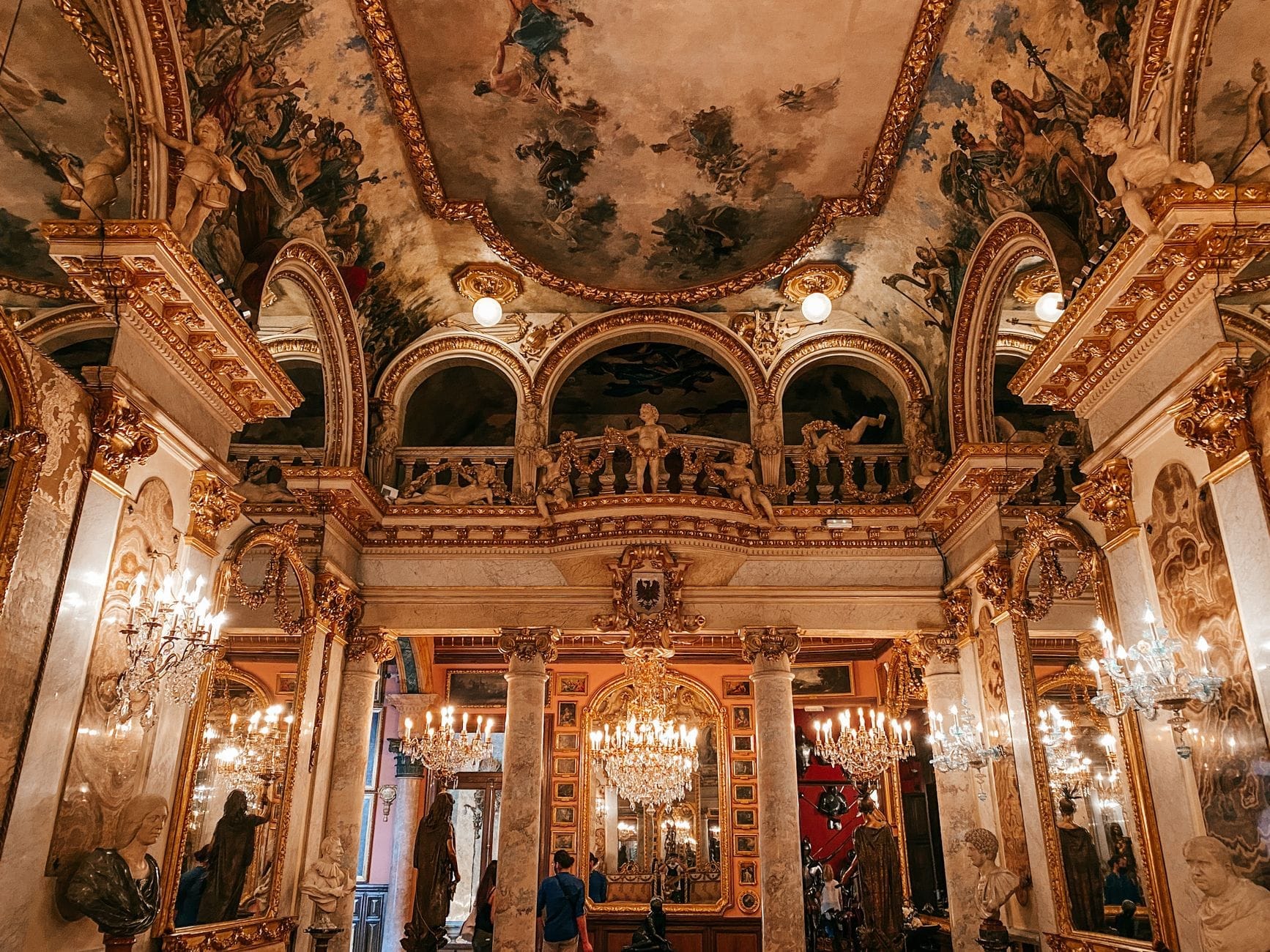
The ground floor sets the tone immediately. The entrance hall is formal and decorative, with the kind of layered density that was fashionable in aristocratic interiors of the period. As you move through the sequence of rooms, the character shifts: some spaces feel intimate and library-like, others are grand reception rooms designed to impress guests. The ballroom, in particular, is one of the most visually striking interiors in Madrid's smaller museums, with its mirrored walls, painted ceiling, and gilt surfaces. Photographs do not capture the scale of it properly.
The private chapel on the upper level is modest by the standards of the rest of the building but contains works of genuine quality. It offers a quieter moment after the visual density of the reception rooms. Take the staircase slowly: the stair hall itself is decorated with weapons and armour, and the arrangement is deliberate rather than chaotic.
The study and library areas give the clearest sense of the Marquis as a person rather than simply a collector. Books, correspondence items, and personal objects are present alongside art. If you want context on the Marquis and his times, the Museo del Romanticismo is a 15-minute walk northeast and covers the same 19th-century Madrid aristocratic world from a different angle. Visiting both in one afternoon is a coherent and rewarding combination.
How the Experience Changes by Time of Day
Morning visits, particularly on weekday mornings between Tuesday and Friday, tend to be very quiet. The museum draws a small but consistent flow of visitors rather than crowds, and in the first hour after opening at 09:30 it is possible to have entire rooms to yourself. The light entering the east-facing rooms in the morning hours is clear and direct, which makes the paintings on those walls easier to examine in detail.
Sunday mornings bring more visitors, largely because admission is free on Sundays and partly because the 10:00 opening fits neatly into a late-morning itinerary. Even then, the museum rarely feels crowded in the way that Madrid's larger institutions do. The ceiling height and spatial generosity of the palace rooms means that ten or fifteen visitors can occupy the same space without it feeling congested.
Thursday evening sessions (17:00–20:00) have a slightly different atmosphere. The light is warmer and lower, the staff are sometimes more relaxed, and the visitor mix includes local Madrid residents as well as tourists. The ballroom in particular benefits from the warmer afternoon light, which softens the gilt surfaces in a way that midday light does not.
Getting There and Practical Logistics
The museum is located at Calle Ventura Rodríguez 17, in the Argüelles area just north of Plaza de España. The most direct metro access is Ventura Rodríguez station on Line 3, which deposits you almost directly outside. Plaza de España station (Lines 3 and 10) is a short walk south and useful if you are combining the visit with the plaza itself or with attractions further into the city centre.
The neighbourhood is worth a few minutes of attention in its own right. The Moncloa-Argüelles district has a residential, lived-in character quite different from the tourist intensity of Sol or Gran Vía. There are several decent cafés on Calle Ventura Rodríguez and the surrounding streets if you want a coffee before or after the visit.
Opening hours are Tuesday to Saturday 09:30–15:00, with Thursday afternoons extended to 17:00–20:00 (except public holidays; last access is one hour before closing). Sunday and public holiday hours are 10:00–15:00. The museum is closed on Mondays. Admission is €3 for general entry and €1.50 for reduced (verify current eligibility categories on the official website before visiting). The Thursday evening session and all Sundays, as well as certain national holidays and commemorative dates, are free. The museum also accepts the Eight Madrid Museums Pass (€16, valid 15 days), the Four Madrid Museums Pass (€8, valid 10 days), and the National Museums Pass (€36.06). Prices should be confirmed close to your visit date as they are subject to change.
ℹ️ Good to know
Bags, rucksacks, umbrellas, and bulky items must be left at the ticket office. Travel light or leave your bag at your accommodation before visiting.
Accessibility and Practical Warnings
The building is a 19th-century palace and was designed as a private residence, not as a public museum. The original room layouts involve stairs and narrow passages in some sections, and the historic fabric of the building imposes real limitations on modern accessibility infrastructure. The official website includes a dedicated accessibility section with current details on which parts of the museum are accessible and what facilities are available. Check this before visiting if mobility is a concern.
Visitors who prefer open-plan, light-filled contemporary galleries may find the density and enclosure of the palace rooms uncomfortable. The aesthetic logic of a house museum is accumulation rather than curation, and not everyone responds well to rooms where every surface is occupied. If you prefer the experience of encountering individual works in deliberate isolation, the Museo del Prado or the Museo Thyssen-Bornemisza will suit you better.
Where Museo Cerralbo Fits in a Madrid Itinerary
The museum works well as a focused morning visit before moving on to the nearby Templo de Debod or the Parque del Oeste, both within a 10-15 minute walk to the west. The Palacio Real is also within walking distance to the south, making it possible to spend a coherent half-day exploring this western edge of central Madrid without using public transport.
For travellers who want to see several of Madrid's smaller national museums, pairing Museo Cerralbo with the Museo de Historia de Madrid or the Museo del Romanticismo creates a satisfying thematic thread around 19th-century Madrid life. The best museums in Madrid guide covers how these smaller institutions compare with the larger collections if you are trying to prioritise limited time.
Insider Tips
- Thursday evenings (17:00–20:00) are free and consistently less visited than Sunday mornings, despite both being free sessions. If your schedule allows, Thursday is the better choice.
- The ballroom is the room most visitors remember most clearly, but allow time for the stair hall and the upper-floor rooms, which receive less foot traffic and contain some of the collection's more unusual pieces.
- The museum's ticket office requires you to leave bags, rucksacks, and umbrellas. If you are carrying a large bag, plan ahead: there are no commercial luggage lockers available on the immediate surrounding streets.
- Photography is generally permitted without flash in most areas of the museum, but policies on specific rooms can change. Ask at the ticket desk when you arrive rather than assuming.
- The multi-museum passes (such as the Abono 8 Museos de Madrid and Abono 4 Museos de Madrid) that include Museo Cerralbo also cover institutions like the Museo del Romanticismo and the Museo Arqueológico Nacional. If you plan to visit more than two national museums during your stay, the pass typically pays for itself.
Who Is Museo Cerralbo For?
- Travellers interested in decorative arts, 19th-century European collecting culture, or Spanish aristocratic history
- Visitors who find large museums exhausting and want a complete, manageable experience in under two hours
- Those travelling on a budget who want a genuinely high-quality cultural experience for €3 or free
- History and art enthusiasts looking for an alternative to Madrid's crowded headline museums
- Anyone combining a western Madrid itinerary that includes the Palacio Real, Templo de Debod, or Parque del Oeste
Nearby Attractions
Other things to see while in Moncloa & Argüelles:
- Casa de Campo
Once a royal hunting ground reserved for Spanish kings, Casa de Campo is now Madrid's largest public park, covering 1,535.52 hectares west of the Royal Palace. Free to enter year-round, it offers a lake, forest trails, a cable car connection, and two family attractions, all within reach of the city centre.
- Ermita de San Antonio de la Florida
A small neoclassical hermitage beside the Manzanares River holds one of the most extraordinary ceiling fresco cycles in Spain, painted by Francisco de Goya in 1798. Entry is free, crowds are light, and the painter himself is buried beneath the dome he decorated.
- Madrid Río
Madrid Río is a roughly 150-hectare linear park stretching about 7 kilometres along the Manzanares River, built on top of the buried M-30 motorway. Free to enter and open around the clock, it offers cycling paths, playgrounds, riverside promenades, and views of the Royal Palace — all within walking distance of central Madrid.
- Faro de Moncloa
At 92 metres above street level, the Faro de Moncloa observation deck delivers sweeping 360-degree views of Madrid for as little as €4. Built in 1992, this slender 110-metre tower is one of the most affordable viewpoints in the city, and one of the least crowded.