Museo Nacional del Prado: Spain's Greatest Art Museum
The Museo Nacional del Prado holds one of the most important collections of European art in the world, with around 7,000–8,000 paintings spanning five centuries of Western painting. Located on the Paseo del Prado in the Retiro district, it is the cultural centerpiece of Madrid and the reason many visitors come to the city at all.
Quick Facts
- Location
- Paseo del Prado s/n, 28014 Madrid (Retiro district)
- Getting There
- Metro: Banco de España (L2) or Estación del Arte, formerly Atocha (L1); multiple EMT bus lines on Paseo del Prado
- Time Needed
- 2–4 hours minimum; a full day for serious visitors
- Cost
- General admission fee applies; free entry to the collection on weekdays 18:00–20:00 and Sundays/holidays 17:00–19:00 (verify before visiting). Paseo del Arte combo pass available at €32.80 (verify).
- Best for
- Art lovers, history enthusiasts, cultural travelers, first-time Madrid visitors
- Official website
- www.museodelprado.es
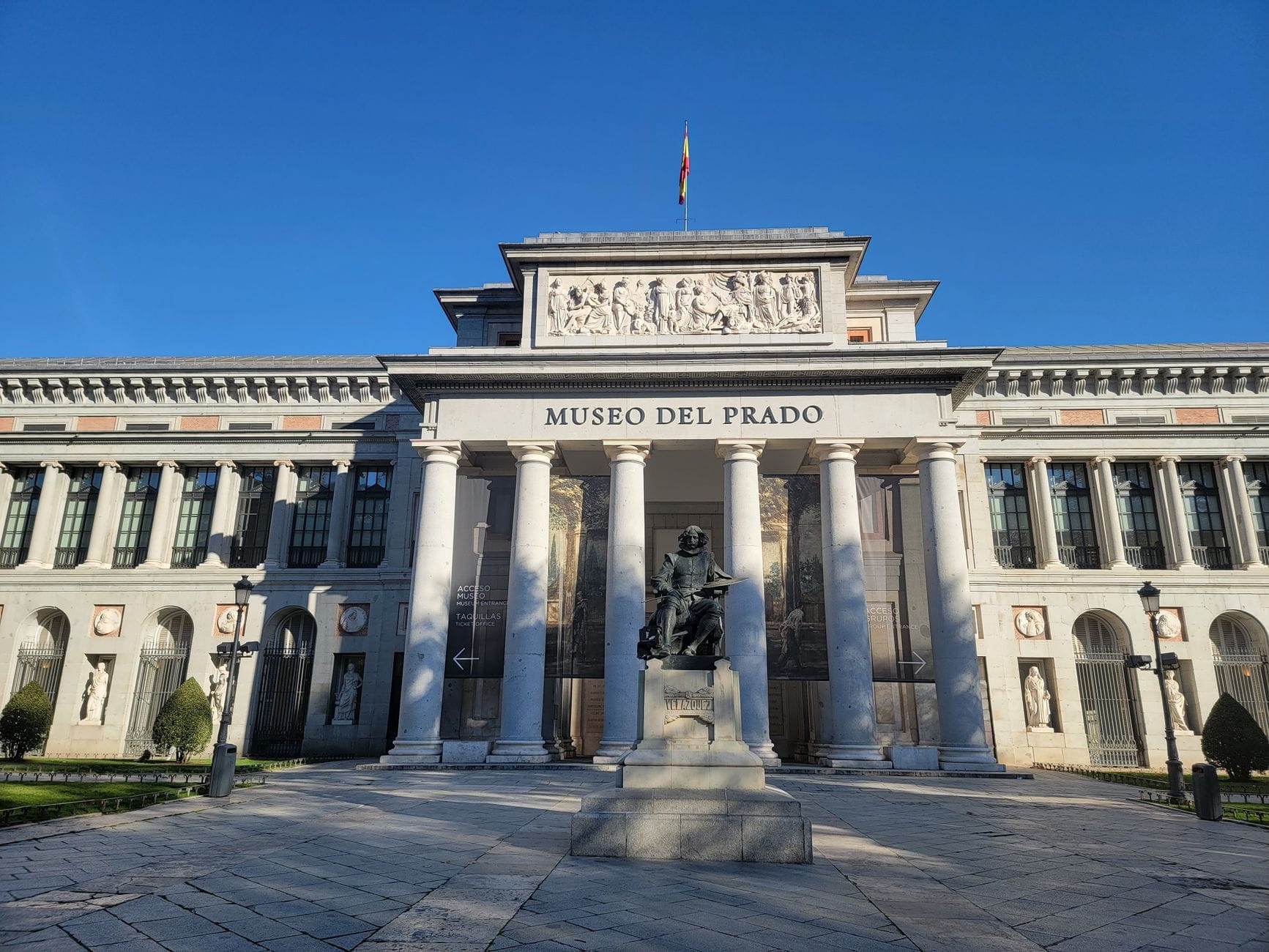
What the Prado Actually Is
The Museo Nacional del Prado is not simply a large art museum. It is the institutional memory of five centuries of Spanish and European court culture, housed in a neoclassical building that was never originally intended to hold paintings at all. Architect Juan de Villanueva designed the structure in the 1780s under Charles III as a natural history and science cabinet. It was Ferdinand VII, encouraged by his wife María Isabel de Braganza, who pivoted the project toward art, and the museum opened to the public on 19 November 1819 as the Royal Museum of Paintings and Sculptures. It now holds around 7,000–8,000 paintings, of which roughly 1,300 are on display at any given time.
That gap between 8,000 and 1,300 matters. The Prado is not a highlights reel. It is an archive with a public face, and the curation of what gets shown, and where, reflects deliberate choices about Spain's artistic identity. Goya fills entire rooms. Velázquez commands a central gallery. El Greco, Ribera, Zurbarán, Murillo, and Titian each occupy substantial space. Visitors from outside Spain are often surprised by how much Flemish and Italian painting also fills the walls, a direct consequence of the Spanish Habsburg dynasty's vast European dominion.
ℹ️ Good to know
The ticket office opens at 09:45, and general museum access starts at 10:00. Arriving at 09:45 gives you a head start on the queue. Book online in advance to skip the ticket line entirely, especially from March through October.
The Building and Its Setting
Villanueva's building is a statement in itself. The long south-facing facade on Calle de Murillo and the main Goya entrance on the north side both display the clean horizontal lines and ionic columns of Spanish neoclassicism. The ochre stonework changes tone depending on the hour: warm and almost golden in morning light, flatter and more austere in the afternoon. The extension designed by Rafael Moneo, completed in 2007, adds a contemporary wing at the rear, connecting to the adjacent Iglesia de los Jerónimos and providing additional gallery space without disrupting the original building's visual logic.
The Prado sits on the Paseo del Prado, a tree-lined promenade that forms part of the Paseo del Arte cultural corridor. Within a ten-minute walk, you can also reach the Museo Thyssen-Bornemisza and the Museo Reina Sofía, making this one of the most concentrated clusters of world-class art in any city in Europe.
Tickets & tours
Hand-picked options from our booking partner. Prices are indicative; availability and final rates are confirmed when you complete your booking.
Paseo del Arte pass for Museo Nacional Thyssen-Bornemisza, Reina Sofia Museum and Prado Museum
From 37 €Instant confirmationGuided visit of the Prado and Reina Sofia museums
From 68 €Instant confirmationFree cancellationMadrid Prado Museum Ticket and In-App Audio Tour
From 36 €Instant confirmationPrado Museum VIP Exclusive Early Access Tour
From 109 €Instant confirmationFree cancellation
What You Will See: The Core Collection
Velázquez's Las Meninas is the room most visitors navigate toward first, and rightly so. The painting from 1656 is structurally complex in a way that rewards standing in front of it for several minutes rather than walking past with a phone camera. The scale surprises people; at roughly 3.2 by 2.8 metres, it fills a field of vision in a way that reproductions simply cannot replicate. The room is usually crowded by 11:00, so arriving at opening time or during the free evening hours gives you a better chance of a quiet moment with it.
Goya's Black Paintings, transferred from the walls of his house to canvas in the 1870s, occupy a room that tends to silence visitors. Saturn Devouring His Son is the piece most people recognize, but the full sequence, including The Dog, Witches' Sabbath, and Fight with Cudgels, creates a sustained and unsettling atmosphere. These were private works, painted directly onto plaster in the last years of Goya's life, never intended for public display. The fact that they now hang in a national museum says something about how Spain has chosen to reckon with its most difficult artistic inheritance.
The Titian rooms reflect the long Habsburg patronage relationship with the Venetian painter. Charles V commissioned the equestrian portrait that now dominates one wall. Philip II accumulated an extraordinary series of mythological paintings from Titian, several of which remain here. The paint surface of these works, when seen in person rather than in print, reveals a looseness of brushwork that was remarkably advanced for the 1550s and directly influenced subsequent European painting.
For visitors with limited time, Madrid's best museums guide can help you decide how to allocate your hours between the Prado, the Reina Sofía, and the Thyssen-Bornemisza. The Prado's collection is weighted toward pre-19th-century painting, so if contemporary and modern art is your priority, the Reina Sofía should come first.
How the Experience Changes by Time of Day
Opening time at 10:00 is the single best moment to visit. The Velázquez rooms are navigable, the Goya rooms are quiet, and the natural light in certain galleries, particularly those facing east, is at its clearest. By 11:30, tour groups arrive in force and the main rooms become significantly more crowded. The ambient noise level in the central galleries rises noticeably, and the physical density around Las Meninas means you may need to wait to get close.
Midday between 13:00 and 15:00 is the museum's busiest stretch. If you arrive then, head to the upper floors first, particularly the 19th-century Spanish painting and the Flemish section, where crowds are consistently thinner. The lesser-known rooms, including the drawings collection and the decorative arts holdings, can feel almost private at any hour.
The free evening hours on weekdays (18:00–20:00) and Sundays and public holidays (17:00–19:00) deserve careful consideration. Crowds are lighter than at peak daytime, the light through the skylights creates a different atmosphere, and the experience of seeing Goya or Velázquez with fewer people around is genuinely different. The trade-off is that some secondary galleries may be closed during these periods, and security starts moving visitors toward exits from about 19:50.
💡 Local tip
Free entry hours are widely known among Madrid residents and savvy travelers. Arriving 20–30 minutes before the free window opens means you pay regular admission but enter ahead of the free-entry crowd that forms at the gates. Consider it a small investment for a calmer first hour.
Practical Walkthrough: Getting In and Moving Around
The main entrance is the Goya Door on the north side of the building, facing the statue of Goya. Ticket holders with online bookings use a fast-track lane here. The Jerónimos entrance, at the east side near the Moneo extension, is less used and can be quieter for ticketed visitors. The Murillo entrance on the south side is primarily for groups.
Inside, the building is organized across three floors. The ground floor holds Flemish and Italian Renaissance painting, along with Velázquez and Goya's Black Paintings. The first floor covers the 16th and 17th centuries in depth, including Goya's early works and the Flemish masters. The second floor holds part of the 19th-century collection. There is no strict route; the museum does not enforce a one-way circuit, which means you can structure your visit around what matters most to you.
The museum's free floor plan, available at the entrance or downloadable from the official website, is worth using. The galleries are clearly numbered, but the building's layout is not immediately intuitive, and it is easy to miss entire wings without a reference. Audio guides and guided tours in Spanish and English are available; the guided tour adds approximately 90 minutes and costs an additional about €10 per person on top of general admission.
⚠️ What to skip
Photography without flash is permitted throughout most of the Prado, but tripods and selfie sticks are not allowed. Bags larger than cabin luggage size must be checked at the cloakroom. The cloakroom is free but can have queues at peak times.
Historical Context: Why This Collection Exists Here
The Prado's collection began with 311 paintings from the Spanish Royal Collections when it opened in 1819. Those works did not arrive through the mechanisms of modern museum acquisitions. They were accumulated over three centuries by a succession of monarchs: Charles I (Holy Roman Emperor Charles V), Philip II, Philip IV, and Charles IV, among others, who commissioned, purchased, and received as diplomatic gifts works from across their European empire. Velázquez himself was Philip IV's court painter and helped acquire works for the royal collection, including paintings by Rubens and Titian.
The decision to open the collection to the public in the early 19th century followed a broader European shift toward state-sponsored museums, influenced partly by the Louvre's founding in 1793. Spain's political turbulence during the Napoleonic Wars had created urgency around preserving and formalizing ownership of these collections. The museum's name changed over time, becoming the Museo Nacional del Prado in its current form, reflecting the transition from a royal institution to a national one.
The Prado's neighborhood, the Retiro district, reflects this history at street level. The boulevard outside, the Botanical Garden to the south, and the former royal park that became the public Parque del Retiro all belong to the same 18th-century vision of a scientific and cultural corridor running alongside the city's eastern edge.
Who May Not Enjoy This Visit
The Prado is not well suited to visitors who need high levels of stimulation or interactivity. There are no significant multimedia installations, no augmented reality features, and limited hands-on elements. The collection is almost entirely painting and drawing, with some sculpture and decorative arts. Families with very young children often find the pace and the hushed environment difficult to sustain. The museum does offer family activity guides and some child-oriented resources, but it is fundamentally a collection of large, old paintings in quiet rooms.
If you have a single afternoon in Madrid and want a broader overview of the city's culture rather than a deep art experience, the combination of Parque del Retiro and a walk along the Paseo del Prado may give you a more varied first impression. The Prado rewards visitors who come with specific interests or at least some prior knowledge of the collection; those who arrive with no context sometimes find the sheer scale overwhelming.
Insider Tips
- The Prado's online ticket system lets you select a specific entry time slot. Choosing the 10:00 opening slot on a Tuesday, Wednesday, or Thursday gives you the best combination of full access and low crowds.
- The Paseo del Arte pass (verify current price before visiting) covers the Prado, the Thyssen-Bornemisza, and the Reina Sofía at a discount versus buying three separate tickets. If you plan to visit all three within a few days, it is almost always worth buying.
- The museum's café and restaurant are in the Moneo extension at the rear. They are significantly less crowded and better quality than most museum cafés in Europe. The café near the Jerónimos cloister has good coffee and is a reasonable place to break up a long visit.
- The Prado's online collection catalogue is one of the most comprehensive freely accessible art databases in the world. Spending 30 minutes on it before your visit, identifying ten or fifteen works you specifically want to find, transforms the experience from overwhelming to focused.
- The statue of Velázquez at the Goya entrance and the statue of Goya himself are useful orientation landmarks. Locals meet at 'the Velázquez entrance' — the same phrase you will see on signage.
Who Is Museo Nacional del Prado For?
- First-time visitors to Madrid who want to understand Spain's cultural identity through art
- Art history enthusiasts with specific interest in Spanish Golden Age painting, Flemish masters, or Italian Renaissance works
- Travelers combining the Prado with the Thyssen-Bornemisza and Reina Sofía for a full Paseo del Arte day
- Solo travelers who can move at their own pace through the collection
- Anyone visiting Madrid in summer who needs several hours of quality air-conditioned time
Nearby Attractions
Other things to see while in Retiro:
- CaixaForum Madrid
CaixaForum Madrid is a striking cultural centre on Paseo del Prado, housed in a converted early-20th-century power station redesigned by Herzog & de Meuron. Alongside rotating international exhibitions, it features a celebrated vertical garden by botanist Patrick Blanc and sits within walking distance of the city's three great art museums.
- Estanque Grande del Retiro
The Estanque Grande del Retiro is a vast artificial lake at the center of Parque del Retiro, created in the 17th century for royal festivities and now open to everyone for free. Rent a rowboat, watch street performers, or simply sit on the surrounding promenade as the Alfonso XII monument reflects in the water.
- Museo Nacional Centro de Arte Reina Sofía
The Museo Nacional Centro de Arte Reina Sofía is Spain's national museum of 20th-century art, housed in a converted 18th-century hospital near Atocha station. Its permanent collection includes Picasso's Guernica and major works by Dalí and Miró, making it one of the most significant modern art institutions in Europe.
- Museo Thyssen-Bornemisza
Housed in the neoclassical Palacio de Villahermosa on Paseo del Prado, the Museo Nacional Thyssen-Bornemisza spans eight centuries of Western art in one of the world's most cohesive private collections. It completes Madrid's legendary Art Triangle alongside the Prado and Reina Sofía, but offers something neither rival does: a single chronological sweep from medieval panel paintings to 20th-century American abstraction.