Museo Reina Sofía: Madrid's Temple of Modern Art
The Museo Nacional Centro de Arte Reina Sofía is Spain's national museum of 20th-century art, housed in a converted 18th-century hospital near Atocha station. Its permanent collection includes Picasso's Guernica and major works by Dalí and Miró, making it one of the most significant modern art institutions in Europe.
Quick Facts
- Location
- Calle de Santa Isabel 52, 28012 Madrid
- Getting There
- Metro: Estación del Arte (Line 1); Cercanías: Atocha (Madrid Puerta de Atocha – Almudena Grandes) station
- Time Needed
- 2–4 hours for highlights; full day for the complete collection
- Cost
- €12 general admission; free Mon & Wed–Sat 19:00–21:00, Sun 12:30–14:30
- Best for
- Modern art enthusiasts, architecture lovers, budget visitors using free slots
- Official website
- www.museoreinasofia.es
What the Museo Reina Sofía Actually Is
The Museo Nacional Centro de Arte Reina Sofía (MNCARS) is Spain's national museum dedicated to 20th- and 21st-century art. It sits at the southern end of the Paseo del Prado, forming one corner of what Madrileños informally call the Golden Triangle of Art, alongside the Prado and the Thyssen-Bornemisza. Of the three, the Reina Sofía is the one most visitors underestimate. They come for Guernica and leave having discovered entire floors of Surrealism, Spanish Civil War photography, and post-war abstraction they hadn't expected.
The museum's permanent collection spans from the early 20th century through contemporary practice. Its depth in Spanish modernism, from Juan Gris and Joan Miró to Antoni Tàpies and Eduardo Chillida, is unmatched anywhere outside Spain. The temporary exhibition programme is genuinely ambitious, regularly presenting large-scale retrospectives that draw international critical attention.
ℹ️ Good to know
The museum is closed every Tuesday. Plan accordingly — this catches more visitors off-guard than any other practical detail.
The Building: A Hospital Transformed
The main structure, known as the Sabatini Building, was originally the Hospital de San Carlos, a neoclassical institution whose origins date to the 16th century when Philip II consolidated Madrid's hospitals at this site. The current granite facade and interior courtyards date to an 18th-century redesign by Francisco Sabatini, the same architect who shaped much of Bourbon-era Madrid. When you walk into the main entrance hall, the proportions are unmistakably institutional, corridors wide enough for hospital gurneys, ceilings high enough to feel formal rather than intimate.
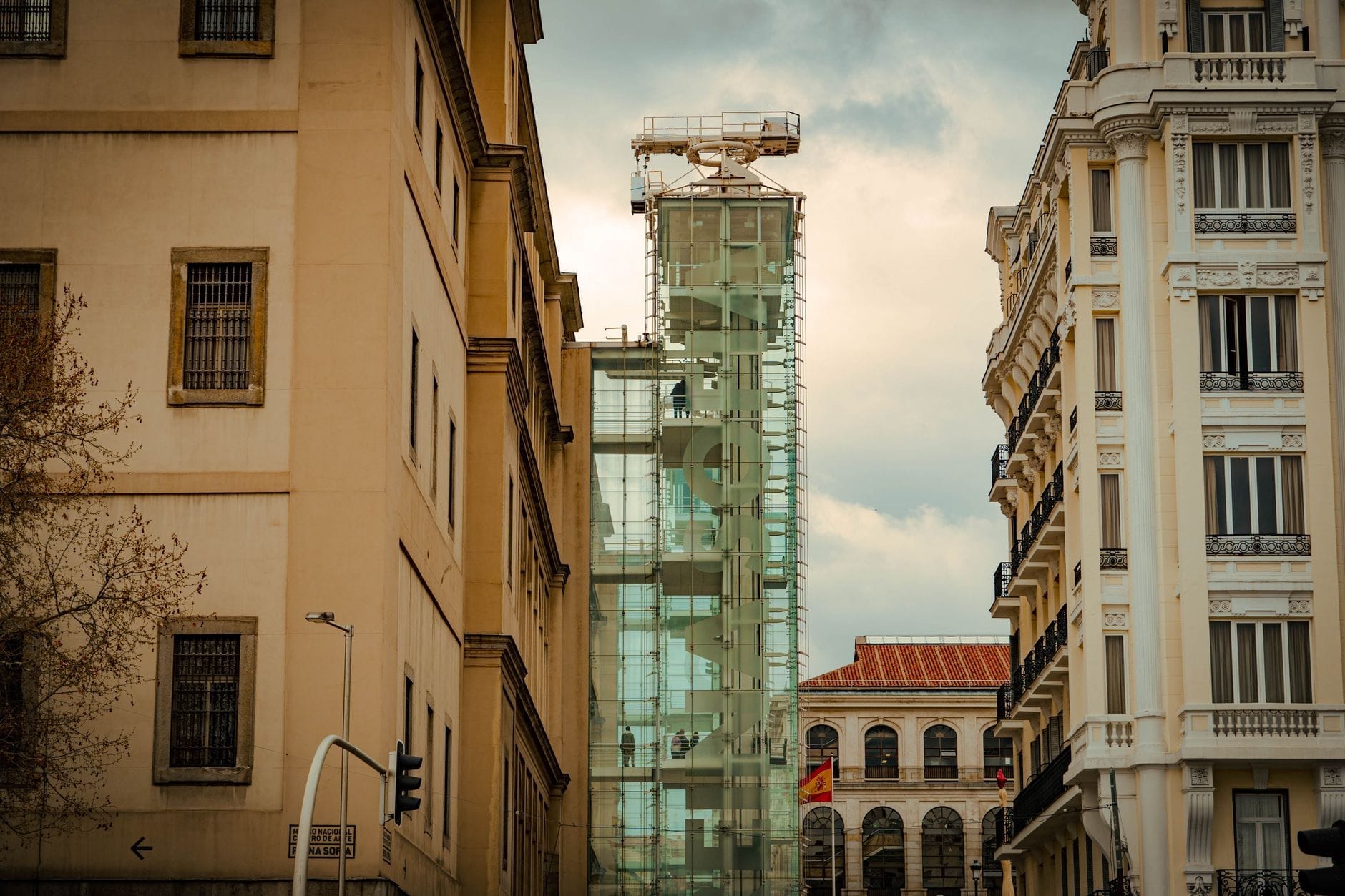
In 1986, the Centro de Arte Reina Sofía opened to the public in this building, becoming a national museum by royal decree in 1988. The formal inauguration took place on 10 September 1992, and the museum was named in honour of Queen Sofía. The two glass elevator towers added to the exterior facade have become one of Madrid's minor architectural talking points: functional additions that make no attempt to mimic the neoclassical stone around them.
The more striking architectural gesture is the Nouvel Building, a 2005 extension by French architect Jean Nouvel located on the Ronda de Atocha side of the complex. Its metallic canopy in deep red and grey extends over a large public plaza, creating a covered outdoor space used for events and, in warmer months, as a gathering point for students from the nearby art schools. The interior of the Nouvel Building houses temporary exhibitions and has a deliberately different atmosphere: lower ceilings, more industrial detailing, a sense of controlled drama rather than the Sabatini's austere grandeur.
For a broader look at Madrid's architectural layers, the Madrid architecture guide puts the Reina Sofía in useful context alongside the city's other landmark buildings.
Tickets & tours
Hand-picked options from our booking partner. Prices are indicative; availability and final rates are confirmed when you complete your booking.
Paseo del Arte pass for Museo Nacional Thyssen-Bornemisza, Reina Sofia Museum and Prado Museum
From 37 €Instant confirmationMadrid Reina Sofia Museum Tickets and In-App Audio Tour
From 24 €Instant confirmationGuided visit of the Prado and Reina Sofia museums
From 68 €Instant confirmationFree cancellationTickets to Reina Sofia Museum Madrid's iconic modern art museum
From 12 €Instant confirmation
Guernica: The Room That Changes the Visit
Picasso's Guernica occupies Room 206 on the second floor of the Sabatini Building, and the experience of standing in front of it is notoriously difficult to prepare for. The painting measures 3.49 metres high and 7.76 metres wide, so photographs consistently underrepresent its physical presence. The room is kept relatively dim, with the canvas lit directly. Most visitors fall quiet when they enter.
The work depicts the bombing of the Basque town of Guernica by Nazi German and Fascist Italian warplanes in April 1937, carried out at the request of Francisco Franco's Nationalist forces during the Spanish Civil War. Picasso painted it in grey, black, and white, a palette that reads simultaneously as newsprint and ash. The surrounding rooms contextualise the painting within Picasso's preparatory sketches, his related works, and the broader political climate of 1930s Spain.
💡 Local tip
Arrive at the Guernica room within the first 30 minutes of opening, ideally on a weekday morning. By 11:30, group tours stack up and the room becomes crowded enough to make contemplation difficult. The painting rewards slow looking, and that is only possible when the space is not overwhelmed.
The Rest of the Permanent Collection
Most visitors spend all their time on the Guernica floor and leave having seen perhaps 15% of the permanent collection. The museum is organised thematically and chronologically across multiple floors of both the Sabatini and Nouvel buildings. The early 20th-century galleries cover Spanish contributions to Cubism and Surrealism, including significant holdings of work by Salvador Dalí, Joan Miró, and lesser-known figures like Óscar Domínguez and Benjamín Palencia.
The post-war and contemporary floors deal with harder material: the art produced under and after dictatorship, the emergence of Spanish abstraction in the 1950s and 60s, and the explosion of experimental practice after Franco's death in 1975. These rooms are quieter and particularly rewarding for anyone with patience. The photography collections, particularly the documentary work from the Civil War period, are among the most historically significant holdings in any Spanish institution.
The museum also manages two satellite venues inside the Parque del Retiro: the Palacio de Velázquez and the Palacio de Cristal. Both are used for large-scale installations and are free to enter, though they are closed on Tuesdays. The Palacio de Cristal, a 19th-century iron and glass structure, is particularly worth visiting when it hosts site-specific work designed to interact with its light-filled interior.
If you are building a fuller museum itinerary, the best museums in Madrid guide covers how to sequence the Reina Sofía with the Prado and Thyssen-Bornemisza without burning out.
Hours, Prices, and Getting In Free
The museum is open Monday and Wednesday through Saturday from 10:00 to 21:00, and Sunday from 10:00 to 14:30. It is closed every Tuesday. General admission costs €12 and covers the permanent collection and temporary exhibitions.
Free admission is available on weekdays and Saturdays between 19:00 and 21:00, and on Sundays between 12:30 and 14:30. The evening free slots are the most useful for independent travellers: the crowds are lighter than midday, the building is cooler in summer, and the quality of light entering the upper-floor galleries changes noticeably in late afternoon. The museum is also free on 18 April, 18 May, 12 October, and 6 December.
⚠️ What to skip
The Sunday free slot (12:30–14:30) closes early, at 14:30 overall on Sundays. If you arrive at 12:30 for a free visit, you have exactly two hours. That is enough for Guernica and one additional floor, but not a thorough visit.
The nearest metro stop is Estación del Arte on Line 1, a three-minute walk from the main entrance. Atocha Cercanías station is slightly further but connects to the wider rail network, making it a logical stop if you are arriving from another part of the city or from out of town. The museum has full accessibility for visitors with reduced mobility.
How the Visit Changes Through the Day
The building runs warm in summer and the air conditioning in the Sabatini Building is adequate but not generous. Morning visits between 10:00 and 12:00 are the most comfortable in July and August, when Madrid's daytime temperatures regularly exceed 35°C. The granite interior of the main building retains the cool from the night before, and the early morning light through the courtyard windows has a particular quality that the afternoon crowds never experience.
The museum's cafe and restaurant are located in the Nouvel Building's courtyard level. The outdoor seating under the red canopy works well in spring and autumn, roughly April to June and September to October, when temperatures are comfortable and the plaza has a relaxed social atmosphere. In the height of summer, the terrace is too exposed for a leisurely lunch.
The Reina Sofía sits at the foot of the Paseo del Prado, one of Madrid's great urban promenades. Walking north from the museum entrance takes you past the Thyssen-Bornemisza and eventually to the Cibeles fountain, making a logical half-day cultural route on foot.
Who Should Think Twice
The Reina Sofía rewards visitors who come with some engagement with 20th-century art history. If you have no particular interest in modernism or the Spanish Civil War's cultural context, the collection beyond Guernica may feel difficult to navigate without guidance. The museum's wall texts are informative but dense, and the thematic organisation can be disorienting on a first visit without a plan.
Families with young children will find the visit more challenging here than at some of Madrid's other museums. The galleries require quiet sustained attention, and there are few interactive elements designed for children. That said, the Nouvel Building courtyard is a good space for kids to decompress between gallery visits, and the Palacio de Cristal in the Retiro is an easier introduction for younger visitors.
Travellers with limited time should weigh this stop against the nearby Museo del Prado, which typically ranks as the higher priority for first-time visitors to Madrid. For a framework on how to sequence both, the 3-day Madrid itinerary offers a practical structure.
Insider Tips
- The museum library is open to visitors and holds one of the best specialist collections on 20th-century Spanish art in the country. If you have a serious research interest, it is worth knowing this resource exists.
- Pick up a free floor map at the information desk near the main entrance before heading upstairs. The thematic layout is not always intuitive and the map saves meaningful time on navigation.
- The Palacio de Cristal in the Retiro park is managed by the Reina Sofía and is free to enter during its opening days (it closes on Tuesdays and in certain weather conditions). Check the museum's website before your visit to see what installation is currently showing — it is often the most visually arresting space in the entire institution.
- Evening free entry (19:00–21:00 on weekdays and Saturdays) sees lighter crowds than the Sunday morning free slot. If your schedule allows flexibility, the weekday evening visit is the better option for spending time with Guernica without feeling rushed.
- The Nouvel Building's bookshop carries a strong selection of exhibition catalogues and Spanish art monographs at fair prices. It is one of the better art bookshops in Madrid and worth browsing even if you buy nothing.
Who Is Museo Nacional Centro de Arte Reina Sofía For?
- Modern art enthusiasts wanting to see Picasso's Guernica in person
- Visitors with a interest in 20th-century Spanish history and the Civil War
- Architecture lovers interested in the contrast between the neoclassical Sabatini Building and Nouvel's contemporary extension
- Budget travellers who can time their visit to coincide with the free evening admission slots
- Anyone building a full Paseo del Prado cultural day combining the Prado, Thyssen-Bornemisza, and Reina Sofía
Nearby Attractions
Other things to see while in Retiro:
- CaixaForum Madrid
CaixaForum Madrid is a striking cultural centre on Paseo del Prado, housed in a converted early-20th-century power station redesigned by Herzog & de Meuron. Alongside rotating international exhibitions, it features a celebrated vertical garden by botanist Patrick Blanc and sits within walking distance of the city's three great art museums.
- Estanque Grande del Retiro
The Estanque Grande del Retiro is a vast artificial lake at the center of Parque del Retiro, created in the 17th century for royal festivities and now open to everyone for free. Rent a rowboat, watch street performers, or simply sit on the surrounding promenade as the Alfonso XII monument reflects in the water.
- Museo Nacional del Prado
The Museo Nacional del Prado holds one of the most important collections of European art in the world, with around 7,000–8,000 paintings spanning five centuries of Western painting. Located on the Paseo del Prado in the Retiro district, it is the cultural centerpiece of Madrid and the reason many visitors come to the city at all.
- Museo Thyssen-Bornemisza
Housed in the neoclassical Palacio de Villahermosa on Paseo del Prado, the Museo Nacional Thyssen-Bornemisza spans eight centuries of Western art in one of the world's most cohesive private collections. It completes Madrid's legendary Art Triangle alongside the Prado and Reina Sofía, but offers something neither rival does: a single chronological sweep from medieval panel paintings to 20th-century American abstraction.