Museo Thyssen-Bornemisza: Madrid's Most Versatile Art Museum
Housed in the neoclassical Palacio de Villahermosa on Paseo del Prado, the Museo Nacional Thyssen-Bornemisza spans eight centuries of Western art in one of the world's most cohesive private collections. It completes Madrid's legendary Art Triangle alongside the Prado and Reina Sofía, but offers something neither rival does: a single chronological sweep from medieval panel paintings to 20th-century American abstraction.
Quick Facts
- Location
- Paseo del Prado 8, 28014 Madrid (Cortes / Centro district)
- Getting There
- Banco de España (Metro Line 2), 3-min walk
- Time Needed
- 2–3 hours for permanent collection; add 1 hour for temporary exhibitions
- Cost
- €14 standard (permanent collection + temporary exhibitions); free Mondays 12:00–16:00 (permanent collection); under-18s free
- Best for
- Art lovers, first-time visitors to Madrid, couples, rainy-day itineraries
- Official website
- www.museothyssen.org/en
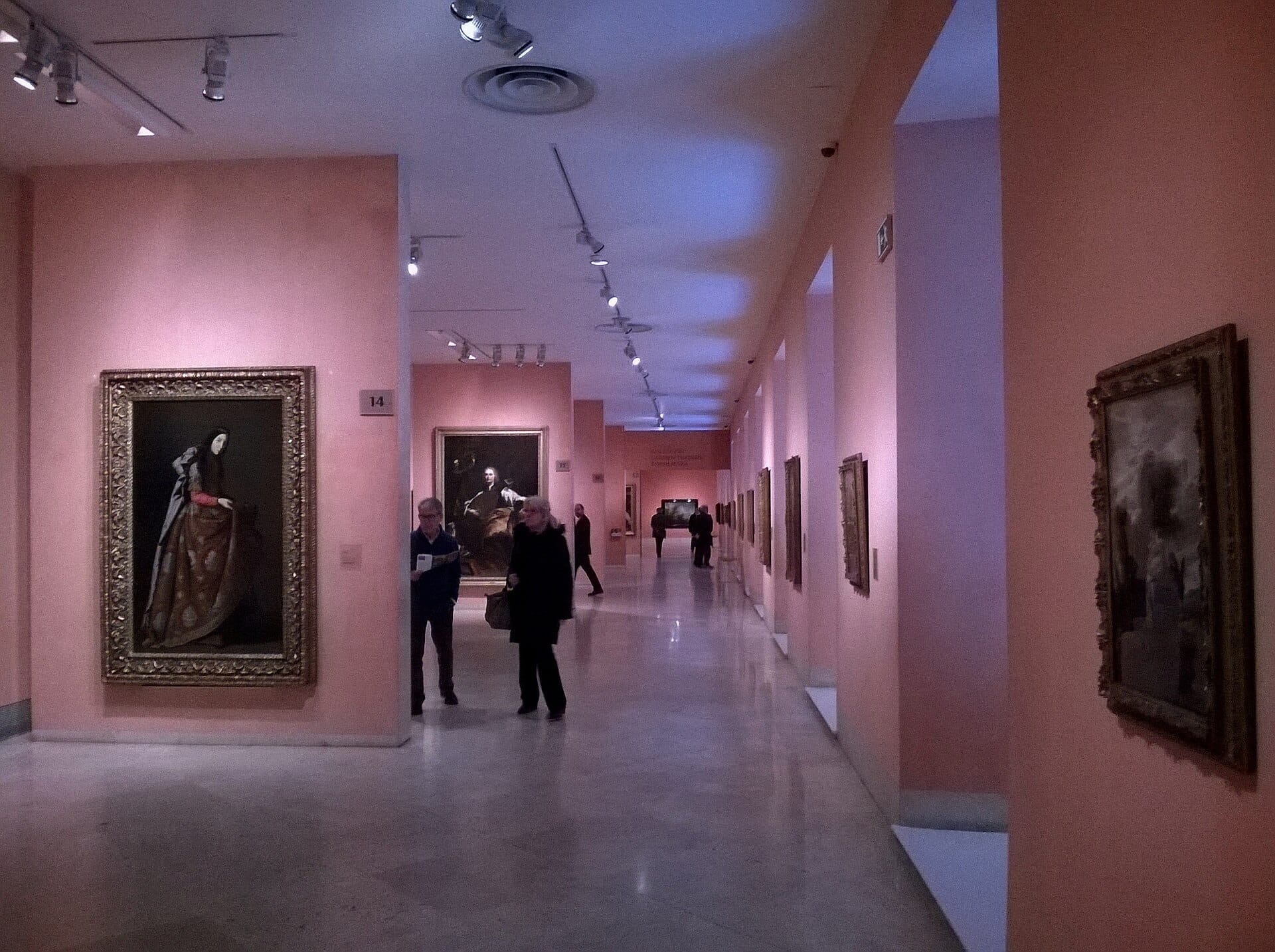
What Is the Thyssen-Bornemisza and Why Does It Matter?
The Museo Nacional Thyssen-Bornemisza opened in October 1992 in the renovated Palacio de Villahermosa, a late 18th-century neoclassical palace whose warm salmon facade now anchors the southern end of Paseo del Prado. The collection it houses was assembled across six decades by Heinrich Thyssen-Bornemisza and his family, beginning in the late 1920s, and today counts around 1,600 works. Roughly 700 of these are on permanent display, arranged chronologically from the 13th century to the late 20th century.
What makes the Thyssen unusual, even among world-class museums, is its breadth of intent. The Prado runs deep in the Spanish and Flemish traditions; the Reina Sofía covers modern and contemporary Spanish art. The Thyssen bridges the gaps, filling in periods and movements that neither neighbor adequately addresses: the Northern European Renaissance, Dutch Golden Age landscapes, 19th-century North American painting, German Expressionism, and the full arc of European Impressionism through to Pop Art. For a traveler doing Madrid's Art Triangle in a single trip, the Thyssen is the connective tissue.
The museum sits on the Paseo del Prado, Madrid's grand cultural boulevard, making it easy to combine with the Museo del Prado or the Museo Reina Sofía on a single art-focused day, though each museum alone deserves several hours.
💡 Local tip
Monday visit hack: The permanent collection is free every Monday from 12:00 to 16:00. Crowds are lighter than weekend afternoons, and the galleries feel considerably calmer than peak Saturday hours.
The Building: Palacio de Villahermosa
Before you engage with a single painting, the building itself rewards attention. The Palacio de Villahermosa dates to the late 18th century and was redesigned in the early 19th century in a Neoclassical style. Its current interior was extensively renovated by Spanish architect Rafael Moneo for the museum's 1992 inauguration. Moneo's intervention was deliberate and restrained: warm terracotta-toned walls (chosen partly to set off the paintings), marble floors, and a central courtyard covered with a glass roof that floods the upper galleries with diffused natural light.
The decision to hang the collection chronologically across three floors means the building itself structures your journey through art history. You enter the oldest works on the second floor and descend through time, arriving at Pop Art and Expressionism on the ground floor. This layout rewards visitors who follow the intended route rather than jumping to highlight rooms.
Tickets & tours
Hand-picked options from our booking partner. Prices are indicative; availability and final rates are confirmed when you complete your booking.
Art & Brunch at Museo Nacional Thyssen-Bornemisza tickets
From 50 €Instant confirmationFree cancellationPaseo del Arte pass for Museo Nacional Thyssen-Bornemisza, Reina Sofia Museum and Prado Museum
From 37 €Instant confirmationMuseo Nacional Thyssen-Bornemisza Skip-the-Line Tickets
From 14 €Instant confirmationMuseo Nacional Thyssen-Bornemisza skip-the-line tickets with audio guide
From 19 €Instant confirmation
What You'll Actually See: A Floor-by-Floor Overview
The second floor (Planta Segunda) opens with medieval religious paintings on wooden panel, where gold-leaf backgrounds and flattened figures give way, room by room, to the spatial experiments of the early Renaissance. Jan van Eyck, Petrus Christus, and Rogier van der Weyden appear in the Flemish galleries, their microscopic surface detail visible even without the magnifying lenses that some visitors bring. The lighting in these rooms is deliberately low and warm, so the effect is intimate rather than gallery-bright.
The 17th-century Dutch rooms are among the strongest in the building. Vermeer, Rembrandt, and Frans Hals are represented, but the section also includes landscape and genre painters who rarely get wall space in major museums. These rooms tend to be quieter than the Impressionist galleries below, which makes them worth slowing down for.
The first floor (Planta Primera) takes you through the 18th and 19th centuries, including a North American landscape section with works by Frederick Edwin Church and Albert Bierstadt that surprises most European visitors. The scale of these canvases, depicting the Rocky Mountains and South American wilderness, feels physically different from European painting of the same era, and the contrast is one of the museum's more unexpected pleasures. The floor concludes with Impressionism and Post-Impressionism: Monet, Renoir, Degas, Cézanne, Gauguin, and Van Gogh's Hotel Room (1888), one of the collection's most reproduced works.
The ground floor (Planta Baja) covers the 20th century: Fauvism, Expressionism, the Bauhaus, Surrealism, and abstraction. Kandinsky, Mondrian, Edward Hopper's Hotel Room (a different work from Van Gogh's, and an interesting curatorial pairing), Mark Rothko, and Roy Lichtenstein all have presence here. The Carmen Thyssen Collection, added in a 2004 extension and accessible from the ground floor, deepens the 19th-century and Impressionist holdings.
ℹ️ Good to know
The museum's layout is designed to be walked top-to-bottom. Take the elevator or stairs to the second floor first, then descend through the collection chronologically for the most coherent experience.
Timing Your Visit: How the Experience Changes by Hour
The museum opens Tuesday to Sunday at 10:00 and closes at 19:00. Monday hours are 12:00 to 16:00 for the permanent collection, with free admission during that window. In practical terms, the first hour after opening (10:00–11:00) on weekday mornings is the quietest window of the week. The medieval and Renaissance rooms on the second floor are often nearly empty at this hour, allowing the kind of prolonged, close-looking that the small-panel Flemish works demand.
Saturday and Sunday mornings from 11:00 onward see a noticeable increase in visitors, particularly in the Impressionist rooms on the first floor, which draw the largest spontaneous crowds. The museum does not feel overwhelmed in the way the Prado can on a busy weekend, partly because the building's layout distributes visitors across floors naturally, but the ground-floor 20th-century rooms can feel congested near the Hopper and Rothko works in the early afternoon.
Some Saturday evenings offer reduced-price or free access to the permanent collection; check the official website before your visit for current schedules, as these promotions change seasonally. The Thyssen Terraces, a rooftop space with views over the Paseo del Prado, operates with limited hours in summer months (specifically June, July, and September), making a late-afternoon visit in those months particularly rewarding.
⚠️ What to skip
Temporary exhibitions at the Thyssen frequently sell out in advance, especially during the spring and autumn seasons. Book a combined ticket (€14 for collections plus temporary exhibitions) through the official website to guarantee entry on your preferred date.
Practical Intelligence: Getting There, Tickets, and What to Bring
The Thyssen-Bornemisza is at Paseo del Prado 8, a short walk (about 3–5 minutes) from Banco de España metro station (Line 2, the red line). From the station exit, head south along Paseo del Prado toward the distinctive salmon-colored palace. Alternatively, buses 1, 2, 14, 27, 34, 37, 45, 51, 52, 53, and 146 stop on or near Paseo del Prado, making this one of the most transit-accessible museums in the city.
Standard admission covering both the permanent collection and temporary exhibitions costs €14. Under-18s enter free. The Monday free window (12:00–16:00) covers only the permanent collection; temporary exhibitions require a separate ticket even on Mondays. Buying tickets online is strongly recommended to skip the queue at the box office, which can be 15–20 minutes long on weekends.
If you are planning a broader art day along Madrid's cultural corridor, consider reading the guide to Madrid's best museums to help sequence your visits efficiently. The walking distance between the Thyssen, the Prado, and the Reina Sofía is under 15 minutes on foot.
The museum has a cloakroom for bags and a café on the ground floor. Comfortable shoes matter: a full walkthrough of both the permanent collection and a temporary exhibition involves considerable standing and walking across multiple levels. The galleries are climate-controlled year-round, which makes this a practical retreat during Madrid's intense summer heat (frequently above 35°C in July and August) or on rainy autumn days.
Accessibility is taken seriously here. The museum offers adapted tours, audio guides in multiple languages (available at the entrance), and elevator access between all floors. Prams and wheelchairs can be accommodated; the box office staff can advise on the most practical entry route.
Photography, the Gift Shop, and Practical Limitations
Photography without flash is permitted throughout the permanent collection. The natural light from the central courtyard on the upper floors makes this one of the easier Madrid museums to photograph without artificial lighting. Temporary exhibition photography policies vary; check signage at each exhibition entrance.
The museum gift shop, near the main entrance, has a well-curated selection of art books, exhibition catalogs, and reproductions. It is one of the better museum shops in Madrid for serious art publications, with titles covering both the Thyssen collection and broader art history that are harder to find in general bookstores.
A note on limitations: visitors expecting the sheer density of masterworks found at the Prado may find the Thyssen's permanent collection thinner in certain rooms, particularly in the mid-20th century abstract sections, where the number of works per movement is smaller. The museum is also undergoing periodic gallery refreshes, so specific works may be in storage or on loan during your visit. The collection's greatest strength lies in its breadth and chronological coherence rather than in depth at any single point.
Travelers combining the Thyssen with outdoor Madrid should note that the Parque del Retiro is a 10-minute walk east, and the Real Jardín Botánico sits directly behind the Prado, a pleasant post-museum walk in spring or autumn.
Insider Tips
- The free Monday window (12:00–16:00) is genuinely uncrowded compared to weekend visits, but arrive by 12:15 if you want the medieval rooms to yourself — tour groups that have pre-booked tend to arrive around 13:00.
- The 17th-century Dutch rooms on the second floor are consistently the least congested part of the museum. If you have limited time and want quality looking-time rather than crowd navigation, start there rather than heading straight for the Impressionist floor.
- Audio guides are available at the entrance and add significant context to the collection's organizational logic. The guide explaining the chronological philosophy behind the hang is worth the first 10 minutes even if you skip the rest.
- The Thyssen Terraces, open in summer months with limited hours, offer rooftop views over Paseo del Prado that very few visitors know about. Check the museum's website under 'Visit' for the current season's schedule before planning an afternoon visit in June or July.
- If you are visiting Madrid in spring or autumn and want to avoid museum fatigue, the Thyssen pairs particularly well with a walk along Paseo del Prado afterward, which is at its most pleasant in mild weather and connects directly to the Retiro park entrance.
Who Is Museo Thyssen-Bornemisza For?
- Art lovers who want a chronological sweep of Western art in a single building rather than a deep dive into one tradition
- First-time visitors to Madrid looking to understand the Art Triangle without committing a full day to each museum
- Couples combining a museum morning with an afternoon in the Retiro neighborhood
- Travelers visiting during summer who need a climate-controlled, full-morning activity during peak heat hours
- Anyone interested in 19th-century North American landscape painting, which is exceptionally well represented and rarely seen outside the United States
Nearby Attractions
Other things to see while in Retiro:
- CaixaForum Madrid
CaixaForum Madrid is a striking cultural centre on Paseo del Prado, housed in a converted early-20th-century power station redesigned by Herzog & de Meuron. Alongside rotating international exhibitions, it features a celebrated vertical garden by botanist Patrick Blanc and sits within walking distance of the city's three great art museums.
- Estanque Grande del Retiro
The Estanque Grande del Retiro is a vast artificial lake at the center of Parque del Retiro, created in the 17th century for royal festivities and now open to everyone for free. Rent a rowboat, watch street performers, or simply sit on the surrounding promenade as the Alfonso XII monument reflects in the water.
- Museo Nacional del Prado
The Museo Nacional del Prado holds one of the most important collections of European art in the world, with around 7,000–8,000 paintings spanning five centuries of Western painting. Located on the Paseo del Prado in the Retiro district, it is the cultural centerpiece of Madrid and the reason many visitors come to the city at all.
- Museo Nacional Centro de Arte Reina Sofía
The Museo Nacional Centro de Arte Reina Sofía is Spain's national museum of 20th-century art, housed in a converted 18th-century hospital near Atocha station. Its permanent collection includes Picasso's Guernica and major works by Dalí and Miró, making it one of the most significant modern art institutions in Europe.